“If [Iran] had a nuclear weapon, I’d be calling the Supreme Leader and I’d be saying, ‘Mr. Supreme Leader, how are you, sir? Is there anything we can do for you?’—as opposed to bombing the crap out of him.”
There is probably no worse statement to make if one is committed to stopping the spread of nuclear weapons. In essence, Trump is saying that if Iran had developed a nuclear weapon, it is highly unlikely that he would have approved the attack on Iran. The ghosts of Saddam Hussein and Muamar Ghadafi would agree because if both Iraq and Libya had possessed nuclear weapons, they would probably still be in power.
North Korea is the poster child of that claim. It is an unlikely developer of nuclear weapons since the country is so poor and cut off from modern technology. But with the assistance of other countries, as well as a willingness to starve its population in order to afford the expensive equipment to develop the bomb, it was able to develop a nuclear capability that led Trump to be the first US President to enter North Korean territory. North Korea is a cantankerous and unpredictable power that was not high on the list of countries to develop nuclear weapons. It is also a country that is now insulated from an armed invasion since there is really nothing to be gained from controlling North Korean territory at the price of a single nuclear retaliation.
This insight deserves greater attention. The current war against Iran initiated by Israel and the US was justified by what was termed an “existential” threat to both countries by a nuclear-armed Iran. In the case of the US, there is little evidence that Iran would have been to attack the US homeland with nuclear weapons. It lacked the means to deliver such a weapon. Israel was more vulnerable since it is closer to Iran and much smaller than the US–any nuclear bomb exploded on Israeli soil would have been catastrophic to the Israeli state.
Israel was the object of much hateful rhetoric from Iran, based on the Islamic Republic’s belief that Israel was illegitimately created by the United Nations in 1948 without any consultation with the people who lived in what was known as Palestine at the time. There is no question that Iran is dedicated to this cause, and has armed its proxies in Lebanon, the Gaza Strip, Syria, and Lebanon to accomplish this aim. However, one should be prepared to admit that the rhetoric on both sides has been inexcusably inflammatory (Trump’s threat to end a “civilization” was utterly chilling).
Iran has been quite careful in the current war to limit its attacks on Israel, despite the fact that Israel serves as the principal US ally in the region and hosts a wide variety of US armaments. Writing for The Conversation, Shahram Akbarzadeh, points out the logic of Iran’s restraint:
“Iran is a hostage of its own inflammatory rhetoric. The regime has made its political fortune on rejecting the West and Israel. The Palestinian cause has been trumpeted as central to its worldview.
“This posture has attracted a following in the Muslim world. And Iran shamelessly exploits this to gain advantage over its Arab rivals, whom Tehran accuses of betraying Palestinians and their plight.
“Yet, the Iranian leadership is fully aware that crossing red lines and engaging in open confrontation with Israel (or the US) could pose an existential threat to the regime. That is why Iran has consistently pulled back from the brink of war and opted for low-intensity skirmishes via its proxies that serve its ideological grandstanding but do not jeopardise its survival.
Iranian restraint is easy to explain. Iran faces two nuclear-armed adversaries, and there is no Iranian objective that would justify an invitation to a US or Israeli nuclear attack on Iran. If Iran used a nuclear weapon to attack Israel, there is no question in my mind that either or both of those states would respond in kind.
That logic pervades the reality of a nuclear-armed world, and we have a name for this condition: mutual assured destruction (MAD). If two states have nuclear capabilities, they are unlikely to use them because the consequences of such actions would vitiate whatever gains were expected from an initial attack. But MAD only works if both sides have nuclear weapons: conventional weaponry does not create a similar condition.
So, I sincerely doubt that Iran would use nuclear weapons against Israel as long as it is vulnerable to a nuclear counterattack. What, then, explains the US and Israeli position of attacked Iran to prevent it from developing a nuclear weapon?
The answer is that both Israel and the US fear that a nuclear Iran would limit their ability to use conventional force. Their use of conventional war against Iran (as well as Syria, Lebanon, Iraq, and the Occupied Territories) can only work if Iran does not have a countervailing threat. And Israel has certainly used its military to expand its territory. It now occupies the Gaza and the West and the “ethnic cleansing” of Palestinians from these areas is quite clearly a war crime. It also commands large swathes of Syrian and Lebanese territory and there is no evidence that it intends to leave these areas.
We all need to ask a counterfactual question: would Israel have conducted it military response to the horrific attacks of 7 October if Iran had a nuclear weapon? I believe the answer is most emphatically no. And that is the real reason why Israel and the US attacked Iran.
For some time, I have been trying to evaluate Iranian claims of damage to US bases in the Middle East. Not surprisingly, that information has not been forthcoming from the Department of Defense. It is rare for one side in a war to admit losses. I was unwilling to accept the press releases from the Iranian government, since exaggerating victories is also a staple of war communications.
But Al Mayadeen, a media company based in Lebanon, but one with a distinctive Iranian bias, has published photographs of the damage to US military bases that was inflicted earlier in the war. I am not an expert on fake photographs, so I am posting this with a warning: Look at the photographs with skepticism, but do not immediately dismiss them. I am sure that over time we will be able to view photographs that can be verified with greater confidence.
But the claims of damage to US military bases in the region are circumstantially verified by the DoD’s statements about the movement of troops and weaponry to bases further away from Iran, most to Israel. I will continue to try to find out more on this issue. But as more information becomes available, we should keep in mind questions which need to be asked:
First, despite all of Trump’s assertions about rebuilding the military, it seems that the military was unable to defeat Iran, an enemy less formidable than either Russia or China. The US has “rebuilt” a military that is out of date: the weapons being built are easily defeated by smaller, more maneuverable weapons like drones.
Second, the preferred strategy of the US is to defend against missiles by using interceptors like the Patriot missiles which are significantly more expensive than the weapons they are being used to shoot down. Indeed, Trump’s plan for a “Golden Dome” of interceptors to protect the US homeland is projected to cost $542 billion for the space-based components alone. The cost mismatch favors an opponent who can afford to play a very long game, as the US is finding out as it runs out of interceptors.
Third, the possibility of significant damages raises serious questions about the role the US has taken since 1945 to be a dominant world power. That power was based upon the US ability to transcend time and space in comparison with its enemies’ more limited capabilities to project power. It attained this position by using almost 800 overseas military bases, though admittedly many of these bases are small. But these bases are hosted by 80 countries, and the Iran War has demonstrated that US access to these bases can be circumscribed if the host countries disagree with US policy. Spain refused to allow US bases to be used in the Iranian attack.
Interesting Facts About US Military Bases Around the World 2026
Source: U.S. Department of Defense, Defense Manpower Data Center (DMDC), December 2025; Congressional Research Service; American University (David Vine); WarCosts.org.
It may be the cases that being a global power is no longer economically or militarily feasible. It may be time to rethink everything about military spending.
President Trump has changed many of the foreign policies of the United States, consistent with his desire to emphasize US national interests. This change is not one of kind since all states place a high priority on concrete interests. But the change away from trying to accommodate global interests has led to a sharp decline in American commitments to international actions and cooperation. What are the long-term consequences of this change in emphasis?
Overview
Donald Trump’s foreign policy centers on an “America First” approach, emphasizing tariffs, reduced multilateral commitments, assertive military actions, and recalibrated alliances, as seen in his Iran diplomacy, tariff regimes, NATO pressure, and interventions such as the Caracas raid.
Core Principles
America First Doctrine: Prioritizes U.S. sovereignty, economic security, and reduced foreign intervention.
Skepticism of Multilateralism: Hostility toward the EU, WTO, and multilateral treaties; preference for bilateral deals.
Economic Nationalism: Heavy use of tariffs to reshape global trade and pressure partners.
Key Areas of Action
1. Middle East & Iran
Trump’s meetings with Netanyahu focused on Iran’s nuclear program and regional influence.
Asserted Iran was taking negotiations more seriously amid heightened tensions.
Proposed a 20% fee on cargo through the Strait of Hormuz, revealing impulsive decision-making and rapid policy reversals.
2. Trade Policy
Imposed sweeping tariffs (10–12.5%) on imports from 60 partners under Section 301, replacing earlier reciprocal tariffs struck down by the Supreme Court. India received a lower 10% rate after policy changes.
Tariffs strained relations with allies and triggered retaliatory measures from China, the EU, and Canada.
3. Alliances & Global Institutions
Criticized NATO as “obsolete,” demanding increased defense spending from allies.
Threatened withdrawal from agreements like NAFTA and the Trans-Pacific Partnership.
4. Military Interventions & Security Strategy
Despite isolationist rhetoric, Trump engaged in assertive military actions, including the Caracas raid removing Nicolás Maduro.
Mixed signals on intervention: withdrew troops from Syria and Afghanistan but also authorized strikes and escalated pressure on adversaries.
5. Ukraine & Russia
Meetings with Zelensky highlighted tensions over U.S. support and internal chaos in diplomatic engagements. Foreign policy under Trump 2.0 remained highly active despite expectations of isolationism.
Strategic Vision
Trump’s National Security Strategy (2025) rejects post–Cold War global hegemony, emphasizing realism, sovereignty, and hemispheric dominance while focusing on China containment.
Trump’s foreign policy consistently blends nationalism, unpredictability, and unilateralism, reshaping U.S. global engagement across trade, security, and diplomacy.
The wars in Ukraine and In the Middle East have demonstrated new military technologies such as drones which have changed power dynamics to favor weaker states. Their effectiveness calls into question the effectiveness of large, massed armies and navies. Do the new military technologies undermine great powers in their interactions with poorer and weaker adversaries? How might these new technologies change the nature of world politics?
The recent rise of nationalist parties in the world raises questions about how citizens of the world regard each other. Intense nationalism, emphasizing blood and soil, excludes many people and has roiled the arenas of immigration, culture, and citizenship. The most insidious form of this attitude is antisemitism, which has once again become more prominent in political discourse. Intense nationalism is also an underlying cause of many wars, most notably World War I. Are we headed in the same direction today?
The rise of antisemitism has reached alarming levels, with a documented increase of 107.7% in antisemitic incidents globally in 2024, driven by a mix of ideological extremism and geopolitical tensions.
Recent Statistics and Trends
In 2024, the Antisemitism Research Center reported 6,326 incidents of antisemitism, marking a staggering increase from previous years. This surge is attributed to a combination of far-left, far-right, and Islamist extremism, with 68.4% of incidents linked to far-left ideology. This represents a significant shift from 2023, where incidents from both far-left and far-right sources were roughly equal. The far-right incidents dropped by 54.8%, indicating a change in the landscape of antisemitic activity
Geopolitical Context
The rise in antisemitism is closely tied to the ongoing Israeli-Palestinian conflict, particularly following the events of October 7, 2023. The conflict has intensified existing tensions, leading to increased hostility towards Jewish communities worldwide. Reports of vandalism, threats, and violence against Jewish institutions have surged, particularly in countries like Australia, where incidents have included graffiti and arson targeting synagogues and Jewish schools
Historical and Ideological Factors
Antisemitism has deep historical roots, evolving from religious persecution to modern political scapegoating. The current rise is fueled by a mix of conspiracy theories, social media disinformation, and radicalized movements that exploit the Israeli-Palestinian conflict to justify antisemitic sentiments. The perception of Jews as responsible for various societal issues has been perpetuated by extremist ideologies, leading to a resurgence of hate onlineopinion.com.au.
Conclusion
The alarming rise of antisemitism in recent years underscores the urgent need for global awareness and action. As antisemitic incidents continue to escalate, it is crucial for communities, governments, and organizations to address the underlying causes and work towards fostering understanding and tolerance. Without decisive action, the world risks entering a new era where antisemitism is not only tolerated but institutionalized, threatening the safety and stability of Jewish life globally.
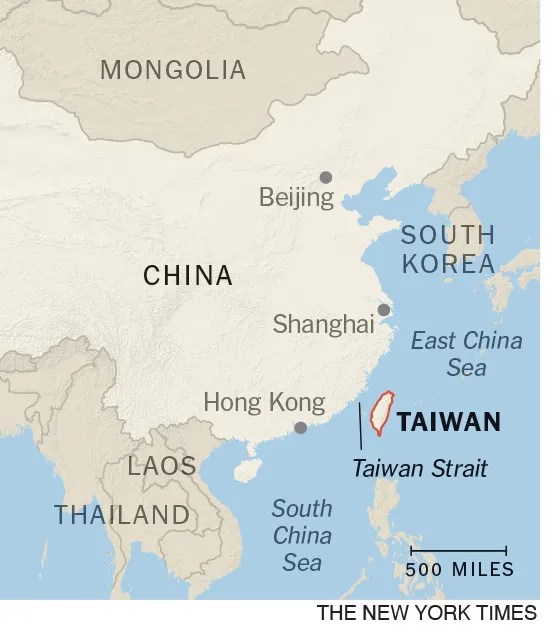
In the Shanghai Communique of 1972, the US agreed that Taiwan is part of China but nonetheless insisted that the eventual integration of Taiwan into the People’s Republic of China should not be a violent transition. Since that time, the US and China have been unable to agree on a strategy to implement that decision, and Chinese President Xi has announced that he wants the question resolved by 2027. Can the dispute over the status of Taiwan be settled peacefully or is a violent conflict on the question inevitable?
CNBC, “Xi warns Trump: Mishandling Taiwan will put U.S.-China relationship in ‘great jeopardy’”, 13 May, 2026
Nov. 5
Artificial Intelligence and the Global Economy
The swift rise of Artificial intelligence (AI) may prove to be as transformative as the Industrial revolution. As was the case with the Industrial Revolution there will be winners and losers in the transformation. The big fear of AI is that it will lead to a diminished power for labor and enhanced power to the owners of capital. Can the burgeoning economic inequality that accompanies AI be managed effectively so that the benefits of Ai can be enjoyed by all. Or will those benefits be concentrated among a small minority of rich people?
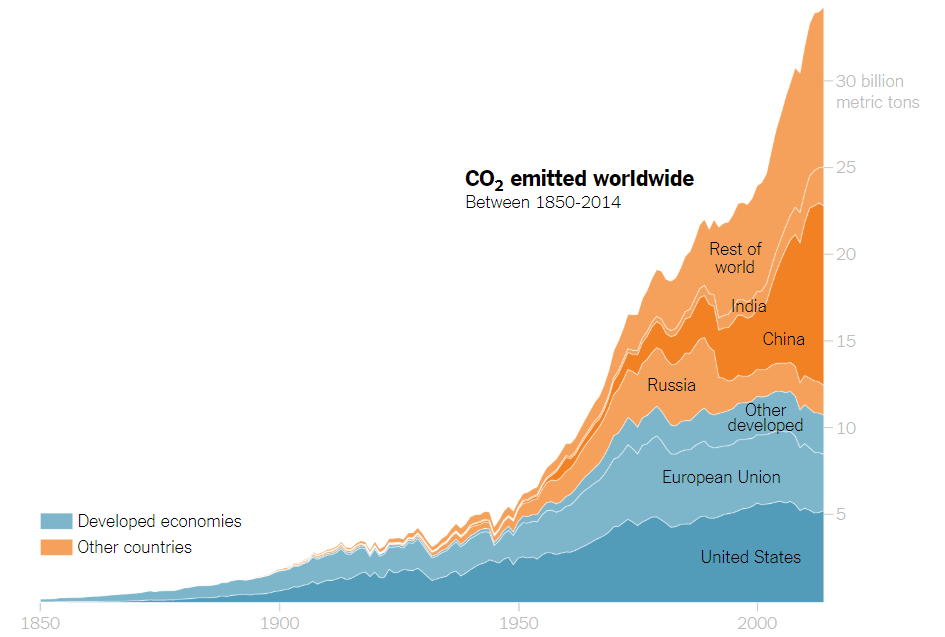
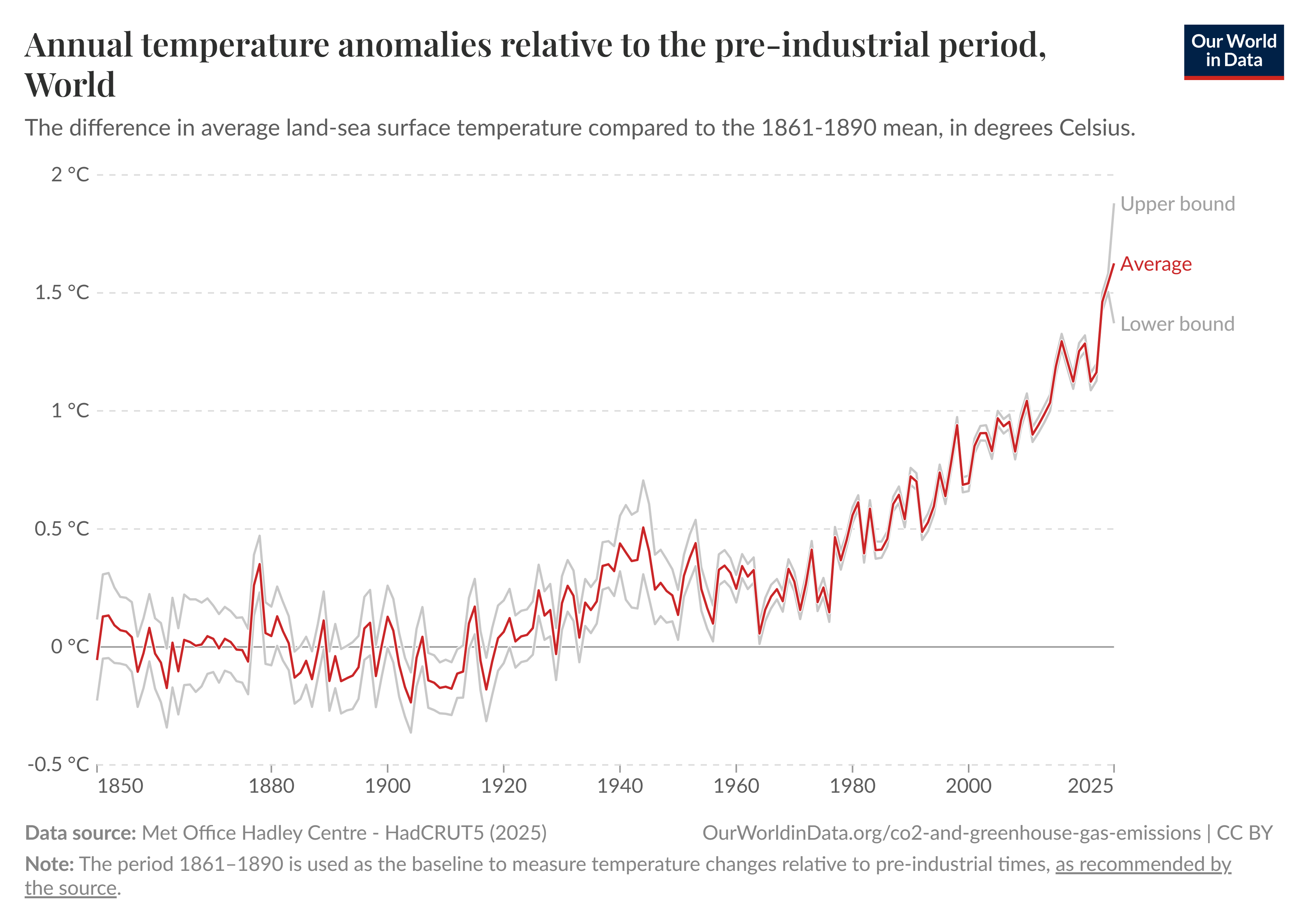
Climate change is unquestionably happening although its effects are not yet universal or as systemic as some fear. Nonetheless, some local effects, such as wildfires, flooding, and heat waves have impacted the lives of millions already. Climate change threatens to upend traditional notions of sovereignty since the more global manifestations of climate change, such as sea level increases and water shortages are becoming more pronounced and are issues that can only be settled by international cooperation. But progress at that level has been sporadic and ineffective. Can the world learn how to manage the process of climate change by cooperating in ways that threaten traditional notions of sovereignty?
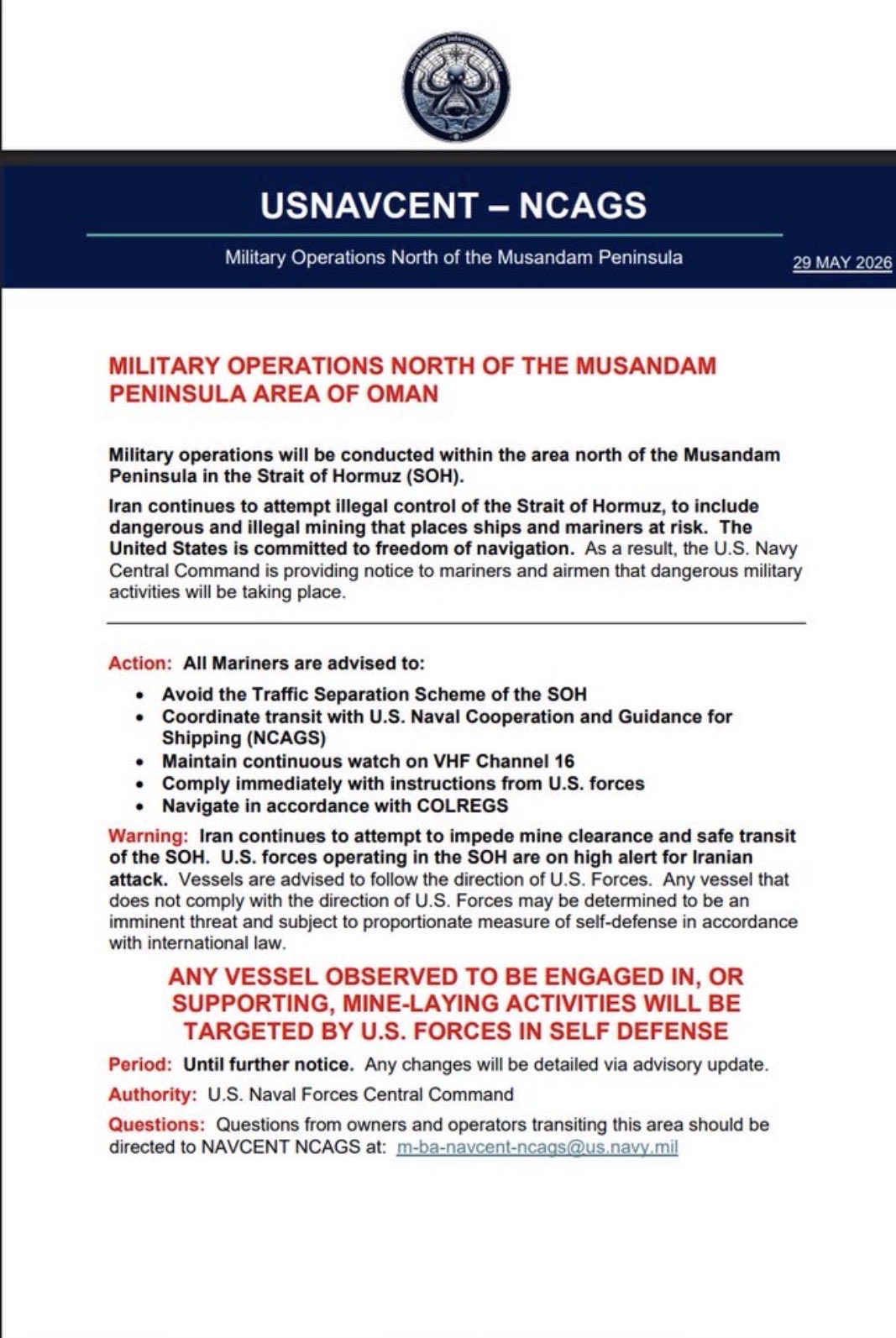
It would be foolish to infer that this warning signals the beginning of active violence against Iran by the US and Israel. But it is also impossible to dismiss that possibility. Despite all the ridiculous drivel that has been published about “broad agreement” on a variety of issues, the most substantive issue, control over the Strait of Hormuz, has not yet even been discussed by the opposed parties. The US has been unable to restrain Israel over the conflict in Lebanon and the question of what to do with the enriched uranium seems to be at an impasse.
The rational response to these conditions would be to find a face-saving exit which would roughly correspond to the JCPOA fashioned by President Obama in 2015 and cancelled by President Trump in 2018. However, that option does not seem to be on the table right now. Equally unlikely would be a continuation of this deadlock. The US is drawing down its reserves (and continues to export petroleum products to the rest of the world) which will lead to an abrupt collapse of the US oil economy if the blockade extends into July.
So, it is not weird to think that this message presages an all-out attack on Iran and seizure of some parts of the Persian Gulf–either the islands (Greater Tunb, Lesser Tunb, and Abu Musa) right near the Strait or some parts of Oman on the other side of the Gulf. Today marks the end of the haj which the Saudis wanted to protect for religious, economic, and political reasons. The Gulf states (except for the United Arab Emirates) are probably strongly opposed to an attack, but I am not at all certain that Trump really cares about their concerns (after all, if they ditch the US, then Israel emerges as the dominant regional power and the populations of those states would find that alliance uncomfortable.
So, I think we should be prepared for a higher level of meaningless violence. There is no reason whatsoever that Iran would ever bend if it felt that its civilization was at risk. The lessons of World War II, the Korean conflict, Vietnam War, and the Afghan war all testify to the impotence of aerial bombardment in changing political calculations.
The New York Times recently assessed Trump’s response to the most recent Iranian proposal to end the war.
“In the post on Truth Social, Mr. Trump cast doubt that the latest proposal would satisfy him, asserting that Iran has ‘not yet paid a big enough price for what they have done to Humanity, and the World, over the last 47 years.’”
This is a statement from a person who knows he has lost. It is a revealing and terrifying statement because it suggests that Trump wants Iran to pay the highest price possible for its ability to outlast the US and Israel. For reasons that are inexplicable, Trump seemed to be unaware that the Strait of Hormuz was completely under Iranian control. That control, however, is not based on military power, but rather by geography and that transit through the Strait is dictated more by economic considerations, and not military ones. As long as Iran controls its coastline, very few commercial vessels will take the risk of being blown up by a drone. And the only way to take away this power from Iran would be to forcibly occupy the coast which is between 840-870 miles–an impossible task for the US and Israeli militaries.
Trump keeps repeating the mantra that the US and Israel have destroyed Iran’s Air Force and Navy. That may be true, but it is also irrelevant. North Vietnam had neither and still won the war. The Taliban had neither but still won the war. Trump and the civilians in the Department of Defense are wedded to an archaic definition of war; I suspect that the intelligence agencies and most of the military in the Department of Defense are well aware of the perils of an asymmetric war.
Furthermore, the US has lost its credibility as a protector of the Gulf States–Saudi Arabia, the United Arab Emirates, Kuwait, Qatar, and Oman. It had placed military bases in these states as a guaranty of security, backed up by US missile interceptors. But it is clear that these bases are not defensible from drone and missile attacks.
Iran inflicted extensive, multi‑billion‑dollar damage on U.S. military bases across the Persian Gulf, primarily through large‑scale missile and drone strikes that hit radar systems, hangars, warehouses, command centers, and key naval infrastructure.
Across Bahrain, Qatar, the UAE, and other Gulf host nations, Iran’s retaliation after U.S.–Israeli strikes produced the most severe damage to U.S. regional basing in decades.
1. Bahrain – U.S. Fifth Fleet Headquarters (Most Heavily Hit)
Thousands of Iranian drones and missiles targeted the base over six weeks.
Radar systems, aircraft hangars, warehouses, and command centers were struck.
Satellite imagery showed large fires, structural destruction, and cratered areas.
The attacks triggered one of the largest evacuations of U.S. military families in recent history.
2. UAE – Al Dhafra Air Base
Iranian‑released satellite images (still debated) show crater impacts and burn scars on U.S. aviation and logistics infrastructure.
Analysts note these images may reflect real damage or information warfare, but they were widely circulated as evidence of successful strikes.
3. Qatar – U.S. Air and Logistics Facilities
Iranian state‑linked media circulated imagery claiming missile damage to U.S. installations in Qatar.
Independent verification remains mixed, but the images contributed to global perception of broad U.S. vulnerability.
4. Iraq – U.S. Munitions Facility
NBC‑confirmed reporting states Iran’s precision strikes severely damaged a U.S. munitions site, part of a wider pattern of coordinated attacks.
Scale of Damage
U.S. investigations estimate over $5 billion in infrastructure losses, excluding destroyed radar and weapons systems.
All 13 U.S. Gulf bases experienced at least partial closure or evacuation.
Iran used Chinese satellite intelligence to refine targeting, increasing strike accuracy.
US protection is no longer credible, and the Gulf states now need to figure out a workable relationship with Iran. They also need to redefine their relationship to Israel and the US. In truth, Iran and the Gulf states share similar objectives: to allow the flow of petroleum and natural gas out of the Persian Gulf. There are many issues that divide them, but they all share an overriding dependence on the sale of oil to the outside world.
They will find willing supporters to reduce their dependence on the US. China has made clear that it will not submit to US sanctions on deals with Iran. For the first time, China has invoked its 2021 Anti-Foreign Sanctions Law and issued a statement ordering all Chinese firms and individuals not to comply with U.S. sanctions targeting five independent Chinese oil refineries accused of purchasing Iranian crude. This decision will force Trump to decide whether he wishes to challenge China despite the US dependence on Chinese rare earth minerals that are indispensable to rebuilding the weaponry expended by the US and Israel since the 28 February attack. Again, I suspect that economic interests will win out over the nationalist impulses of the US, but perhaps not Israel.
The US needs to accept the fact that Iran will ultimately prevail in this war. But I sincerely doubt that Trump will ever accept that outcome. His ridiculous assertion that Iran must “pay a price” for its victory is petulant and signals Trump’s intent to blow up as much of Iranian infrastructure as possible even though there is no possibility for a military victory.
The “Hormuz Strait situation is over” and Iran has agreed to never close the Strait of Hormuz again. He described it as “completely open and ready for business and full passage.”
Iran (with US help) is removing the mines it laid in the strait last month.
Iran has agreed to nearly all (or “virtually all”) of his demands, including ending its nuclear program “forever.”
The war is “very close to over” / “close to being over,” and a final deal should be completed “very quickly” (possibly with talks this weekend). He said most points have already been negotiated.
He agreed to a two-week double-sided ceasefire (suspended bombing/attacks) after requests from Pakistani leaders, conditional on Iran fully opening the strait. Despite Iran’s announcement that the strait is open, the US naval blockade of Iranian ports will remain in full force until the overall transaction/deal with Iran is “100% complete.”
China’s President Xi Jinping is “very happy” that the strait is open/rapidly opening. Trump claimed he is doing this “for them, also — and the World,” and that this situation “will never happen again.”
China has agreed not to send weapons to Iran. Trump predicted his upcoming trip to China will be “special” and “potentially Historic,” and that President Xi will give him a “big, fat, hug.”
He dismissed NATO as a “Paper Tiger” that was “useless when needed.” After the strait reopened, NATO reportedly offered help, but Trump told them to stay away unless they just wanted to “load up their ships with oil.”
He emphasized that the US has already met and exceeded its military objectives. He claimed Iran now has a “new regime” that is “much less radicalized and far more intelligent” than before, making a long-term peace agreement possible. He reiterated that the U.S. will work with Iran “at a leisurely pace” on finalizing the deal.
Not one of these claims is true and the scale of the dishonesty of Trump is breathtaking. Iran has adhered to the terms of the ceasefire and insists that its blockade of the Strait of Hormuz will continue as long as the US maintains its own blockade of Iranian oil tankers transiting the Strait. Iran has not agreed to turn over its enriched uranium, insisting that
“Iran’s enriched uranium is not going to be transferred anywhere. Transferring uranium to the United States has not been an option for us,” Esmaeil Baghaei, Iran’s foreign ministry spokesperson, told state television.
“Iran is thought to possess more than 900 pounds of uranium enriched up to 60 percent purity.
“Trump has repeatedly stated that one of the war aims is to prevent Iran from getting a nuclear weapon.
“Iran says its enrichment of uranium is strictly for peaceful civilian use.”
There are a number of possible reasons for Trump making these outrageous claims. The first is that he is simply delusional. I must admit that after seeing him portray himself as Jesus, this explanation has a great deal of power. I am not qualified to make a clinical judgment, but I strongly suspect that if someone told us that they were Jesus, we would be greatly alarmed.
The second explanation is that Trump is simply saying these things, knowing that Iran will have to deny them. He can them falsely claim that Iran reneged on the deal. Such a claim would then be used to restart the war because Iran’s word “cannot be trusted”.
Third, it is possible that the whole episode of the purported “ceasefire” was designed to give the US time to prepare ground troops for an invasion of Iran. The US just added another 10,000 troops to the already 50,000 in the Middle East. This position is held by Russia, and it is highly likely that the Iranian leadership believes this as well:
“Russia’s Security Council cautioned Monday that ongoing diplomatic negotiations between Washington and Tehran could be serving as cover for preparations for a ground military operation against Iran, citing a significant buildup of American forces across the Middle East.
“‘The United States and Israel can use the peace talks to prepare for a ground operation against Iran,’ the Security Council said in a statement, as the Pentagon continues to expand its military presence in the region.”
This last possibility is the most frightening, since every bit of evidence from every conflict since the end of World War II suggests that invasions rarely succeed if the invasion takes more than a month to accomplish. And the limited successes were purchased at very high costs (I only have one success in mind–the UN action against Iraq in 1991). A ground war would also involve many other states almost by necessity–the region is incredibly interdependent given the imperatives of pumping, refining, and transporting petroleum-based products. Every state requires pretty much the same set-up.
Unfortunately, I think that the third possibility is also the most likely. Trump almost always chickens out, but this time he has boxed himself in by initiating the war, and because of the pressures of the upcoming midterm elections. I desperately hope that I am wrong.
The US and Iran (and, implicitly, Israel) have agreed upon a two-week cease-fire in the current war. The agreement was sponsored by Pakistan and had a variety of conditions that are typical for a cease-fire. But there is one very important concession that was made by the Trump Administration–it implicitly recognizes the right of Iran to control the Strait of Hormuz. The New York Times reports:
“Iran’s foreign minister, Abbas Araghchi, a veteran of past nuclear negotiations with the United States, said in a statement that if Israel and the United States halt their attacks, Iran will also suspend its ‘defensive operation’ for two weeks. But he said ‘Iran’s Armed Forces’ would retain control of the waterway. That would leave Iran in fundamental control of the passageway, and over the pace at which a huge backup of tankers would be allowed to deliver oil to Europe and Asia, helium to semiconductor plants around the world and fertilizer to farmers from Africa to Asia.”
This is a significant concession by the US and most likely one that will not sit well with the Gulf Arab states who now will have to accept Iranian control of the Strait. Additionally, Israel’s objective of disarming the Iranian nuclear program seems to be a very remote possibility, short of a ground invasion into Iran.
Trump finally had to concede the geopolitical advantage of Iran in holding a lever over the global economy. Despite spending almost $60 billion in five weeks, the US and Israel had to submit to the political ambitions of Trump. Trump revealed that the price of oil is the most important consideration in his decision-making: more important than keeping nuclear weapons out of Iranian hands; more important than stopping a state-sponsor of terrorism; more important than protecting the rights of Iranians to protest; and more important than getting revenge for a purported assassination attempt against Trump.
Trump should have accepted that geopolitical reality before he launched the war. If he had, then he would not have started the war because none of the alleged crimes of the Iranian regime really matter to him. Trump’s capitulation is truly pitiful because it was based on deep ignorance and fantasy. And his capitulation will haunt American foreign policy for years to come. What state could possibly take US assurances seriously after this fiasco?
Commit permanently to never pursue nuclear weapons.
Stop all uranium enrichment on Iranian territory.
Transfer all enriched uranium to the International Atomic Energy Agency (IAEA) under a defined timeline.
Decommission three major nuclear facilities: Natanz, Isfahan, and Fordow.
Allow extensive international monitoring and inspections. (Reported as part of “international monitoring” and “civilian nuclear cooperation.”)
Restrict Iran’s ballistic missile program to narrow “self‑defense” purposes.
Impose limits on missile development and testing. (Implied in multiple reports.)
End support, financing, and arming of regional proxy groups (e.g., Hezbollah, Houthis, Iraqi militias).
Dismantle Iran’s proxy network and halt all cross‑border operations.
11. Reopen the Strait of Hormuz immediately and guarantee freedom of navigation.
Commit to keeping the Strait open permanently under international norms. (Implied in multiple reports.)13.
Agree to a one‑month ceasefire between the U.S. and Iran to negotiate a longer‑term deal.
Suspend Iranian missile and drone attacks across the region during the ceasefire. (Implied by the ceasefire framework.)
Sanctions relief in exchange for compliance, including economic normalization and possible civilian nuclear cooperation
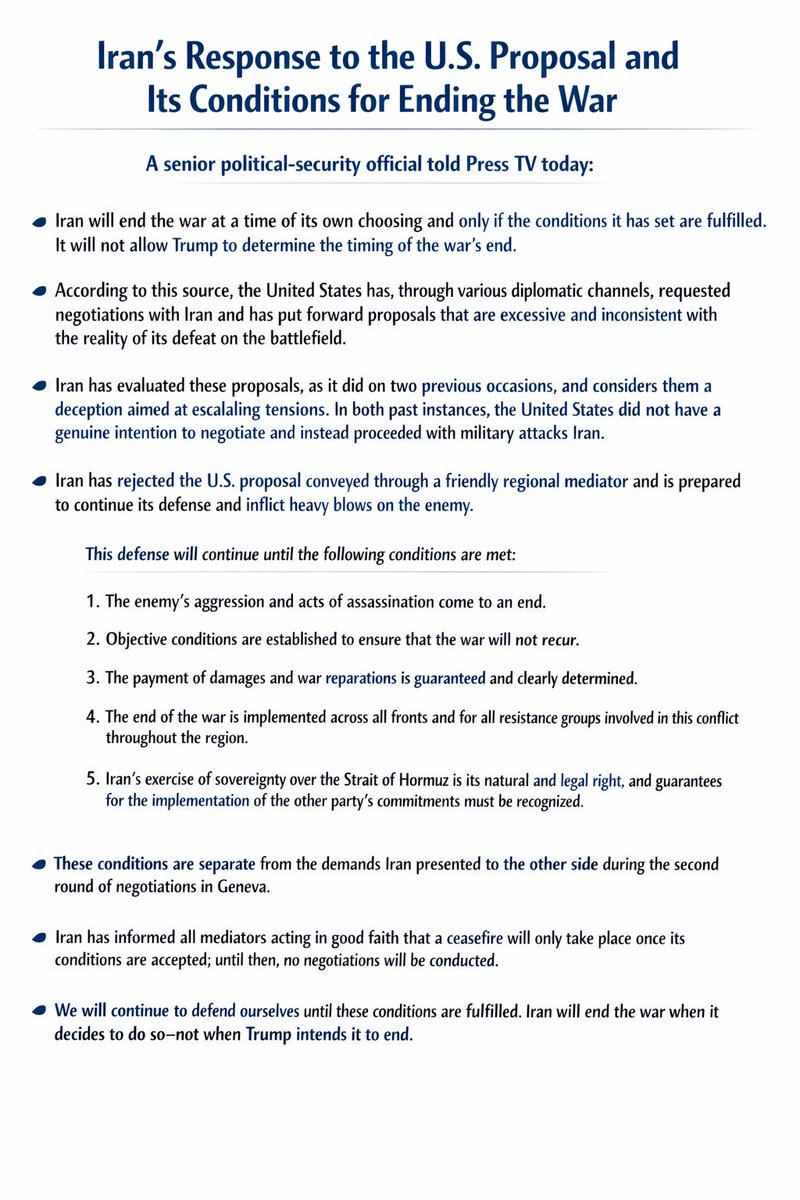
Here is Iran’s counteroffer:
These demands are not ships passing in the night; they are ships passing in different universes. There is literally no common ground in these gambits which suggests that any resolution to the war is very far away.
The US, however, is making incredible threats against Iran. According to CNBC:
“U.S. President Donald Trump said Monday that the U.S. will ‘completely’ obliterate Iran’s electric generating plants, oil wells and Kharg Island if the strategically vital Strait of Hormuz is not ‘immediately’ reopened and a peace deal is not reached ‘shortly.’
“’The United States of America is in serious discussions with A NEW, AND MORE REASONABLE, REGIME to end our Military Operations in Iran,’ Trump said in a post on Truth Social.
“’Great progress has been made but, if for any reason a deal is not shortly reached, which it probably will be, and if the Hormuz Strait is not immediately ‘Open for Business,’ we will conclude our lovely ‘stay’ in Iran by blowing up and completely obliterating all of their Electric Generating Plants, Oil Wells and Kharg Island (and possibly all desalinization plants!), which we have purposefully not yet ‘touched.’”
These threats violate the laws of war. The purpose of war is to disarm one’s enemy, not to destroy it. Total destruction of an enemy is not a legitimate objective, although many states have gone that route. We have witnessed two contemporary wars which have violated this maxim: the Russian assault on Ukraine and the Israeli assault on the Gaza Strip. It seems as if states have become intoxicated with the destructiveness of their weaponry. Wars against the civilian populations is easy, but abhorrent–non-combatants have no defenses and pose no threat to a state’s military.
The reason why international law forbids wars against civilians is because such brutal actions often lead to conflicts that cannot be resolved by diplomacy. When the civilian populations feel aggrieved, restraints on war are difficult to achieve. War is not slaughter–we can slaughter people in all sorts of ways, and nature does a pretty good job of attacking civilians through hurricanes, wildfires, and earthquakes. But slaughter is not a political objective. It is the objective only for those who feel hatred and a need to shed blood vindictively. These attitudes do not lend themselves to an honest resolution of disputes.
“When it was over, Scipio began to weep and publicly lament the misfortune of the enemy. Polybius asked him why he was weeping and he compared the fate of Carthage to that of Troy. He spoke the words of Homer:
“The day shall come in which our sacred Troy and Priam and the people whom spear-bearing Priam rules, shall perish all.”
“Polybius asked him what he meant by this and he said ‘When I consider the mutability of human affairs, I fear that someday this may also be the fate of Rome.’”
Scipio understood well the dynamics of hate and how it should have no place in the conduct of war. All wars should be fought with an eye toward attaining the conditions that will re-establish peace.
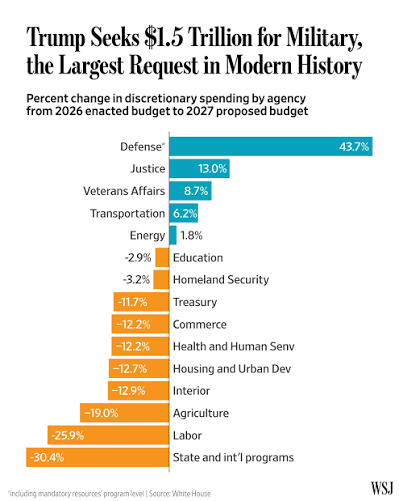
The Trump Administration is asking for an extra $200 billion for its operations in Iran. That number is in addition to the $1 trillion defense department budget already authorized. The request also comes as the evidence seems to indicate that the Administration is seriously thinking about sending ground troops into the battle.
Regardless of how one defines the threats to US national security, it seems clear that the US already spends an incredible amount of money on the ability to wage war. It is hard to assess how realistic this sum is given that the US and its allies already spend significantly more than their primary opponents.
More importantly, Trump is asking for 20% more to prosecute a war that has not been approved by Congress, despite the Constitution’s clear delegation of the power to declare war to the Congress.
The Congress should refuse to authorize the money.
Trump claims that he the power to wage war because his authority as Commander in Chief gives him the right to do so in the face of an “imminent” threat, which assumes that the Congress might not have the necessary time to declare war.
That claim is nonsense. Israel and the US had been panning this war for months before the first bomb was dropped. The plans to attack Iran were not created suddenly in 2026. They were built on years of contingency planning, sharpened by the June 2025 war, and finalized in the months leading up to February 2026 as diplomacy collapsed. Moreover, the “imminence” the asserted Iranian attack was based upon Trump’s assertion that Iran was “weeks” away from developing a bomb. According to FactCheck:
“A week before the recent military operation, on Feb. 21, Trump’s special envoy to the Middle East, Steve Witkoff, was more definitive in describing a time frame for Iran’s nuclear ambitions. Witkoff said in a Fox News interview that while Iran says that its nuclear capability is “about their civil program … they’ve been enriching well beyond the number that you need for civil nuclear. It’s up to 60%. They are probably a week away from having industrial-grade bomb-making material, and that’s really dangerous.” But experts told us it would likely take months for Iran to enrich uranium to that level and then much longer before the “bomb-making material” could be made into a weapon.
“Daryl G. Kimball, executive director of the Arms Control Association, a nonpartisan organization that provides analysis on arms control and national security issues, told us that “it is clear that it would take Iran years to fully rebuild its enrichment plants” that were bombed in June 2025. ‘It is possible that Iran may have a very small number of operational centrifuges somewhere undisclosed,’ Kimball said. ‘But it would still take months for a smaller number of centrifuges to accomplish what thousands of centrifuges at these major facilities could’ve done,’ which would be to enrich small amounts of uranium to weapons-grade level and then turn it into metal to be used for a weapon. ‘It would take longer to fashion a nuclear explosive device.’”
Trump has no authority to wage war under these circumstances, and Congress should assert its Constitutional role. It runs the risk of implicitly declaring war by passing this supplemental budget which is targeted toward military operations against Iran. In the same way, President Lyndon Johnson used the Gulf of Tonkin Resolution to justify the war in Vietnam, even in the absence of a Declaration of War.
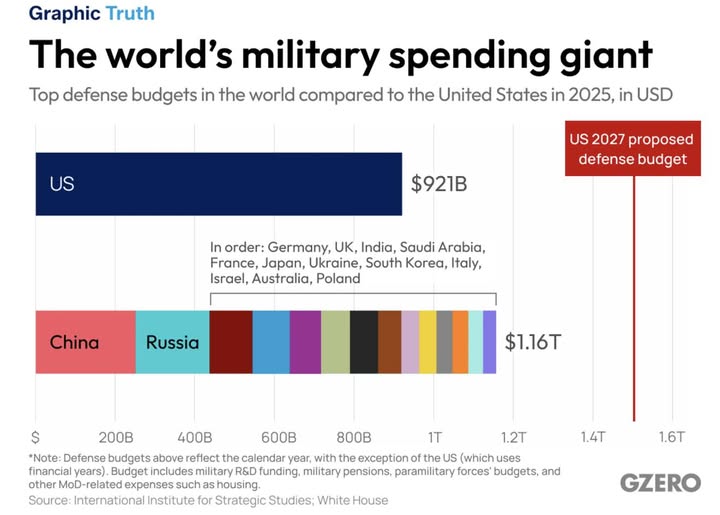
If the supplemental budget is not approved, the Republicans will argue that the action will jeopardize the safety of American troops. That argument is ridiculous. We can put the budget request in context with other states:
First, the Department of Defense has a budget of over a trillion dollars.
Current forecasts put the US Defence Spending for 2024-25 somewhere between $895 billion and $1.04 trillion.
The likely range dwarfs anything else by a margin most people still find surprising. Take the figures below, which come from the same set of Congressional projections.
China: $224 billion.
Russia: $109 billion.
India: $73 billion.
United Kingdom: $71 billion.
When one averages these numbers, US outlays alone account for roughly 40 per cent of all defence money spent around the planet.
It is hard to believe that the Defense Department is bankrupt, particularly since it is notorious for never passing an audit of its expenditures in its entire history. If one wants to see how the DoD spends money foolishly, one should check out this information provided by the Center for Arms Control and Non-Proliferation.
Second, the Congress should demand greater clarity on the purposes of the invasion and the conditions for ending the war. We have been treated to a variety of explanations for the war. Additionally, the Congress should outline what cuts it is willing to make in the current budget so that the American people will know how their money is being spent. Specifically, the supplemental request should be framed in the context of domestic programs that have been cut. For example, the recent cuts to the Affordable Care Act (Obamacare) totaled approximately $92 billion in ACA subsidies–half of the supplemental budget request. Plenty of money to kill people; limited money to heal them.
Third, opponents of the war should advance a simple peace plan: revive the Joint Comprehensive Plan of Action (JCPOA) which all analysts regarded as an effective check to Iranian nuclear ambitions. If Iran agrees to rejoin the plan, then the US should lift all sanctions on Iran. Plenty of problems remain in the US-Iran relationship, but at least the “imminent” threat will be defanged.
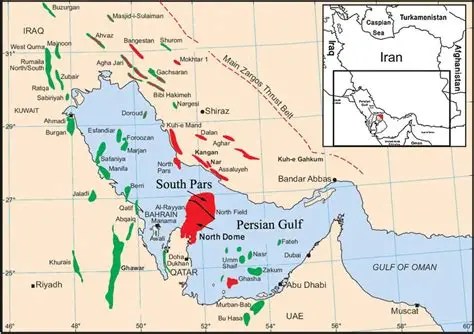
There is news coming in about the war against Iran which I think is of great magnitude. Israel has attacked the South Pars Natural gas fields that are jointly managed by Qatar and Iran. That field is the largest natural gas field in the world and many states, particularly in Europe, are depending on natural gas as they make the transition to green energy since it is more environmentally friendly than coal and oil. Additionally, Europe used to buy a lot of natural gas from Russia, but that has deteriorated as the Ukrainian conflict rages on.
South Pars Natural Gas Field
The Israeli attack crossed a profound redline. When Trump decided to bomb Kharg Island, which is where most Iranian oil is offloaded into tankers for sale abroad, he was careful to state that the US had not attacked any of the oil facilities on the island. That tactic is a critical factor. One can bomb the infrastructure of a state, its military installations, and even (unfortunately) civilian sites. But oil and natural gas are the only commodities that most of the Gulf States can export for profit. There has always been an implicit rule of war in the Middle East to not damage the oil and gas fields because such attacks pose the threat of economic catastrophe. In other words, attacking oil and gas fields is the economic equivalent of nuclear war to the oil producing states in the Gulf Region.
“After the strike on the South Pars gas field, Iran said energy infrastructure in Qatar, the United Arab Emirates and Saudi Arabia would now be considered legitimate targets.The strike on South Pars was “dangerous & irresponsible,” Qatar’s Foreign Ministry spokesman, Majed al-Ansari, said in a post on X.
“Iran’s state-run Press TV reported later on Wednesday that the country’s armed forces had struck ‘US-linked oil facilities in the region in retaliation for attacks on Iran’s oil facilities.’ Qatar’s state oil company said in a social media post that Ras Laffan Industrial City, a hub for exports of liquefied natural gas, was hit by rocket attacks. ‘Fires resulting from the attack … caused significant damage,’ QatarEnergy said.”
The Arab Gulf states are enraged, but now they are posing a very important new consideration for the world. An all-out assault on oil and gas fields would destroy the global economy for a considerable period of time. Although the world has made great progress in eliminating fossil fuels, the unfortunate fact is that those fuels since account for the bulk of economic activity in the world. This war has become one of much higher stakes than other important, but not global, issues in the current war such as the building of missiles, the funding of terror, or the enrichment of uranium.
For the Arab producing Gulf States there are unquestionably pressures to retaliate. But that course of action is not consistent with their long-term economic interests–it would lead to even more destruction of the reservoirs of oil and natural gas. And the destruction of those irreplaceable reservoirs is clearly not compatible with the interests of most people in the world. It remains to be seen whether cooler heads can prevail in this game of “chicken”. I also believe that Iran knows how counterproductive such escalation would be to its future.
The only country that has a more urgent priority than maintaining the integrity of the oil and natural gas markets is Israel. It has a more existential perspective on the war with Iran. Israel sees Iran not only as a threat to its existence, but also a threat to its military freedom in the Middle East. A nuclear armed Iran would place Israeli military actions in the region (Lebanon, Jordan, Syria, the Gaza Strip, and the West Bank) in a completely different strategic context. There are two possibilities that concern Netanyahu.
First, the real threat that Iran would blow up the state of Israel. This is not a threat that any Israeli Prime Minister could ignore, although military power is not necessarily the only way to dissuade Iran from building a bomb. But Netanyahu has chosen a military path to address the concern.
Second, and less obviously, is the possibility that an Iranian nuclear weapon would create the pressure of self-deterrence. Israel has considerable freedom of military action now because it does not face the possibility of nuclear annihilation. But would a real nuclear threat act as a deterrent even to conventional warfare? It apparently did in Ukraine, as the Biden Administration refused to allow Ukraine to procure long-range missiles because Putin had identified such transfers as a possible trigger for nuclear action. But the possibility of self-deterrence seeps down to the general population. Would Israelis have been more restrained in the Gaza Strip if Iran had had a nuclear weapon? Perhaps the citizens of Israel would have considered a different approach to responding to the horrific attacks of 7 October. If those fears are real, then those Israelis who wish to take over the lands they have occupied in the Gaza, the West Bank, Syria, and Lebanon might reconsider the costs and benefits of military action on such a broad scale.