Russia has supplied its bombers in Syria with state-of-the-art air-to-air missiles. The arming comes after Turkey shot down a Russian bomber it said had violated Turkish territory. The move is a legitimate act of self-defense for the Russian pilots, but it makes the air space above Syria significantly more dangerous. In combination with Russia’s best anti-aircraft missile system, the S-400, the Russians now have tight control over Syria. The risk is that this control could also extend to objectives other than tracking down Daesh (ISIS), including activities conducted by Hezbollah in Syria against Israel.
The attacks on Paris and Beirut tend to be viewed in the context of the “global war on terror” which began for the West in 2001. But that perspective ignores the long history of interaction between Western and non-Western peoples. In particular, the Algerian war of independence in the 1950s and 1960s set the stage for how the French respond to acts of terror and why they became the objects of terror. One cannot divorce the history of imperialism from current events–indeed, an appreciation of that history is the only way to understand a way forward.
The Chinese yuan has become the fifth currency to be used to calculate the Special Drawing Rights of the IMF–the other currencies being the US dollar, the Japanese yen, sterling and the euro. The move signals the growing acceptance of the Chinese currency in international transactions and is a significant political victory for China. The move, however, also places a great deal of pressure on China not to manipulate its currency to stimulate its exports so it comes with significant economic costs to China.
There have been repeated stabbings and cars ramming into civilians in the Occupied West Bank over the last few months. The violence remains at a relatively low, but steady, level. Some analysts believe that this stretch of violence represents the third intifada (uprising) in Israeli-Palestinian relations (the first two were in 1987 and 2000). Other analysts believe that the conflict remains manageable. Whether it qualifies as a full-fledged uprising is beside the point. The essential point is that the tension in the Palestinian population is palpable and has no where to go. The Palestinians do not trust their own leadership (President Abbas has unilaterally extended his term of office since 2009 without authority), the Israelis, or the US.
There have been marches and protests all across the globe today in support of the COP-21 climate talks which start in Paris. Marchers in France were banned from assembling because of security concerns, but they used great creativity and left 10,000 pairs of shoes at the Place de la Republique instead. We already have commitments by some countries to reduce their greenhouse gas emissions. According to The Guardian:
The EU will cut its emissions by 40%, compared with 1990 levels, by 2030. The US will cut its emissions by 26% to 28%, compared with 2005 levels, by 2025. China will agree that its emissions will peak by 2030.
Nations responsible for more than 90% of global emissions have now come up with their targets – known in the UN jargon as Intended Nationally Determined Contributions or INDCs .
Unfortunately, with these commitments, the world still falls short of its goal: “Analysis of the INDCS, endorsed by the UN, has suggested that these pledges are enough to hold the world to about 2.7C or 3C of warming.”
Niall Ferguson, a commentator with whom I mostly disagree, has written a biography of Henry Kissinger, a statesperson whose policies I abhorred. Interestingly, however, the theme of the biography is something with which I agree: that the study of history is indispensable to good diplomacy. Apparently, we all agree with Thucydides: “The present, while never repeating the past exactly, must inevitably resemble it. Hence, so must the future.”
Juan Cole is one of the most experienced and insightful analysts of Middle Eastern events, and he has authored an essay for the Nation which urges us to rethink the way we think about the Islamic State (which he prefers to call by its Arabic name, Daesh). His analysis is compelling: the metaphor of war is inappropriate for actions against the group. Treating the Islamic State as a “state” legitimizes the group in the eyes of its followers and potential adherents.
One of the mysteries of the power of the Islamic State is how it gets so much money. We know that it is selling oil, but it has never been clear how it transports the oil out of Syria and Iraq, who sells the oil, and who buys the oil. El Araby, a newspaper out of Qatar, has tracked down these questions and the answers explain a great deal. It appears as if much of the oil is sold to Kurds (a purported ally of the US), shipped and refined through Turkey (another purported ally of the US), and much of it is sold to Israel (another purported ally of the US–the Islamic State oil accounts for as much as 75% of Israel’s oil consumption). In other words, American allies are helping to subsidize the Islamic State to the tune of about $50 million a month. Interestingly, one of the people who figures prominently in this web is Bilal Erdogan, the son of the Turkish Prime Minister, the country that opposes both the Kurds and the Islamic State.
India has maintained a blockade of Nepal since last September. The immediate cause of the blockade is the Indian displeasure with the new Nepalese constitution after almost ten years of living under an interim constitution. India’s concern is that the constitution does not accord full rights to the Nepalese Madheshis who live right on the Indian border. But the blockade almost represents an effort by India to exercise greater control over Nepalese affairs which it regards as necessary to prevent Chinese influence in Nepal. The blockade is causing a serious humanitarian crisis to the landlocked country since virtually all trade to and from Nepal flows through the border.
British prime minister, David Cameron, is trying to persuade the British Parliament to join the US and the French in attacks against the Islamic State but is encountering a high degree of skepticism from British lawmakers. The hesitation stems from the earlier experience in invading Iraq in 2003, an episode that failed to realize specific strategic objectives and led to the high degree of instability that the world currently faces in the Middle East. This hesitation also reflects a perennial problem in the analysis of world politics: what lessons can be learned from history and how to interpret previous experiences with contemporary circumstances which are always slightly different from the historical record.
There was a shooting incident near a Planned Parenthood clinic in Colorado Springs. Early reports indicated that several police and civilians were injured in the shooting. Planned Parenthood has been the target of some anti-abortion groups who believe that abortion is immoral. I wonder if the media will refer to this tragedy as an act of “Christian” terrorism?
There was a gun attack on a Shia mosque in Bogra, Bangladesh. The international media is blaming the Islamic State for the attack on a mosque frequented by both Sunni and Shia Muslims. But the Bangladeshi media is reporting that the attack was carried out by a local group, not the Islamic State. The Shia Muslim population of Bangladesh is believed to be quite small, but, until recently, the country did not have a history of sectarian violence. More recently, however, there have been violent attacks on Christian, Shia Mulsim, and atheist populations.
The US has admitted that it made multiple and tragic errors in the attack against the hospital in Kunduz, Afghanistan. The hospital was run by Doctors Without Borders, and the organization contacted the US while the attack was going on and its pleas were ignored. Among the errors made by the US:
The crew of the AC-130 gunship was not properly briefed before their mission.
Air and ground personnel failed to follow rules of engagement.
The ground commander did not have the authority to direct the airstrike.
Communications and targeting computer malfunctions targeted the wrong location.
Once on site, the aircrew independently chose to strike a building they believed to be the legitimate target.
The aircrew proceeded to use force that was disproportionate to the threat.
There is no way to win a conflict making such egregious mistakes: such incidents always loom larger than any successes to the populations involved.
The French Parliament has voted 325-0, with 21 abstentions to extend and deepen the airstrikes against the Islamic State. The vote indicates the depth of popular sentiment in France after the terrorist attack on Paris. French President Hollande is also in Russia to persuade Russia to coordinate its attacks on the Islamic State with the NATO countries.
Hollande and Putin
Officials in Burundi are complaining of a campaign of vilification against President Pierre Nkurunziza after the US implemented sanctions against him and his close aides. The US imposed sanctions after Nkurunziza ran for a constitutionally-prohibited third term in office. The political tension in the country is continuing to grow, mirroring the conflict that mired the country in a civil war that only ended 10 years ago.
I do not usually post political ads, and I am no supporter of Governor Kasich of Ohio. But he has launched an ad against Donald Trump that I think deserves viewing. I post it not because I do not support Trump, but because the ad uses the words of Martin Niemöller, who was a Lutheran pastor who initially supported Adolf Hitler but who then became a staunch anti-Nazi. These words are important for every generation to remember because they remind us that we are always responsible for each other.
2011-2015 “have been the warmest five-year period on record, with many extreme weather events – especially heatwaves – influenced by climate change.”
2015 is set to be the hottest year on record by far, with the highest ocean surface temperatures ever monitored.
It’s “probable” that total global warming since the industrial revolution will cross the 1°C (1.8°F).
The 3-month average of Northern Hemisphere CO2 levels “crossed the 400 parts per million barrier for the first time.”
The crossing of the 1º C threshold is significant since it indicates that the planet is halfway to the 2º C point at which many climatologists regard as a point of catastrophic change. This year’s temperature extremes are off the charts from previous years.
It is not hard to think that the international system is currently quite fragile–indeed, parts of it seem to be deteriorating rapidly. In many respects, the fragility of the system reflects a loss of confidence in the liberal system to solve problems and to inspire confidence among disparate populations. There really is no alternative to liberalism right now, but the decay of the system is not necessarily due to competition from other systems. It is. rather, a failure to keep pace with the rate of change in the world.
The situation in Syria became significantly more complicated as Turkey has shot down a Russian bomber it said strayed into its airspace. This incident likely precludes the possibility that the US and Russia will cooperate any time soon in their activities against the Islamic State. The more immediate problem is how Russia will respond to this attack since it represents a serious challenge to Russia’s ability to maneuver to protect its military base near Latakia (which is very close to the place where the bombers were shot down). It also highlights the risks of US and allied airplanes operating in such close proximity to Russia airplanes–accidents are impossible to avoid completely.
One of the arguments used by those who deny that a climate change problem exists is the assertion that there was a “pause” in increasing temperatures in recent years. Indeed, using NOAA data there does seem to be a slight plateau in global surface temperatures (although it is hard to believe given the weather we’ve have this fall). New research, however, based upon NASA data, which includes more than land surface temperatures, indicates that there is, in fact, no pause and the the assertions claiming a pause use inconsistent time periods and data bases. Unfortunately, the evidence for increasing global temperatures appears to be conclusive.
A new study indicates that European banks are holding about €1 trillion worth of non-performing (“bad”) loans. This number reflects about 10% of the outstanding loans held by European banks to entities other than other banks–the equivalent rate for US banks is about 3%. The figure suggests that European banks may be especially vulnerable to any shap downturn in economic growth globally–something to wrry about since key countries such as China and Brazil seem to be experiencing dramatic slowdowns in their demand for European products.
Brunei, Cambodia, Indonesia, Laos, Malaysia, Myanmar, the Philippines, Singapore, Thailand, and Vietnam have voted to create a EU-style institution of economic cooperation to be called the ASEAN Community. The region is home to 600 million people (the EU has about 500 million) and is a very economically active region of the world Reducing constraints on the movement of lan, labor and capital would increase economic efficiencies in the region tremendously. Interestingly, however, the proposed institution would have pretty much the same problems as the EU, most notably the distinction between those countries which remain wedded to the agricultural sector and those countries that have moved high up the manufacturing chain. The aspiration is laudable, but the degree of cooperation among the ASEAN countries as of now suggests that the process will be slow and arduous.
Last September the UN approved a set of principles to govern sovereign debt crises in a more systematic fashion and also in a manner that was less biased toward the interests of the creditors and more sensitive to the problems of debtors. The resolution articulated these principles:
a sovereign’s right to initiate a debt restructuring,
sovereign immunity,
equitable treatment of creditors,
(super) majority restructuring,
transparency,
impartiality,
legitimacy,
sustainability, and
good faith in negotiations
The resolution was favored by 136 countries and opposed by 6 (led by the US). Unfortunately, the resolution is not binding and a treaty must be written to make these principles binding. The chances for a treaty right now are quite dim given the high level of opposition within the global financial community.
Mauricio Macri won the Argentine presidential election on Sunday. The result ends a ten-year period of Peronist rule that was dominated by center-left policies that helped the poor but failed to ignite economic growth, leading to a long period of stagnation. Macri has promised to move the country’s economic policies to the center-right and will undoubtedly cheer the international financial community. Let us hope that Macri can deliver the goods–Argentina desperately needs its economy to grow faster.
Bangladesh executed two political leaders for crimes committed during the war for independence in 1971. The opposition leaders, Ali Ahsan Mohammad Mujahid and Salauddin Quader Chowdhury, were hanged after the Supreme Court rejected their appeals. The two were convicted by a special tribunal for genocide and torture of civilians after East Pakistan moved to secede from Pakistan and to become an independent state. Almost 3 million people were killed in that struggle and the political tensions from that conflict persist to the present day.
I was in Belgium earlier in the semester, and I was struck by how low-key the country seemed to be. People were pleasant, they walked everywhere, and the cafes and restaurants were packed. The situation now is apparently quite different according to my friends there. The trains are empty, the metro is closed, and no one seems to be walking around. The country is on the highest alert for an expected terrorist attack and the US Embassy is telling all American citizens not to go to work or to be highly visible.
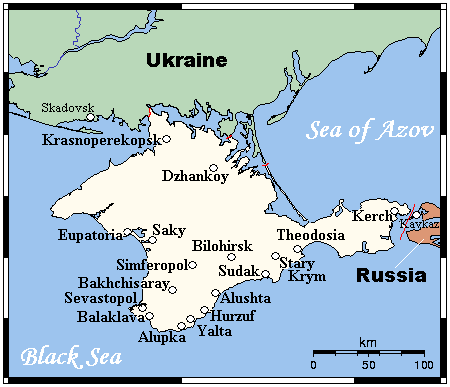
Russia annexed Crimea in February of 2014 and the transition to Russian rule has been difficult for the people there. Today, the situation became even more difficult as saboteurs cut the main power lines from Ukraine into the peninsula. The Crimeans are in a difficult situation because most of the power and water comes from Ukraine which now considers the territory to be occupied by a foreign power. It is doubtful that Russia can fill the void in the short run.
Writing in the British magazine, Prospect, Matthew Goodwin outlines the reasons why the right-wing in Europe is achieving such electoral success. In many respects, Goodwin blames the progressive wings of European politics for not taking the right-wing seriously and failing to respond to the rhetoric of the right that increasingly appeals to larger numbers of citizens:
Across Europe the radical right is connecting because it recognised early on that public anxieties over migration, refugees and Islam are as much about perceived threats to their cultural security, values and ways of life as they are about welfare states and the distribution of resources. By pitching unequivocally to this feeling of cultural angst, however fluid and abstract it might seem, the likes of Wilders and Le Pen are drawing strength from voters who stand firmly on one side of a value divide in Europe—between liberal progressives who celebrate social change, cosmopolitanism, open Europe and have little patience for those who think otherwise, and cultural conservatives who feel fundamentally under threat from this change, want to assert the values of their own group and worry about the capacity of Islam to accommodate central aspects of democratic life, such as the freedom of expression and gender equality.
The French Prime Minister, Manuel Valls, has introduced a new security bill which would allow the state to close mosques if they became “too radical.” Goodwin’s argument can be made for progressives in the US, although it is probably harder to take Trump and Carson seriously.
Russia is taking serious steps to assure that the world takes its military capabilities seriously. Russian authorities have issued a video of two Russian Tu-160 Blackjack bombers flying a 13,000 km journey from Russia to Syria and back, escorted by three Su-30SM Flankers launched from Latakia. The bombers launched cruise missiles on unspecified targets in Syria. The You Tube video was for political purposes, but I sincerely doubt that anyone in the know doubts Russian military prowess.
The UN Security Council has passed Resolution 2249 exhorting member states to take action against the Islamic State. The text reads as follows:
Reaffirming the principles and purposes of the Charter of the United Nations, Reaffirming its respect for the sovereignty, territorial integrity, independence and unity of all States in accordance with purposes and principles of the United Nations Charter,
Reaffirming that terrorism in all forms and manifestations constitutes one of the most serious threats to international peace and security and that any acts of terrorism are criminal and unjustifiable regardless of their motivations, whenever and by whomsoever committed,
Determining that, by its violent extremist ideology, its terrorist acts, its continued gross systematic and widespread attacks directed against civilians, abuses of human rights and violations of international humanitarian law, including those driven on religious or ethnic ground, its eradication of cultural heritage and trafficking of cultural property, but also its control over significant parts and natural resources across Iraq and Syria and its recruitment and training of foreign terrorist fighters whose threat affects all regions and Member States, even those far from conflict zones, the Islamic State in Iraq and the Levant (ISIL, also known as Da’esh), constitutes a global and unprecedented threat to international peace and security,
Recalling that the Al-Nusrah Front (ANF) and all other individuals, groups, undertakings and entities associated with Al-Qaida also constitute a threat to international peace and security,
Determined to combat by all means this unprecedented threat to international peace and security,
Noting the letters dated 25 June 2014 and 20 September 2014 from the Iraqi authorities which state that Da’esh has established a safe haven outside Iraq’s borders that is a direct threat to the security of the Iraqi people and territory, S/2015/890 2/2
Reaffirming that Member States must ensure that any measures taken to combat terrorism comply with all their obligations under international law, in particular international human rights, refugee and humanitarian law;
Reiterating that the situation will continue to deteriorate further in the absence of a political solution to the Syria conflict and emphasizing the need to implement the Geneva Communiqué of 30 June 2012 endorsed as Annex II of its resolution 2118 (2013), the Joint Statement on the outcome of the multilateral talks on Syria in Vienna of 30 October 2015 and the Statement of the International Syria Support Group (ISSG) of 14 November 2015,
1. Unequivocally condemns in the strongest terms the horrifying terrorist attacks perpetrated by ISIL also known as Da’esh which took place on 26 June 2015 in Sousse, on 10 October 2015 in Ankara, on 31 October 2015 over Sinaï, on 12 November 2015 in Beirut and on 13 November 2015 in Paris, and all other attacks perpetrated by ISIL also known as Da’esh, including hostage-taking and killing, and notes it has the capability and intention to carry out further attacks and regards all such acts of terrorism as a threat to peace and security;
2. Expresses its deepest sympathy and condolences to the victims and their families and to the people and Governments of Tunisia, Turkey, Russian Federation, Lebanon and France, and to all Governments whose citizens were targeted in the above mentioned attacks and all other victims of terrorism;
3. Condemns also in the strongest terms the continued gross, systematic and widespread abuses of human rights and violations of humanitarian law, as well as barbaric acts of destruction and looting of cultural heritage carried out by ISIL also known as Da’esh;
4. Reaffirms that those responsible for committing or otherwise responsible for terrorist acts, violations of international humanitarian law or violations or abuses of human rights must be held accountable;
5. Calls upon Member States that have the capacity to do so to take all necessary measures, in compliance with international law, in particular with the United Nations Charter, as well as international human rights, refugee and humanitarian law, on the territory under the control of ISIL also known as Da’esh, in Syria and Iraq, to redouble and coordinate their efforts to prevent and suppress terrorist acts committed specifically by ISIL also known as Da’esh as well as ANF, and all other individuals, groups, undertakings, and entities associated with Al Qaeda, and other terrorist groups, as designated by the United Nations Security Council, and as may further be agreed by the International Syria Support Group (ISSG) and endorsed by the UN Security Council, pursuant to the Statement of the International Syria Support Group (ISSG) of 14 November, and to eradicate the safe haven they have established over significant parts of Iraq and Syria;
6. Urges Member States to intensify their efforts to stem the flow of foreign terrorist fighters to Iraq and Syria and to prevent and suppress the financing of terrorism, and urges all Members states to continue to fully implement the above – mentioned resolutions;
7. Expresses its intention to swiftly update the 1267 committee sanctions list in order to better reflect the threat posed by ISIL also known as Da’esh;
8. Decides to remain seized of the matter.
Strangely, however, the Resolution does not invoke Chapter Seven of the UN Charter that authorizes the use of force. Perhaps the Russians (and the Chinese) were willing to go that far in the resolution.