The New York Times has published an article on the rise of the Islamic State, tracing its roots back to the turmoil in Iraq after the fall of Saddam Hussein and the American occupation of Iraq. The background is useful in tracing the politics and ideology of the IS. The article makes clear that the group’s potential was never fully appreciated by the US, a condition that prevented the US from taking the initiative. As a consequence, the US is only reacting to events and has lost the ability to control those events. Scott Atran and Nafees Hamid have written an essay for the New York Review of Books which outlines how the Islamic State has been able to exploit this vulnerability.
The Institute for Economics & Peace has published its Global Terrorism Index, 2015. The research found that “Boko Haram, the Nigerian jihadist group, was responsible for 6,644 deaths in 2014, compared with 6,073 at the hands of ISIS”. Although Boko Haram is the deadlier organization, its profile in the West is much lower, an unfortunate manifestation of the relative disregard for events in Africa.
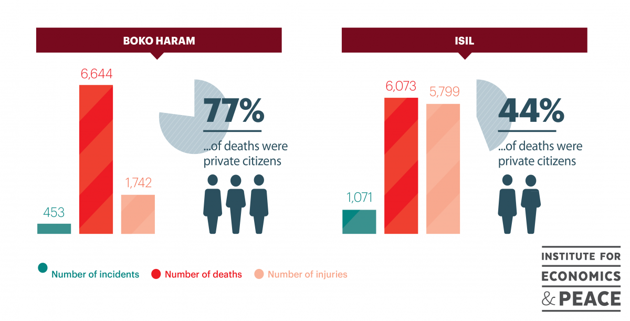
The overall effects of terrorism in the world have grown dramatically over the last few years. The Atlantic reports:
“More broadly, this year’s index reports that 2014 was the worst year yet for terrorism, with an 80-percent increase from 2013 in fatalities, to 32,658. Sixty-seven countries experienced at least one or more deaths from terrorism, as opposed to 59 countries in 2013. Some things stayed the same, though: Just as in 2013, the vast majority of deaths from terrorism occurred in one of five countries: Afghanistan, Iraq, Nigeria, Pakistan, and Syria.”


Pingback: Paris, Terrorism, and Race | Catherine Onyemelukwe