“We’re therefore building the structure of a new, transregional strategy for countering terrorism over the long term. This will be based on infrastructure we’ve already established in Afghanistan, the Levant, East Africa, and Southern Europe.
“Because we cannot predict the future, these regional nodes – from Morón, Spain to Jalalabad, Afghanistan – will provide forward presence to respond to a range of crises, terrorist and other kinds. These will enable unilateral crisis response, counter-terror operations, or strikes on high-value targets. But they’re about more – they’ll also allow us to enable partners to respond to a range of challenges. To pre-position equipment for ourselves and our partners. And to provide important opportunities to innovate, to develop new command-and-control structure, new ways to manage the force, new capabilities, and new operational concepts.”
The vision is remarkably similar to the policy of containment that the US adopted to confront the Soviet Union at the onset of the Cold War. It suggests that the US is committed to a very long-term strategy.
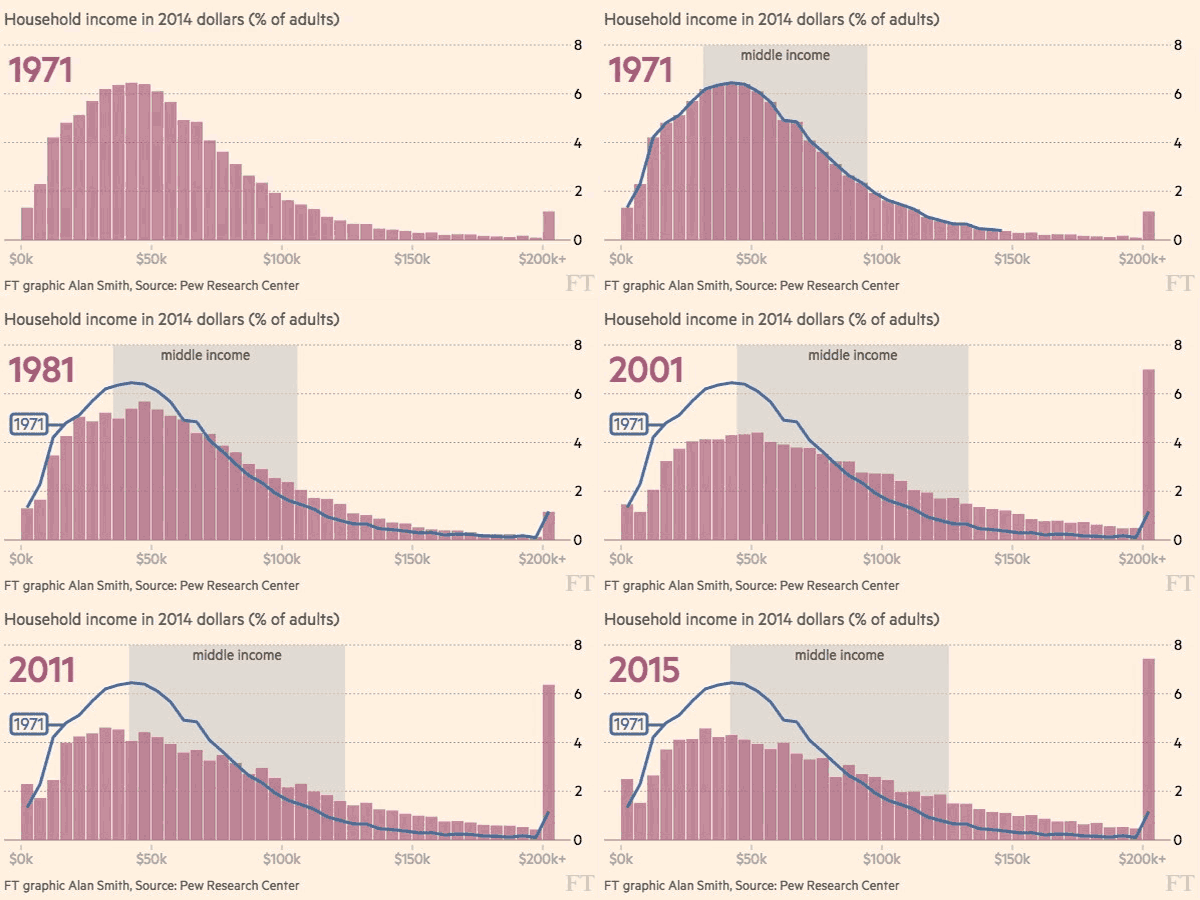
The Financial Times has a devastating article on the decline of the American middle class. It was once the envy of the world and now accounts for less than half of the American population. The decline is not an accident: it is the deliberate and considered outcome of policy decisions made in the US since the 1970s to deregulate the economy, to reduce taxes, and to protect capital at the expense of labor. Unless the pattern is changed, the US will not be able to restore its once vibrant middle class.
One of the central tenets of Dependency Theory is that the creation of wealth also leads to the creation of poverty–the determining factor being who produces the inputs and who sells the outputs. There is probably no better example of this phenomenon than the success of the Walmart chain of stores. Walmart was able to produce many goods in low wage areas of the world, primarily China. In so doing, many higher paying jobs in the US were lost as firms that could not compete with the low wage production. Researchers have estimated that about 400,000 manufacturing jobs in the US were lost as a result. The owners of Walmart became very rich (the three siblings are among the 20 richest Americans) and the workers in China who had jobs became richer (but hardly rich). But the workers in the US became poor since they lost their jobs. Wealth and poverty are causally related.
PressTV, the Iranian television news media, has released a video on the impact of globalization on Islam. The video is fascinating and offers a different perspective on how global trends have affected Muslim populations and how Islam is interpreted by those populations. It is not a perspective that Western media appreciate at all.
China has relaxed some of the restrictions on the movement of its citizens, a policy called hukou which made it difficult for migrants to receive medical care and education when they moved to take advantage of employment opportunities in the cities. The change will affect about 13 million people and will dramatically enhance labor mobility in the country. The move amplifies the effect of the earlier loosening of the one-child policy in China.
Pentagon officials have labeled the campaign rhetoric of Republican presidential candidate Donald Trump as dangerous to American national security. Many Americans tend to forget that the rest of the world often listens carefully to the language of American elections, and do not fully appreciate how that language shapes US power. In this particular case, Trump’s anti-Muslim rhetoric is clearly playing into the hands of those who believe that the US is on a “Crusade” to diminish the power of Islam in the world.
Bloomberg has developed a global “carbon clock” which outlines the significant variables concerning Carbon Dioxide as a greenhouse gas. It is a remarkable interactive graphic that expresses some complex ideas very directly and succinctly.
Daesh (the Islamic State) has produced a propaganda video in Mandarin to gain the attention of Chinese Muslims. China has become increasingly apprehensive about Chinese nationals who have gone to fight for Daesh and who might return to China to support the Uighur minority groups in the northwest province of Xinjiang. Some Uighurs have resorted to violent protests in order to gain greater autonomy for the Muslim Uighurs.
After 16 years of socialist rule under Presidents Chavez and Maduro, Venezuela overwhelmingly voted for opposition parties giving them total control of the country’s parliament. Voter participation was very high at nearly 75% indicating that the election reflects a rather deep and wide sentiment. The outcome means that Venezuela will be faced with a difficult transition as high rates of inflation have to come down and the government will have to reduce much of its spending. Where the government cuts will determine which sectors of the population will suffer the most.
For the first time in many years, CO2 emissions globally declined slightly from the previous year. The decline likely stems from an economic slowdown in China as well as concerted efforts within China to reduce carbon dioxide emissions. The news is certainly good, but the future really depends on the use of coal which has been staging somewhat of a comeback as its price has declined considerably. India appears to be increasing its use of coal significantly and even in countries such as Germany which has made a sustained effort to boost solar and wind power, the use of coal has been creeping back up. Interestingly, ExxonMobil has released its own report on the future. Its own research indicates that “without government action” temperatures by the end of the century may rise between 7 and 12 degrees Fahrenheit.
Unfortunately, for the first time ever, China has released its first “red alert” for smog levels in Beijing signalling profoundly unhealthy air for the next three days.
“The wealthiest 20 individuals in the United States today hold more wealth than the bottom half of the U.S. population combined. These 20 super wealthy — a group small enough to fly together on one Gulfstream G650 private jet — have as much wealth as the 152 million people who live in the 57 million households that make up the bottom half of the U.S. population.”
The researchers point out that the increasing inequality of the American population is the consequence of deliberate political choice: the tax laws and their loopholes inordinately favor those who possess highly mobile capital and disenfranchise those who rely almost exclusively on income derived from labor.
Forbes Top 20 Rank
Name Wealth ($bill) Source of Wealth Residence
1 Bill Gates 76 Microsoft Medina, WA
2 Warren Buffett 62 Berkshire Hathaway Omaha, NE
3 Larry Ellison 47.5 Oracle Woodside, CA
4 Jeff Bezos 47 Amazon Seattle, WA
5 Charles Koch 41 Koch Industries Wichita, KS
6 David Koch 41 Koch Industries New York, NY
7 Mark Zuckerberg 40.3 Facebook Palo Alto, CA
8 Michael Bloomberg 38.6 Bloomberg LP New York, NY
9 Jim Walton 33.7 Wal-Mart heir Bentonville, AR
10 Larry Page 33.3 Google Palo Alto, CA
11 Sergey Brin 32.6 Google Los Altos, CA
12 Alice Walton 32 Wal-Mart heir Fort Worth, TX
13 S. Robson Walton 31.7 Wal-Mart heir Bentonville, AR
14 Christy Walton 30.2 Wal-Mart heir Jackson, WY
15 Sheldon Adelson 26 Sands Casino Las Vegas, NV
16 George Soros 24.5 Hedge funds Katonah, NY
17 Phil Knight 24.4 Nike Hillsboro, OR
18 Forrest Mars, Jr 23.4 Mars Candy heir Big Horn, WY
18 Jacqueline Mars 23.4 Mars Candy heir The Plains, VA
18 John Mars 23.4 Mars Candy heir Jackson, WY
Top 20 Combined: $732 Billion Source: Forbes, September 29, 2015.
Turkey has detained Russian vessels trying to navigate the Bosporus as Russia and Turkey continue to escalate their diplomatic spat. The naval violations detected by Turkish authorities do not seem to be especially egregious:
There are a number of Russian military vessels in the area as both sides continue to brandish their swords.
The right-wing National Front party in France, led by Marine Le Pen, has scored significant victories in French regional elections. President Hollande’s Socialist Party appears to have come in a distant third in the polling spelling significant ruling problems for France in the near future. Many interpret the vote for the National Front as an explicit rejection of the traditional ruling parties, an interpretation which is also reflected in the polling trends in the US as well.
Iraq has protested the presence of Turkish troops on Iraqi territory near the city of Mosul. Turkish troops have frequently entered Iraqi territory in the past in pursuit of Kurdish forces, but this time the intent seems to be different even though Turkish forces have in fact been bombing Kurdish positions in northern Iraq. According to the Turkish newspaper, Hürriyet:
“The deal regarding the base was signed between Kurdistan Regional Government (KRG) President Massoud Barzani and Turkish Foreign Minister Feridun Sinirlioğlu, during the latter’s visit to northern Iraq on Nov. 4.”
The idea that Turkey is training Kurdish forces in Iraq is difficult to understand: Turkey has made it very clear that it fears Kurdish demands for an independent state. Why would it train Kurdish fighters?
Not surprisingly, Turkey has firmly denied the charges, and the US has indicated its full faith in its NATO partner, Turkey. But the charge is a mind-boggling case of realpolitik: Turkey bombs some Kurds, but works with other Kurds, and gives money to Daesh while at the same time bombing them. Unfortunately, since the charges come from Russia few in the Western press are taking the accusations seriously. They deserve to be investigated fully.
The Indian city of Chennai has been hit by devastating floods with rainfalls of as much as 14 inches in 24 hours. Almost 270 have been killed, thousands have been displaced, and the city has been paralyzed. Some meteorologists believe that this year’s extraordinary el Niño is responsible for the excessive rainfall, but Chennai, the 4th largest city in India, has also made questionable planning decisions concerning runoff. But if climate change is involved, then the flooding may only be a harbinger of things to come.
Recent polls indicate that the opposition parties are set to win majorities in the elections scheduled for Venezuela this weekend. The economy is experiencing dramatic shortages of essential products and very high rates of inflation as the declining price of oil has forced the government to print money that is not backed by any tangible assets. The current President, Nicolás Maduro, took over after the death of Hugo Chavez and has promised to sustain the “Bolivarian Revolution” initiated by Chavez. Ominously, Maduro has stated that he would “not hand over the revolution” if the ruling party loses the election.
Paul Krugman has written a review of Robert Reich’s new book, Saving Capitalism for the New York Review of Books. The review is an elegant summary of the competing theories behind the dramatic increase in income inequality in the US since the 1970s. Reich’s argument is that
“….widening inequality largely reflects political decisions that could have gone in very different directions. The rise in market power reflects a turn away from antitrust laws that looks less and less justified by outcomes, and in some cases the rise in market power is the result of the raw exercise of political clout to prevent policies that would limit monopolies.”
In other words, concentrated economic power has been translated into political power to favor capital at the expense of labor. The essay is definitely worth a close read.
One of the background issues in the Syrian civil war is the proposed natural gas pipeline from Qatar to Turkey. Qatar has been pushing for this pipeline for many years but has been stymied by the refusal of Syrian President Assad to allow the pipeline to be built across Syria. The Turks obviously favor the pipeline because it would allow Turkey to collect transit fees which would be a considerable source of revenue. The Russians oppose the pipeline because it would bring alternative natural gas supplies to Europe that would undercut Russian control of the European energy market.
The major power that has remained somewhat aloof from the conflict in the Middle East is China and it is difficult to figure out eaxctly what China’s interests are in the long run. Clearly, China cannot remain indifferent to the disposition of petroleum and natural gas, its most important imports. But beyond those concrete interests, how does the conflict fit into the Chinese world view? A Chinese blogger, Yang Hengjun, places China’s perspective in the context of the “Clash of Civilizations” thesis developed by Professor Samuel Huntington several years ago. I do not personally subscribe to the thesis, but it offers an interesting insight into Chinese values.
The lower house of the Brazilian Congress has initiated impeachment proceedings against the president, Dilma Rousseff. The proceedings will add a great deal of uncertainty to a country that is already reeling from an economic downturn and corruption scandals.
NATO has decided to invite Montenegro to join the alliance. The military alliance, created in 1949 in response to the growing Cold War, has expanded its membership since that time as the Soviet alliance (the Warsaw Pact)) disintegrated and the Soviet Union itself disappeared. NATO expansion has always been a sore point with the Russians which believes that NATO still exists to constrain the power of Russia. The move to invite Montenegro has rankled the Russians and it is not at all clear why NATO chose to make this decision in a time of very strained Western-Russian relations.
President U Thein Sein of Myanmar promised a smooth transition of power after the recent elections. The National League for Democracy party, led by Daw Aung San Suu Kyi, won nearly 80 percent of the seats in the national election, ending a long period of military rule (1962-2010). Suu Kyi is constitutionally prohibited from becoming President (the military insisted that the constitution bar anyone with a foreign spouse from that post), but it is widely acknowledged that she will be setting the agenda for the country. The issues confronting Myanmar are quite serious and the top of that list is the growing hostility toward Muslims in the country.
John Cassidy of The New Yorker has written an interesting essay on the climate talks in Paris. He is optimistic that an agreement will be reached during the two-week conference; he is not optimistic that the agreement will really tackle the problem of climate change. The conference will not produce a treaty–neither the Americans or the Chinese are interested in a treaty. The US fears a treaty because it would unquestionably be defeated in the US Senate. The Chinese fear a treaty because they do not wish to give up any control over their economy. The problematic country in the mix is India which believes that the treaty must address the economic inequities implicit in carbon controls over poor countries at this time. In an op-ed for the Financial Times, Indian Prime minister Modi wrote:
Justice demands that, with what little carbon we can still safely burn, developing countries are allowed to grow. The lifestyles of a few must not crowd out opportunities for the many still on the first steps of the development ladder.
The Pew Research Center has conducted a poll in 38 countries on attitudes toward freedom of speech and freedom of the press. The results suggest broad support for those freedoms, but the regional differences in support are important to notice. The poll also asked questions about freedom of religion and gender equality which reflect wider diversity across the 38 countries. The poll reveals the extent to which liberal values underpin much of global civic society.
Germany has decided to send 1,200 troops to join the fight against Daesh (ISIS). The troops will be in a supporting and advisory role, but by simply sending troops abroad, Germany has made a bold statement. Since the end of World War II, Germany has been especially sensitive to any move that would suggest a rebirth of German militarism. Additionally, Germany has one of the largest Muslim populations in all of Europe and runs the risk of alienating that segment of its population by joining a fight against Muslim fighters.
Brazil’s economy shrank by 1.7% in the third quarter of 2015, a decline significantly larger than the predicted 1.2% decline. The data confirms that Brazil–which has the largest economy in Latin America–is in a full-fledged recession, spelling trouble for the entire region. Additionally, the economic decline spells further trouble for President Rousseff who has been undermined by corruption scandals surrounding some of her closest aides.