US President Trump has announced a new policy in Afghanistan. I just listened to the speech he delivered in Arlington, VA and have not had a chance to read the speech or go over it in detail. I will probably have more the say about the speech in subsequent posts. My initial reaction is a degree of confusion. President Trump announced that the US would move from a time-based decision-making process to a conditions-based one. In military terms, that shift is a very important one, but the conditions are not specified so we do not know what the costs might be. If the conditions include a fully-functioning central government in Afghanistan, then the costs might be very high. It they include the elimination of all 22 groups identified by President Trump as security threats to the US, then the costs might be very high as well. If the condition simply means an agreement between the Taliban and the central government in Afghanistan to divide up control of the country, then the costs might be very low. As this point, I really know very little about what the US objectives might be.
The US has been in Afghanistan since October 2001 when it overthrew the government of Afghanistan to hunt down Osama bin Laden. The war is the longest in American history and has cost the lives of 2,350 US soldiers and over $1 trillion. The new policy does not square with his statements about US policy in Afghanistan while he was a candidate. Zack Beauchamp has compiled a partial list of the statements and tweets Mr. Trump made before his election and he appeared at that time to be adamantly opposed to any continued military role for the US.
One of the most important determinants of political legitimacy is the faith that citizens have that their political and economic systems function in a way that assure a better future for the next generation. If that faith holds true, then parents are willing to suffer a great deal in the present so that their children will be better off. The Pew Research Center has conducted a poll in many countries asking the question, “When children today in our country grow up, they will be better off or worse off than their parents?” The results are quite diverse although a general pattern does emerge: the currently rich countries are pessimistic and those countries which we call emerging economies are more optimistic.
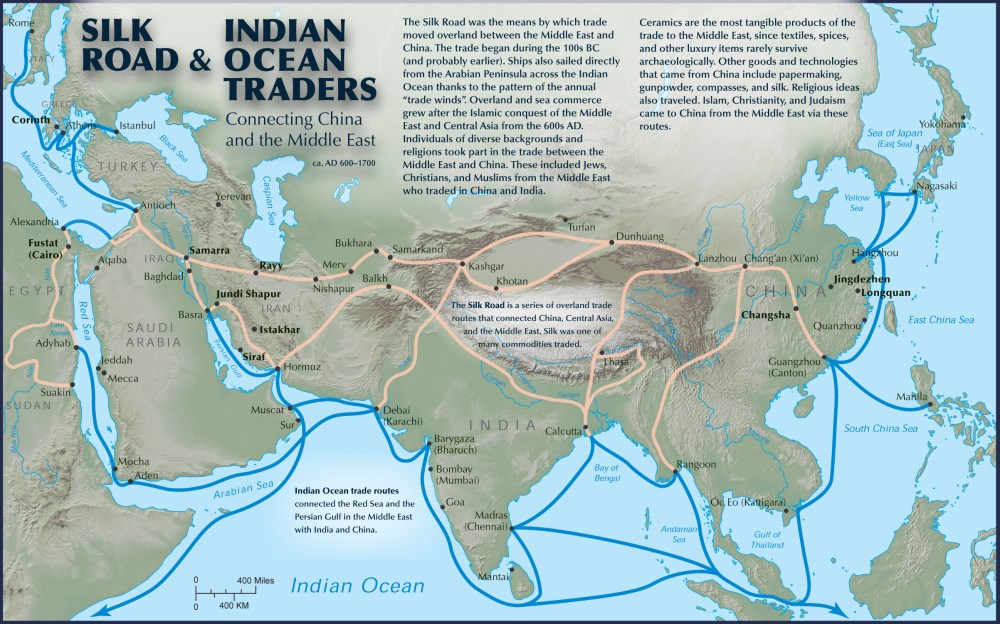
Globalization gave us the apple. Researchers have done a genetic analysis of the modern apple and traced its origins back to the Tian Shan (Heavenly) Mountains in modern-day Kazakhstan. According to the report in Nature Communcation:
“Cultivated apple (Malus domestica Borkh.), one of the most widely produced and economically important fruit crops in temperate regions, has been domesticated from M. sieversii in the Tian Shan Mountains for 4000–10,000 years, and dispersed from Central Asia to West Europe along the Silk Road, allowing hybridization and introgression of wild crabapples from Siberia (M. baccata (L.) Borkh.), Caucasus (M. orientalis Uglitz.), and Europe (M. sylvestris Mill.)”
Scuffles have broken out between Indian and Chinese troops along their disputed border near Kashmir. The video, broadcast by India’s NDTV, shows Indian and Chinese troops throwing stones and punches at each other near Pangong Lake in Ladakh. This incident is far from the Doklam region which has also seen tensions rise between India and China over Chinese road building near Bhutan. There is little question that India and China are having a very difficult time adjusting to each other’s rise in the region and the world. The volatility in South Asian international politics seems to be increasing quite dramatically.
A group of countries calling itself the Lima Group, consisting of 12 Latin American states plus the US and Canada, condemned the Venezuelan Constituent Assembly as an illegitimate usurpation of power by the government of Nicolas Maduro. The Constituent Assembly has taken on the powers of the Venezuelan Congress which is controlled by opposition parties and there is no part of the government in which the opposition has any effective voice. The Maduro government immediately attacked the Lima Group declaration as an illegal intrusion into the internal affairs of Venezuela. The international community is going to have to speak effectively to force the Venezuelan government to allow opposition voices, but it must be careful not to give Maduro any excuse to tighten his control any further.
The election of Emmanuel Macron three months ago was hailed as a new phase of French politics, as all the traditional political parties were trounced by Macron and his relatively new political party, République En Marche. The bloom has faded quickly from that rose as Macron’s popularity has fallen precipitously. There are a variety of theories about Macron’s fall from grace, but the more important issue is how difficult it has become for effective governance in today’s political climate. The level of citizen dissatisfaction all over the world seems to have reached levels that defy normal politics. Where that leaves us all is completely unknown.
The US has initiated an investigation into Chinese trade practices using Section 301 of the Trade Act of 1974. The move is significant because that section has rarely been used since the World Trade Organization was created in 1995 and most trade disputes now are handled through that organization. Section 301 bypasses the WTO and allows the US to unilaterally impose sanctions if trade violations are determined. THe investigation will be on Chinese protections of international property rights, a very contentious issue in US-Chinese trade. Almost certainly the Chinese will respond and we may be witnessing the opening of a trade war. Such a war would be truly unfortunate since the US benefits tremendously from trade with China.
Cambridge University Press has removed Chinese access to certain articles from its prestigious journal, China Quarterly, at the request of the Chinese government. Articles that deal with materials the Chinese government regards as sensitive, such as references to the protests in Tiananmen Square in 1989, are no longer available to Chinese citizens. In addition, the press has blocked access to many books. The moves come in response to Chinese President Xi’s decision that all media in China must be consistent with the doctrines of the Communist Party. The decision reflects the determination to resist the freedoms necessary for a liberal society.
Stephen Metcalf has written an essay on the meaning of the word “neoliberalism”. We see the word everywhere and it is used as a pejorative as well as an indisputable truth. Metcalf’s short definition is borrowed from the IMF and he takes to to describe policies that mandate deregulation, opening national markets to trade and capital, and for governments to shrink themselves via austerity or privatization. It is, according to Metcalf, an ideology that holds “that competition is the only legitimate organising principle for human activity.” My favorite passage in the essay is his description of Adam Smith, who would absolutely shudder in disgust at how market capitalism has been perverted by “free market” advocates (“Who is John Galt?”):
“Adam Smith’s “invisible hand” had already given us the modern conception of the market: as an autonomous sphere of human activity and therefore, potentially, a valid object of scientific knowledge. But Smith was, until the end of his life, an 18th-century moralist. He thought the market could be justified only in light of individual virtue, and he was anxious that a society governed by nothing but transactional self-interest was no society at all. Neoliberalism is Adam Smith without the anxiety.”
I highly recommend the essay for those who wish to understand more about this ideology.
US President Trump has repeated a story about US General Pershing in the US-Philippines War (the second part of the Spanish-American War which started in 1898). After the defeat of the Spanish in the Philippines, the US took control of the archipelago. There was fierce resistance from many Filipinos who had hoped for independence and there was an initial phase of the US-Philippines war in which the US put down the “rebellion”. Filipinos had declared their independence on 12 June 1898 but the US did not recognize it as an independent state. The leader of the new republic was Emilio Aguinaldo and he waged a guerrilla war against the Americans which end on 23 March 1901 after the US captured Aguinaldo. The second part of the US-Philippines war lasted from 1901-1913 when Muslims in the southern part of the Philippines resisted American control in what the US calls the Moro Rebellion. It is in this phase that General Pershing took control.
President Trump has asserted that Pershing dipped bullets in pigs blood and executed Muslim prisoners with these bullets. Contact with pigs is forbidden to Muslims and President Trump asserted that Pershing’s tactics effectively ended the rebellion. The story is categorically false and there is no evidence that Pershing ever engaged in such a horrific tactic. There is little question that the repression of the Moros was brutal and conducted by many American soldiers whose only experience was in repressing the Native American peoples in horrific ways. But President Trump’s story is false. Moreover, it is deeply troubling to hear an American President endorse the execution of prisoners of war, an unquestioned war crime.
Pershing in 1903
Venezuela’s newly elected Constituent Assembly has taken over the powers reserved for the elected Congress. The move effectively puts President Maduro in control of all three branches of government and he is free to rule as a complete dictator with no legal opposition. Maduro has thus finalized his coup d’etat and there is no peaceful or civil mechanism to check his power. The situation in Venezuela is dire with desperate shortages of food and medicine. It is very difficult to see a way out for the Venezuelan people other than an open rebellion, either violent or non-violent.
The US-North Korean stand-off seems to have relaxed a bit, but the US and South Korea are scheduled to begin their annual military exercise on Monday. These exercises have always been a serious bone of contention and the North Koreans invariably respond in some way to their perceived threat. It is difficult to see negotiations between the US and North Korea anytime soon, but the parameters of such negotiations are well-articulated by Lee Jong-Wha. The necessary element for productive talks is a promise by the US that it is committed to the denuclearization of the entire Korean peninsula and that China need not be concerned about a possible change in regime in North Korea.
Alex Chow, Nathan Law, and Joshua Wong, three of the young leaders of Hong Kong’s “Umbrella” protest movement in September 2014, were sentenced to jail for their part in inciting an “illegal assembly”. They had been convicted earlier for their participation, but the Hong Kong court did not impose imprisonment. That decision was regarded as “too lenient” by the chief prosecutor and he ordered imprisonment. The Umbrella Movement was a protest against the intervention of the central government in Beijing in the affairs of Hong Kong. Although Hong Kong is part of China, certain freedoms were guaranteed to the people of Hong Kong for 50 years after the British turned over the city to China in 1997 under the principle of “one country, two systems“.
The Three Leaders: Joshua Wong, Nathan Law and Alex Chow
The stand-off between India and China over the Doklam region continues and seems to be getting perilously close to open conflict. The tension has been aggravated over the last few months because of disagreements between the two on China’s “One Belt, One Road” program which India regards as intrusive on Indian economic and strategic interests, over India’s support for the Dalai Lama, and China’s refusal to allow India to join the Nuclear Suppliers Group. Apparently Chinese and Indian patrols all along the very extensive shared border have been exchanging blows with each other.
John Davison has written an interesting article for Reuterswhich I have not been able to confirm in other media sources but which rings of an unsettling truth. Davison writes that the US military forces will likely stay in northern Syria for many years. The US is building military bases in the region and it is unlikely to simply leave them once built. But more importantly, even after Daesh (the Islamic State) is pushed out of the area, the region will still be unsettled as the Kurds, the Syrians, and the Turks sort out some arrangements for the future. Given all the blood that has been spilled in the region, all these groups believe that they have earned a say in controlling the territory and it is unlikely that they will agree.
“About eight-in-ten U.S. Muslims (82%) say they are either very (66%) or somewhat concerned (16%) about extremism committed in the name of Islam around the world, about the same as the share of the general public that feels this way (83%).”
The poll should put to rest the ignorant belief that Islam is not compatible with the American system. One hopes that these results would be broadly shared by the American media.
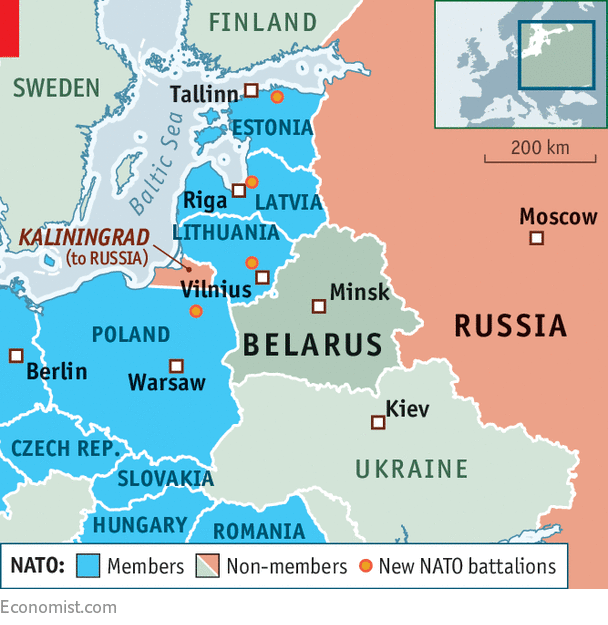
Every four years in September the Russian military conducts a massive military exercise code-named Zapad (“West”). Experts will be closely watching this year’s exercise since it is the first since the Russian annexation of Crimea and its infiltration of eastern Ukraine. Earlier Zapads had been used as a cover for real military actions by Russia in Georgia and in Ukraine, and many are concerned that this year’s exercise will be used to bring Russian pressure on Belarus. Belarus is a former Soviet Republic and is officially an ally of Russia, but it has tried to remain somewhat neutral in the frosty relations between Russia and the West. Given the recent very tense relations between Russia and NATO, the prospect of perhaps as many as 100,000 Russian soldiers actively engaged so close to NATO members is quite unnerving.
The Venezuelan government is pursuing legislation which would bar opposition candidates from running in elections if they were found to have participated in any of the violent anti-government protests earlier this year. It is also considering a new law that would punish people who express “hate or intolerance” with up to 25 years in prison. Elections are scheduled for October, but all the evidence suggests that the newly “elected” constituent assembly will allow any results that compromise the ability of the government to maintain its authoritarian control.
The US-North Korean dispute has a very strange twist. If a conflict were to break out over a perceived North Korean attack or threat to the American homeland, at least the initial phases of the conflict would likely be fought on South Korean soil. As US Senator Lindsey Graham (R-SC) was quoted as saying on NBC News:
“‘If there’s going to be a war to stop [Kim Jong Un], it will be over there. If thousands die, they’re going to die over there. They’re not going to die here. And He (sic) [US President Donald Trump] has told me that to my face,’ Graham said.
“‘And that may be provocative, but not really. When you’re president of the United States, where does your allegiance lie? To the people of the United States,’ the senator said.”
The question is what voice does South Korea have on this matter? Is it true that the US could make a decision that leads to the death of millions of South Koreans without the active consent of the South Korean government? The answer is, apparently, yes. At the beginning of the Korean War (which has not officially ended since there never has been a peace treaty between North and South Korea), a decision was made to place operational control of both South Korean and American troops in South Korea in the hands of the US. At the time, these forces were operating under the authority of the United Nations, and many states participated under that authority (South Korea, the US, United Kingdom, Thailand, Canada, Turkey, Australia, Philippines, New Zealand, Ethiopia, Greece, France, Colombia, Belgium, South Africa, Belgium, and the Netherlands).
Subsequently, in 1978 a joint committee was formed, the Republic of Korea – United States Combined Forces Command (CFC). The Commander of the CFC is American and the Deputy Commander is South Korean. There was a decision made to transfer complete operational control of all South Korean forces to a single South Korean command no later than 2012, but that transfer has yet to be effectuated. So the US does have the theoretical ability to make a unilateral decision about the use of military force in South Korea.
“War must never break out again on the Korean Peninsula. Only the Republic of Korea can make the decision for military action on the Korean Peninsula. Without the consent of the Republic of Korea, no country can determine to take military action. The Government will do all it can to prevent a war from breaking out. No matter what twists and turns we undergo, the North Korean nuclear problem must be addressed in a peaceful manner. In this regard, my Administration`s position is not different from that of the U.S. Government.”
He went on to talk about the conditions for negotiations with North Korea:
“The resolution of the North Korean nuclear issue has to start with a nuclear freeze. When the North at least stops additional nuclear testing and missile provocations, the conditions for dialogue can be created. The purpose of enhanced sanctions and pressure against the North is not to heighten military tensions but to bring it back to the negotiating table. In this regard, the position of the Korean Government is not different from that of the U.S. Government.”
Filip Novokmet (Paris School of Economics), Thomas Piketty (Paris School of Economics), and Gabriel Zucman (UC Berkeley and NBER) have published a fascinating paper, “From Soviets to Oligarchs: Inequality and Property in Russia 1905-2016″. The paper documents what many of us have believed but could never find the evidence to support the belief. The paper finds that ” Russian living standards were about 60-65% of the Western European average in 1989-1990, and reached about 70-75% by the mid-2010s.” In terms of income and wealth inequality, the authors found that the relative equality of both under the Soviet regime has changed substantially after the collapse of the Soviet regime in 1991 and that inequality in Russia is now roughly comparable to other rich countries. According to the abstract: ” According to our benchmark estimates, top income shares are now similar to (or higher than) the levels observed in the United States. We also find that inequality has increased substantially more in Russia than in China and other ex-communist countries in Eastern Europe. We relate this finding to the specific transition strategy followed in Russia. According to our benchmark estimates, the wealth held offshore by rich Russians is about three times larger than official net foreign reserves, and is comparable in magnitude to total household financial assets held in Russia.” Finally, the authors make an interesting political observation about the phenomenon in Russia today:
“In effect, extreme inequality seems acceptable in Russia, as long as billionaires and oligarchs appear to be loyal to the Russian state and perceived national interests. Whether this fragile equilibrium will persist in the coming years and decades remains to be seen.”
Happy Birthday, Pakistan!!! Seventy years ago the British ended its colonization of India and two new states emerged: India and Pakistan. The partition of the former colony into two new states was not an easy one. For some, the partition was a way to create a Muslim state called Pakistan on 14 August 1947 in order to give stability and order to those individuals who believed that the overwhelming Hindu composition of India could not be comfortable for Muslim citizens. So a great migration (the largest migration in human history–17 million people) occurred with huge numbers of people moving into what they believed to be a Muslim Pakistan or a Hindu India. Both states retain secular constitutions, although revisions to Pakistan’s constitution made during the rule of General Zia-ul Haq in the 1970s brought the laws into closer conformity with Islamic tradition.
Also, on this day in 1941 US President Franklin Roosevelt met with British Prime Minister Winston Churchill on the USS Augusta just off the coast of Newfoundland, Canada. Together they drafted what came to be known as the Atlantic Charter which outlined the objectives of what would become an alliance against Nazi Germany. The British were locked in the Battle of Britain as the Germans tried to knock off the last liberal state in Europe, and the British were facing a possible defeat. The US had officially stayed out of the war (and would not enter it until the Japanese attack on Pearl Harbor on 7 December 1941) but Roosevelt was strongly in favor of supporting the British and entering the war. The Atlantic Charter was first to use the phrase “United Nations” which ultimately came into being in 1944.
On 13 August 1521, the capital of the Aztec Empire, Tenochtitlán, fell after a three-month siege by Hernán Cortés and his local allies, the Tlaxcaltec. The city was founded in 1325 CE and by 1502 it reached the height of power in central Mexico under the rule of Montezuma II. The Aztec Empire was sophisticated and complex, but ultimately it was unable to resist the military power of the Spanish which was underpinned by gunpowder. Subsequently, Bartolomé de Las Casas wrote many tracts on how the Spanish had destroyed the indigenous culture of Mexico, culminating in his Short Account of the Destruction of the Indies which was written in 1542 and published in 1552.
Artist Rendering of Tenochtitlán as It Might Have Appeared in 1521
Only a fool would try to predict the next steps in the US-North Korean crisis–both leaders are deliberately unpredictable and incredibly loose with their pronouncements. But we do have some sort of a timeline. North Korea has given 15 August as the day it will launch missiles toward the island of Guam. We do not know how close the missiles will land, what type of missiles they might be, and whether they will even be armed. The US and South Korea are also scheduled to hold joint military exercises on 21 August, and those activities are always considered highly provocative by North Korea. One point, however, is certain. The US and North Korea have fought before in the Korean War, 1950-53. That war ended in an armistice, not a peace treaty, so the war has never officially ended. Bruce Cumings is the author of the authoritative book in the English language on the Korean War, and he has written a short essay on the current situation. North Korea is no stranger to the “fire and fury” of the US military.
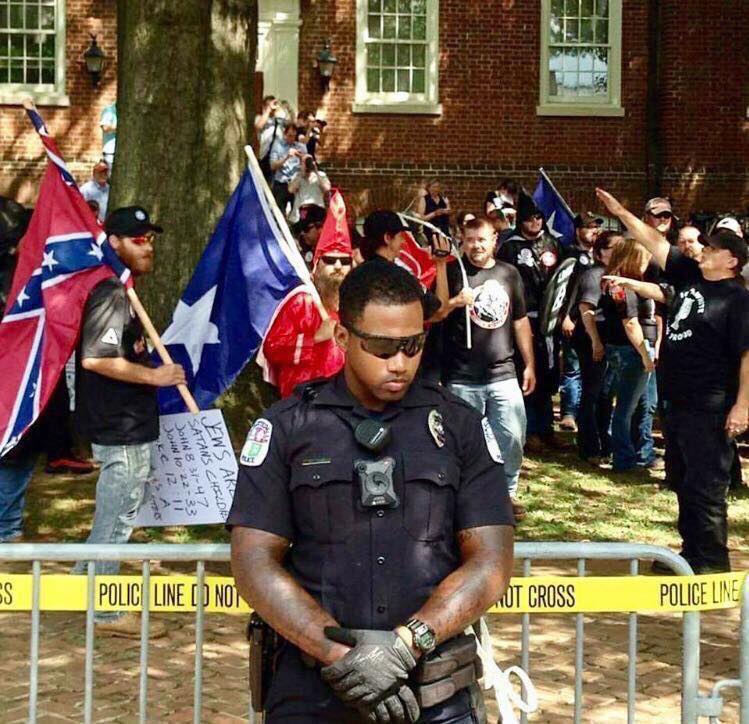
I count the recent days in Charlottesville, Virginia as some of the saddest days of my life. White supremacists and neo-nazis have always been part of the American social and political fabric throughout my life, but they were always in the background, kept there by the vast majority of decent citizens who held their views abhorrent and repugnant. These groups apparently believe that they now have the backing of significant elements within the US political system and have decided that they can now emerge from the shadows. I do not doubt that they will be forced back, but I am overwhelmed by the knowledge that old battles have to be refought. There was, however, one photograph from the violence in Virginia that gave me great hope and inspiration. An African-American police officer was so committed to the ideals of the Constitution that he upheld the right of people to state their views, even though those views were personally destructive to him. That police officer is a person of great courage, dedication, and embodies the greatest aspirations of the America that I hope will someday be fully realized.
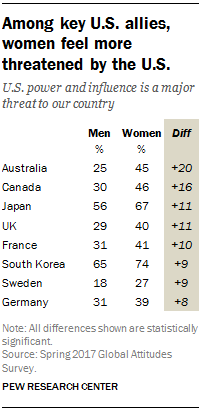
Some of the increased threat perception occurred in reliable US allies:
“Just in the past year, perceptions of the U.S. as a major threat have increased by at least 8 percentage points among several long-standing American allies, including Australia (13 points) and the UK (11 points). Concern about U.S. power is up 10 points in Canada, Germany and Sweden, and 8 points in France and the Netherlands.”
There is also a striking difference in the threat perceptions of women as opposed to men as the chart below indicates.
At least 24 people have died in post-election violence in Kenya. The official results gave Uhuru Kenyatta, the current President, 54.3% of the votes, but his opponent, Raila Odinga, called the election a charade. As of now, the violence does not seem to be as widespread as it was after a contested election in 2007, but the opposition party does not intend to contest the election in courts, believing that there could not be a fair trial. A lot now depends on whether Kenyatta can take action to alleviate the fears of his opponents.
Russian President Putin expelled 755 people associated with the US diplomatic staff in Russia in retaliation for the new sanctions imposed on his country by the US. Not all these individuals are Americans–they include support staff at the embassy and consulates who are Russian. But the expulsion of diplomats is a very serious matter. Yesterday, President Trump thanked Putin for the expulsions, explaining that the move would “save a lot of money”. It is impossible to describe what a slap in the face that comment was to the entire State Department. It is also hard to explain why a person who was entrusted to defend his citizens would thank anyone who just expressed great contempt for them.