Researchers have published a paper in the journal World Development that attempts to quantify the amount of money used to subsidize the production of fossil fuels. The subsidies come through various tax mechanisms and other government policies that create incentives to produce fossil fuels. The Guardian does a very good job ofoutlining the expansive definition of subsidies used by the researchers, many of which are totally hidden from the eyes of consumers of fossil fuels. The subsidies globally come to about $5.3 trillion in 2015 or about 6.5% of global GDP. According o the summary of the article:
“Undercharging for global warming accounts for 22% of the subsidy in 2013, air pollution 46%, broader vehicle externalities 13%, supply costs 11%, and general consumer taxes 8%. China was the biggest subsidizer in 2013 ($1.8 trillion), followed by the United States ($0.6 trillion), and Russia, the European Union, and India (each with about $0.3 trillion). Eliminating subsidies would have reduced global carbon emissions in 2013 by 21% and fossil fuel air pollution deaths 55%, while raising revenue of 4%, and social welfare by 2.2%, of global GDP.”
If all these subsidies were taken into account, we could more accurately compare the costs of renewable energies which are often heavily subsidized as well.
US President Trump indicated that there is a “military option” among those available to the US with respect to the constitutional crisis in Venezuela. Presumably, the President believes that there may be an effective role for the American military in the event a civil war breaks out in Venezuela. What that option might be is beyond me. What intervening in Venezuela has to do with “America First” is also beyond me. An American intervention in a Latin American civil war would in all probability make the situation significantly worse. If there is a humanitarian crisis and civilians need to be evacuated, there are other regional militaries that would be less intrusive.
A meeting between top military representatives from India and China to resolve the stand-off over the border dispute near Bhutan ended inconclusively. India is sending more troops along its entire eastern border. According to the Times of India:
“The Army has steadily but stealthily moved troops to their “operational alert areas” on the borders with China in Sikkim and Arunachal Pradesh, while also maintaining high operational readiness of its other formations and units all along the 4,057-km long Line of Actual Control stretching from Ladakh to Arunachal, as was reported by TOI earlier.”
In a move that I find inexplicable, the US has sent a destroyer (the USS John McCain–I kid you not) into the South China Sea within the 12-mile limit of a Chinese facility near Mischief Reef (again, I kid you not). This is the third time the Trump Administration has tested the right of freedom of navigation in the South China Sea, and the US has international law on its side. But testing the Chinese at a time when the US is complaining that China is not doing enough to restrain the North Korean nuclear program makes no sense at all. Moreover, the US move comes at a time when the Association of Southeast Asian Nations (ASEAN) has made the first tentative steps to reach an accommodation with China over the South China Sea (see the post of 6 August), a move that makes even less sense. China seems to be losing patience with both the US and North Korea, but it is clearly biased in favor of no changes in the status quo on the Korean peninsula. An editorial in Global Times, often a conduit for the official Communist Party position makes this position clearly:
“Beijing is not able to persuade Washington or Pyongyang to back down at this time. It needs to make clear its stance to all sides and make them understand that when their actions jeopardize China’s interests, China will respond with a firm hand.
“China should also make clear that if North Korea launches missiles that threaten US soil first and the US retaliates, China will stay neutral. If the US and South Korea carry out strikes and try to overthrow the North Korean regime and change the political pattern of the Korean Peninsula, China will prevent them from doing so.”
Note the conditions concerning US and South Korean actions: 1) carry out strikes; 2) try to overthrow the North Korean regime; and 3) change the political pattern of the Korean peninsula. There appears to be a degree of ambiguity about what the Chinese will and will not permit.
38 North is a website devoted to information about North Korea (its title refers to the 38th parallel–the boundary established between North and South Korea). It is a publication of the US-Korea Institute at the School of Advanced International Studies at the Johns Hopkins University and it is by far one of the most reliable sources of information about North Korea. One of its recent posts has to do with how the media translates Korean and often misses the nuances of the language. North Korean Foreign Minister Ri Yong Ho gave a speech at the recent Association of Southeast Asian Nations (ASEAN) and the pertinent parts of his speech were translated in this way:
“We will, under no circumstances, put the nukes and ballistic rockets on the negotiating table. Neither shall we flinch even an inch from the road to bolstering up the nuclear forces chosen by ourselves, unless the hostile policy and nuclear threat of the U.S. against the D.P.R.K. are fundamentally eliminated.”
38 North offers a different translation of that part of the speech which is far less categorical:
“Unless the hostile policy and nuclear threat of the U.S. against the D.P.R.K. are fundamentally eliminated, we, under no circumstances, will put the nukes and ballistic rockets on the negotiating table and will not flinch even an inch away from our path of strengthening of the nuclear forces, which is chosen by ourselves.”
It is extraordinary that the differences are so stark. 38 North argues that the second translation is more consistent with previous statements made by North Korea. In diplomacy, intelligent statespeople will choose the interpretation that offers more opportunity for negotiation. In the Cuban Missile Crisis, US President Kennedy received two very different messages from Soviet leader Khrushchev. He chose to conduct the negotiations on the basis of the more benign message and Khrushchev did not object. The strategy actually earned a catchphrase: it was know as the “Trollope Ploy” after a “plot device by nineteenth-century British novelist Anthony Trollope, in which a woman interprets a casual romantic gesture, such as squeezing her hand, as a marriage proposal”.
Kenya held national elections on Tuesday, pitting the current President, Uhuru Kenyatta, against his opponent, Raila Odinga. The same candidates ran against each other in the election of 2013 which Kenyatta won despite being under indictment by the International Criminal Court for his role in the violence of an earlier election in 2007. May Alam, another Mount Holyoke alumna who has also become a noted analyst in international affairs, has written a superb background to the election, emphasizing the importance of the election to the country and the region. Initial results have given 54% of the vote to Kenyatta, but Odinga has claimed fraud. There are reports of sporadic violence in the country, but information has been spotty. This election is critical to the future of one of the most important countries in Africa and we should monitor events as they unfold.
Polling Station in Kenya
US President Trump and members of his administration have issued several statements about the North Korean nuclear weapons program. US intelligence has apparently determined that North Korea had developed the ability to miniaturize a nuclear bomb so that it could be fitted onto a intercontinental ballistic missile. This information, along with the two tests of ICBMs earlier this month, led President Trump to issue a warning to North Korea:
“‘He’—Kim Jong-un, the North Korean leader—’has been very threatening beyond a normal statement,’ Trump went on. ‘And as I said, they will be met with the fire and fury and, frankly, power, the likes of which this world has never seen before. Thank you.'”
This language is unusual in a crisis. Typically, leaders attempt to manage a crisis carefully and thus avoid language that could be perceived as inflammatory and contribute to an escalation of the crisis. Indeed, hours later, US Secretary of State Rex Tillerson issued such a tempered message, as described by The Army Times:
“’What the president is doing is sending a strong message to North Korea in language that Kim Jong Un can understand, because he doesn’t seem to understand diplomatic language,’” Tillerson said. “’I think the president just wanted to be clear to the North Korean regime on the U.S. unquestionable ability to defend itself.’” He said the U.S. “’will defend itself and its allies.’
“The comments put Tillerson once again in the role of translating the president’s aggressive rhetoric into more diplomatic terms, and of working to minimize the chances of public panic. In fact, Tillerson argued that North Korea’s escalating threats indicated it was feeling the pressure from a successful U.S. strategy.”
“The United States and our allies have the demonstrated capabilities and unquestionable commitment to defend ourselves from an attack. Kim Jong Un should take heed of the United Nations Security Council’s unified voice, and statements from governments the world over, who agree the DPRK poses a threat to global security and stability. The DPRK must choose to stop isolating itself and stand down its pursuit of nuclear weapons. The DPRK should cease any consideration of actions that would lead to the end of its regime and the destruction of its people.
“President Trump was informed of the growing threat last December and on taking office his first orders to me emphasized the readiness of our ballistic missile defense and nuclear deterrent forces. While our State Department is making every effort to resolve this global threat through diplomatic means, it must be noted that the combined allied militaries now possess the most precise, rehearsed and robust defensive and offensive capabilities on Earth. The DPRK regime’s actions will continue to be grossly overmatched by ours and would lose any arms race or conflict it initiates.”
The rhetoric is not consistent. The inconsistency may be deliberate. There are those who believe that the Administration is following a “Madman Theory” of diplomacy, a reference to a ploy used by President Nixon in bargaining with North Vietnam during the peace negotiations. Nixon instructed his National Security Adviser, Henry Kissinger, to warn the North Vietnamese that Nixon was “out of control” and might amplify the bombing of North Vietnam if progress was not made in the peace negotiations. Those threats also included a nuclear alert that was intended to send a message to the Soviet Union to stop supporting North Vietnamese intransigence.
If the Trump Administration is following the Madman Theory then it should also know that Nixon’s ploy failed. It failed because North Vietnam was more committed to its policy than the US was to its policy–North Vietnam was willing to suffer more damage than the US was willing–not capable, but willing–to inflict. Thus, the question is whether North Korea is more committed than the US is on the issue of North Korea’s nuclear program.
The US could probably overthrow the North Korean regime if it decided to bring the full force of its military power to bear. I hesitate to accept that outcome as quickly as others appear to be. There is considerable evidence that regimes are far more durable than most Americans assume. It took time for the US to overthrow Hussein in Iraq in 2003, it has failed to overthrow Assad in Syria, it was unable to even find Osama bin Laden for almost 9 years. Military power failed to achieve objectives in Iraq, Afghanistan, and Cuba.
But the costs of that effort would be very high for American allies, particularly South Korea and Japan. The US is concerned that North Korea could potentially hit the American homeland with nuclear weapons at some point in the future; North Korea already has the ability to do so with South Korea and Japan. If the US attacked North Korea with its full might, then there is nothing that the US could do to stop an attack upon its allies. The missile defense systems already deployed in those countries are touted as eminently reliable. They have never been tested in combat and just one failure of those systems would be catastrophic. Moreover, North Korea would not even need to use nuclear weapons to attack South Korea. It has substantial conventional weaponry to inflict serious damage on the South Korean population. According to Secretary Mattis in an interview with Meet the Press:
“A conflict in North Korea, John, would be probably the worst kind of fighting in most people’s lifetimes. Why do I say this? The North Korean regime has hundreds of artillery cannons and rocket launchers within range of one of the most densely populated cities on earth, which is the capital of South Korea.”
So the real question for the US is: how many non-American lives is it willing to sacrifice? The answer to that question is probably not very many unless North Korea struck first.
The other side of the calculation is how committed North Korea is to its nuclear program? Why does it refuse to even put the issue of its nuclear capabilities on the negotiating table?
There is little question that North Korea believes that nuclear weapons are its only defense against an American invasion. Most Americans do not take this matter seriously enough because few Americans believe that the US intends to overthrow the Kim Jong-un regime. However, analysts need to shed such preconceptions in order to understand the situation more clearly.
First, it is interesting that most Americans do not take the rhetoric of their government seriously. The rhetoric about North Korea has been unremittingly hostile since the onset of the Korean War in 1950. There is little to commend about the way North Korea is governed and its human rights abuses are despicable. But North Korea was not, until very recently, a strategic threat to the US. North Korea has witnessed the US overthrow of governments in Iran (1953), Guatemala (1954), the Dominican Republic (1961), and Cuba (1961) as well as numerous interventions in the internal affairs of other states such as the Congo in 1960 and Chile in 1973.
Second, North Korea refers to two historical examples of nations where the regime was overthrown by the US and attributes those overthrows to the absence of nuclear capabilities: Libya and Iraq.
Iraq was on the “axis of evil” along with Iran and North Korea. The phrase was coined by US President George W. Bush in 2002 after the attacks on the US on 11 September 2001. In March 2003, Iraq was invaded by the US ostensibly to eliminate weapons of mass destruction and the regime of Saddam Hussein was overthrown and he was subsequently hung. North Korea withdrew from the Non-Proliferation Treaty in 2003 after the invasion of Iraq. The implication was clear: North Korea believed that if Iraq had had a nuclear capability, the US would not have invaded it. North Korea was not going to run the risk.
In December of 2003, Libya renounced its nuclear program, induced to do so by promises from Great Britain and the US that they would cease efforts to overthrow the regime of Muammar Gaddaffi. However, in 2011, amid the turmoil of the Arab Spring, the US and its NATO allies bombed Libya and targeted Gaddaffi’s locations with aerial bombardment. Ultimately, Gaddaffi was overthrown and murdered in the streets. Again, the North Koreans believed that Gaddaffi would not have been overthrown if he had had nuclear weapons.
We characterize North Korea as “irrational”. However, it has clearly chosen a very risky strategy that it believes is its only defense against an American invasion. And, so far, that strategy has worked.
On this day in 1995, Jerome John “Jerry” Garcia died. Peace out, Jerry.
Every four years, 13 US Federal agencies are required to submit what is known as the National Climate Assessment. The previous three reports have indicated that climate change has occurred and that human activity is partially responsible for the change. Copies of the 4th report are currently being circulated and there were many scientists who were concerned that the US Environmental Protection Agency, which is currently under the direction of Scott Pruitt who has expressed doubts about climate change, would water down the report in line with the doubts expressed by many within the Trump Administration. Last March Pruitt made this statement to CNBC:
‘”I think that measuring with precision human activity on the climate is something very challenging to do and there’s tremendous disagreement about the degree of impact, so no, I would not agree that it’s a primary contributor to the global warming that we see.”
“China will not allow the military standoff between China and India in Doklam to last for too long, and there may be a small-scale military operation to expel Indian troops within two weeks, Chinese experts said after six ministries and institutions made remarks on the incident within the past 24 hours.”
Setting a deadline is risky business in world politics. It makes it very difficult for both sides to back down.
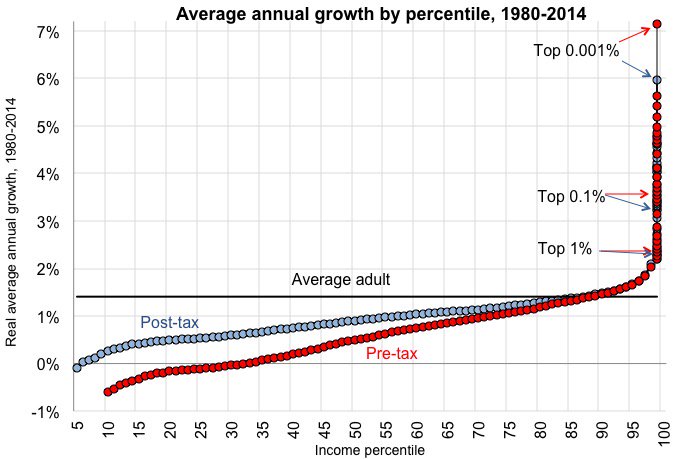
Income inequality is perhaps the second-most important issue facing the world (after climate change), but it is only recently that it has become rigorously studied. The pioneering work of Thomas Piketty (Paris School of Economics), Emmanuel Saez (UC Berkeley and NBER), and Gabriel Zucman (UC Berkeley and NBER) involved some incredibly detailed analyses of inequality in the US and the conclusions of those studies are uniformly grim. Since the 1980s, the vast majority of citizens in the US have seen their incomes stagnate and the bulk of income growth has gone to a remarkably small number of people. Their most recent paper, released in July, reinforces this conclusion. David Leonhardt has written an op-ed for the New York Times which summarizes the conclusions of the papers.
The distribution of economic growth in the United States
Gabrielle Rifkind of the Oxford Research Group has written one of the most intelligent analyses of the situation with North Korea and the best ways to resolve the crisis. The analysis should be required reading for all the leaders of the states on the UN Security Council. Additional sanctions without understanding North Korea’s motivations will only be counterproductive.
The United Nations Security Council unanimously passed UNSCR 2371, a resolution imposing additional sanctions on North Korea for its recent launching of two intercontinental ballistic missiles (ICBMs). The new sanctions include:
Expand the existing sanctions on North Korea’s economy to include a full ban on the export of coal, iron, iron ore, seafood, lead and lead ore;
Expand the list of designated entities and individuals by adding four entities and nine individuals;
Expand sanctions on joint ventures and commercial cooperation with North Korea; and,
Prohibit countries from allowing additional North Korean laborers into their territories.
These sanctions will definitely hurt the economy of North Korea and it is notable that both Russia and China voted in favor of the sanctions. But the real stumbling block to resolving this issue is the insistence of the Trump Administration that North Korea agree to abandon its nuclear program. North Korea firmly believes that its program is the only thing preventing a US invasion and will never give up its nukes. The US needs to initiate concessions, such as halting its joint military exercises with South Korea if it sincerely wishes to begin negotiations.
Joint Security Area of the Demilitarized Zone Between North and South Korea
NBC NewsUS is considering airstrikes against is reporting that the Daesh (the Islamic State) in the Philippines. The strikes would most likely be carried out by drones, but if they occur, would constitute a serious commitment to the government of President Duterte, a leader who has been accused of 1,400 extra-judicial killings by various human rights organizations. The decision reflects the relative priorities of the US: security interests outweigh the issue of human rights.
Progress is one of the most important values in a liberal society. For some societies, stability and tradition are more important; for other societies, faith in an after-life is more important. But liberal society promises a better future for one’s children and that future is measured in material terms. It is a difficult value to measure, but some aspects of a better future seem to be pretty simple. For example, artificial light makes life significantly easier (although for some it has ruined humanity’s appreciation for the normal rhythms of natural light). Guido Mingels has written a short essay on how the costs of producing light have come down over the years:
“One hour of light (referred to as the quantity of light shed by a 100 watt bulb in one hour) cost 3200 times as much in 1800 in England than it does today, amounting to 130 euros back then (or a little more than 150 dollars). In 1900, it still cost 4 euros (close to 5 dollars). In the year 2000, we arrived at a cost of 4 euro cents (5 U.S. cents).”
Today marks the 72nd anniversary of the dropping of the atomic bomb on the Japanese city of Hiroshima. The use of the atomic bomb marked the beginning of the end of traditional world politics, although few at the time realized its full significance. There are now nine nuclear states: the US, Russia, China, Great Britain, France, India, Pakistan, Israel, and North Korea. Fortunately, nuclear weapons have not been used in war since the end of World War II, but they remain a very active dynamic in world politics. Last month, 122 members of the United Nations passed a Treaty to ban nuclear weapons, but none of the nuclear armed states signed the Treaty. Intriguingly, Japan also refused to sign the Treaty.
“In Sunday’s video, a man who identified himself as Juan Carlos Caguaripano, a former National Guard captain, said: ‘We demand the immediate formation of a transition government.’ He was flanked by about a dozen men in military uniforms.
‘”This is not a coup d’etat,’ he said. ‘This is a civic and military action to re-establish constitutional order. But more than that, it is to save the country from total destruction.’
The uprising occurred after the newly elected constituent assembly, whose members were all hand-picked by the government of Nicolas Maduro, ousted Luisa Ortega, a prosecutor who has worked hard to control the government from breaking the law. There should be little doubt that Maduro will use the failed coup attempt to further crush opposition in the country.
European researchers have estimated that up to 152,000 people a year could die in Europe by the year 2100 if nothing is done to stop the process of climate change. The study assumes a rise in temperatures of 3°C by the end of the century, which is above the current targets of 2°C for the Paris Agreements, and also does not assume any steps to mitigate or adapt to the process of climate change. Thus, it is literally a “worst case” projection. However, it did not take into account the decision by the US to leave the Paris Agreement which may well render the Paris Agreement targets moot.
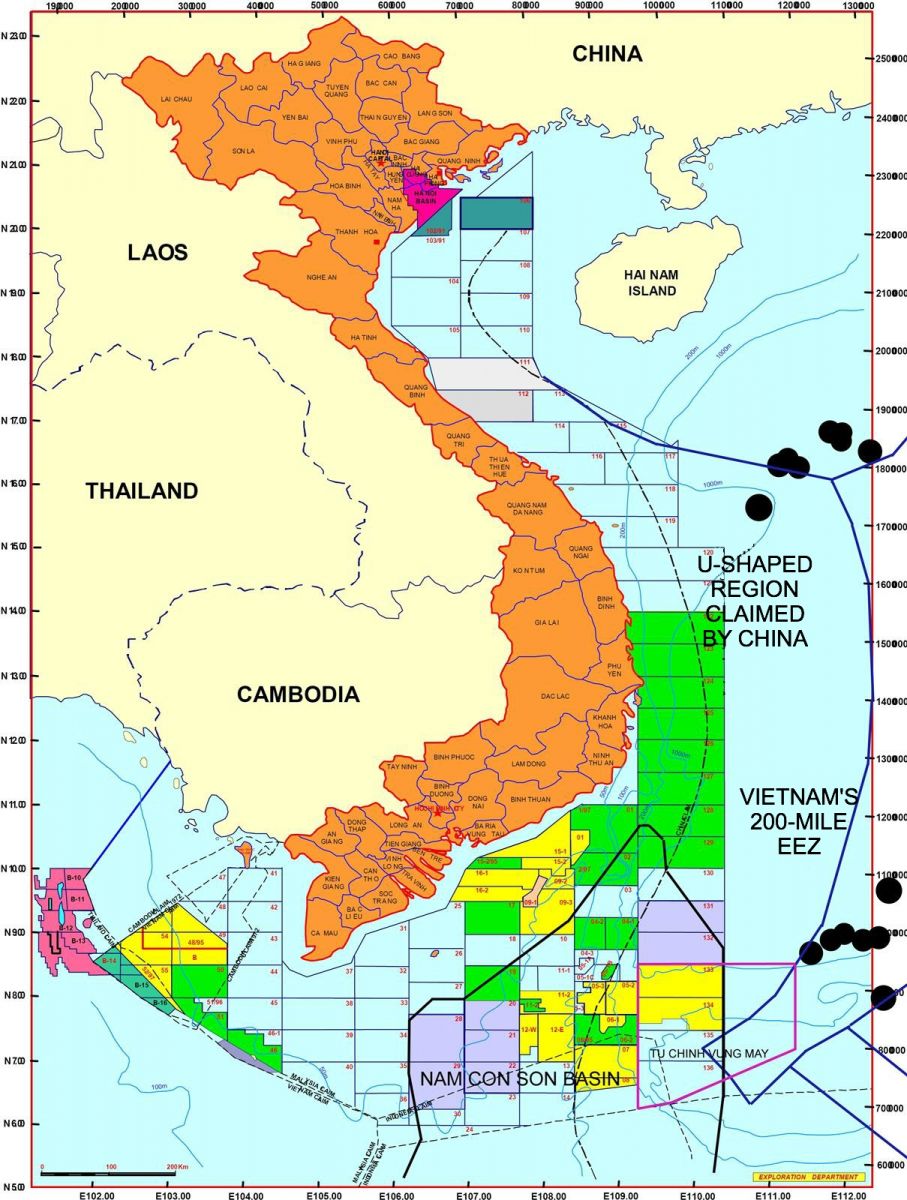
The situation in the South China Sea continues to evolve. Vietnam has recently stopped exploration of an oil and natural gas reservoir in the Sea, and there are suggestions that it did so because it believed that the US would not back up its claim. The strategic significance of the Sea rests on the value of world trade that passes through it. Virtually all the trade of East and Southeast Asia transits the sea, but China overwhelmingly depends on its ability to send and receive ocean-going vessels through key areas of the sea. Even if China were to control the entire South China Sea, it would still be dependent on access through some of these choke points (the Malacca, the Lombak, and the Sunda Straits) which are all controlled by other states. The Chinese are well aware of these vulnerabilities and they should be taken into account when assessing the threat posed by Chinese moves in the South China Sea.
“….68% say America’s openness to foreigners is a defining characteristic of the nation, while just 29% say ‘if America is too open to people from all over the world, we risk losing our identity as a nation.'”
There are differences among different age groups and different party affiliations, but those differences do not seem to account for the current discourse in American politics. The poll confirms an earlier poll taken by Pew last February on American attitudes toward ethnic and racial diversity.
The Pew Research Center has done a poll in 38 countries on which issues or nations represent the greatest security threats. Not surprisingly, the major concerns vary across different regions and different economic conditions. In many countries, the US is regarded as a greater security threat than some other countries. Generally speaking, countries with poorly performing economies tend to think that the condition of the global economy is a security threat. But the most striking finding is how many people in the world regard climate change a a major threat.
Researchers at the Finnish Meteorological Institute have made a graphic that illustrates global warming in the 20th century. The graphic clearly indicates that the phenomenon is truly global and not just a local phenomenon. The graphic also shows that the process of warming seems to be accelerating.
For those of us who regularly read and watch the news, The Economist has some dispiriting information. The news media apparently has little effect on how some citizens determine their political preferences. Indeed, among some constituencies, more would prefer shutting down or fining media outlets that broadcast stories that are “biased or inaccurate”. Freedom of the press is a cardinal value of a liberal society, but some of our colleagues do not regard that freedom as sacrosanct. And it does not appear that they are willing to entertain information that conflicts with their beliefs.
“The most frequently used indicator to compare recessions is GDP. According to the International Monetary Fund, Venezuela’s GDP in 2017 is 35% below 2013 levels, or 40% in per capita terms. That is a significantly sharper contraction than during the 1929-1933 Great Depression in the United States, when US GDP is estimated to have fallen 28%. It is slightly bigger than the decline in Russia (1990-1994), Cuba (1989-1993), and Albania (1989-1993), but smaller than that experienced by other former Soviet States at the time of transition, such as Georgia, Tajikistan, Azerbaijan, Armenia, and Ukraine, or war-torn countries such as Liberia (1993), Libya (2011), Rwanda (1994), Iran (1981), and, most recently, South Sudan.
“Put another way, Venezuela’s economic catastrophe dwarfs any in the history of the US, Western Europe, or the rest of Latin America.”
Poverty is so pervasive in the country that 74% of Venezuelans have involuntarily lost 19 pounds in weight, in-patient mortality in hospitals have increased ten-fold, and infant mortality in hospitals has increased 100-fold.
Cobalt is an indispensable mineral for many electronic devices and 60 percent of the world’s cobalt comes from the Democratic Republic of Congo. The miners who dig the cobalt from deep within the earth get paid very little for doing incredibly dangerous work. The Washington Post has an article on the conditions in the mines and it reports that the miners earn between $2 and $3 a day and that many of these miners are children. It is deeply disturbing that so much wealth is generated by cobalt and that such a small amount goes to the people who actually make it possible to use the mineral.
One of the more nettlesome issues in world politics is the discrepancy between nations and states. Nations self-identify–they are groups of people who believe that there is something distinctively different about their group that separates them from others. By this criterion, there are about 2,000 communities with populations greater than 100,000 which could qualify as nations. But there are only 194 states in the international system as determined by membership in the United Nations. Thus, the term “nation-state” is highly misleading. Even within nations there are disputes about what constitutes membership in the group. No where is this issue more interesting than in the case of the American nation: who belongs?
Democracy Now conducted a survey of voters in the 2016 election posing many questions to voters that touch on this question, and the survey yielded some fascinating results. There seems to be widespread and strong support for three criteria: 1) Respect for American political institutions and laws; 2) American citizenship; and 3) a willingness to accept diverse and religious backgrounds. But the third criterion breaks down among different groups within the two major political parties, and the difference between most American and voters who voted for Donald Trump in the 2016 primaries is dramatic. According to the study:
“Thus, substantial numbers of Americans, particularly among Republicans and Trump primary supporters, appeared to embrace a conception of citizenship predicated on birthplace and especially Christian faith. Both criteria polarized the parties more than any other, suggesting that the politics of immigration will remain fraught if the debate revolves around whether adherents of non-Christian religions—especially Muslims—can be truly American.”
“We have reaffirmed our position towards North Korea, that what we are doing, we do not seek a regime change; we do not seek the collapse of the regime; we do not seek an accelerated reunification of the peninsula; we do not seek an excuse to send our military north of the 38th parallel. And we’re trying to convey to the North Koreans we are not your enemy, we are not your threat, but you are presenting an unacceptable threat to us, and we have to respond. And we hope that at some point, they will begin to understand that and that we would like to sit and have a dialogue with them about the future that will give them the security they seek and the future economic prosperity for North Korea, but that will then promote economic prosperity throughout Northeast Asia.”
More than anything, North Korea is responding to what it perceives as an existential threat by the US. Until the US appreciates the North Korean perception, there is little hope for any progress. Indeed, until the US indicates that it understands the North Korean perception, then all US pressure on the country merely confirms its fears.
Climate change will affect everyone on the planet, but some areas of the world will be more seriously affected than others. One region of special concern is South Asia. New research indicates that some areas in the region may be uninhabitable if climate change occurs unchecked. The abstract to the research paper reads as follows:
“….a wet-bulb temperature of 35°C can be considered an upper limit on human survivability. On the basis of an ensemble of high-resolution climate change simulations, we project that extremes of wet-bulb temperature in South Asia are likely to approach and, in a few locations, exceed this critical threshold by the late 21st century under the business-as-usual scenario of future greenhouse gas emissions. The most intense hazard from extreme future heat waves is concentrated around densely populated agricultural regions of the Ganges and Indus river basins. Climate change, without mitigation, presents a serious and unique risk in South Asia, a region inhabited by about one-fifth of the global human population, due to an unprecedented combination of severe natural hazard and acute vulnerability.”
The wet-bulb temperature refers to the combination of heat and humidity.