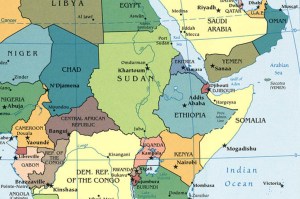
Over the last three weeks violence has broken out in the Central African Republic. The country has experienced outbreaks of violence over the last 15 years of rather severe violence. The rebel groups are a coalition of disaffected groups that have organized under the Seleka alliance suggesting that the current violence may be more organized than in the past. The CAR is a very poor country–62% of the population lives beneath the poverty line. Other African countries are trying to broker a cease-fire, and we will have to see how effective these efforts can be.
Charles Emmerson has published a provocative essay in foreign policy, comparing the world in 1913 to the world in 2013. The byline of the essay reads: “Why 2013 eerily looks like the world of 1913, on the cusp of the Great War.” There are some astonishing parallels to the two time periods, enough to creep anyone out. Obviously, the comparison is overstated, but we study history so that we can better understand whatever patterns we discern in our contemporary lives. History doesn’t teach lessons, but it does provide some remarkable insights.
Japan’s new government under Shinzo Abe is taking a sharp nationalist turn. His new cabinet is full of individuals who would like the Japanese constitution to be revised so that Japan can build a more assertive military. The action is in response to China’s military moves, but is obviously part of the security dilemma cycle: all of Japan’s neighbors cannot help but be nervous about the changes and will likely respond in similar fashion.
There are few solid estimates of the effectiveness of the sanctions against Iran. It seems clear that inflation has risen substantially because of the sanctions, but there is little evidence that the Iranian regime is changing its nuclear policy. However, there is increasing evidence that the US is having a very difficult time persuading its allies, notably Turkey and Pakistan, to adhere to the sanctions. If true, then the sanctions will only weaken over time.
The President of Argentina, Cristina Fernández de Kirchner, published a letter written to British Prime Minister, David Cameron, protesting British control of the contested Falklands/Malvinas Islands. Publishing letters is not standard diplomatic activity, and Cameron was quick to respond. The two countries fought a war over the islands in the 1980s, and the issue has been moved to the front burner in Argentina as Kirchner’s popularity has declined due to economic turmoil. Whether hostilities will erupt again remains to be seen.
The aggregate net worth of the 100 richest people on the planet was $1.9 trillion in 2012. It was a great year for the super wealthy. Ordinary Greeks, on the other hand, have bee reduced to a barter economy.
The UN has released new estimates of the number of people killed in the Syrian civil war which are considerably higher than previous ones: 60,000. The number does not break down how many have been killed by the Syrian government or by the rebels, but there is little question that the Syrian military has been especially brutal in the last few months. Unfortunately, the UN did not, at the same time, announce any new initiatives to stop the violence.
Early in 2012, the US Congress passed a new law, entitled “The Countering Iran in the Western Hemisphere Act.” The law is supposed to address the growing influence of Iran in South and Central America, although there are no real substantive or tangible measures identified in the bill. Needless to say, Iran does not think kindly of the law, nor does it seem to have much support elsewhere in the world.
One of the predicted consequences of globalization is a certain degree of homogenization in values leading to the growth of a truly global civil society. Whether this outcome will, in fact, come about is highly contested. Here is an essay that suggests that the convergence of global values is truly happening.
The Times of Oman has an interesting op-ed piece explaining the Russian support for Syria. It touches all the right bases, and one can hardly quarrel with the analysis. But it begs the question: how do the Russians view the end-game in Syria? Surely, they can’t believe that Assad will survive. It is very difficult to determine the Russian interest under these circumstances, particularly since the UN prognosis for increased violence is so grim.
Egyptian politics is about to get a lot more difficult, as the country implements new economic austerity measures to satisfy the demands of the International Monetary Fund. These austerity measures will certainly test the strength of the Morsi government since one can expect the general population to bear the brunt of the burden. IMF austerity programs invariably target government programs that subsidize the consumption patterns of the largest segments of the population–always the poorer groups. We can expect protests similar to the ones we have witnessed in Greece.
The New York review of Books has published a statement written by Nomika Zion, a member of Migvan, an urban kibbutz in Sderot, the Israeli city about a mile from the Gaza Strip border. The statement is a powerful critique of the policies pursued by Prime Minister Netanyahu toward the Gaza Strip. What makes the statement even more remarkable is that it comes from an individual who lives well within the range of the missiles fired by Hamas into Israel.
As Syria continues to unravel, there as been much speculation about how Assad’s possible departure will affect the balance of power in the Middle East. The Russians have backed away from Assad to a certain degree, and Hamas has all but repudiated him and moved strongly into the orbit of the Egyptians. Analysts are now beginning to consider whether the Iranians might be recalculating their alliance with Assad. Such a move would move the region strongly into the sphere of Saudi influence.
The death of a young woman who was brutally raped and killed by a gang of six men in India has led to a massive protest and painful introspection. The tragedy is far from an isolated incident in world, but its indescribable savagery raises all sorts of questions about how women are regarded in the world. Despite some signs of progress over the last 40 years, it is hard to believe that any progress has been made to elevate the status of women.
The ruling elite of China includes many descendants of the original Maoist revolution in 1949. This elite, however, is quite different from its predecessors, and would probably be considered traitors to the purposes of the Communist revolution. Interestingly, the ruling elite does not appear to be particularly unsettled by the change in direction.
Bilawal Bhutto Zardari, a young man with a distinctive political lineage in Pakistani politics, has made his first foray into the politics of Pakistan. He is too young to enter formal politics, but he gave a speech clearly signaling that he intends to stand for office when he comes of age. The Bhutto family has been a dominant force in Pakistani politics ever since the country was created.
Sunnis in Iraq have gathered in large protests against the rule of Prime Minister Maliki, raising the prospect of increased sectarian violence. The stresses in Iraq resonate with the violence in Syria as well as the fear of the aspirations of Iran in the region. There is little evidence that other Sunni states (such as Saudi Arabia) are involved in the protests, but it would hardly surprise anyone. Iraq is just one more state becoming involved with these regional rivalries.
Foreign Policy has a round-up of the ten conflicts to watch in 2013. It is an interesting, and not implausible, list. Some of the possibilities are no-brainers; others will make one wonder. We should keep the list and score it next December.
There is a long standing dispute between Argentina and Great Britain over territories in the South Atlantic, principally over the status of what the British call the Falkland Islands and the Argentinians call the Malvinas Islands (they fought a war over the islands). The British recently renamed parts of Antarctica “Queen Elizabeth Land” in honor of the Queen’s diamond jubilee. The Argentinians criticized the UK’s “anachronistic imperialist ambitions that hark back to ancient practices”.
Nigeria has a long-running area of conflict in the north which is usually described as tension between Muslims and Christians. The description is not inaccurate since each event leaves bodies of one sect or the other, and not of both. But it is hardly a religious dispute. The Council on Foreign Relations has a great backgrounder on the violence in Nigeria.
One of the true greats of Rock and Roll, Fontella Bass, has died. Rock on, Fontella!
For a little more background on the recent Israeli settlement decisions, Foreign Policy has published a short essay on the West Bank settlement of Ma’aleh Adumim. This settlement has been around for some time, and all the new settlements proposals are essentially plans to expand around it. The significance of these moves for a future peace between Israelis and Palestinians is difficult to overstate.
As all of you know, I’ve been keeping track of the rise of right-wing parties in Europe. Svoboda is a nationalist party in Ukraine that entered Parliament for the first time last October. Its agenda is fervently Ukranian and its leader once referred to the “Muscovite-Jewish mafia.” Its rise has been meteoric, similar to the rise of the Golden Dawn in Greece, Jobbik in Hungary, and the True Finns in Finland. The overall rise of right-wing parties closely mimics the rise of fascism in the 1920s and 30s.
Now for something you already know. Textbook prices are out of control–but more out of control than any reasonable person would believe. Check out this graph:
Israel has announced a third round of new settlements near Jerusalem, bringing the total for a week to nearly 5,500. It is hard to interpret these actions as anything less than a repudiation of the two-state policy that Israel, the Palestinian Authority, and the US adopted in Oslo in 1993. It is highly likely that, if re-elected in January, Prime minister Netanyahu will formally repudiate the two-state solution. Since there is no diplomatic alternative to Oslo right now, such a stance would mean the end of peace negotiations. Perhaps the Europeans might be able to formulate an alternative.
One of the more interesting developments in the last 20 years has been the rise of Chinese foreign direct investment in areas that are former European colonies. The hope was that this new source of capital would give the developing world a more viable development alternative. The verdict is still out, but it does not appear as if the Chinese are more insightful than the Europeans when it comes to cultural difference. How these investments play out over the next few years will be an important measure of whether foreign capital can ever really be helpful to true development.
The economic troubles in Europe have been going on for 5 years now, and they are now beginning to affect how the younger generation views the future of Europe. The departure of many of Europe’s best young professionals to other regions of the world signals a quickening of the structural factors leading to economic decline. Notably, these young people are not going to the US or other traditional safe havens–they are more likely to go to the newly emerging market economies. We’ll see how long-lasting this shift is.