The Congressional Research Service has issued its annual report on the sale and transfer of conventional weapons in the world. In 2015, the total value of arms agreements in the world was $65.2 billion and the largest recipients of these agreements were developing countries. The US and France were the largest sellers of weapons in the world:
“In 2015, the United States ranked first in arms transfer agreements with developing nations with $26.7 billion or 41% of these agreements. In second place was France with $15.2 billion or 23.30% of such agreements. In 2015, the United States ranked first in the value of arms deliveries to developing nations at $11.9 billion, or 35.42% of all such deliveries. Russia and France tied for second in these deliveries at $6.2 billion each and each representing 18.45%.”
France displaced Russia in 2015, but Russia will likely regain the second spot in 2016.
The European Central Bank has conducted a survey of incomes in the eurozone since the Great Recession of 2008-09 and has found that income inequality has grown throughout the region but more dramatically in the poorest countries of the eurozone. According to The Australian:
“While all eurozone households were poorer in 2014 than in 2010, when the Greek crisis erupted, “the differences are larger for the lower percentiles”, the European Central Bank said. Net wealth in the bottom quarter of households fell by 14.7 per cent, compared with 10.2 per cent lost by those in the top quarter.”
Greece, Cyprus, Spain, Italy and Portugal were countries in which the increase in income inequality was the greatest. The full ECB report can be accessed here.
A new study has indicated that increasing urbanization will seriously diminish agricultural productivity in the future. One of the more unfortunate aspects of current food production is that the most productive croplands are close to urban areas. According to The Guardian:
“A major worry surrounding the disappearance of this productive land is the impact it will have on staple crops such as maize, rice, soya beans, and wheat, which are cornerstones of global food security. Many of these crops occur in areas that will be consumed by urban spread in years to come. ‘Due to urbanisation in Nigeria, 17% of rice production and 12% of maize production will be hampered,’ Creutzig says. ‘Egypt will lose more than 40% of its rice, and more than 60% of its maize.’ In Africa, there will a 26% continental loss of wheat. Rice is forecast to suffer the most, with a 9% global decline, occurring predominantly in Asia where the bulk of this crop grows.”
Cities tend to grow where land is productive so the causal relationship between urbanization and agricultural productivity is negative. New cities are unlikely to be built in areas where food production is constrained.
Over a year ago, IMF researchers attempted to calculate the societal costs of fossil fuel consumption. In economic terms, such costs are called externalities because the costs are not reflected in the price of the good consumed but are rather absorbed by society as a hidden cost paid for by something other than the market mechanism. The IMF researchers state it this way:
“We define energy subsidies as the difference between what consumers pay for energy and its “true costs,” plus a country’s normal value added or sales tax rate. These ‘true costs’ of energy consumption include its supply costs and the damage that energy consumption inflicts on people and the environment. These damages, in turn, come from carbon emissions and hence global warming; the health effects of air pollution; and the effects on traffic congestion, traffic accidents, and road damage. Most of these externalities are borne by local populations, with the global warming component of energy subsidies only a fourth of the total.”
When these hidden costs are finally quantified and totaled up, their price is astonishing: $5.3 trillion a year. The authors conclude:
“The fiscal implications are mammoth: at US$5.3 trillion, energy subsidies exceed the estimated public health spending for the entire globe. It also exceeds the world’s total public investment spending. The resources freed from subsidy reform could be used to meet critical public spending needs or reduce taxes that are choking economic growth.”
If we were to take these externalities into account, the costs of renewable energies would fade away.

We only have vague references to climate change by President-elect Trump who had earlier called the claims of climate change a “hoax”. Some of his cabinet appointments, such as Pruitt to the Environmental Protection Agency and Tillerson to Secretary of State, indicate that he prizes the opinions of skeptics as well. For those of us who believe that the evidence indicating that climate change is highly likely, if not inevitable, without policy changes, the idea that efforts to prevent climate change might be delayed by at least four years is a terrifying thought. Clare Foran has written an essay for The Atlantic that gives some guidance about how to think about the next four years.
Bob Carr is a former Australian Foreign Minister and he has written an article for the Sydney Morning Herald on the UN Security Council Resolution condemning the Israeli settlements in the Occupied West Bank. He lays out the legal arguments underpinning the resolution and develops the full implications of its passage. Carr also develops the stark choices facing Israel if it continues to build settlements in violation of international law.
Israeli Prime Minister Netanyahu reacted with fury to the passage of the UN Resolution condemning the continued building of settlements in the Occupied West Bank. He is quoated as blaming the Obama Administration for suggesting the resolution: “From the information that we have, we have no doubt that the Obama administration initiated it, stood behind it, coordinated on the wording and demanded that it be passed”. The full text of the resolution is as follows:
The Security Council,
Reaffirming its relevant resolutions, including resolutions 242 (1967), 338 (1973), 446 (1979), 452 (1979), 465 (1980), 476 (1980), 478 (1980), 1397 (2002), 1515 (2003), and 1850 (2008),
Guided by the purposes and principles of the Charter of the United Nations, and reaffirming, inter alia, the inadmissibility of the acquisition of territory by force,
Reaffirming the obligation of Israel, the occupying Power, to abide scrupulously by its legal obligations and responsibilities under the Fourth Geneva Convention relative to the Protection of Civilian Persons in Time of War, of 12 August 1949, and recalling the advisory opinion rendered on 9 July 2004 by the International Court of Justice,
Condemning all measures aimed at altering the demographic composition, character and status of the Palestinian Territory occupied since 1967, including East Jerusalem, including, inter alia, the construction and expansion of settlements, transfer of Israeli settlers, confiscation of land, demolition of homes and displacement of Palestinian civilians, in violation of international humanitarian law and relevant resolutions,
Expressing grave concern that continuing Israeli settlement activities are dangerously imperilling the viability of the two-State solution based on the 1967 lines,
Recalling the obligation under the Quartet Roadmap, endorsed by its resolution 1515 (2003), for a freeze by Israel of all settlement activity, including “natural growth”, and the dismantlement of all settlement outposts erected since March 2001,
Recalling also the obligation under the Quartet roadmap for the Palestinian Authority Security Forces to maintain effective operations aimed at confronting all those engaged in terror and dismantling terrorist capabilities, including the confiscation of illegal weapons,
Condemning all acts of violence against civilians, including acts of terror, as well as all acts of provocation, incitement and destruction,
Reiterating its vision of a region where two democratic States, Israel and Palestine, live side by side in peace within secure and recognized borders,
Stressing that the status quo is not sustainable and that significant steps, consistent with the transition contemplated by prior agreements, are urgently needed in order to (i) stabilize the situation and to reverse negative trends on the ground, which are steadily eroding the two-State solution and entrenching a one-State reality, and (ii) to create the conditions for successful final status negotiations and for advancing the two-State solution through those negotiations and on the ground,
1. Reaffirms that the establishment by Israel of settlements in the Palestinian territory occupied since 1967, including East Jerusalem, has no legal validity and constitutes a flagrant violation under international law and a major obstacle to the achievement of the two-State solution and a just, lasting and comprehensive peace;
2. Reiterates its demand that Israel immediately and completely cease all settlement activities in the occupied Palestinian territory, including East Jerusalem, and that it fully respect all of its legal obligations in this regard;
3. Underlines that it will not recognize any changes to the 4 June 1967 lines, including with regard to Jerusalem, other than those agreed by the parties through negotiations;
4. Stresses that the cessation of all Israeli settlement activities is essential for salvaging the two-State solution, and calls for affirmative steps to be taken immediately to reverse the negative trends on the ground that are imperiling the two-State solution;
5. Calls upon all States, bearing in mind paragraph 1 of this resolution, to distinguish, in their relevant dealings, between the territory of the State of Israel and the territories occupied since 1967;
6. Calls for immediate steps to prevent all acts of violence against civilians, including acts of terror, as well as all acts of provocation and destruction, calls for accountability in this regard, and calls for compliance with obligations under international law for the strengthening of ongoing efforts to combat terrorism, including through existing security coordination, and to clearly condemn all acts of terrorism;
7. Calls upon both parties to act on the basis of international law, including international humanitarian law, and their previous agreements and obligations, to observe calm and restraint, and to refrain from provocative actions, incitement and inflammatory rhetoric, with the aim, inter alia, of de-escalating the situation on the ground, rebuilding trust and confidence, demonstrating through policies and actions a genuine commitment to the two-State solution, and creating the conditions necessary for promoting peace;
8. Calls upon all parties to continue, in the interest of the promotion of peace and security, to exert collective efforts to launch credible negotiations on all final status issues in the Middle East peace process and within the time frame specified by the Quartet in its statement of 21 September 2010;
9. Urges in this regard the intensification and acceleration of international and regional diplomatic efforts and support aimed at achieving, without delay a comprehensive, just and lasting peace in the Middle East on the basis of the relevant United Nations resolutions, the Madrid terms of reference, including the principle of land for peace, the Arab Peace Initiative and the Quartet Roadmap and an end to the Israeli occupation that began in 1967; and underscores in this regard the importance of the ongoing efforts to advance the Arab Peace Initiative, the initiative of France for the convening of an international peace conference, the recent efforts of the Quartet, as well as the efforts of Egypt and the Russian Federation;
10. Confirms its determination to support the parties throughout the negotiations and in the implementation of an agreement;
11. Reaffirms its determination to examine practical ways and means to secure the full implementation of its relevant resolutions;
12. Requests the Secretary-General to report to the Council every three months on the implementation of the provisions of the present resolution;
13. Decides to remain seized of the matter.
Since 1972, the US has vetoed 79 UN Security Council Resolutions that in anyway criticized Israeli policy in the Occupied Territories, many of which, starting in 1976, explicitly criticized the Israeli policy of building settlements in the Occupied Territories. These vetoes were cast despite the fact that official US policy since 1967 has uniformly and consistently held that the settlements were obstacles to peace and to a two-state solution which the US held was the only possible basis for peace between Israelis and Palestinians.
These vetoes have been cast despite the overwhelming legal sentiment that Israeli conduct in the Occupied Territories violates international law. The International Court of Justice ruled against Israeli policy in 2004. The United Nations Human Rights Council issued a finding in 2012 that emphatically found that the settlements violated international law. The US is the only country in the world that disagrees with these findings even though its own policy rests upon the belief that the settlements are an obstacle to peace. The US abstention in the most recent resolution is the very first time that the US has voted in a manner consistent with its own policy.
So Prime Minister Netanyahu’s complaint about the US ignores all the support the US has given Israel over the last 70 years, including the most recent promise of $38 billion in aid over the next ten years. According to the Congressional Research Service: “Israel is the largest cumulative recipient of U.S. foreign assistance since World War II. To date, the United States has provided Israel $124.3 billion (current, or non-inflation-adjusted, dollars) in bilateral assistance.”
But Netanyahu’s complaint is also short-sighted. Given that the Trump Administration has condemned the Obama Administration for its abstention on the resolution, it is more than likely that the political constituencies in Israel for the complete annexation of the Occupied territories will believe that the US under Trump will not oppose the move. If Israel does take control of the Occupied Territories then it will have a difficult decision to make. If it is to remain a true democracy it will have to give full rights to all the Palestinians who live in the Occupied Territories who will more than likely refuse to accept the current privileges enjoyed by Jewish citizens in Israel and who will be able, by virtue of their majority population, end those privileges. Or Israelis could insist upon Israel’s distinctive identity as a Jewish homeland and deny full citizenship to non-Jewish citizens. The critical question is whether the Jewish nation can exist within a democratic state.
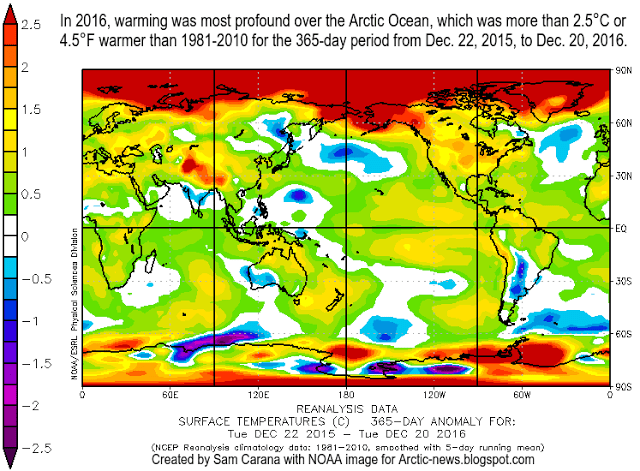
The stretch of warm weather in the Arctic continues. Arctic News points out:
“On December 22, 2016, the Arctic was on average 3.33°C or 5.99°F warmer than it was in 1979-2000.”
“Within the Arctic, the Arctic Ocean is warming most rapidly. While the Arctic as a whole was as much as 3.34°C or 6.01°F warmer than in 1979-2000 on December 22, 2016, temperatures over much of the Arctic Ocean were at the top end of the scale that day, i.e. as much as 30°C or 54°F warmer than in 1979-2000.”
The warming is unparalleled in recorded history. The warming of the ocean water is astonishing and will lead to further changes leading to warmer temperatures, such as the release of methane from the ocean floor. But the warmth in the Arctic is paired with deep cold in Siberia (and now, North America), a combination that has led to a new hypothesis about climate change called “Warm Arctic, Cold Continents”.
US-China relations were roiled by a telephone call from Taiwan’s President, Tsai Ing-wen, to President-elect Trump after the election. Trump officials, and Mr. Trump himself, tried to pass off the call as simple courtesy from one leader to another. But more information has been coming in that indicates that the telephone call was carefully planned, and the result of the pressure from Robert Dole, the Republican candidate for President in 1996 and now a paid lobbyist with the Washington law firm Alston & Bird. It now seems clear that the telephone call was specifically planned to signal the People’s Republic of China that Mr. Trump was willing to play a “Taiwan” card to change US-China relations.
Jason Brennan asks an interesting question: “Democracy is the will of the people but what if the people have little clue as to what they are doing?” In his essay on Brexit, Brennan explores the degree to which misinformation and deliberately distorted information affect the outcome of the referendum. He raises a central question about whether democracy is capable of effective governance under such conditions.
Malaysia, New Zealand, Senegal and Venezuela took Egypt’s resolution on the illegality of Israel’s settlements and put it up to a vote. The resolution passed 14-0-1 with the US abstaining and refusing to use its veto. The decision to abstain was immediately attacked by the Israeli Prime Minister, Benjamin Netanyahu, who said:
“Israel rejects this shameful anti-Israel resolution at the U.N. and will not abide by its terms….At a time when the Security Council does nothing to stop the slaughter of half a million people in Syria, it disgracefully gangs up on the one true democracy in the Middle East, Israel, and calls the Western Wall ‘occupied territory.’”
The move was also condemned by President-elect Trump who had earlier taken the rather extraordinary step of telling the Obama Administration to veto the resolution prior to the vote. Trump tweeted:
“As to the U.N., things will be different after Jan. 20th.”
After 20 January he does have a right to speak for the US. But not today.

The international law on occupied territory is actually fairly clear. The Fourth Geneva Convention deals with population transfers into and from Occupied Territories:
DEPORTATIONS, TRANSFERS, EVACUATIONS
ARTICLE 49 [ Link ]
Individual or mass forcible transfers, as well as deportations of protected persons from occupied territory to the territory of the Occupying Power or to that of any other country, occupied or not, are prohibited, regardless of their motive.
Nevertheless, the Occupying Power may undertake total or partial evacuation of a given area if the security of the population or imperative military reasons so demand. Such evacuations may not involve the displacement of protected persons outside the bounds of the occupied territory except when for material reasons it is impossible to avoid such displacement. Persons thus evacuated shall be transferred back to their homes as soon as hostilities in the area in question have ceased.
The Occupying Power undertaking such transfers or evacuations shall ensure, to the greatest practicable extent, that proper accommodation is provided to receive the protected persons, that the removals are effected in satisfactory conditions of hygiene, health, safety and nutrition, and that members of the same family are not separated.
The Protecting Power shall be informed of any transfers and evacuations as soon as they have taken place.
The Occupying Power shall not detain protected persons in an area particularly exposed to the dangers of war unless the security of the population or imperative military reasons so demand.
The Occupying Power shall not deport or transfer parts of its own civilian population into the territory it occupies.
The US has regarded the settlements as an obstacle to peace since 1967 and has frequently called for the cessation of building additional settlements. The US government’s position on the settlements has been very clear and the official US statements on them leave no room for doubt. The Israeli interpretation of the Geneva Convention differs substantially from the almost total unanimity among legal scholars that the settlements violate the Geneva Convention and can be found here. The Israeli position that the Jewish people have an historic tie to the land and that the land was never under the sovereignty of a Palestinian Arab state is unquestionably true. The same argument, however, can be made for the non-Jewish populations that have occupied the land for a significantly longer period of time.
The UN resolution will, unfortunately, change nothing. Israel will not abide by the resolution and the statements by President-elect Trump suggest that the US will stop putting pressure on Israel to cease building.
President-elect Trump ramped up his language concerning nuclear weapons, telling a morning talk-show host: “Let it be an arms race because we will outmatch them at every pass and outlast them all.” It is hard to process such loose language since the language trivializes the extraordinary destructiveness of the weapons and fails to appreciate the incredible expense of a nuclear arms race. There is also nothing in the current security context which suggests that there is some weapons deficiency. Will we use nukes to confront terrorism? To fight climate change? Would the US use nuclear weapons to get Russia out of Ukraine? Or China out of the South China Sea?
Russian President Putin and US President-elect Trump injected a troubling note of uncertainty into world politics. Both leaders called for greater attention to nuclear weapons, with Mr. Trump signaling the need to “expand” US nuclear capabilities. I am still having a hard time trying to figure how to treat foreign policy by tweets and sound bites, so I don’t know exactly how to assess the seriousness of these statements. But ever since the Cuban Missile Crisis, both the US and Russia have tried to reduce the number of nuclear weapons in their arsenals. That crisis proved that once a certain level of destruction can be assured (the technical phrase is Mutual Assured Destruction [MAD]), the actual number of weapons is irrelevant.

There was to have been a vote in the UN Security Council today on a resolution sponsored by Egypt which condemned Israeli settlements in the Occupied West Bank. The US has in the past vetoed such resolutions, but there were many reports that the US would abstain on the resolution, allowing it to pass. Egypt abruptly withdrew the resolution and the suspicion is that both Israel and President-elect Trump put a lot of pressure on Egypt to withdraw the resolution. Given the weakness of Egypt’s economy and the fragility of its politics right now, it is unlikely that Egypt wanted to risk alienating either Israel or the US.
Russia, Turkey, and Iran are negotiating the fate of Syria and have pointedly excluded the US, the UN, and the European Union from the discussions. All three have an intense dislike of Daesh (the Islamic State) and two of them (Russia and Iran) strongly support the rule of Syrian President Assad. Turkey has apparently decided that its fear of Kurdish independence outweighs its reservations about Assad. The three states have de facto formed an alliance against Sunni Muslims in the region, raising fears in Saudi Arabia and the Gulf States that Iran’s dream of extending its Shiite influence all the way to the Mediterranean will be realized with control of Iraq, Syria, and Lebanon within its grasp. Israel will certainly fear Iran’s dominance over Hezbollah and Hamas, sworn enemies to the state of Israel. And Western influence in the region will be limited to a much smaller range of states.
The cooperation seems to have allowed many Syrians to leave the besieged city of Aleppo but it is not clear how safe they will be. There are reports that Iranian militias are killing Sunnis, raising tensions with Sunni-dominant Turkey. Moreover, an end to the violence in Syria with Assad still in power will not relieve the migrant pressure in Europe since many Syrians were fleeing the Assad regime as well as the violence of the civil war. Finally, the costs of rebuilding Syria after all the destruction will be far beyond the means of the Syrian state and it remains to be seen how much financial assistance Russia, Iran, and Turkey can grant to Syria.
So the three states may have achieved a tactical victory in excluding the Western powers from the negotiations, they have also completely “owned” Syria. Syria has little to offer those three states in return for assistance, so blind allegiance will likely be the price for help.
Foreign ministers, Sergei Lavrov (C) of Russia, Mevlut Cavusoglu (R) of Turkey and Mohammad Javad Zarif of Iran

The Trump transition team has announced that Peter Navarro will lead the new White House National Trade Council. Navarro is an economist from the University of California-Irvine and has written extensively against Chinese trade practices. Not much is known about Navarro, but the Chronicle of Higher Education has a good backgrounder on him. Navarro’s book on China was turned into a documentary and the poster for the film communicates a great deal about his attitude toward China. Not particularly subtle.

Moreover, much of Navarro’s thinking about trade is idiosyncratic. Matthew Yglesias has written an essay on Navarro’s approach which suggests that the underlying basis for his thoughts on trade policy are flawed.
For the second winter in a row, temperatures in the Arctic are expected to rise above 0°C. The temperature rises are closely associated with the loss of sea ice cover and are part of a positive feedback loop that suggests even greater sea ice loss next year. The polar vortex North America is experiencing this winter are due to the fact the the diminished temperature gradient between the usually cold Arctic and the warmer temperate regions are contributing to a weakening jet stream (hyperbolically suggested in the movie, “The Day After Tomorrow”).
As Russian-Turkish relations go through yet another difficult phase, Ishaan Tharoor has written a short essay on the history of those relations. Needless to say, the relations of close neighbors is often quite difficult, but the tension between the emerging Russian Empire and the declining Ottoman Empire in the 19th century was deep and enduring. The struggle was over control of the Bosporus and the Black Sea, but was also amplified by the religious tension between the Muslim Ottomans and the Eastern Orthodox Russians. Somehow, those tensions have never gone away.
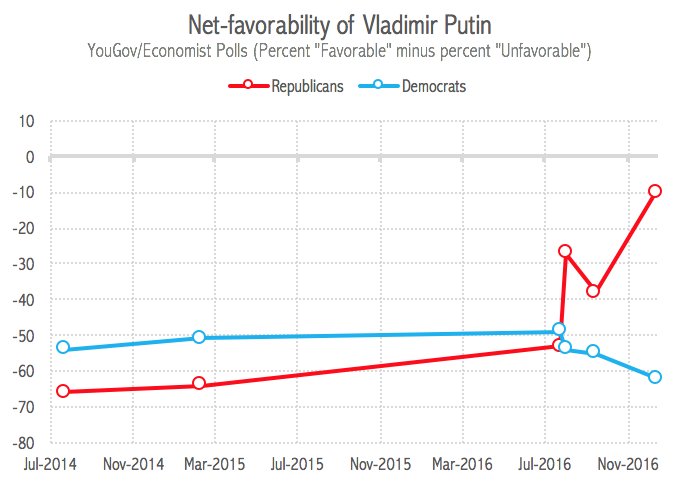
Surprisingly, US-Russian tensions have undergone a dramatic transformation. Yochi Dreazen has written an essay for Vox on the troubling questions surrounding the Russian role in the US presidential election and what it suggests about President-elect Trump’s relations with Russian President Putin. In the article, Dreazen posts an interesting graph which suggests that Republicans now have a more positive view of Vladimir Putin, a massive change from the traditional Republican view of Russia.
The carnage in Berlin caused by a truck driven into a crowded Christmas market is causing havoc in the German political system. Chancellor Merkel addressed the German people in terms that suggested that Germany needs to adhere steadfastly to its liberal values. But other politicians are suggesting that German politics needs to change dramatically. Horst Seehofer, the head of the Christian Social Union, the party allied with Merkel’s Christian Democrats, made an ominous speech after the tragedy: “We owe it to the victims, their families and the entire populace to rethink and readjust our entire immigration and security policies.” It is difficult to predict the direction of German politics in the near term.
The US is likely to respond to the charges that Russia was involved in leaking hacked computer materials in order to influence the recent Presidential election. It is hard, however, to determine what the best response might be since the US is more vulnerable to computer hacking than is Russia. Tim Weiner is a journalist with a long track record of ferreting out information about the US CIA and he has written a fascinating essay on how the US might respond, looking at a previous cyberwarfare effort in the 1980s.

The danger of private economic interests overriding national interests became quite apparent in the decision of the US Senate not to renew the “STAND for Ukraine” Act. The bill would have made the sanctions against Russia for its intervention in Ukraine in 2014 stand for another five years. ExxonMobil lobbied hard against the bill since the company has a long-standing license agreement with Russia to pump oil from the Arctic. With the defeat of the bill, the new Secretary of State, Rex Tillerson the CEO of ExxonMobil, can have the sanctions overturned with just an executive decision by President Trump. In 2016, ExxonMobil spent $8,840,000 on lobbying expenses in Washington, DC. The money was well spent since ExxonMobil has more land under its control in Russia than it does in the US:
“Exxon boosted its Russian holdings to 63.7 million acres in 2014 from 11.4 million at the end of 2014, according to data from U.S. regulatory filings. That dwarfs the 14.6 million acres of rights Exxon holds in the U.S., which until last year was its largest exploration prospect.”
The Russian Ambassador to Turkey was shot and killed in Ankara. The Ambassador, Andrey Karlov, was speaking at a photographic exhibit when a 22-year old riot policeman shot him in the back. The assassin shouted out “Don’t forget Aleppo! Don’t forget Syria! As long as our brothers are not safe, you will not enjoy safety”. The incident comes at a point when Turkish-Russian relations were improving although both sides are diametrically opposed on the question of whether Syrian President Assad should remain in power. I have long wondered at how long it would take before Russia was being blamed for the slaughter of Muslims in Syria. Russia needs to be careful since almost 15% of its population is Muslim and it is the fastest growing part of the Russian population.
Michael Klare is our colleague at Hampshire College and he has written extensively on world affairs, particularly on the role of resource constraints on politics. His most recent essay is an examination of President-elect Trump’s energy plan. It is based largely on the campaign promises made by Mr. Trump, so we cannot be sure that these policies will actually be followed. But the incoherence of the plan is made clear by Klare. In his words: “In other words, Trump’s plan will undoubtedly prove to be an enigma wrapped in a conundrum inside a roiling set of contradictions.” But following even a few of Mr. Trump’s policies will move the US far away from its promises to avert climate change.
I am not sure what to make of the phenomenon known as “fake news”. It is a current buzzword, but I sincerely doubt that there was ever a time when false stories were not circulated by those who wished to muddy political waters. Some of the stories are truly unbelievable as is the current story circulating around Venezuela that the US is taking 100 Bolivar bank notes out of Venezuela in order to stimulate inflation and overthrow the government of President Maduro. The 100 Bolivar note is now worth around 2 US cents and Maduro has announced his own intention to take the notes out of circulation in January and replace them with 500 Bolivar notes. With an expected inflation rate of about 500% next year, the Venezuelan economy has already passed the point of collapse.

Joseph Kabila has been President of the Democratic Republic of Congo (DRC) for the last 15 years and Monday is supposed to be his last day in office. But it does not appear as if he is prepared to step down, and his refusal to stand aside could trigger off violent protests. The DRC is no stranger to violence: between 1997 and 2003 almost 5 million people were killed in political violence. Since its independence in 1960, the DRC has never experienced a peaceful transfer of power.


