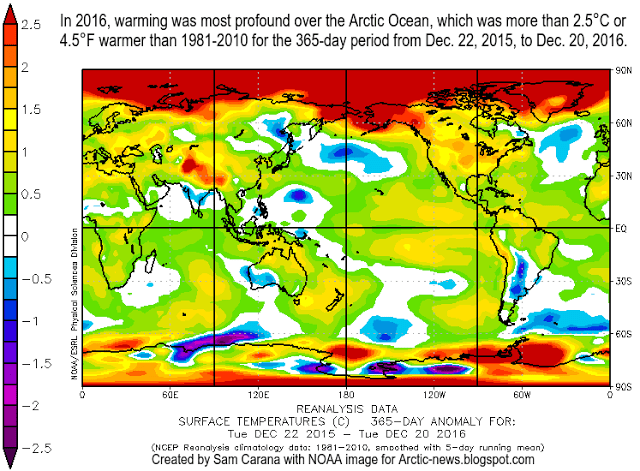
The stretch of warm weather in the Arctic continues. Arctic News points out:
“On December 22, 2016, the Arctic was on average 3.33°C or 5.99°F warmer than it was in 1979-2000.”
“Within the Arctic, the Arctic Ocean is warming most rapidly. While the Arctic as a whole was as much as 3.34°C or 6.01°F warmer than in 1979-2000 on December 22, 2016, temperatures over much of the Arctic Ocean were at the top end of the scale that day, i.e. as much as 30°C or 54°F warmer than in 1979-2000.”
The warming is unparalleled in recorded history. The warming of the ocean water is astonishing and will lead to further changes leading to warmer temperatures, such as the release of methane from the ocean floor. But the warmth in the Arctic is paired with deep cold in Siberia (and now, North America), a combination that has led to a new hypothesis about climate change called “Warm Arctic, Cold Continents”.
US-China relations were roiled by a telephone call from Taiwan’s President, Tsai Ing-wen, to President-elect Trump after the election. Trump officials, and Mr. Trump himself, tried to pass off the call as simple courtesy from one leader to another. But more information has been coming in that indicates that the telephone call was carefully planned, and the result of the pressure from Robert Dole, the Republican candidate for President in 1996 and now a paid lobbyist with the Washington law firm Alston & Bird. It now seems clear that the telephone call was specifically planned to signal the People’s Republic of China that Mr. Trump was willing to play a “Taiwan” card to change US-China relations.
Jason Brennan asks an interesting question: “Democracy is the will of the people but what if the people have little clue as to what they are doing?” In his essay on Brexit, Brennan explores the degree to which misinformation and deliberately distorted information affect the outcome of the referendum. He raises a central question about whether democracy is capable of effective governance under such conditions.


I sometimes find it interesting how important events like the Brexit can feel quite far away from one’s daily life.
LikeLike
It is probably a good thing that we can turn things off. Otherwise we would go crazy.
LikeLike