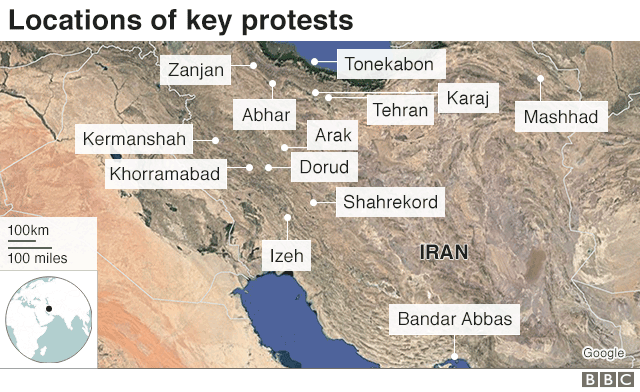
Protests in Iran have continued into the 4th day. Thus far, 12 deaths have been reported, but it is difficult to know exactly what is going on. The protests have occurred in a large number of cities, but they do not appear to be organized nor do they seem to cohere around a single objective. These protests are quite different from those that occurred in 2009 when the “Green Movement” was an organized attempt to derail the re-election of President Ahmadinejad whom many believed was corrupt. These protests seem to be calling for reform, not regime change–the current President, Rouhani, was re-elected handily last May. The US and Israel would be well-advised to pay attention to this difference. Iran is a highly educated, very sophisticated society and if foreign powers become too involved in cheering on the protests, there is a real risk that the protests could be de-legitimized by the hard-liners in Iran.
US President Trump rang in the New Year with a Tweet excoriating Pakistan:
“The United States has foolishly given Pakistan more than 33 billion dollars in aid over the last 15 years, and they have given us nothing but lies & deceit, thinking of our leaders as fools. They give safe haven to the terrorists we hunt in Afghanistan, with little help. No more!”
Mr. Trump made similar comments about Pakistan last August, but there has been no indication that the public criticism had much tangible effect on Pakistani policy. Needless to say, the Pakistanis rejected the criticism and it is highly unlikely that public shaming will produce anything other than hard feelings.
Angus Deaton won the Nobel Prize in Economics in 2015. He has written a short essay on inequality that addresses a central concern: is economic inequality simply the result of normal economic activity or is it something that is deliberately constructed through selfish interests? His answer is the latter. The essay is difficult to follow, but not long. It is well worth the effort.
The Guardian is a reliably lefty British newspaper and it has published an article on the apparent collapse of the left and center-left in European politics since the Great Recession of 2008-09. In most elections since that time, right-wing nationalist parties have done quite well and we have tended to explain their popularity in terms of fears of immigration, globalization, and the stagnation of wages. What is equally important, and so far unexamined, is why left-wing parties have been unable to respond to these challenges as effectively. The issue is critically important for the US as the left-wing needs to figure out a way to revive the Democratic Party rather than allowing dissatisfaction with the status quo to default to the Trump wing of the Republican Party.
The Haas Institute at the University of California, Berkeley, has been monitoring the growth of anti-Islamic sentiment in the US since the attacks of US territory in September 2001. Specifically, the Institute has followed the introduction of anti-sharia legislation in the the US and it has issued a report, “Legalizing Otherhood” which documents this movement in the US. The report finds that “Of 194 anti-Muslim bills proposed in state legislatures across the country from 2010 to 2016, 18 have passed and been enacted into law”. Twenty of those bills have passed the Mississippi legislature, a state that has a minuscule Muslim population. Such legislation is totally unnecessary since Federal Law is the supreme law of the land and forbids the introduction of religious law into account in all judicial proceedings. The laws, however, are designed to engender fear of Muslims, a political, rather than a legal, objective.
Protests in Iran have continued into the third day, and they are beginning to take on a common theme: opposition to the religiously-based character of the regime. According to Western reports, and such reports are not to be considered as authoritative, the protests do not seem to be aimed at President Rouhani, but rather at the authority of the Supreme Leader Ayatollah Ali Khamenei. That dissatisfaction may be real, but it is more likely that the rising prices of necessary commodities is the most immediate reason for the protests. But the burning of banners bearing the likeness of Khamenei must be a worrying sign for the regime.
Supreme Leader Ayatollah Ali Khamenei

Last week the African National Congress (ANC) elected Cyril Ramaphosa as its leader, replacing Jacob Zuma, the President of South Africa. That moved paved the way for the country’s Supreme Court to issue a ruling that the Parliament had not held Zuma responsible for using government funds for personal use. Zuma has been President since 2009 and South Africa was plagued by corruption and economic decline during his rule. The ruling opens the door to Zuma’s impeachment and perhaps an end to the poor governance of a potentially very rich and vibrant country.
China has responded to US President Trump’s tweet charging China with secretly supplying oil to North Korea. An editorial in Global Times, which serves as an official mouthpiece for the Beijing government, asserts that
“If Washington wants to accuse Beijing, it should hand out tangible evidence. It should point out which shipping company those vessels belong to and with which Chinese authority they are associated. If the US finds illegal acts by anyone from the Chinese mainland, Beijing welcomes the tipoffs and will punish the lawbreakers. “
The editorial points out the necessary evidence to support Mr. Trump’s accusation has not been made public and that the photographs released by the South Korean government are hardly conclusive. Most tellingly, the editorial simply describes the tweet as beneath the dignity of the US President: “This is not how a US president should behave.
There are reports of protests in several Iranian cities. The protests seem to focus on rising prices in the country and on the government’s emphasis on foreign policy at the expense of domestic issues. Protests are not usual in Iran and the reports suggests that many of the protesters were arrested. There will be increased pressure on Iran in the next few weeks, as US President Trump will need to decide a course of action on the Iranian nuclear deal if Congress does not act on Mr. Trump’s de-certification. The US has been working with closely with Israel to contain Iranian influence in the Middle East.
US President Trump has publicly called out China for selling oil to North Korea despite the UN Security Council prohibitions on doing so. In a Twitter post today, Trump said:
“Caught RED HANDED – very disappointed that China is allowing oil to go into North Korea. There will never be a friendly solution to the North Korea problem if this continues to happen!”
Satellite photos show Chinese and North Korean vessels transferring oil while in the Yellow Sea. The photos were released by South Korean but were likely taken by US spy satellites. China has made it clear that it does not support any sanctions that harm ordinary North Koreans and that it does not wish the regime in North Korea to fall. President Trump does not seem to understand China’s interests in this dispute and he clearly expects China to support US objectives without reservation. It is very difficult to understand how publicly shaming China’s behavior serves US interests in this matter. In fact, Trump’s actions will likely alienate China even further.
Satellite Photos of Chinese and North Korean Ships Transferring Oil at Sea

The US military would have us believe that it has defeated Daesh (ISIS) in Iraq and Syria, but while it no longer controls extensive territory in those countries it is far from being defeated. Indeed, the group has launched a brutal attack in Afghanistan where the US military has been engaged in its longest war. The group attacked a Shi’ite cultural center in Kabul and the primary victims were children. There is no military solution to the problem of violent extremism. The US (as well as the Russians, the Kurds, the Iranian Revolutionary Guard, and the Syrian Army) have killed many supporters of ISIS, but the movement has proven to be highly resilient.
It is cold in South Hadley!!! Much colder than we are used to in December and the forecast does not offer much hope for a warm-up very soon. The rest of the world, however, seems to be enjoying warmer than usual temperatures. Note how much warmer than normal it seems to be in the Arctic.
/cdn.vox-cdn.com/uploads/chorus_asset/file/9941073/gfs_world_ced_t2anom_1_day.png)
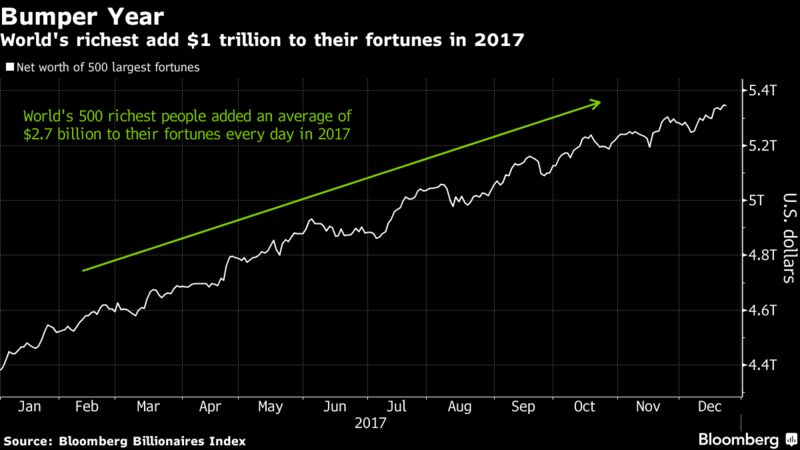
The world’s richest people became significantly richer in 2017. The Bloomberg media outlet keeps a list of the 500 richest people in the world and found that they added $1 trillion to their collective wealth in 2017. The increase was 23% greater than the increase in 2016 so the pace of accumulation seems to be picking up. According to Bloomberg: “By the end of trading Tuesday, Dec. 26, the 500 billionaires controlled $5.3 trillion”. The Guardian puts the good fortunes of the wealthy in context:
“These millionaires – who account for 0.7% of the world’s adult population – control 46% of total global wealth that now stands at $280tn. At the other end of the spectrum, the world’s 3.5 billion poorest adults each have assets of less than $10,000 (£7,600). Collectively these people, who account for 70% of the world’s working age population, account for just 2.7% of global wealth.”
It is hard to imagine that such inequality is sustainable over the long run. As The Guardian puts it: “The world’s super-rich hold the greatest concentration of wealth since the US Gilded Age at the turn of the 20th century”.
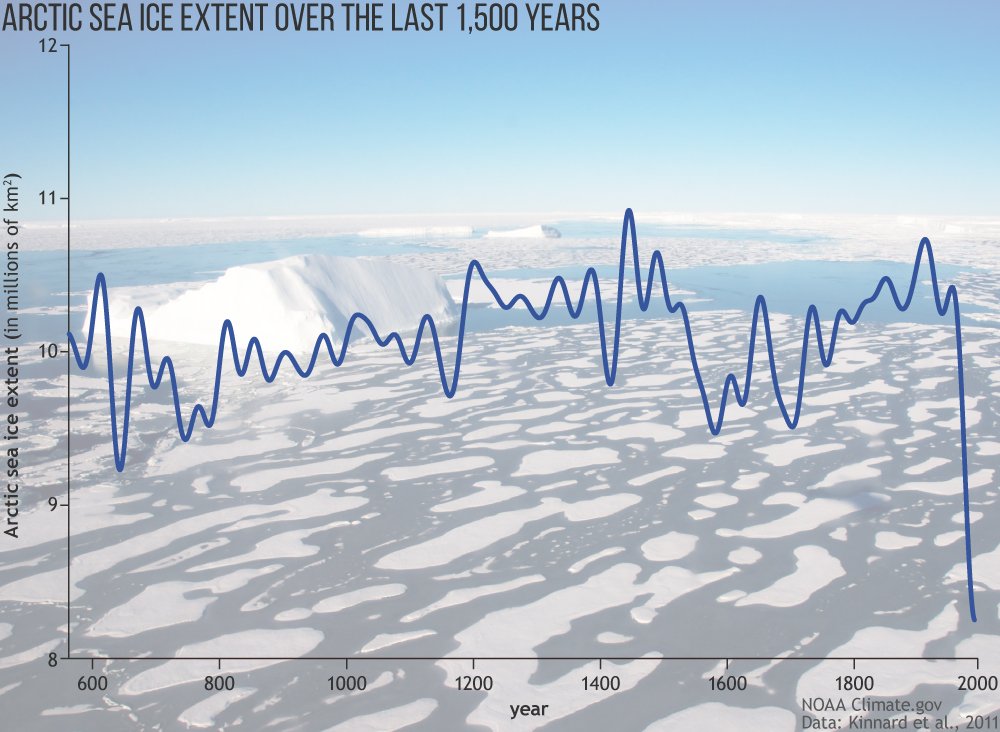
The US National Oceanic and Atmospheric Administration (NOAA) has released its annual “Arctic Report” and the report suggests that the Arctic is changing at a more rapid rate than ever in the last 1,500 years. Jeremy Mathis is an arctic scientist at NOAA and assesses the changes in this way: “There is no normal….That’s what so strange about what’s happening in the Arctic. … The environment is changing so quickly in such a short amount of time that we can’t quite get a handle on what this new state is going to look like.” The change in sea ice has been dramatic in recent years and many believe that permanent sea ice may not exist in a few years.
Alexei Navalny, a prominent opposition figure to Russian President Vladimir Putin, has been barred by the Russian Election Commission from running in next year’s election as a Presidential candidate. The grounds for his disqualification were a conviction for embezzlement in 2013, a conviction that was rejected by the European Curt of Human Rights, but reinstated by the Russian Supreme Court. Navalny is a popular figure who had no chance of defeating Putin but someone who was quite adept at mobilizing his base to undermine Putin’s authoritarian rule. Navalny has called for a boycott of the election, but Russian authorities dismiss his significance and the chances for an effective boycott.
Alexei Navalny

The US has negotiated a substantial decrease in its contributions to the UN budget. The decrease is $285 million off the 2016-2017 final budget and represents a big cut to the UN’s overall budget. According to The Guardian: “the US is responsible for 22% of the the body’s annual operating budget, or around $1.2bn in 2017-18, and 28.5% of the cost of peacekeeping operations, estimated at $6.8bn over the same period.” In defending he budget cuts, the US Ambassador to the UN said:
“The inefficiency and overspending of the United Nations are well known. We will no longer let the generosity of the American people be taken advantage of or remain unchecked. This historic reduction in spending – in addition to many other moves toward a more efficient and accountable UN – is a big step in the right direction. While we are pleased with the results of this year’s budget negotiations, you can be sure we’ll continue to look at ways to increase the UN’s efficiency while protecting our interests”.
There is little question that the US action is in response to the 128-9 vote condemning the US decision to recognize Jerusalem as the capital of Israel.

The US State Department announced on Friday that it would supply lethal weapons to Ukraine to aid the government in suppressing the rebellion in the eastern part of the country. The conflict in Ukraine has deep historical roots, but the cause of the immediate crisis stems from popular protests against the Ukrainian government in late 2013. The protests overthrew a Russian-backed leader and led to a Russian takeover of Crimea and Russian support for separatists in the east. That conflict has waxed and waned over the years despite attempts at cease-fires. The US has avoided sending lethal weaponry into Ukraine to fight the separatist, fearing an escalation of the conflict which might give Russia an excuse to annex outright the Russian-speaking parts of the country. Needless to say, the Russians interpret the American move as aggressive and I fear that the conflict, which has already taken 10,000 lives, might escalate quickly.

New Zealand’s Mount Taranaki is the third natural feature of the country’s geography to be granted legal status as a person. The mountain joins the Whanganui river as a legal personality. The ruling is significant because it protects these geographic features in a distinctive and effective manner. The decision is a victory for the Taranaki iwi, a group within the Maori nation, who have suffered under the Treaty of Waitangi which founded New Zealand in 1840. The decision also recognizes the fact that the Maori rights have long been ignored in the islands’ governance and is an attempt to redress those grievances. But the decision is also important because it is a fundamental change in the way humans recognize their relationship to the natural environment.
Mount Taranaki

In the first year of World War I, allied and German troops celebrated what has come to be known as the “Christmas Truce”. It was an extraordinary event in military history and one that rattled the military command centers of both sides. German and British soldiers decided not to continue firing at each other and instead came out of their trenches and exchanged gifts, drank together, and played soccer. The personal accounts of the incident are deeply moving (for another account, click here). The soldiers recognized that their common humanity overrode their national identity. Their officers realized that such a recognition undermined their authority and the objectives of the war. It is too bad that the soldiers did not prevail.


The UN Security Council has voted to impose more sanctions on North Korea. The sanctions include refined petroleum products and North Korean exports of food products, machinery, electrical equipment, stone and wood. The final resolution represented a compromise since the US had lobbied for an immediate repatriation of North Korean workers from Russia and China and for a complete ban on petroleum exports to North Korea. These measures were opposed by China and Russia, and the China Times ran an editorial which outlined the concessions demanded by the two states:
“China and Russia went through tough negotiations with the US regarding the proposals. China firmly opposes any indication that the council might grant the US permission for military action. It also objects to a maritime military blockade against Pyongyang that might trigger conflict. The US compromised on these issues. The new sanctions include slashing limits on North Korean imports of refined oil from an annual 2 million barrels a year to 500,000. The resolution caps crude oil imports at 4 million barrels a year and extends the deadline for North Korean workers to return home from 12 months to 24 months. The sanctions don’t include leading North Korean leaders. North Korean exports and its imports from China are restricted by category, but not entirely banned.”
The editorial goes on to point out the reasons for the concessions:
“Pyongyang’s nuclear and missile development is unacceptable. It is also unacceptable to use force against it and change the political situation in North Korea and the Korean Peninsula. It is hoped that Washington and Pyongyang can discover their common interests.
“The new resolution is extremely harsh. It may be the last hope for a desperate situation on the peninsula. South Korea recently said it could suspend joint military drills with the US until after the PyeongChang Winter Olympics in February 2018. It is hoped Pyongyang gets the message and responds positively.”
In other words, China’s position remains unchanged: it wants North Korea to stop the development of its nuclear weapons testing (but does not support the US objective of denuclearization) but is also not willing to impose measures that might lead to the downfall of the North Korean regime.
Jane’s Defence Budgets is one of the world’s most authoritative sources on military spending and it has just released its annual report (it is incredibly expensive so I cannot provide a link to the actual report). The press release on the report contains some interesting information. Significantly, global defense spending has reached a record high:
“According to the Jane’s report, defence spending will grow for the fifth consecutive year, reaching $1.67 trillion in 2018 and overtaking the previous post-Cold War record of $1.63 trillion seen in 2010.”
Not surprisingly, the US leads the pack with a proposed 4.7% increase in the defense budget in President Trump’s budget. But western and eastern European states are also raising their military spending to a tremendous extent and many of those states will meet NATO’s target of 2% of total spending (US, Greece, Estonia, Turkey, Latvia, the UK, Lithuania, Poland, and Romania). The increase spending reflects growing fears of Russia military pressure as that country continues to forge a more ambitious foreign policy in Europe and the Middle East, despite the fact that Russia’s own military spending is going down. Even though the absolute numbers are increasing, military spending is taking a smaller share of total wealth: “….over the last decade global defense spending has dipped to an average of 2.2 percent of GDP, down from 2.7 percent.”
The New York Times is reporting that the recently passed tax bill in the US might result in counter-actions by many of the US trading partners. US trade and investment partners realize that they now have to compete with the US on their corporate tax rates and all the subsidies in the tax code to promote US investments abroad. In a very real sense, the chief export of the new US tax code will be austerity as other countries will have to reduce their revenue streams as well. The impact on China will be significant, particularly since its corporate tax rate is about 45%. When considering dramatic changes in economic policy in a globalized world, one should never forget to anticipate the reaction of other states to expected outcomes. One should always assume that whatever one thinks is a positive for the domestic economy will have a negative effect on international partners.
Environmental economists Wolfram Schlenker and Anouch Missirian have published a paper in Science that correlates requests for asylum in Europe and climate change projections of the US National Aeronautics and Space Administration (NASA). The abstract of the paper reads:
“Here we examine how, in the recent past (2000–2014), weather variations in 103 source countries translated into asylum applications to the European Union, which averaged 351,000 per year in our sample. We find that temperatures that deviated from the moderate optimum (~20°C) increased asylum applications in a nonlinear fashion, which implies an accelerated increase under continued future warming. Holding everything else constant, asylum applications by the end of the century are predicted to increase, on average, by 28% (98,000 additional asylum applications per year) under representative concentration pathway (RCP) scenario 4.5 and by 188% (660,000 additional applications per year) under RCP 8.5 for the 21 climate models in the NASA Earth Exchange Global Daily Downscaled Projections”.
2016 saw a record number of asylum seekers in Europe. According to the Public Broadcasting System: “The EU received 1.2 million applications from first-time asylum seekers in 2015, a record setting number and more than double the year prior. What’s more, about half of Europe’s asylum applicants from 2015 to 2016 still had decisions pending at the end of 2016.” An increase of 188% would be politically unsustainable.
If you are rich, however, there is a different way to get into Europe: buy distressed properties in Greece whose housing market has yet to recover from the financial crisis of 2008-09. Russians, Chinese, Turks, and Arabs are snapping up these properties and buying a “golden” passport from Greece. According to Bloomberg:
“Greece awarded 2,053 golden visas between 2013 and October 2017, with Chinese investors accounting for 43 percent of them, according to Enterprise Greece, the state agency responsible for promoting investments and exports. Russians are in second place with 18.6 percent and investors from neighboring Turkey third at 8.4 percent. Greece has raised more than 513 million euros in foreign investments from the visa program.”
With a resident visa from Greece, foreigners have access to the entire European Union under the Schengen Program.
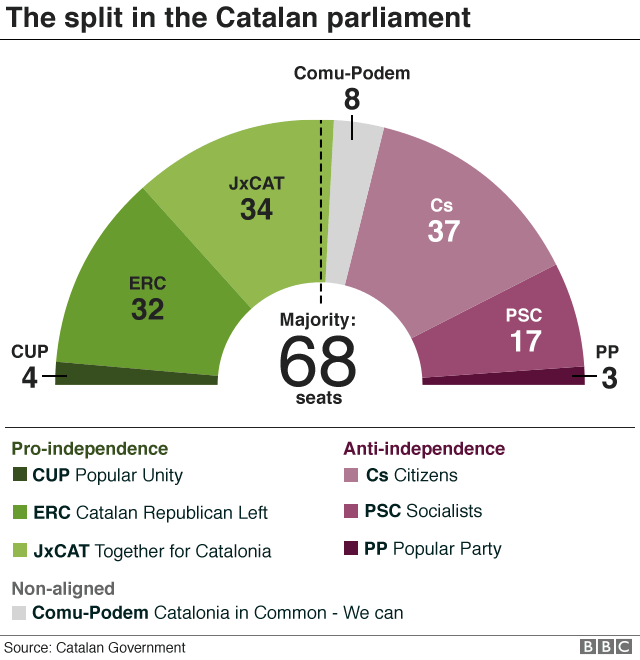
In an interesting twist to a long-simmering story, pro-independence candidates have won 70 seats in the 135-seat Catalan regional parliament. The regional election was called by the central government of Spain after an attempt at independence by Catalonian separatists was short-circuited by the imposition of Spanish control over the regional government. It now appears that Spain will continue to address the demands for independence, although the three parties that have the majority of seats are not united in their stance toward independence or greater autonomy. The leaders of the pro-independence parties state that they will only meet with the Spanish government outside of Spain.
Election Results
The pro-independence parties are Mr Puigdemont’s Together for Catalonia (JxCat), the Republican Left of Catalonia (ERC) and Popular Unity (CUP)