The South China Morning Post has an excellent article on China’s Belt and Road Initiative (BRI). The initiative is an ambitious attempt to revive the old Silk Road that dominated the global economy before the rise of European power. The article is very balanced, looking at the benefits and disadvantages of the effort for countries in southeast, south, and central Asia. It is also an attempt by China to reshape the global economy in ways that serve its interests better than the current liberal world order.
“The growth in investment in places like Cambodia comes despite mounting criticism and resistance, and underlines Beijing’s accelerated push for the world’s most ambitious project amid China’s economic wrangling with the United States and European powers and their unfolding geopolitical rivalry.
“Those ambitions will be in the spotlight this week when 37 heads of state, including Hun Sen and Russian President Vladimir Putin, head to Beijing for the Belt and Road Forum, the second of its kind in less than two years. But neither India nor the US will send senior representatives.”
As the week unfolds there will be more articles on the meeting in Beijing goes on. Keep an eye on how the BRI is received by the less wealthy states.
Climate change has been occurring since the beginning of the industrial revolution and the current situation is the result of the cumulative level of greenhouse gas emissions since the 18th century. There is no question which country is most responsible for the largest contribution to this cumulative problem. Carbon Brief has put together the video below which dramatically illustrates the US role. But pay attention to how rapidly China and India rise in the rankings.
Animation: The countries with the largest cumulative CO2 emissions since 1750
Ranking as of the start of 2019:
1) US – 397GtCO2 2) CN – 214Gt 3) fmr USSR – 180 4) DE – 90 5) UK – 77 6) JP – 58 7) IN – 51 8) FR – 37 9) CA – 32 10) PL – 27 pic.twitter.com/cKRNKO4O0b
The Economist has a fascinating article entitled “Where growth is concerned, is population destiny?” It rightly points out that for much of the past, the more populous nations, such as CHina, were the center of the global economy. The period where European, and subsequently US dominance since the 1500s is an anomaly because these nations were much smaller. The question is straightforward:
“For centuries prior to the Industrial Revolution, Asia’s massively populous societies made the continent the world’s centre of economic gravity. Industrialisation in Europe and North America in the 19th century briefly knocked it from its perch. But now their collective economic might, measured in real output on a purchasing-power-parity basis, is forecast to account for more than half of global production by 2020. Was the West’s period of dominance an anomaly, which could only ever have been short-lived? Is population destiny?”
As economic activity shifts to Asia, it seems as if China is destined to return to its former place. But technological innovation propelled Europe to dominance and that dynamic seems to be independent of overall population density.
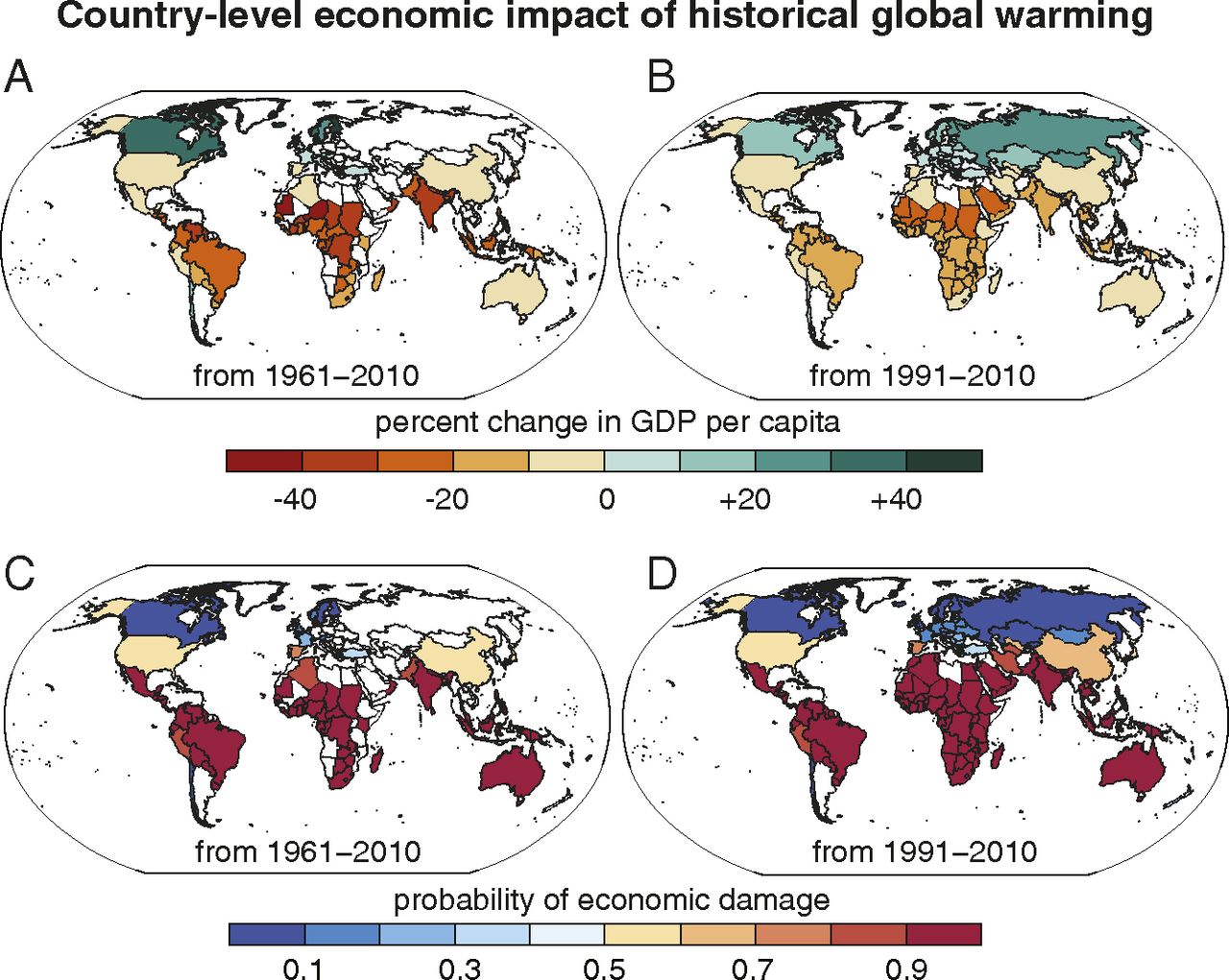
The National Academy of Sciences has published new research which indicates that climate change has exacerbated economic inequality in the world. It is a very technical article, but the authors detail the significance of their findings:
“We find that global warming has very likely exacerbated global economic inequality, including ∼25% increase in population-weighted between-country inequality over the past half century. This increase results from the impact of warming on annual economic growth, which over the course of decades has accumulated robust and substantial declines in economic output in hotter, poorer countries—and increases in many cooler, wealthier countries—relative to a world without anthropogenic warming. Thus, the global warming caused by fossil fuel use has likely exacerbated the economic inequality associated with historical disparities in energy consumption.”
I cannot say that I understood all the equations, but the findings are consistent with my own understanding of the dynamics of climate change. Climate change will definitely affect the poor and vulnerable far more than the people in rich countries who can probably afford to accommodate some of the worst effects of climate change. Jason Daley, writing for the Smithsonian magazine, provides clear examples:
“Warming for many economically powerful nations in the temperate region, including the United States, China and Japan, has pushed them into the perfect temperature ranges for economic output. Norway’s GDP, on the other hand, has grown an extra 34 percent due to warming and Iceland’s economic output is double what it would otherwise have been. That won’t last, the author’s warn, as temperatures increase over the next few decades.
“On the down side, India’s GDP is about 30 percent lower today than it would have been without rising global temperatures. Diffenbaugh tells McKenna that’s on the same order of magnitude as the impacts of the Great Depression in the United States. Lydia DePillis at CNN reports that Costa Rica, which according to the study has experienced a 21% lower GDP, has seen lower yields of coffee and more disease among the crop all due to increasing temperatures.”
“We have made our demands very clear to the ayatollah and his cronies: end your pursuit of nuclear weapons, stop testing and proliferating ballistic missiles, stop sponsoring and committing terrorism, halt the arbitrary detention of US citizens. Our pressure is aimed at ending these and others and it will continue to accelerate until Iran is willing to address them at the negotiating table.”
The affected countries include India, China, South Korea, Japan and Turkey. The move will likely tighten up the global petroleum market–expect gasoline prices to go up as a consequence. The Europeans, however, are expected to try to evade the sanctions by setting up a payments program that the US cannot detect.
The US is threatening to veto a UN Security Council resolution on combatting the use of rape as a weapon of war. The resolution initially called for the creation of a monitoring body to investigate these crimes, but the section was stripped out by threats of vetoes by Russia, China, and the US. But the US is now threatening to veto the watered-down version because it contained a single reference to reproductive rights. According to The Guardian:
“In recent months, the Trump administration has taken a hard line, refusing to agree to any UN documents that refer to sexual or reproductive health, on grounds that such language implies support for abortions. It has also opposed the use of the word ‘gender’, seeking it as a cover for liberal promotion of transgender rights.”
The European states are adamant that the reference to reproductive rights. Again, according to The Guardian:
“European states, led by Germany, the UK and France, have been resisting abandoning the language on access to family planning and women’s health clinics, as they believe it would mean surrendering the gains of recent decades in terms of international recognition of women’s rights.
“’If we let the Americans do this and take out this language, it will be watered down for a long time,’ a European diplomat, who asked to remain anonymous because of the sensitivity of the negotiations, said. ‘It is, at its heart, an attack on the progressive normative framework established over the past 25 years.’
“’Until the Trump administration, we could always count on the Americans to help us defend it. Now the Americans have switched camp,’ the diplomat said. ‘Now it’s an unholy alliance of the US, the Russians, the Holy See, the Saudis and the Bahrainis, chipping away at the progress that has been made.’”
Let us hope that the US changes its position on this incredibly important resolution.
Ukrainian comedian Volodymyr Zelensky won the presidential election in Ukraine by a landslide, gaining 70% of the votes against the current President, Petro Poroshenko. It was the second round of voting and 37 candidates were eliminated in the first round. The outcome was a humiliating defeat for Poroshenko since Zelensky has no political experience whatsoever. According to the BBC:
“Mr Zelensky, 41, is best known for starring in a political satirical drama called Servant of the People in which his character accidentally becomes Ukrainian president.
“He ran under a political party with the same name as his show.
“With no previous political experience, his campaign focused on his difference to the other candidates rather than on any concrete policy ideas.”
Zelensky thus becomes the most recent anti-politics leader of a country, joining such people as Macron in France and Trump in the US.
More than 200 people were killed in eight bombings in Sri Lanka that targeted Christians celebrating the Easter holiday. Sri Lanka is no stranger to violence as it endured a 26-year civil war between its majority Buddhist and minority Tamil populations that ended in 2009. But this outbreak of violence is unusual and unexpected. As of this writing, no group has yet claimed responsibility for the attacks, but the level of coordination in the bombing strongly suggests a well-organized group. Some of the attacks were suicide attacks indicating a very high degree of commitment. So far, authorities have arrested seven people.
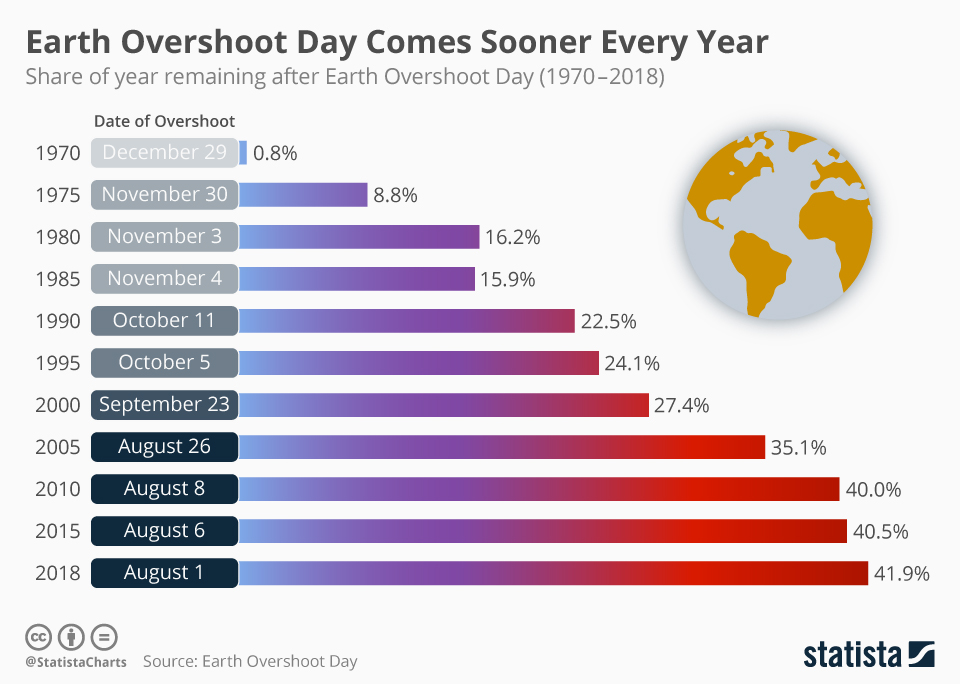
Tomorrow is Earth Day. One way to measure the human strain on the earth’s resources is to think about what is termed the overshoot day which is “calculated by comparing humanity’s total yearly consumption (Ecological Footprint) with Earth’s capacity to regenerate renewable natural resources in that year (biocapacity).” As the chart below suggests, every year we use up the earth’s resources at a much faster pace.
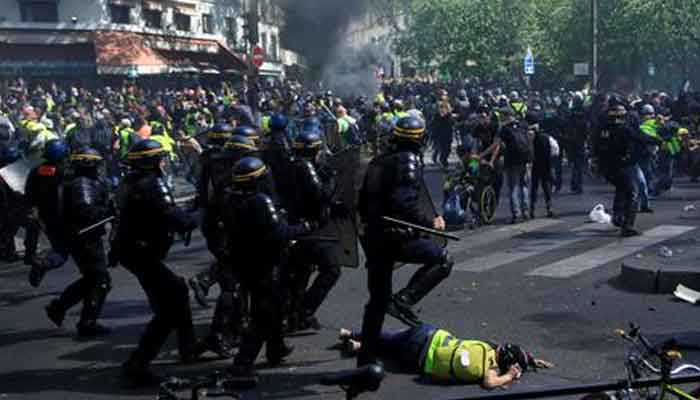
The yellow vest protests in France took place again, as they have since last November. The protests today, however, seemed to be revived as the protesters identified the $1 billion contributions from rich French citizens to rebuild the Notre Dame cathedral. The protesters assert that the contributions prove their point about income inequality in France, and that similar charity is not offered to ordinary French citizens. The question is legitimate and powerful: the rich can choose how to allocate their wealth, while the poor have no such options. Some of the protest sign revealed great anger: “‘Millions for Notre-Dame, what about for us, the poor?’ read a sign worn by a demonstrator. ‘Everything for Notre-Dame, nothing for the miserables,’ read another sign that evoked Victor Hugo’s well-known novel.”
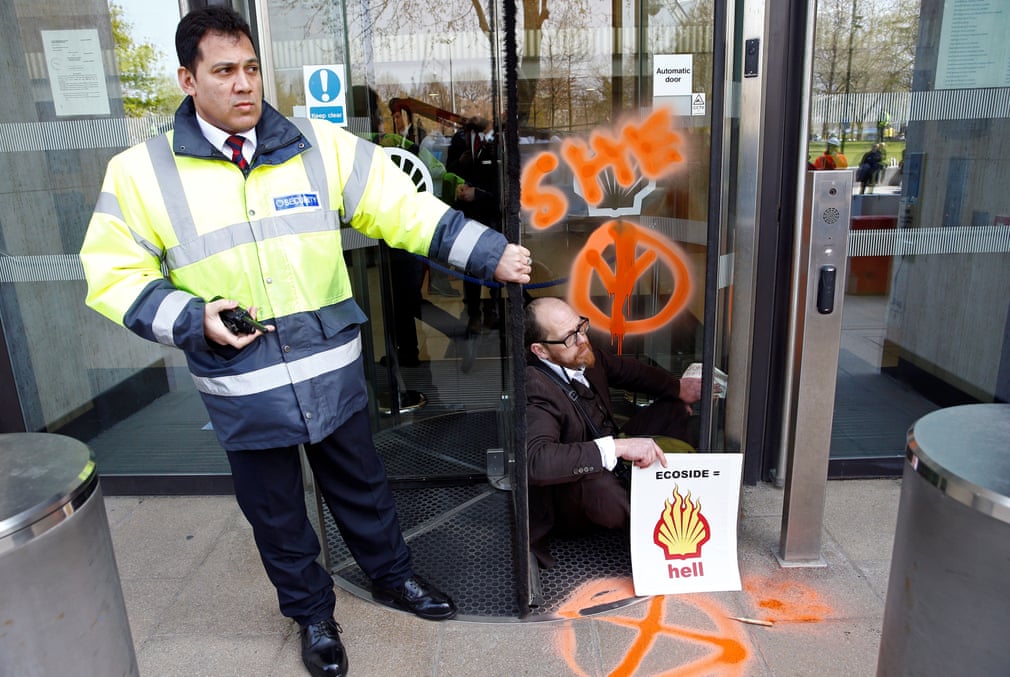
Climate change protests continue in many cities across the planet, as the group, Extinction Rebellion, has organized non-violent events designed to obstruct daily life for many people. Over 750 people were arrested in England alone. The escalation of the tactics by some environmental groups represents an important shift in perspective. Disruption is a politically expensive tactic: those disaffected by the disruption will likely condemn it. But it is difficult to imagine a more compelling way to underscore the urgency for action. There were fewer such protests in the US and it will be interesting to see if the tactic takes hold in the US.
Russia and China are not natural allies. They have years of conflict through which to view their relationship and they have fundamentally different social and economic patterns. But they do have shared interests. One such interest is the development of what is known as the Northern Sea Route, a sea lane through the Arctic. Russia controls about 50% of the Arctic Circle and China has a strong interest in developing a trade route that cuts weeks off of the traditional sea lanes through the South China Sea and the Indian and Atlantic Oceans. The two states are working hard to formalize this mutual interest: Russia is building up an infrastructure along the Northern Sea Route with Chinese assistance and the Chinese are very interested in getting access to Russian oil and natural gas. It remains to be seen, however, if the two states can overcome their mutual suspicions. But climate change has opened up the Arctic to great power politics.
Northern Sea Route
Francis Fukuyama is an astute analyst. I often disagree with his point of view, but I always find his arguments stimulating and provocative. He has written an essay for Eurozineon the different meanings of the word populist and how the term is used to describe many of the movements in the world today. He connects the economic dissatisfaction of many in liberal democracies with a need for cultural identity:
“This fear that immigrants are taking away our national identity is a theme that unites virtually all of the new populist movements. The reason that immigration is such a big policy issue for them is precisely because they feel that they used to define the national identity and that that is no longer true; that national identities are now being undermined not just by immigrants, but by the elites that support immigrants and want those immigrants to come in. And that defines the political contest that is ahead of us.”
Unfortunately, Fukuyama does not offer a solution to this conundrum, but I think his analysis is spot on.
North Korea has requested that US Secretary of State Mike Pompeo should not be involved in future negotiations between the US and North Korea. North Korean foreign ministry official Kwon Jong-gun referred to recent testimony by Pompeo who referred to North korean leader Kim as a tyrant. Kwon commented that Pompeo “spouted reckless remarks, hurting the dignity of our supreme leadership… to unveil his mean character”. According to the BBC:
“On Thursday, he [Kwon] said that if Mr Pompeo were to be involved in further talks, ‘the table will be lousy once again and the talks will become entangled’.
“‘Even in the case of possible resumption of dialogue with the US, I wish our dialogue counterpart would not be Pompeo but… [another] person who is more careful and mature in communicating with us,’ Mr Kwon said, according to the Korean Central News Agency (KCNA).
Pompeo has not been notably successful in his negotiations with North Korea so perhaps a change would be a good move. But we should wait to see if the Trump Administration wants to hold a 3rd summit with Kim. At this point, it appears as if Administration officials want to see more tangible steps before another summit is held.
Reporters without Borders is a non-governmental group that monitors press freedom in the world and it publishes a annual report entitled “World Press Freedom Index”. The 2019 report highlights a steady deterioration of protections for journalists and publishers. The report argues:
“The RSF Index, which evaluates the state of journalism in 180 countries and territories every year, shows that an intense climate of fear has been triggered — one that is prejudicial to a safe reporting environment. The hostility towards journalists expressed by political leaders in many countries has incited increasingly serious and frequent acts of violence that have fuelled an unprecedented level of fear and danger for journalists.”
National Public Radio summarizes the sad state of affairs: “….only 24% of the 180 countries and territories in the assessment were classified as having a safe or satisfactory environment for the press.” The report has some harsh words for the US which dropped down to 48th place out of 180 countries.
“As a result of an increasingly hostile climate that goes beyond Donald Trump’s comments, the United States (48th) has fallen three places in this year’s Index and the media climate is now classified as “problematic” (orange). Never before have US journalists been subjected to so many death threats or turned so often to private security firms for protection. Hatred of the media is now such that a man walked into the Capital Gazette newsroom in Annapolis, Maryland, in June 2018 and opened fire, killing four journalists and one other member of the newspaper’s staff. The gunman had repeatedly expressed his hatred for the paper on social networks before ultimately acting on his words.”
“A free press can, of course, be good or bad, but, most certainly without freedom, the press will never be anything but bad.” ― Albert Camus
The Trump Administration is renewing many of the sanctions against Cuba that were lifted by the Obama Administration. The US has maintained sanctions against Cuba since October 1960 after Fidel Castro overthrew the regime of Fulgencio Batista. The sanctions were imposed in an effort to lead to internal dissatisfaction with Castro in hopes that the regime would be overthrown. One can only say that the sanctions have failed to achieve that objective and after 59 years of futility one could reasonably expect a different tactic. Unfortunately, the Trump Administration hopes that the renewed sanctions would change Cuban policy toward Venezuela which largely consists of humanitarian and security assistance in exchange for imported oil. The European Union and Canada announced that they would not cooperate with the sanctions, suggesting that the new sanctions would be similarly ineffective.
Michael Corleone on the Eve of the Castro Revolution
The Guardian is reporting on the findings of a new book which argues that “half of England is owned by 25,000 landowners – less than 1% of its population”. The article quotes the author of the book:
“Guy Shrubsole, author of the book in which the figures are revealed, Who Owns England?, argues that the findings show a picture that has not changed for centuries. ‘Most people remain unaware of quite how much land is owned by so few,’ he writes, adding: ‘A few thousand dukes, baronets and country squires own far more land than all of middle England put together.’
“’Land ownership in England is astonishingly unequal, heavily concentrated in the hands of a tiny elite.’”
I found the report to be astonishing, far beyond what I would have predicted. The article continues:
“Carys Roberts, chief economist of the left-of-centre thinktank the Institute for Public Policy Research, said she was ‘shocked but not surprised’ by Shrubsole’s findings on the concentration of land ownership. She said that the concentration of land in a few hands was a big reason why wealth as a whole was so unequal in the country, as those without land were prevented from generating more income.
“She added: ‘We have this idea that the class structures have changed so that the aristocracy is not as important as it used to be. What this demonstrates is the continuing importance of the aristocracy in terms of wealth and power in our society.’
“She said that one effect of the sale of public land was that the public lost democratic control of that land and it could not then be used, for example, for housing or environmental improvements. ‘You can’t make the best social use of it,’ she added.”
I doubt that a similar study has been done in other countries, but it would be very important information for any electorate.
North Korea has announced that it has tested a new tactical guided weapon, although we do not yet know exactly what that means. It does not, however, appear to be a nuclear bomb or a ballistic missile, both of which would violate the implicit understandings between the US and North Korea about a weapons program “pause”. The New York Times puts the test in context:
“In recent days the North Korean leader has said he would give the United States until the end of the year to come up with concrete proposals that would lift sanctions on the North — an implicit warning that, after that deadline, it might resume the testing that appeared, in the summer of 2017, to be leading to conflict.
“But the announcement of Thursday’s test suggested that Mr. Kim was willing to consider raising the stakes sooner, and making Mr. Trump fear that his signature foreign policy initiative could collapse before the 2020 elections.”
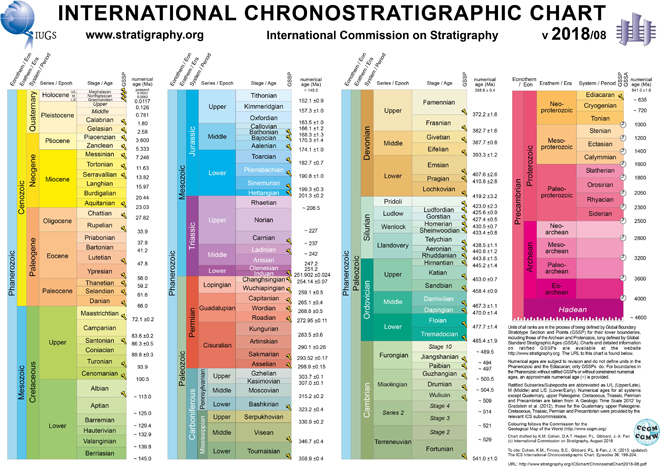
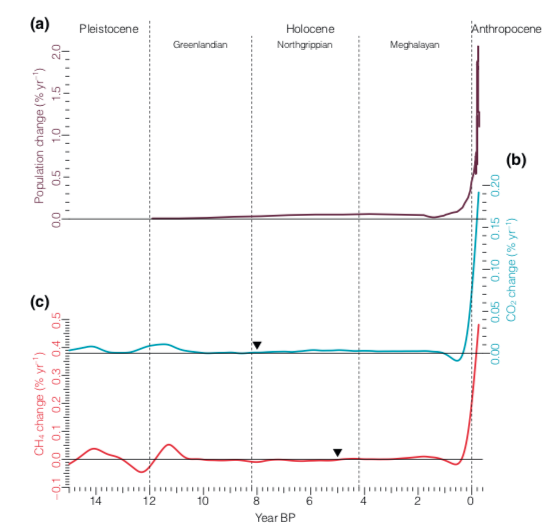
There is a debate in the scientific community about whether the process of climate change should be marked by identifying a new geologic era, which many researchers are calling the Anthropocene to distinguish it from the age that is called the Holocene Era. The interest in identifying a new era stems from the belief that human activities, rather than normal geologic processes, have altered the earth’s climate.
Geologic Time Scales
The debate over the question is intense among researchers who disagree over whether human activities have slowly been altering the earth’s climate or whether it was a dramatic change in the middle of the 20th Century. Humans have been altering the earth’s climate since the invention of agriculture. But there is a credible case that the Industrial Revolution was profoundly changed after World War II.
Population, Carbon, and Methane All Spiked After 1950
The debate is important to geologists and all others who study the earth, but it is not terribly meaningful to the debate over reducing greenhouse gas emissions. But I personally like the date of 1950 since I was born in 1949 and therefore predate the decisive change.
“The measure had passed the House on a 247-to-175 vote earlier this month and was approved by the Senate last month with the support of seven Republicans.
“This month’s House vote marked the first time both chambers had acted to invoke the same war-powers resolution to end U.S. military engagement in a foreign conflict. It also represented the latest instance of Congress’s challenging Trump’s decisions as commander in chief.”
Trump vetoed the bill because he believed that the war was necessary to protect the lives of US citizens. In his statement vetoing the bill, Trump wrote: “This resolution is an unnecessary, dangerous attempt to weaken my constitutional authorities, endangering the lives of American citizens and brave service members, both today and in the future.” Those who supported the bill argued that it was necessary to prevent further US complicity in the inordinately high civilian death rate in Yemen as well as to signal US disapproval of the Saudi government’s role in the murder of journalist, Jamal Khashoggi.
We still do not know what US President Trump’s plan for Middle East peace is, but, now that the Israeli elections are over, details about the plan are beginning to leak. The Washington Post has published an article about the plan which seems to be well-informed. Reuters is reporting that very few officials know the specifics of the plan, and that even President Trump has not been informed of many of the details. But it seems to be the case that the plan does not foresee an independent sovereign Palestinian state, ending many years of US support for that outcome. It also seems to be the case that the emphasis will be on economic development in the region, including Jordan and Egypt. But there are no plans for a substantial US monetary commitment which would be difficult to pass in the current Congress. The Palestinian Authority cut off all dialogue with the US after the US moved its embassy from Tel Aviv to Jerusalem and it is highly unlikely that it would support anything that did not include a Palestinian state. Indeed, high-ranking European officials have sent a letter toThe Guardian condemning any plan that does not include an independent Palestinian state:
“High-ranking former European politicians have condemned the Trump administration’s one-sided Israel-Palestine policy and called in a letter for Europe to reject any US Middle East peace plan unless it is fair to Palestinians.
“The letter, sent to the Guardian, the EU and European governments, was signed by 25 former foreign ministers, six former prime ministers, and two former Nato secretary generals.
“’It is time for Europe to stand by our principled parameters for peace in Israel-Palestine,’ read the letter, calling for a two-state solution in which Israel and Palestinian states live side by side.
“Europe, it said, should reject any plan that does not create a Palestinian state alongside Israel with Jerusalem as the capital for both countries.
“’Unfortunately, the current US administration has departed from longstanding US policy,’ it said, criticising Donald Trump’s 2017 recognition of ‘only one side’s claims to Jerusalem’.
“Washington had also ‘demonstrated a disturbing indifference to Israeli settlement expansion’ in the occupied West Bank and cut hundreds of millions of dollars in aid to Palestinians, a move the letter said was ‘gambling with the security and stability of various countries located at Europe’s doorstep’”.
We shall have to wait for the details of the plan, but it seems to be a non-starter at this point, and it is unlikely that the outcome of the recent Israeli election will make it any more likely.
“Since its launch last year, members have shut bridges, poured buckets of fake blood outside Downing Street, blockaded the BBC and stripped semi-naked in Parliament.
“It has three core demands: for the government to ‘tell the truth about climate change’, reduce carbon emissions to zero by 2025, and create a citizens’ assembly to oversee progress.
“Controversially, the group is trying to get as many people arrested as possible.
“One of the group’s founders, Roger Hallam, believes that mass participation and civil disobedience maximise the chances of social change. “
I would not be surprised to see similar and more dramatic protests in the future. Non-violent but disruptive protests are probably the only way to prod governments into taking the necessary steps to avoid the worst outcomes of climate change.



 World Politics News