Archive for the ‘World Politics’ Category
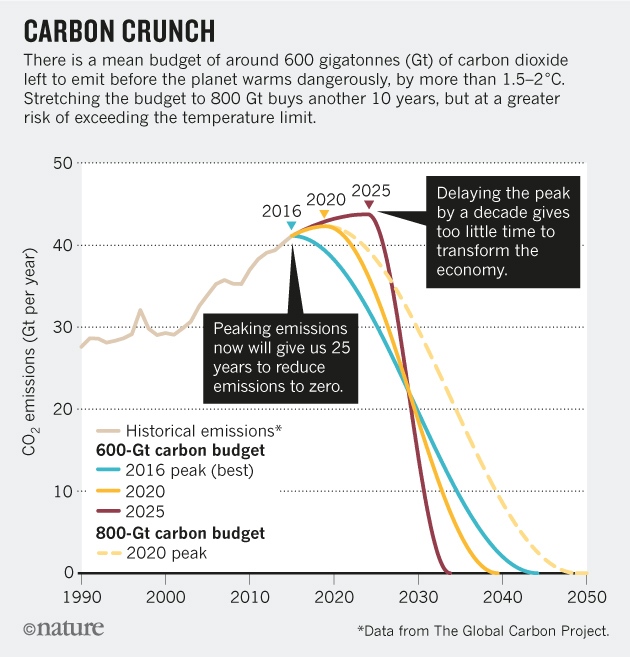
Researchers have published a paper in the science journal Nature that posits the year 2020 as a crucial year in the process of mitigating climate change. The authors note that there have been much progress in reducing emissions of carbon dioxide (CO2):
“Greenhouse-gas emissions are already decoupling from production and consumption. For the past three years, worldwide CO2 emissions from fossil fuels have stayed flat, while the global economy and the gross domestic product (GDP) of major developed and developing nations have grown by at least 3.1% per year (see go.nature.com/2rthjje). This is only the fourth occasion in the past 40 years on which emission levels have stagnated or fallen. The previous three instances — in the early 1980s, 1992 and 2009 — were associated with global economic predicaments, but the current one is not.
“Emissions from the United States fell the most: by 3% last year, while its GDP grew by 1.6%. In China, CO2 emissions fell by 1% in 2016, and its economy expanded by 6.7%. Although it is too early to tell whether this plateau will presage a fall, the signs are encouraging.”
The authors outline a six-point program to ensure that the progress continues, although concerns over the policies of the US are significant.
It appears that US President Trump no longer believes that China can exert effective pressure on North Korea to stop its nuclear program. It announced sanctions on a Chinese bank, a Chinese company, and two Chinese individuals for their ties to North Korea. At the same time, the Administration announced a $1.4 billion arms sales package for Taiwan. It is not clear how Chinese President Xi might respond to this pressure, but the open characterization of Chinese failure by President Trump on 20 June is certain to be viewed as disrespectful by China. Trump’s actions may also signal a return to the tougher line toward China he articulated during the campaign. But the biggest uncertainty is how close Mr. Trump may be to taking unilateral action against North Korea.
There has been a battle being waged for over a month in the city of Marawi in the Philippines between insurgents and government forces. The insurgents identify with the Islamic State and claim to represent the interests of Muslims who have suffered from discrimination at the hands of the Christian majority in the southernmost island of the Philippines, Mindanao. Islam is older than Christianity in the country, but Muslims are a minority who do not hold significant power. The conflict between Muslims and Christians in the country is an old conflict that has never been satisfactorily addressed.

Chatham House, a think-tank in London, has published an interesting report entitled “Chokepoints and Vulnerabilities in Global Food Trade”. It raises a concern that is not often considered–the vulnerability of the world food system to interruptions in food trade. According to the report:
“Global food security is underpinned by trade in a few crops and fertilizers. Just three crops – maize, wheat and rice – account for around 60 per cent of global food energy intake. A fourth crop, soybean, is the world’s largest source of animal protein feed, accounting for 65 per cent of global protein feed supply. Each year, the world’s transport system moves enough maize, wheat, rice and soybean to feed approximately 2.8 billion people. Meanwhile, the 180 million tonnes of fertilizers applied to farmland annually play a vital role in helping us grow enough wheat, rice and maize to sustain our expanding populations.”
The study identifies 14 places where the transport of items vital to food supply are vulnerable to breakdown. The global food system is far more fragile than we had believed.
Paul Pillar is my favorite analyst of US policy toward the Middle East (we were friends in college). He served on the Middle East desk of the CIA during the Iraq invasion, and subsequently left the Agency and wrote an essay on how the CIA’s analysis of Iraq’s weapons of mass destruction was “cherry-picked” by the Bush Administration. The essay was published in the March/April issue of Foreign Affairs. He is now at Georgetown University and he has written another essay on how the Trump Administration is “cherry-picking” the evidence on Iran in order to justify a policy of regime change in that country. Paul knows what he is talking about and his fears should be taken seriously.
Nick Turse has written an essay for The Nation which points out that the Trump Administration has maintained Special Operations forces into 137 countries (in many cases, some of these troops are hold-overs from the Bush and Obama Administration). There are only 195 states in the international system so the US has troops in 70% of the world’s countries. Most Americans are completely unaware of how extensive American military commitments are. The commitments are clear evidence of imperial overstretch.
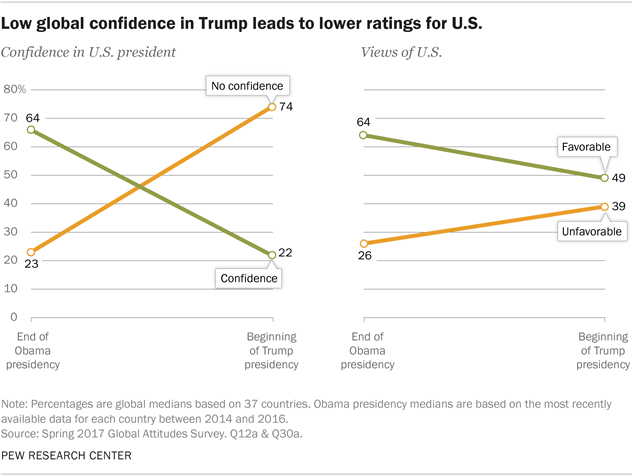
The Pew Research Center has released a new poll showing that foreign publics have lost confidence in the US. The report on the poll states:
“Trump and many of his key policies are broadly unpopular around the globe, and ratings for the U.S. have declined steeply in many nations. According to a new Pew Research Center survey spanning 37 nations, a median of just 22% has confidence in Trump to do the right thing when it comes to international affairs. This stands in contrast to the final years of Barack Obama’s presidency, when a median of 64% expressed confidence in Trump’s predecessor to direct America’s role in the world.”
The fall in confidence is dramatic. Interestingly, the only leader mentioned in the poll who received favorable ratings was German Chancellor Angela Merkel. The poll also has some very interesting insights on the views in specific countries. US President Trump was viewed favorably in only Russia and Israel.

Prosecutors in Brazil have charged the country’s President with corruption. President Michel Temer came into office just last year after the previous President, Dilma Rousseff, was impeached on corruption charges as well. Temer has substantial support in the Brazilian Congress, but he is deeply unpopular with approval ratings in the single digits. He has been trying to introduce stringent neoliberal reforms to a deeply troubled economy with an unemployment rate of almost 14%. The scandal will make governing Brazil even more difficult.

The US President has released the following statement:
“The United States has identified potential preparations for another chemical weapons attack by the Assad regime that would likely result in the mass murder of civilians, including innocent children. The activities are similar to preparations the regime made before its April 4, 2017 chemical weapons attack.
“As we have previously stated, the United States is in Syria to eliminate the Islamic State of Iraq and Syria. If, however, Mr. Assad conducts another mass murder attack using chemical weapons, he and his military will pay a heavy price.”
The press is reporting that these preparations are taking place at the same air base it bombed in April. Unfortunately, there has been no media coverage of the report this blog covered yesterday that the “chemical attack” actually occurred. The report that Syria is considering another chemical attack makes no sense. Why would Syria invite US retaliation and the opprobrium of the world? All the evidence suggests that Syrian President Assad is winning the civil war–a chemical weapons attack at this point would undermine his gains. On the other hand, the US might be preparing the world for a serious air attack.
On 6 April US President Trump authorized an air attack on a Syrian government air base in retaliation for what he claimed was the use of chemical weapons against Syrian civilians. The attack was a dramatic shift in US policy. Trump justified the attack with these words: “”There can be no dispute that Syria used banned chemical weapons, violated its obligations under the Chemical Weapons Convention and ignored the urging of the UN Security Council. Years of previous attempts at changing Assad’s behavior have all failed and failed very dramatically.” Welt, a German media outlet, has published an essay by Seymour Hersh which raises serious doubts about the accuracy of that claim. Most importantly, Hersh provides evidence that the US intelligence services knew that chemical weapons had not been used but that President Trump made the decision to attack before that information was provided to him. Welt also published a transcript of conversations between a security adviser and an active US American soldier on duty on a key operational base about the events in Khan Sheikhoun to corroborate the story.
In a world of nation-states, the idea that states have complete control over their borders is incontestable. Generally speaking, those borders create a clear distinction between citizens and non-citizens, and the traditional assumption is that the primary obligation of states is to their citizens. Thus, states have the power to either allow or bar refugees. A larger question than the simple legal question, however, is whether there are moral obligations to allow entry to refugees who face discrimination, mortal danger, or extreme deprivation. The world is currently facing the largest number of refugees in recorded history, and the moral imperatives to allow entry to such persons is being strained. Joseph Carens, a professor of political theory at the University of Toronto, makes the argument in favor of refugees.
Syrian refugees attempting entry into Turkey in 2015

A third study published this year indicates that ocean levels are rising faster than anticipated. The rate of sea level increase in 1993 was 2.2 millimeters a year and in 2014 the rate of increase was 3.3 millimeters a year. Most of the increase comes from thermal expansion of the seas due to higher water temperatures and melting of land-based glaciers in the North and South Poles and in other areas of the world. Both causes are related to climate change, and the studies suggest that the rate of increase will increase in the future.
Over the last year women working in garment factories in Cambodia have suffered serious health concerns. The factories supply sportswear to some of the world’s most popular brands, such as Nike, Puma, and Asics. The working conditions in the factories are horrible. According to The Guardian:
“The women who collapsed worked 10 hour days, six days a week and reported feeling exhausted and hungry. Excessive heat was also an issue in three factories, with temperatures of 37C (98°F). Unlike in neighbouring Vietnam, where factory temperatures must not exceed 32C, Cambodia sets no limit, though if temperatures reach a “very high level” causing difficulties for workers, employers must install fans or air conditioning.”
There are non-governmental campaigns to improve the working conditions in such factories, such as the group, Women in Informal Employment: Globalizing and Organizing (WIEGO). They are having an effect, but progress is very slow.
Venezuela’s protests continue and the country is in total collapse. Venezuelan citizens watched Venezuelan authorities shoot a protester on live TV as there seems to be no restraints on the government forces supporting the regime of President Maduro. Protesters who have been arrested have been subjected to inhumane treatment and conditions. The international community seems powerless to influence the course of events–there does not seem to be any way out of this impasse.

Fareed Zakaria has written an op-ed for the Washington Post which argues that US President Trump’s policies are leading the US “into another decade of war in the greater Middle East. And this next decade of conflict might prove to be even more destabilizing than the last one.” The US has ramped up is military responses in Syria, Yemen, Iraq, and Afghanistan but there does not seem to be any underlying policy justifying these responses. It seems to be just more of the same policies of the last 16 years which have only served to destabilize the region even further.
The conflict in Yemen has been going on for years as Saudi Arabia and Iran fight over control of the small country. The Saudi Arabian attacks have been devastating and ruthless, and the consequences of the destruction of civil society is unfortunately predictable. The people of Yemen are now confronting one of the largest outbreaks of cholera in recent years, with over 200,000 people infected and 5,000 more each day. The outbreak is due to the breakdown of medical and sanitation facilities. The victims of this outbreak should be regarded as victims of the war. The recent elevation of Mohammed bin Salman to be the Crown Prince of Saudi Arabia likely means that the Saudi attacks on Yemen will only become more savage. The United Arab Emirates (UAE), a member of the Saudi coalition, has maintained control over the city of Aden in southern Yemen where the former President of Yemen, Abdrabbuh Mansur Hadi, remains sequestered waiting for the Saudis to return him to power. The Saudis believe that the Houthi rebels who overthrew Hadi are under control of its arch-rival in the Gulf region, Iran. Several human rights groups accuse the UAE of running secret detention and torture cells in Aden. The Saudis and its coalition partners are using weapons provided by the US to conduct the war in Yemen and US President Trump has recently sold the Saudis significantly more weapons, assuring that the war will not end soon.

China and the US have reached an agreement to structure security talks in the future, suggesting that the two sides will engage in regular discussions about matters of disagreement. According to Global Times, a media outlet generally regarded as representing the voice of the Chine Communist Party:
“China and the United States reached an important consensus on the development of bilateral relations and security issues at a high-level dialogue held Wednesday in the US capital of Washington D.C..
“The First Round of China-US Diplomatic and Security Dialogue, which was described by both sides as “constructive” and “fruitful,” represents a major step in implementing the consensus reached by Chinese President Xi Jinping and his US counterpart Donald Trump during their meeting in Florida in April.
“Looking ahead, the two sides pledged to expand mutually-beneficial cooperation and manage differences on the basis of mutual respect, all in a bid to promote the steady development of China-US relations in the long term.”
One interesting feature of the agreement is that apparently the Chinese have finally agreed with the US that the objective of discussions with the North Koreans should be the “complete, verifiable and irreversible” denuclearization of the Korean peninsula. It is extremely doubtful that the North Koreans will ever agree to that objective as long as American troops are stationed in South Korea.
It has been reported earlier that US President Trump has given greater authority to the US Secretary of Defense, General Mattis, to determine troop levels in Afghanistan and that Mattis has decided to send an additional 4,000 American troops at this time. The ability of the US State Department to support the diplomatic aspects of a renewed military commitment to Afghanistan, however, has slowly declined. There was a special office set up in the State Department, the Office of the Special Representative for Afghanistan and Pakistan, during the height of the American war effort in the country. That office had about a hundred staff members, but it is now down to a handful of staffers and the Trump Administration is thinking about abolishing the office. Decreasing the level of diplomatic expertise at the same time an increased military commitment is being contemplated is a foolish policy.
The Financial Times ran an article on the use of the British Virgin Islands (BVI) as a tax haven. The FT has a strict paywall so unless you are using a computer at an institution that has a subscription the link will not get you to the article. But the article estimates that the BVI registers about $1.5 trillion of corporate and personal wealth:
“Offshore companies in the British Virgin Islands have assets of more than $1.5tn, more than twice the sum estimated in 2010.
“Two-thirds of the offshore companies registered in the BVI are used for “corporate structuring”, and more than 140 listed businesses in London, New York and Hong Kong have a unit in the BVI, according to research carried out on behalf of the BVI government.”
The money is probably not physically present in the BVI but governments which wish to tax that wealth has no idea who owns it. The BVI claims not to be a “tax haven”. According to Lorna Smith, interim executive director of BVI Finance: “The BVI has never been a secrecy jurisdiction. We adhere to privacy for clients.” If one can tell me the difference between secrecy and privacy, let me know. Just for information, the BVI is about 58 square miles and has a population of about 30,000 people.
Saudi Arabia, Bahrain, United Arab Emirates and Egypt have issued a list of 13 demands to Qatar before they will lift the blockade on the small country. The demands are extensive, including a demand that Qatar reduce its diplomatic representation with Iran, a demand that ignores the fact that Iran and Qatar share one of the world’s largest natural gas fields. The states are also demanding that Qatar shut down its media outlet, al Jazeera. The Washington Post has a good article on why Saudi Arabia hates al Jazeera so much. Qatar was given 10 days to comply, but it is extremely doubtful that Qatar will accede to all the demands. Kuwait is trying to mediate the crisis, but these extreme demands suggest that there might be little willingness to make any concessions.
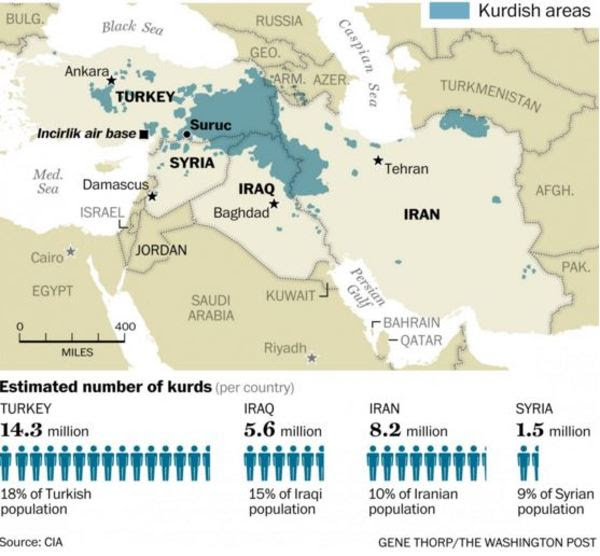
The successes of the Kurdish militias in battles against Daesh (the Islamic State) is leading to a conclusion that will roil the Middle East. The Kurds have proven that they are able to hold and defend territory, that they have the passionate support of citizens who define themselves as Kurds, and that they are reliable battle allies. These are all the characteristics of a nation-state, a demand that the Kurds have been pursuing since the collapse of the Ottoman Empire. Once the battle against Daesh is over, the Kurds will undoubtedly press the world to recognize their nation-state, much to the dismay of the Turks, the Syrians, the Iraqis, and the Iranians.
The cat and mouse game between the US and Russian pilots continues and is becoming incredibly dangerous. Reuters is reporting that a NATO jet buzzed a Russian Sukhoi-27 military jet carrying Russian Defense Minister Sergei Shoigu from the Russian enclave in Kaliningrad back to Russia. The incident follows similar buzzing incidents over the Baltic and Black Seas and the shooting down of a Syrian government fighter plane as well as three Syrian drones. The collision between the Arleigh Burke-class destroyer USS Fitzgerald and 29,000-ton Filipino container ship ACX Crystal on 17 June off the Japanese coast is an example of how accidents can occur. An accident between US and Russian pilots would be a serious crisis.

In the case of a Russian-American confrontation, it is clear that President Putin enjoys far greater public confidence than does President Trump at this time. The Pew Research Center conducted a poll that indicates that, despite an economic slowdown, Putin is very popular at home.

The United Nations has published its World Population Prospects 2017 and predicts that the global population will reach 8 billion in 2023. The Guardian reports that:
“Half the growth in numbers of people will come from just nine countries: India, Nigeria, Democratic Republic of the Congo, Pakistan, Ethiopia, Tanzania, the US, Uganda and Indonesia. By 2050 seven of the world’s 20 most populous nations will be African.”
Europe, on the other hand, will likely suffer a population decline and that “the number of people over 60 will top 1 billion in 2018 – and 2 billion by 2050.”
US President Trump hosted Ukrainian President Petro Poroshenko at the White House today. In the photo-op, Mr. Trump made a mistake that many make when referring to Ukraine: he referred to “the” Ukraine. Ukrainians have a problem with the declarative article. The Washington Post explains:
“Exactly why the declarative article came to be attached to Ukraine in the first place is hard to know, but the reasoning may lie in the country’s history. Between 1919 and 1991, Ukraine was officially known as the Ukrainian Soviet Socialist Republic in the English language; it may have been this Soviet period that resulted in the ‘the’ being added. A more likely alternative may lie in the etymology of the word ‘Ukraine,’ which is believed by many (but not all) scholars to come from the Old Slavic word “Ukraina,” thought to have meant something like ‘the borderland.’
“This explains why ‘the Ukraine’ annoys many Ukrainians. The mistake seems to imply that Ukraine can only be defined by its relation to its larger neighbor, Russia, and the years of domination it suffered under Moscow during the Soviet Union and the Russian Empire before that. Calling Ukraine ‘the Ukraine’ would seem to question its sovereignty: A fraught thing after Russia’s annexation of Crimea and support for rebels in east Ukraine.”
Nature Climate Change has published a research paper on the likelihood that almost half of the world’s population will be subjected to lethal heat events for at least 20 days a year by the end of the century if climate change is not reversed. From the abstract to the paper:
“We reviewed papers published between 1980 and 2014, and found 783 cases of excess human mortality associated with heat from 164 cities in 36 countries. Based on the climatic conditions of those lethal heat events, we identified a global threshold beyond which daily mean surface air temperature and relative humidity become deadly. Around 30% of the world’s population is currently exposed to climatic conditions exceeding this deadly threshold for at least 20 days a year. By 2100, this percentage is projected to increase to ∼48% under a scenario with drastic reductions of greenhouse gas emissions and ∼74% under a scenario of growing emissions. An increasing threat to human life from excess heat now seems almost inevitable, but will be greatly aggravated if greenhouse gases are not considerably reduced.”
The evidence continues to accumulate that climate change is occurring and that adapting to those changes is going to be very difficult.
“While I greatly appreciate the efforts of President Xi & China to help with North Korea, it has not worked out. At least I know China tried!”
It is very difficult to interpret tweets and President Trump is not careful with his language, so it is impossible to know how all these issues coincide. But at one point it seemed as if President Trump was expecting China to take the lead on preventing another North Korean nuclear test. The phrase “it has not worked out” may signal that President Trump will take action if there is a test.
A US aircraft shot down a Syrian government aircraft near the Syrian city of Raqqa. According to the US Central Command:
“At approximately 4:30 p.m. Syria time, June 18, Pro-Syrian regime forces attacked the Syrian Democratic Forces-held town of Ja’Din, South of Tabqah, wounding a number of SDF fighters and driving the SDF from the town.
“Coalition aircraft conducted a show of force and stopped the initial pro-regime advance toward the SDF-controlled town.
“Following the Pro-Syrian forces attack, the Coalition contacted its Russian counterparts by telephone via an established ‘de-confliction line’ to de-escalate the situation and stop the firing.
“At 6:43 p.m., a Syrian regime SU-22 dropped bombs near SDF fighters south of Tabqah and, in accordance with rules of engagement and in collective self-defense of Coalition partnered forces, was immediately shot down by a U.S. F/A-18E Super Hornet.
“Ja’Din sits approximately two kilometers north of an established East-West SDF-Syrian Regime de-confliction area.”
The report does not say whether an American pilot was flying the F/A-18E Super Hornet but we should assume that it was not an American pilot. The “de-confliction” area (a very awkward word) refers to an area where the opposing forces (primarily the US and Russia) have agreed not to fire on each other. The Syrian Democratic Forces consist of:
“The Syrian Democratic Forces (Kurdish name: Hêzên Sûriya Demokratîk, arabic name: قوات سوريا الديمقراطية), usually shortened as SDF or QSD, are an alliance of Kurdish, Arab, Turkmen, Assyrian and Armenian militias mainly fighting against ISIS, Al-Nusra Front and other Jihadist groups in the Syrian Civil War. The goal of the group is to establish and protect the federal region ‘Rojava – Northern Syria’.”
The strike represents a significant escalation of the conflict. There appears to be an interest in some circles of the Trump Administration to increase the American role in the conflict. According to Foreign Policy:
“Ezra Cohen-Watnick, the senior director for intelligence on the National Security Council, and Derek Harvey, the NSC’s top Middle East advisor, want the United States to start going on the offensive in southern Syria, where, in recent weeks, the U.S. military has taken a handful of defensive actions against Iranian-backed forces fighting in support of Syrian President Bashar al-Assad.”
In response, the Ministry of Defence of the Russian Federation issued the following statement on its Facebook Page (you have no idea how hard it is for me to type that out–Bismarck is rolling over in his grave):
“Statement of the Russian defence ministry fact downing of thunder in a Syrian Village Al-Rasafe Su-22 aircraft Syrian Air Force:
“On 18 June 2017 G. American F-18 fighter from the international coalition missile-air plane ” SU-22 Syrian air force, as the support units of government troops, leading offensive against ISIS terrorists, in the town of al-rasafe (40 kilometers southwest of g. Raqqa).
“Striking a Syrian aircraft was destroyed. Syrian air force pilot ejected over the area controlled by ISIS, terrorists, his fate is unknown.
“Syrian air force aircraft destroying American Aviation in Syrian airspace, cynical violation of the sovereignty of the Syrian Arab Republic.
“Repeated Hostilities Aviation USA under the guise of “fighting terrorism” against the legitimate armed forces United Nations Member States, are a flagrant violation of international law and in fact – military aggression towards the Syrian Arab Republic.
“Moreover, the Syrian air space at a given time, the tasks of Russian aircraft of the code. However, coalition forces not utilized an existing channel of communication between air commands airbase el udeyd (Qatar) and hmeymim airbase to prevent incidents in Syrian air space.
“Consider this action U.S. military commanders as wilful failure to comply with its obligations under the memorandum of the prevention of incidents and ensure flight safety aviation during operations in Syria, dated 20 October 2015 G.
“The Ministry of defence of the Russian Federation from 19 June this year. Ceases to interaction with the American side in the framework of the memorandum on the prevention of incidents and ensure flight safety aviation during operations in Syria, and requires a thorough investigation into the American command with providing information about its results and the measures taken.”
“In areas of non-Combat-capable of Russian aircraft in the sky of Syria any aerial installations, including planes and unmanned international coalition found west of r. Euphrates will be taken in by Russian escort aircraft ground and air defence as air targets “.
Sputnik, a Russian-government controlled media offers an idea of the defensive capabilities of the Russian military in Syria–they are formidable.
,The Iranians have also escalated their role in the conflict by launching a missile strike against Daesh (Islamic State) forces in Syria. The strikes were in retaliation for the Daesh attack on the Iranian parliament and the mausoleum of Ayatollah Khomeini in Tehran.

To make matters more complicated, the Wall Street Journal is reporting that Israel has been giving money and military assistance to Sunni rebels in Syria for the last four years. Israel has conducted air raids against forces in Syria to prevent the flow of arms to Hezbollah, an Iranian backed group in Syria opposed to the existence of the state of Israel. But this report may serve to legitimize some of the rebels fighting against Assad and will certainly feed the Iranian propaganda war against those opposed to Assad.
Finally, the Saudi Arabian Press Agency is reporting that the Saudi military foiled an attack by members of the Iranian Revolutionary Guard on the Marjan offshore oil field, one of Saudi Arabia’s largest oil fields. According to the Saudis, three Iranians were captured in a vessel carrying explosives. If this report is true, then it represents a very serious escalation of the tension between Saudi Arabia and Iran.


