The US Senate passed, 98-2, new sanctions against Russia. The legislation amplifies current sanctions by imposing penalties on non-US companies that are involved in various investments in Russia, including those involved in building pipelines. The tough sanctions reflect a resolve by the Senate to penalize Russia for its interference in the US presidential elections in 2016 as well as Russian aggressive moves in Ukraine and eastern Europe. Germany and Austria complained bitterly about the legislation because it jeopardizes the building of a new natural gas pipeline from Russia to Europe, the Nord Stream 2. We expect that the Trump Administration will lobby hard in the US House of Representatives to change the legislation, an action which will likely aggravate those in the US who believe that the Trump Administration is too “soft” on Russia. Coincidentally, the controversy sheds light on the issue of the natural gas pipeline from Qatar to Turkey since that natural gas will compete with Russian natural gas.
Nordstream Pipelines
Alex de Waal works for the World Peace Foundation and he has written an essay for The London Review of Books on the use of starvation as a weapon of war. He is concerned at the present time about starvation which is occurring in north-eastern Nigeria, Somalia, South Sudan and Yemen. In all these cases, millions are dying because food is deliberately being withheld in order to force concessions among warring factions in brutal civil wars. Unfortunately, this tactic is far more common than believed:
“The organisation I work for, the World Peace Foundation, has compiled a catalogue of every case of famine or forced mass starvation since 1870 that killed at least 100,000 people. There are 61 entries on the list, responsible for the deaths of at least 105 million people. About two thirds of the famine deaths in this period were in Asia, about 20 per cent in Europe and the USSR, just under 10 per cent in Africa. The biggest killers were famines that resulted from political decisions, among them the Gilded Age famines, the Great War famines in the Middle East, including the forced starvation of a million Armenians, the Russian Civil War famine, Stalin’s starvation of Ukraine from 1932 until 1934 (now known as the Holodomor), the Nazi ‘hunger plan’ for the Soviet Union, the famines during the Chinese Civil War, the starvation inflicted by the Japanese during the Second World War, and by Mao’s Great Leap Forward of 1958-62, the largest famine on record, which killed at least 25 million.”
Humanitarian organizations have a very difficult time addressing starvation under these circumstances and the issues raise important ethical and practical concerns.
Daniel Kurtz-Phelan has written a short piece on the new Cuba policy articulated by US President Trump for New York Magazine. He points out the narrow political concerns that underlie the policy reversal and how those concerns ignore the changes in Cuba that former President Obama’s openness precipitated. Most importantly, Kurtz-Phelan suggests that the reversal of policy leaves the US out in the cold as other nations rush to position themselves in anticipation of the retirement of Raul Castro in 2018.
Joseph Nye has been writing about international relations for many years and has a very sophisticated view of the international system, although one that is quite solicitous of American power. He has written an essay on China’s Belt and Road Initiative (BRI), an ambitious infrastructure program that seeks to create a land-based trading route reminiscent of the old Silk Road. The initiative is not simply economic–it has powerful political implications as well. Nye believes, however, that Chinese political aspirations of achieving a level of dominance through the BRI will likely be less than hoped for.
There have been numerous studies documenting the growth of income and wealth inequality in the world. The conclusions from these studies are dramatic: both income and wealth are being increasingly concentrated in a smaller group of people. Yet these studies may underestimate the concentration of income and wealth because they rely on tax records. We know that a lot of money is hidden in tax havens such as the Cayman Islands or the British Virgin Islands, but estimating how much money is hidden is very difficult. A pioneering study by a group of researchers with access to information leaked from some of these tax havens came to this startling conclusion, summarized by The Guardian:
“So what are the consequences for inequality? At the very top of the pyramid, it is much greater than previously estimated. In Norway, where the available wealth data is particularly detailed, the super-wealthy appear to be 30% wealthier than previously thought, when all the wealth hidden in tax havens is taken into account. The share of wealth owned by the top 0.1% increases from 8% to 10%”.
More action must be taken to dismantle the laws that allow people to avoid taxation if we expect taxes to be paid fairly.
The Associated Press is reporting that the Trump Administration is planning to send 4,000 additional soldiers to Afghanistan. This deployment is the largest yet of the Trump Administration. At its peak in 2011, NATO forces were about 140,000 in 2011 but those levels were drawn down by President Obama to about 9,800 in 2015. The mission of the new troops remains unclear at this point, but it is hard to see how additional soldiers can accomplish what so many more failed to accomplish earlier.
US President Trump gave a speech in Miami declaring that, in his words, “I am canceling the previous administration’s completely one-sided deal”. He did not, however, revoke the decision to place a US Embassy in Cuba. He did restore the embargo on Cuba which will cause a certain degree of misery to the Cuban people but which did not, over its entire history since 1962 produced no changes in Cuban policy toward the US. Mr. Trump claims that this reversal in policy is due to the authoritarian aspects of the Cuban government. This exercise in futility stands in strong contrast to the US embrace of authoritarian regimes in the Middle East, Russia, and the Philippines.
Antarctica’s 2016 summer was apparently warmer than normal as ice melts on the West Antarctica ice shelf lasted longer than usual and covered areas as wide as the US state of Texas. We are slowly learning more about the South Pole and the effects of climate change on the weather there. The accumulating evidence suggests that we knew far less about Antarctica than we thought, and that climate change is already having a dramatic effect.
Click on the link for a video of a rare waterfall in Antarctica
There is, however, growing evidence that the world is taking climate change seriously. One of the most effective ways to reduce the emission of greenhouse gases is through carbon pricing–essentially taxing users for their damage to the environment. Carbon pricing is slowly becoming effective in a growing number of countries, as this graphic from Sightlines indicates:
Dominic Tierney has written an interesting essay for The Atlanticabout a topic that is almost always on the minds of students of international relations whenever a leader gets into trouble at home–whether a foray into foreign affairs can divert the attention of a dissatisfied populace. As Tierney recounts the history of such diversions:
“In the real world, many historians interpret the Crimean War of 1853-1856 as an effort by French Emperor Louis Napoleon to buttress his support among French Catholics by fighting the Orthodox Russians. Karl Marx wrote that the emperor ‘has no alternative left but revolution at home or war abroad.’ In 1857, President James Buchanan sent troops to reassert federal control over the Mormon regime in Utah, and in the words of one confidant, drown out ‘the pipings of Abolitionism’ with the ‘almost universal excitement of an Anti-Mormon Crusade.’ Shortly after the outbreak of the Russo-Japanese War in 1904, the Russian minister of the interior said: ‘We need a little, victorious war to stem [the tide of] revolution.'”
We worry about these possibilities because difficulties abroad stoke feelings of nationalism which can tamp down domestic differences. Fortunately, this pattern is not hard and fast and we can hope that US President Trump does not intend to use this gambit to divert attention away from his domestic problems.
Income inequality in the US has grown tremendously since the 1980s. The pattern is a dramatic break from the pattern established after the Great Depression in which incomes were spread more equitably. It is also a pattern that manifests the dismantling of the financial controls, such as the repeal of the Glass-Steagall Act which prevented commercial banks from making speculative investments, that were imposed in order to prevent another Depression. The political consequences of such a skewed distribution of income are hard to predict, but there is little question that the legitimacy of political institutions in the US is being questioned by many.
About 1700 people were arrested in protests against corruption in Russia. Among those arrested was the leader of opposition to President Putin, Alexei Navalny. Navalny has stated his intention to stand for election in opposition to President Putin in the Russian elections scheduled for next March. The protests were held despite intense opposition from the authorities who refused to grant some permits and changed venues after permits had been granted. Participation in such protests is a dangerous activity in Russia and the willingness of so many to express their views is testimony to a deep commitment to good politics in Russia. If one were watching the state-owned media, one would hardly be aware that such protests ever occurred.
“This is the cost the Tsai administration needs to pay. Tsai has always refused to acknowledge the 1992 Consensus, leading to a great leap backward in cross-Straits ties. She should understand that the 1992 Consensus is an important political foundation to maintain stable cross-Straits relations. If she takes step to weaken this foundation, her administration will be bound to suffer the consequences.
“During Ma Ying-jeou’s eight-year rule, the number of countries that Taiwan had “diplomatic” ties with remained at 23 and Taiwan signed free trade agreements with two countries. Now Tsai has been in office for only a year or so, but three countries have severed ties with Taiwan. Tsai claimed she would win dignity for Taiwan from the international community, but Taiwan has ended up having less space on the world stage. The people of Taiwan have been taught a lesson as well.”
It remains to be seen whether all support for Taiwan begins to ebb because of this significant change.
For those who have a difficult time understanding the British exit from the European Union (Brexit), I strongly recommend this video from John Oliver. But not if one is easily offended.
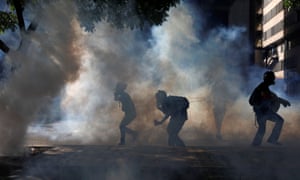
Violent protests are entering a third month in Venezuela. The situation continues to deteriorate as President Maduro refuses to make any concessions to those who believe that he has destroyed Venezuela’s democratic institutions. 67 people have died in this most recent phase of protests, but, unlike the protests in 2014, it does not seem as if these protests will die down. Infant mortality and malaria rates are on the rise as basic medical care becomes increasingly inaccessible. Venezuela is in a state of complete collapse and it is hard to see how the situation can be stabilized.
Protests in Caracas on Saturday
A counter-terrorism court in Pakistan has condemned a man to death for the crime of blasphemy. Taimoor Raza, 30 years old and a Shia Muslim, had engaged in a sectarian debate on Facebook and was convicted of insulting the Prophet Mohammed by criticizing the Deobani sect, a Sunni Muslim sect. Raza had unknowingly engaged in the Facebook debate with a counter-terrorism agent of the Pakistani government. The application of blasphemy laws to social media represents a major expansion, and an expansion that seriously threatens to use those laws in ways that could be a weapon of personal vendetta.
The referendum in Puerto Rico yielded mixed results. 97% of those voting voted for statehood. That sounds like a resounding vote in favor of statehood, but only 23% of Puerto Ricans voted in the referendum. The ballot question was worded in a specific manner–it asked for an answer to the question as to how Puerto Rico should implement the “decolonization” of Puerto Rico. The wording of the ballot and the exceptionally low turnout (Puerto Rico usually averages 80% participation) suggests that the US Congress will feel no pressure to act upon the results.
The French conducted the first round of their parliamentary elections and Emmanuel Macron’s new party appears headed for a significant victory, suggesting that it might get between 390 and 430 of the 577 seats available. Given that the party, En Marche!, was only founded last year, this possible outcome is stunning. Unfortunately, the election also saw a significant number of non-voters, with only 49% of registered voters actually casting a ballot. But even the abstentions indicate that the established parties of France, which have been around for a very long time, do not seem to command the loyalty of the voters–a troubling sign.
Elena Milashina, a reporter for the Russian magazine, Novaya Gazeta, has written about an intense campaign in Chechnya against gays. Chechnya has a long history of unrest against central control from Moscow–most of its residents are Muslim. It has been ruled by Ramzan Kadyrov who, in return for professing total loyalty to President Putin, has been allowed to run the region essentially as a fiefdom. The campaign against gays includes torture, detention, and murder, but Moscow has done little to protect its citizens human rights. Without the courage of reporters like Milashina it is unlikely that the world would be aware of this horrific situation.
Paul Pillar is one of the most learned and intelligent analyst of Middle Eastern affairs and he has written a short essay for the National Interest on the dust-up between Saudi Arabia and Qatar. The dispute itself seems larger than the issues involved, and Pillar makes the case that the Trump Administration has unnecessarily aggravated the tensions because of its hard-line against Iran. Fortunately, it appears as if Kuwait and Oman are trying to mediate the crisis to avoid it spilling over into violence.
The US gained control over Puerto Rico in the Spanish-American War of 1898. Since that time, the island has been an American territory–an ambiguous relationship. It was not a colony and the people of Puerto Rico have since gained American citizenship. But is was not a state in the United States and the people do not have the right to vote in a national election, nor do they have a vote in Congress. For the fifth time since 1898, the people will have a chance to vote on their preferences. There will be a referendum tomorrow that offers three choices: the status quo, independence, or statehood. The last vote in 2012 favored statehood, but because of a poorly worded referendum, the US Congress ignored the vote. The odds are that the Puerto Ricans will favor statehood because the island is facing a crippling budget crisis that it cannot address on its own. It is, however, unlikely that the Republican Congress will honor the vote since the island leans Democratic.
In the aftermath of the financial crisis of 2008-09 the US Congress passed what came to be known as the “Volcker Rule”. Named after a former Chairman of the Federal Reserve, the rule did two things: “The first limits banks’ ability to buy and sell exotic financial instruments, and the second limits the ability of banks to operate and invest in hedge funds and private-equity funds.” The risky investments of the banks leading up to the crisis led to a widespread financial collapse, one that, according to the Globe and Mail cost the US trillions of dollars:
“In a paper for the Dallas Federal Reserve, economists David Luttrell, Tyler Atkinson and Harvey Rosenblum calculate that the total cost to the U.S. of the financial crisis was something in the order of $6-trillion (U.S.) to $14-trillion. The top end of this range represents one full year of U.S. economic output. If they were to add in what they call “broader” measures that reflect the lingering trauma of the recession, they figure that the actual cost could be twice as high.”
The US House of Representatives has just passed legislation that repeals the Volcker Rule. It appears as if we never learn.
The US is sending troops to help the Philippines fight an armed insurgency in the southern island of Mindanao. The Philippines has a law preventing foreign forces from fighting within its territory, so the US troops are there just as advisors. Under President Duterte, the Philippine had adopted a rather hostile attitude toward the US, but that stance appears to have changed since the election of President Trump. The Philippines is mostly Christian, but the southern islands have primarily Muslim populations and the US regards the insurgency as part of the campaign against Daesh (the Islamic State). The US is no stranger to armed conflict on Mindanao. In the second part of the Spanish-American War, the US fought against Filipino insurgents led by the leader, Aguinaldo. It was a brutal war: “An estimated 20,000 Filipino troops were killed, and more than 200,000 civilians perished as a result of combat, hunger, or disease. Of the 4,300 Americans lost, some 1,500 were killed in action, while nearly twice that number succumbed to disease.” US General Smedley Butler fought in the war, and at the end of his military career, he wrote:
“I spent 33 years and four months in active military service and during that period I spent most of my time as a high class muscle man for Big Business, for Wall Street and the bankers. In short, I was a racketeer, a gangster for capitalism. I helped make Mexico and especially Tampico safe for American oil interests in 1914. I helped make Haiti and Cuba a decent place for the National City Bank boys to collect revenues in. I helped in the raping of half a dozen Central American republics for the benefit of Wall Street. I helped purify Nicaragua for the International Banking House of Brown Brothers in 1902-1912. I brought light to the Dominican Republic for the American sugar interests in 1916. I helped make Honduras right for the American fruit companies in 1903. In China in 1927 I helped see to it that Standard Oil went on its way unmolested. Looking back on it, I might have given Al Capone a few hints. The best he could do was to operate his racket in three districts. I operated on three continents.”
― Smedley D. Butler, War is a Racket: The Antiwar Classic by America’s Most Decorated Soldier
British Prime Minister May indicated that she will try to create a majority in Parliament by inviting the Democratic Unionist Party from Ireland to join in a coalition with the Conservative Party. When she called for the elections 7 weeks ago, May anticipated a 100-seat Tory majority in the House of Commons–they ended up losing 13 seats and their majority in the House by eight seats. The defeat was stunning and comes just as Great Britain will begin its Brexit talks with the European Union. The Democratic Unionist Party (DUP) held 10 of the 18 seats allocated to Northern Ireland in the election and it was founded “by Ian Paisley” and “is the largest party in the Northern Ireland Assembly and the fifth-largest party in the House of Commons of the United Kingdom.” The marriage between the Tories and the DUP will be difficult since the DUP has a strong stance against a “hard” Brexit and favors a strong continued relationship with the EU from the outside. Meanwhile, the Scottish National Party has indicated that it would work with the Labor Party and Jeremy Corbin.
“We call on the Kingdom of Saudi Arabia, the United Arab Emirates, Bahrain, and Egypt to ease the blockade against Qatar. There are humanitarian consequences to this blockade. We are seeing shortages of food, families are being forcibly separated, and children pulled out of school. We believe these are unintended consequences, especially during this Holy Month of Ramadan, but they can be addressed immediately.”
But an hour later in a press conference with the President of Romania, US President Trump said:
“The nation of Qatar, unfortunately, has been a funder of terrorism at a very high level….I’ve decided, along with Secretary of State Rex Tillerson, our great generals, and military people, the time has come to call on Qatar to end its funding. They have to end that funding. And its extremist ideology in terms of funding.”
One would be hard pressed to figure out what the American position on Qatar is, and, given the state of the embargoes against Qatar, there is not much time to offer help to the people of Qatar.
Vision of Humanity publishes an annualGlobal Peace Index. It is a fascinating attempt to create measures of peacefulness, internal and external, and the effort is much more broadly based than the typical indices of violence in international relations. According to the 2017 edition:
“Most of the nations in the GPI became more peaceful over the last year. 93 countries improved while 68 deteriorated. Over the longer run however, there has been an increase in ‘peace inequality’, with most countries having only small increases in peacefulness, while a handful of countries have had very large deteriorations in peace.
“Iceland remains the most peaceful country in the world, a position it has held since 2008. It is joined at the top of the index by New Zealand, Portugal, Austria, and Denmark, all of which were ranked highly in the 2016 GPI. There was also very little change at the bottom of the index. Syria remains the least peaceful country in the world, followed by Afghanistan, Iraq, South Sudan, and Yemen.”