So far the strategy toward dealing with North Korea and its nuclear program seems to consist of two policies: put pressure on China to get North Korea to stop the program and threaten “severe” consequences (presumably a military attack) toward the same end. The end objective of both policies is to get North Korea to “denuclearize” (a dreadful word). The objective is a fool’s errand: there is absolutely no reason to believe that any nuclear state would voluntarily destroy its arsenal without similar actions on the part of other nuclear states. There is, however, a third policy which does not seem to be considered at all: to sit down and talk with North Korea about what measures would offer security guarantees sufficient to persuade North Korea to stop its program to develop further its capabilities. It seems as if that option should be explored more vigorously.
Kim Jong-un
We know that the US is considering sending 4,000 more soldiers to Afghanistan to supplement the 9,800 soldiers already there in order to help the Afghan government defend territory against Taliban attacks. It is not clear how these troops will accomplish more than the 110,000 who were there in 2015. But there also seem to be serious considerations in using private contractors deploy mercenary forces to aid the US military effort. Erik Prince is the former head of Blackwater, a private military corporation that was used extensively in Iraq after the US invasion in 2003. The historical use of mercenaries is a story that is best described by Niccolò Macchiavelli:
“…if one holds his state on the basis of mercenary arms, he will never be firm or secure; because they are disunited, ambitious, without discipline, unfaithful; gallant among friends, vile among enemies; no fear of God, no faith with men; and one defers ruin insofar as one defers the attack; and in peace you are despoiled by them, in war by the enemy.”
Niccolò Machiavelli, The Prince, Ed. Angelo M. Codevilla. 1997 Yale University Press, Chapter 12 (“How many are the kinds of militia, and mercenary of soldiers”), pp. 45-46.
The lesson on private soldiers is a warning to anyone who wishes to defend civil society.
It is likely that the Trump Administration will soon make a decision whether to place tariffs on imported steel. Free trade is one of the most important rules of the liberal international system, but it is also a rule that is often violated. The US has been the strongest champion of free trade since 1945 and its defection from the system might undermine confidence in the system as a whole. The two largest beneficiaries of the free trade regime are Germany and China so we should expect the strongest opposition to come from them. But the significance of trade has been declining in recent years as the graph below suggests.
New York Magazine has published a grim article by David Wallace-Wells on the worst scenarios of climate change. It is hard to assess which of these scenarios are most likely, but any one of them is terrifying. Rather than accepting any as inevitable, the right way to think about the essay is as a context for a discussion of what steps to avoid climate change need to be taken now. It is similar to discussions about the horrors of nuclear war: none of the worst scenarios spun out in the the 1960s of a possible nuclear war were ever highly likely, but they stimulated better methods to assure that such a war never occur. Denying the consequences without prudent steps to avoid them is an exercise in faith, not responsible policy.
Chris Uhlmann writes for the Australian Broadcasting Company and he has written an essay on the G-20 meeting and the American role in world affairs under the Trump Administration. Like others, Uhlmann believes that the US will seek a diminished role and he wonders what countries might fill the vacuum. It is a nettlesome question, not just for Americans, but for the world as a whole. The Obama Administration similarly sought a lesser role in the world, as Obama believed that the Iraq and Afghanistan wars sapped American willingness and capability to maintain a vigorous role. But Trump’s withdrawal is based on a different set of considerations and Uhlmann worries that under those circumstances, the world might regret the American decision.
Metrocosm has published a fascinating video on immigration into the US over time. The visual presentation is stunning.
The dispute over Russian interference in the US presidential election in 2016 is a fascinating spotlight on the realist definition of the “national interest”. The bedrocks of the realist definition are the ability to defend national territory and the ability of the state to govern exclusively in terms of the interests of its citizens. In ways that the realists of the 19th century (Metternich and Bismarck, for example) could never have imagined, it appears as if the national interest of the US was seriously compromised by Russia. But perhaps more importantly, in a globalized world in which electronic transmissions are difficult to contain and monitor, it may be the case that the old idea of the national interest is no longer tenable.
After three years of occupation by Daesh (the Islamic State), the city of Mosul in Iraq seems close to liberation. Iraqi troops are closing in on the last holdouts who seem to be fight to the death. It will be some time before the city is safe and the civilians who have suffered brutal occupation feel safe enough to return. But, while the government seems close to control, there will be fighting over the future of the city among the forces who were allied against Daesh: Iranian militias, Kurds, and different Sunni and Shia groups. It will be very interesting to see how the US and Iran jockey for influence in Iraq once the threat of Daesh recedes.
Iraqi Troops Outside Mosul
One of the largest protests in recent Turkish history–the protesters were numbered in the hundreds of thousands–took place in opposition to the increasingly authoritarian politics of President Erdogan. The protest occurred about a year after an abortive coup against Erdogan led to the imposition of harsh policies against the military, the press, and the judiciary. The response by Turkish authorities will undoubtedly be harsh–the world should try to assure that the protests do not elicit a complete breakdown of the civil order in Turkey.
One of the highly touted “positive” outcomes of the Trump-Putin discussions was a cease-fire in southwest Syria. Significantly, both Jordan and Israel are “partners” to the cease-fire. There have been four previously declared “cease-fires” in Syria, and all of them were failures. It is testimony to the relative impotence of both Russia and the US in the tangled politics of Syria. There are far too many well-armed actors in the country, all of which have their own agendas. These actors pay little attention to “great” powers and the great powers actually have too little at stake in peace in Syria.
North Korea has accelerated its missile testing program since the election of US President Trump and Mr. Trump regards the missile program as a serious threat to the US and has threatened severe consequences for North Korea if it continues. The reasons for Mr. Trump’s concerns are clear: a North Korean ICBM can threaten the US homeland. The argument sounds plausible, but it ignores the fact that many states can threaten the US homeland with a nuclear attack and the US has learned how to live with those threats. The question is whether North Korea should be plausibly regarded as different from these other states. Gregory Elich has written a fairly detailed article for Counterpunch that places the North Korean nuclear threat in context and suggests that Mr. Trump’s fears are not justified.
The G-20 has issued its Final Communique and it is consistent with other such communiques: aspirational language with few specific details. But there is one interesting difference from previous summaries and the difference shows the unmistakable hand of Chancellor Merkel:
“We take note of the decision of the United States of America to withdraw from the Paris Agreement. The United States of America announced it will immediately cease the implementation of its current nationally-determined contribution and affirms its strong commitment to an approach that lowers emissions while supporting economic growth and improving energy security needs….
“The Leaders of the other G20 members state that the Paris Agreement is irreversible.”
It is rare for an individual state to be singled out for a smackdown. It is clear that the leaders of the other 19 countries were not pleased with the US position.
The G-20 meeting had a host of agenda items, including climate change and maintaining the free trade system. It appears, however, that US President Trump, in a very dramatic shift of American policy, is not interested in these issues or in protecting the liberal order established by the US in 1945. The vacuum created by the US decision leaves the world adrift, with an unlikely quartet of leaders–Merkel, Xi, Putin, and Modi–unprepared and ill-equipped to maintain the stability of the international system. It remains to be seen whether these leaders can, over time, agree on the rules of a possible system with an absent, and possibly recalcitrant, US.
The US Recedes at the G-20
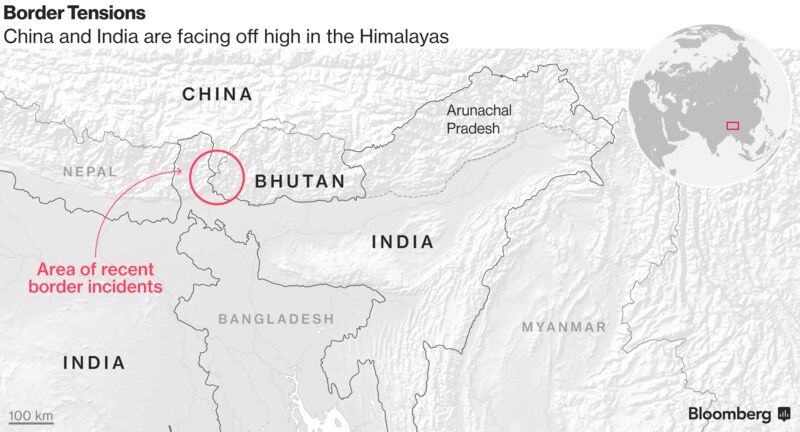
While most of the media is focused on the Trump-Putin relationship at Hamburg, there is an equally important confrontation going on between Indian Prime Minister Modi and Chinese President Xi over a disputed border. The dispute is long-standing but has flared up recently and it involves a road the Chinese are building over the Doklam plains in the Chumbi Valley, an area under the nominal control of Bhutan. Sikkim became an Indian protectorate in 1950 and an official Indian state in 1975, but China has never officially recognized Indian control over the territory. The India-China border is a constant irritant since much of the border is based upon what is known as the McMahon Line which was drawn in the early 20th century by the British:
“In the early 20th Century Britain sought to advance its line of control and establish buffer zones around its colony in South Asia. In 1913-1914 representatives of China, Tibet and Britain negotiated a treaty in India: the Simla Convention. Sir Henry McMahon, the foreign secretary of British India at the time, drew up the 550 mile (890 km) McMahon Line as the border between British India and Tibet during the Simla Conference. The so-called McMahon Line, drawn primarily on the highest watershed principle, demarcated what had previously been unclaimed or undefined borders between Britain and Tibet. The McMahon line moved British control substantially northwards. The Tibetan and British representatives at the conference agreed to the line, which ceded Tawang and other Tibetan areas to the imperial British Empire. However the Chinese representative refused to accept the line. Peking claimed territory in this far north down to the border of the plain of Assam.”
Armed conflict has broken out between the two states at various points and the Chinese seem to be pushing the issue harder than usual as it tries to establish more firmly its sovereignty over the East and South China Seas as well as along the Indian border.
Thousands have protested in Hamburg, the site of the G-20 meeting. Many of the protesters were expressing strong anti-capitalist sentiments while many others were protesting some of the participants to the meeting, including US President Trump and Russian President Putin. The protests are not unusual at a G-20 meeting since the participants represent the 20 largest economies in the world. Deutsche Welle has in-depth coverage of the protests and the issues at the meeting. It is hard to imagine that much of substance will be accomplished at the meeting.
The crack in the Larsen C ice shelf is now about 200 kilometers long and is attached to the shelf by only 5 kilometers of ice. Its calving is being monitored by satellites, and when it does break off it will be one of the largest icebergs ever recorded: “about 190 m thick and contain about 1155 cubic kilometres of ice.” Since it is part of an ice shelf, its melting will not raise sea levels immediately, but the berg will pose a threat to shipping in the region. The calving is also evidence of warming in Antarctica that was not expected until quite recently.
Supporters of embattled Venezuelan President, Nicolas Maduro, attacked the National Assembly and injured several opposition members. The country shows no sign of stabilizing and Maduro seems intent on using whatever violence is necessary to remain in power. Despite his thuggish behavior, many still support Maduro because of the programs initiated by Hugo Chavez that helped the poor substantially. A plebiscite is scheduled for 16 July for the citizens to express their views of the government, but it is unclear how reliable a vote could be under the violent circumstances.
As I was driving home from a very nice vacation with old friends, I was listening to the news on the radio. There was breathless reporting about North Korea’s “challenge” to the US. The challenge is the launching of a missile with the theoretical potential to reach Alaska from a launch in North Korea. The North Korean leader was typically bellicose in announcing that “the American bastards would not very happy with this gift sent on the July 4 anniversary”. The US Ambassador to the UN, Nikki Haley, offered strong language to the world at the Security Council, arguing that:
“So in order to have an impact, in order to move North Korea off its military escalation, we must do more. We will not look exclusively at North Korea. We will look at any country that chooses to do business with this outlaw regime. We will not have patience for stalling or talking our way down to a watered-down resolution.
“Yesterday’s ICBM escalation requires an escalated diplomatic and economic response. Time is short. Action is required. The world is on notice. If we act together, we can still prevent a catastrophe and we can rid the world of a grave threat. If we fail to act in a serious way, there will be a different response.
“Much of the burden of enforcing U.N. sanctions rests with China; 90 percent of trade with North Korea is from China. We will work with China. We will work with any and every country that believes in peace.
“But we will not, repeat, the inadequate approaches of the past that have brought us to this dark day.”
It seems as if US President Trump has decided that China will not exert sufficient pressure on North Korea to “de-nuclearize”. He tweeted:
“Trade between China and North Korea grew almost 40% in the first quarter. So much for China working with us — but we had to give it a try!”
Trump still does not understand that China fears the collapse of the North Korean regime more than it fears a nuclear-armed North Korea. What Trump apparently does not understand is that China (as well as South Korea, Russia, and Japan) have been living with a nuclear-armed Korea for many years–it is only the US that thinks that an intercontinental ballistic missile is significant. The ICBM does not add any risk to those countries and there is no reason for them to take any steps that might aggravate North Korea in order to protect the American homeland.
More importantly, Trump should also understand that there is no reason to fear North Korea any more than it feared the Soviet Union or China during the Cold War. The media constantly talk about the “irrationality” of the North Korea regime and I remember the same language being used about the Russians and the Chinese when I was growing up. North Korea may have about 20 nuclear weapons; the US has about 1,790. North Korea may have a population of about 28 million people; the US has 320 million people. North Korea developed nuclear weapons for one reason and one reason only: to deter an American attack against North Korea. Anyone who does not understand that logic of deterrence is being “irrational”.
If the US decides to take military action against North Korea, the consequences would be catastrophic. The New York Times has an article that outlines the likely unfolding of such a war. While the US citizenry might not be seriously affected by the action, it is clear that others would pay a very heavy price.
I was quite concerned about the way the news media has framed the issue, talking about the “challenge” to Trump. As we listen to the reporting about the matter, we should not forget that the media makes a lot of money by making people frightened about the imminence of war. There is probably no way to prevent the scare mongering from occurring, but it is important not to succumb to it.
Researchers have published an article in Science that estimates the costs of climate change on the US economy. Such predictions are difficult and the researchers frame their predictions in terms of a wide range of probabilities. The abstract, however, summarizes the research in straightforward terms:
“Estimates of climate change damage are central to the design of climate policies. Here, we develop a flexible architecture for computing damages that integrates climate science, econometric analyses, and process models. We use this approach to construct spatially explicit, probabilistic, and empirically derived estimates of economic damage in the United States from climate change. The combined value of market and nonmarket damage across analyzed sectors—agriculture, crime, coastal storms, energy, human mortality, and labor—increases quadratically in global mean temperature, costing roughly 1.2% of gross domestic product per +1°C on average. Importantly, risk is distributed unequally across locations, generating a large transfer of value northward and westward that increases economic inequality. By the late 21st century, the poorest third of counties are projected to experience damages between 2 and 20% of county income (90% chance) under business-as-usual emissions.”
Not surprisingly, climate change will aggravate income and wealth inequality in the US as the poor will lack the ability to make the necessary adaptations to the changes in climate.
India introduced a single tax on the sale of goods and services to replace the almost 500 different taxes levied by the states. The new Goods and Services Tax is the most sweeping tax reform in independent India’s history. The change was accompanied by a great deal of confusion (not surprisingly) and it will take some time to assess its effectiveness and efficiency. But it follows the process of demonetization that occurred earlier in Prime Minister Modi’s administration–he has introduced some major changes in the daily lives of Indians.
The party of Japanese Prime Minister Shinzo Abe, the Liberal Democratic Party (LDP), suffered a major loss in local elections in Tokyo. Abe has been in office for nearly five years but has been plagued recently by a corruption scandal. The returns seem to indicate a pattern seen in earlier elections in the US and Europe: the results are less a victory for the opposition than a repudiation of the mainstream parties. Abe is undoubtedly weakened by these returns and he may not be able to secure enough votes to amend the Japanese constitution to allow Japan greater military presence abroad. Amending the pacifist parts of the constitution has been a major priority for Abe.
Jonathan Cook has written a follow-up essay on the story by Seymour Hersh that there was no Syrian government chemical attack on the town of Khan Sheikhoun on April 4. Cook notes that no media outlets in the US have picked up Hersh’s story and that the only responses have been a warning from the Trump Administration that the Syrians were ramping up another chemical attack and a re-release of the information provided by the Organization for the Prohibition of Chemical Weapons. It seems likely that Hersh’s story will die out without any refutation, and will be consigned to future historians to corroborate. Such was the case of the infamous attacks in the Gulf of Tonkin in the Vietnam War. US President Johnson claimed that the North Vietnamese had attacked US naval vessels and used the incident to justify a major expansion of the war. It was only much later that doubts were raised about the authenticity of the narrative.
Saturday was the 20th anniversary of the British handover of Hong Kong to the Chinese central government. China ceded Hong Kong in 1841 as a consequence of the British victory in the First Opium War (1839-1842). It has not been an easy 20 years. The handover involved a promise by the Chinese government to uphold certain personal freedoms not enjoyed by Chinese citizens on the mainland. The agreement was described as “one country, two systems” but over the years the central government in Beijing has tried to exercise greater control over the city. At times there has been sporadic resistance, notably in 2014 in what was called the “Umbrella Movement” as people in Hong Kong tried to preserve the right to choose their own candidates for the city council. At the anniversary celebration in 2017, President Xi made it very clear that the Communist Party was in control. The China Times, which represents the official view of the Chinese government, made it very clear to the world that it would brook no outside interference in Hong Kong affairs.
The British steamship, Nemesis, in the First Opium War
There are suggestions that US President Trump is thinking about imposing tariffs on steel and aluminum, using an old law justifying such tariffs on national security grounds. The reports come just as President Trump is preparing to go to the G-20 meeting where issues concerning the global economy are going to be discussed. The threat of tariffs would anger US trading partners, particularly China and its European allies, and may even trigger off retaliatory action which might lead to a trade war. This issue should be watched carefully.
I have been following the news about the attack on the Khan Shaykhun area of Syria on 4 April That attack was characterized as a chemical weapons attack by the US and it was used to justify an air attack on a Syrian government air field. We reported on the article by Seymour Hersh in Die Welt which argued that there was, in fact, no chemical weapons attack. The Organisation for the Prohibition of Chemical Weapons (OPCW) released its report on the attack yesterday which asserts that Sarin gas was used by the Syrian government in the 4 April attack. Scott Ritter, a former weapons inspector who denied that Iraq had weapons of mass destruction prior to the US invasion in March 2003, offers his own analysis supporting Hersh’s position. The OPCW’s Executive Council will discuss the report on 5 July and Russia is on the Executive Council. I will try to follow up on this meeting since the Russians have strongly disputed the report and find out the basis for their denial.
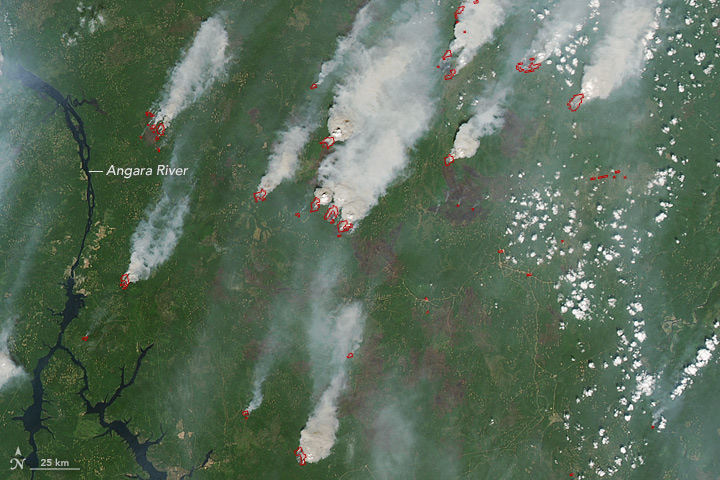
The US National Aeronautic and Space Administration (NASA) has published satellite images of wildfires burning in Siberia. Scientists estimate that these are the worst wildfires in about 10,000 years. Since November, temperatures in Siberia have been about 4°C above average. These fires release a great deal of carbon into the atmosphere and destroy the ability of large swathes of forests to act as an effective carbon sink.
The Global Cities Institute at the University of Toronto has published a study of urbanization trends in the 21st century. Given current trends, the Institute predicts that in the year 2100 the four largest cities in the world will be: 1) Lagos, Nigeria; 2) Kinshasa, Democratic Republic of Congo; 3) Dar es Salaam, Tanzania; and 4) Mumbai, India. The projections are a dramatic shift away from the historical patterns of urbanization and suggest that global dynamism will be located in Africa.