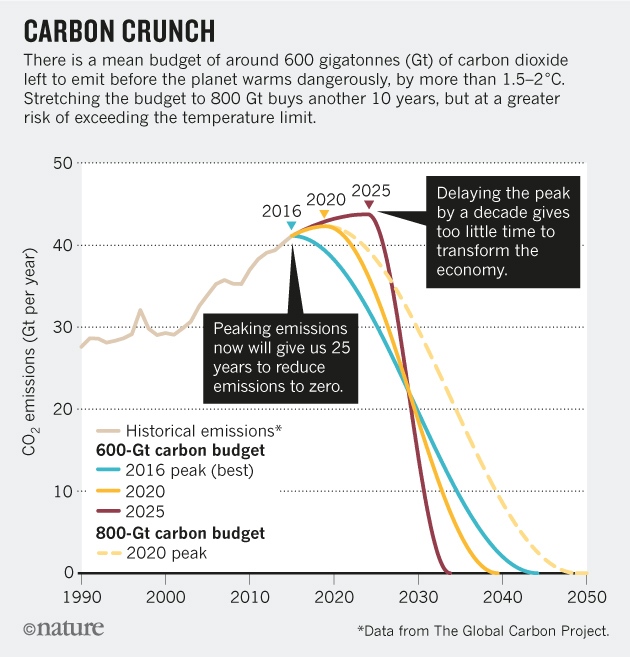
Researchers have published a paper in the science journal Nature that posits the year 2020 as a crucial year in the process of mitigating climate change. The authors note that there have been much progress in reducing emissions of carbon dioxide (CO2):
“Greenhouse-gas emissions are already decoupling from production and consumption. For the past three years, worldwide CO2 emissions from fossil fuels have stayed flat, while the global economy and the gross domestic product (GDP) of major developed and developing nations have grown by at least 3.1% per year (see go.nature.com/2rthjje). This is only the fourth occasion in the past 40 years on which emission levels have stagnated or fallen. The previous three instances — in the early 1980s, 1992 and 2009 — were associated with global economic predicaments, but the current one is not.
“Emissions from the United States fell the most: by 3% last year, while its GDP grew by 1.6%. In China, CO2 emissions fell by 1% in 2016, and its economy expanded by 6.7%. Although it is too early to tell whether this plateau will presage a fall, the signs are encouraging.”
The authors outline a six-point program to ensure that the progress continues, although concerns over the policies of the US are significant.
It appears that US President Trump no longer believes that China can exert effective pressure on North Korea to stop its nuclear program. It announced sanctions on a Chinese bank, a Chinese company, and two Chinese individuals for their ties to North Korea. At the same time, the Administration announced a $1.4 billion arms sales package for Taiwan. It is not clear how Chinese President Xi might respond to this pressure, but the open characterization of Chinese failure by President Trump on 20 June is certain to be viewed as disrespectful by China. Trump’s actions may also signal a return to the tougher line toward China he articulated during the campaign. But the biggest uncertainty is how close Mr. Trump may be to taking unilateral action against North Korea.
There has been a battle being waged for over a month in the city of Marawi in the Philippines between insurgents and government forces. The insurgents identify with the Islamic State and claim to represent the interests of Muslims who have suffered from discrimination at the hands of the Christian majority in the southernmost island of the Philippines, Mindanao. Islam is older than Christianity in the country, but Muslims are a minority who do not hold significant power. The conflict between Muslims and Christians in the country is an old conflict that has never been satisfactorily addressed.


Leave a comment