The Harvard economist, Carmen Reinhart, had an interview with the German magazine, Der Spiegel, about the current policies of the world’s central banks. Those policies are loosely termed “quantitative easing” which is simply a policy of printing money in order to purchase long-term capital assets such as bonds. The policy of printing money always carries with it the risk of higher inflation, and Rienhart warns about that will happen if that situation arises in the future. It’s a pretty grim warning.
Chilean students have been protesting for a number of years against the lack of public funding for higher education in the country. The strikes get very little attention outside of Chile, but the protests represent a very sustained effort to force the country to address what the students believe to be a major cause of the income inequality in the country. The protests have recently picked up in intensity and the government is responding in force. There are elections scheduled soon in Chile and it will be interesting to see how the strikes affect the outcome.
Cypriots just learned that one of the conditions for the “bailout” of Cypriot banks also included the seizure of all of Cyprus’s gold reserves. Apparently, even the Cypriot Central Bank was not informed of this condition for the bailout. Needless to say, the seizure was not well-received. But the Central Banks of all the other weak eurozone countries that might require a similar bailout are quite apprehensive of similar conditions. The bailout conditions are nothing short of draconian and will unquestionably make it more difficult for weak governments to request outside assistance. Such reluctance will only make the solutions more difficult in the future.
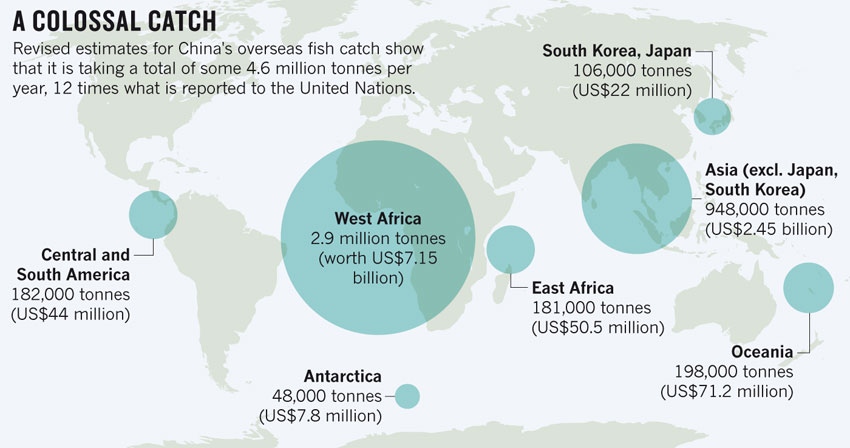
A new study suggests that China’s overseas fishing catch may be as much as 12 time more than it has reported to international fisheries. China has the world’s largest fishing fleet, and the suggested number is certainly within the realm of possibility. However, if true, that level of fishing is not globally sustainable. Of particular concern is the fishing stocks off the coast of West Africa.
Source: Christopher Pala, “China Estimated to Dramatically Underreport Its Overseas Fishing Catch,” Scientific American, 2 April 2013.
The French Parliament is debating legislation designed to reduce the power of labor unions in the French economy, and the French unions are not taking the debate well. Many union workers are protesting the policies proposed by the Socialist Prime Minister Francois Hollande. The French economy is slowing down and it is unclear whether the legislation will pass.
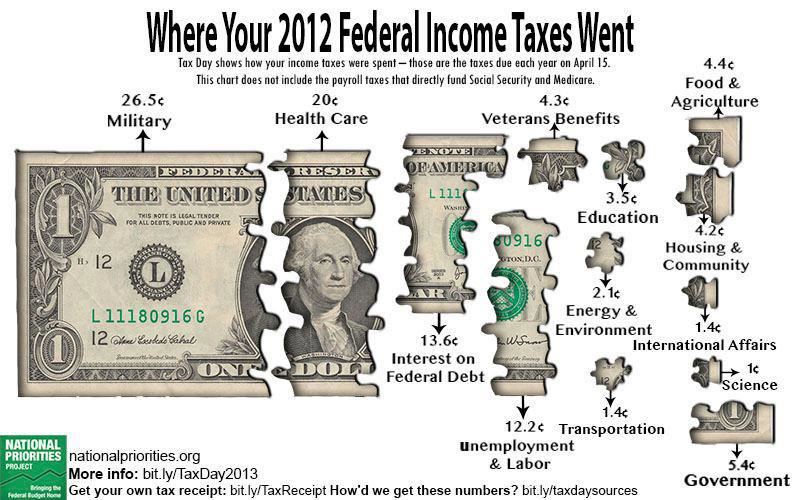
Have you paid your taxes yet? Here’s where the money goes.
The North Korean situation continues to evolve as North Korea readies for a missile test. The US intelligence believes that the North Korean missiles are liquid-fueled which means that it is likely that the missiles will be fired within a few days (the US and other states use solid-fueled missiles which don’t need to be fired quickly–liquid fuel evaporates rapidly and it is a “use-it-or-lose-it situation”). Everything now depends on where the missiles are pointed. If it doesn’t appear as if it is targeted toward or near US or allied forces, then I suspect that nothing immediate will happen. If, however, it flies close to a vital target, the US, Japan, or South Korea will likely shoot it down. That will lead to a further confrontation.
Margaret Thatcher (or, “The Iron Lady”, as Mikhail Gorbachev called her) has dies and many are mourning her passing. It is appropriate to mourn the passing of a fellow human being, but, for many, Thatcher was a hero. I will confess that I do not fall into that category. Thatcher introduced some harsh reforms into the British economy, most notably the crushing of the coal miners union. “Thatcherism” is synonymous to neo-liberalism, the “Washington Consensus,” and, in the current jargon, austerity. Thus, I was very surprised to read in the German magazine, Der Spiegel, comments critical of her policies. Who knows? Many the Germans can be persuaded to relax some of their policies toward the economically weak eurozone states.
The controversy over the use of drones got more complicated today with the release of a report that suggests that US targeting of al-Qaeda militants is less precise than has been asserted by the US government. I’m not sure that this report will actually settle things, but it offers additional information to ponder.
In an earlier post, I mentioned the outbreak of a new strain of influenza in China. There have not been any independent reports of the outbreak, but apparently there are some curious aspects of the outbreak that need to be explained. As I suggested earlier, there is no reason to be especially worried about the outbreak, but the Chinese government needs to respond more effectively to these questions if it is to be trusted with serious public health matters. In a fully globalized world, there is no such thing as a local problem with a contagious disease.
The Congressional Research Service argued last year that “U.S. income distribution appears to be among the most unequal of all major industrialized countries and the United States appears to be among the nations experiencing the greatest increases in measures of income.” The inequality undermines any real progress toward an economic recovery since demand is very slow to pick up–businesses are therefore reluctant to make capital investments to increase production. Inequality also undermines the legitimacy of the political and economic system if people perceive the economic game to be rigged in favor of the wealthy. Addressing income inequality is perhaps te most urgent issue facing the US today.
The US has announced that it is postponing a missile test out of California in order to not aggravate the tension between it and North Korea. The Chinese also issued a rebuke to its ally for causing a tense situation. The two moves are calculated to give North Korea a chance to back away from the standoff. The chances are highly likely, however, that the North will launch a missile next 15 April, the birthday of Kim Il Sung, the father of the current leader. Much will depend on the nature of the missile launch.
The negotiations between the P5+1 (the UN Security Council Permanent members and Germany) and Iran concluded without any signs of tangible progress. Iran has voluntarily slowed down some of its operations but refuses to concede its right to enrich uranium for medical research. Needless to say, the P5+1 believes that the enrichment program is designed to develop sufficient fuel for an atomic bomb. The negotiations have eased some of the tension, but it is likely that Israel will take the failed negotiations as a sign that peaceful measures will not work.
Portugal’s approved deficit reduction plan with the troika was shot down by the country’s highest court which held that some of the budget cuts were unconstitutional. The ruling means that Portugal must find other cuts to meet the deficit reductions demanded by the EU. The disarray will likely roil the world markets as austerity plans are getting harder to sell to a very reluctant public.
Cyberwarfare is being waged at a furious pace. US banks have been attacked over the last six months with denial of service attacks resulting in over 249 hours of downtime for the websites of American banks. Anonymous has declared 7 April as a day of attacks against the Israeli government and has claimed to have shut down or defaced over 9000 websites in Israel. It is very hard to verify the severity of the attacks, but the scale of attacks is extraordinary.
Something to keep an eye on. A new influenza virus, H7N9, has been detected in China. Additional cases have been found in other countries as well, but China seems to be ground zero for the strain. It is exceedingly difficult to figure out how flu viruses will spread, and most of the time the viruses do not really catch hold in human populations. In those rare cases, however, when they do become easily transmissible the consequences can be deadly (the 1918 influenza pandemic killed millions). Disease has often had a decisive effect on world politics, so we should watch how this new bug evolves.
The Guardian and a number of intrepid journalists have begun to pull the cover off of the huge amount of money being held in offshore accounts by individuals wishing to avoid taxation. Obviously, it is very difficult to get a handle on the total amount, but estimates are that as much as $20 trillion could be hidden away (out of a total World GDP of about $70 trillion). Just think what your taxes would be like if everyone paid their full share.
I’ve been away, giving a speech at SUNY-Geneseo on American foreign policy. SUNY-Geneseo is a great school and the students were wonderful: they asked great questions and were quite knowledgeable. But I wasn’t able to post any blogs while I was away. My apologies.
The standoff with North Korea continues to escalate and it’s hard to figure out where the crisis is heading. Obviously North Korea is looking for some sort of recognition as a nuclear power, but its rhetoric makes it difficult to treat it with respect. The US’s attempts to signal its commitment to South Korea seem only to inflame the North Koreans even more, but it is difficult for the US to do nothing while an ally is being threatened. In the meantime, we can only hope that there aren’t some unforeseen accidents that might precipitate an outbreak of hostilities.
Regular readers of this blog know that I have been worried about the rise of right wing movements in the world. This fear dates back to the onset of the Great Recession in 2007, and has only grown stronger in my mind. Other scholars have picked up on this worrisome trend and have written about the phenomenon. Here is an interview with Joshua Kurlantzick, author of the book, Democracy in Retreat: The Revolt of the Middle Class and the Worldwide Decline of Representative Government, which I have on my reading list for this summer.
We are all going to be hearing about Bitcoins an awful lot in the near future. Bitcoins are a virtual currency issued by no government and governed by a mysterious set of algorithms that no one has been able to hack. Weirdly, people are attaching values to the Bitcoins and using them as “normal” currency. We should become better informed about this new currency.
Ambrose Evans-Pritchard is a British financial columnist who writes for the London Telegraph and is extraordinarily perceptive. One of his more recent posts on the Cyprus crisis is especially bleak, but it is hard to find fault with his argument. One cannot imagine the euro persisting in its present form without some serious changes. But those changes are highly unlikely in the middle of a crisis.
The controversy over the use of drones is a difficult one to navigate because of the absence of hard information. Here’s an article that parses out what little we know how the effectiveness of drone strikes. It’s helpful, but don’t look for a resolution of the controversy. Significantly, it confirms what many of us have suspected: that drones are almost always used with the consent of states in which the strikes occur, even if those states later publicly state that their sovereignty has been violated.
A Harvard study has indicated that the total cost of the Iraq and Afghan wars, when one includes the full medical costs of the veterans through their expected lifetimes, could reach between $4 and $6 trillion. When White House officials starting talking about the wars in 2002, the estimates floated at the time were around $200 billion. It’s incredible how much money was spent on these wars, most of which was borrowed money.
North Korea has announced that it is now in “a state of war” with South Korea, and that all decisions will now be made according to wartime protocol. It’s not clear what the declaration means, since the North announced a few days ago that was abrogating the armistice with the South, indicating that the war which ceased in 1953 was now renewed. I haven’t read anything so far which makes the rhetoric out of the North any more comprehensible. It is difficult to figure out how seriously one should take the rhetoric.
The International Monetary Fund has issued a new report, blasting the nations of the world for granting economic subsidies for fossil fuel production. The IMF has a long track record of attacking subsidies, but typically it has focused on government subsidies for poor people. This report, however, focuses on not only tax benefits for fossil fuel producers, but also includes the costs of not adequately pricing the cost of carbon pollution. With this expanded definition of subsidies, the IMF found that oil and coal producers receive a global subsidy of roughly $1.9 trillion.
The Economist has published a fascinating report on the growth of Indian military power. The numbers are straightforward: the Indian military is one of the largest in the world. But Indian strategy toward the world is not clearly defined. Who are the enemies? What is the strategic vision? A very good analysis.