Evidence is mounting that an a Western airstrike against imminent against Syria. European military airplanes are being flown to the British airbase in Cyprus, just 100 miles from the Syrian coast. US Secretary of State Kerry said the evidence of a chemical attack was “undeniable” and called it a moral obscenity–such language commits the US to action. The Russian government has warned that any strike would be a blatant violation of international law. The likely strike would be a cruise missile strike against Syrian government military facilities. Such an attack would indeed violate international law unless it were authorized by the UN Security Council, an unlikely prospect given Russian opposition. So we have a very difficult situation. The chemical attack is a violation of international law; any military response without UN authorization is also a violation of international law. The continued violence against civilians in Syria is also a violation of international law.
What can we expect? The US, the French, and the British will attempt very carefully calibrated and precise attacks. They will stress that their attacks are designed only to disarm the Syrian military’s chemical arsenal. The Syrian air defenses are reputed to be quite effective, but their capabilities have never really been tested. Indeed, the Israelis have attacked Syrian territory on several occasions with great effectiveness. Let’s assume that the Wetsern attacks are successful and involve little loss of civilian life.
The next step would be up to the Syrians, the Russians, the Turks, and the Iranians. The Syrians offer little threat to the Western allies–if their air defenses fail, there is not much else for them to do. The attacks, however, would stiffen the backs of Assad’s supporters, and redoubled attacks on the rebel forces would be likely. The Turks would resent the intrusion of Western power into the region, but they support the rebels and would likely welcome the change in the balance of power. The Russians would be furious, but they are unlikely to confront the West directly. They would, however, increase their assistance to Assad. As long as no Russians soldiers are killed in the attacks, they are unlikely to join the fray. The Iranians are most likely to respond directly. Iran already has soldiers in Syria, and its ally, Hezbollah, would likely increase its military activity in both Syria and Lebanon (a move that would greatly unsettle the Israelis). However, their ability to confront the West military power directly is limited–more likely is an increased use of subversive activities such as cyberwarfare.
In short, the attacks would most likely not send the region into a general war. However, the one thing we don’t know about is how things could go wrong in the attack. Large civilian casualties would isolate the West from global public opinion. Attacks that kill Russian or Iranian soldiers would bring about pressure for direct confrontation and escalation. Increased refugee pressures due to the attacks would destabilize surrounding countries–Lebanon, Turkey, Iraq, and Jordan–and large movements of Kurds would also be highly destabilizing. Finally, we don’t know what the Israeli government would think of these attacks and whether it would see an opportunity to take action itself against Syria of Iran.
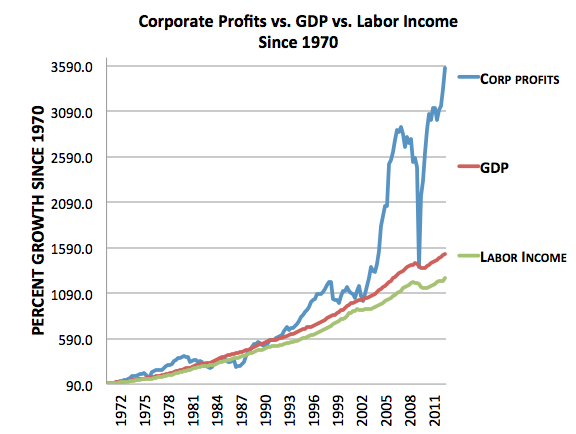
The American (and the global) economy has changed dramatically in the last 30 years, and the changes have led to significant changes in the distribution of the ways wealth is distributed. We cannot specifically pinpoint the causes of the change, but the two most likely sources of the change are the process of globalization and technology. The changes are also associated with the widening income inequality which has been evident in most economies throughout the planet. THis graph shows how the rewards of economic activity have moved toward the people who posses capital and away from those who can only offer labor to the market.
Medecins Sans Frontieres (Doctor Without Borders) is on the ground in Syria, and it is reporting that about 3,600 people flooded into hospitals after the recent attacks and that about 10% of that number died. The organization cannot itself confirm the use of chemical agents, nor can it identify who used the alleged agents, but it does affirm that the symptoms of the sick were consistent with the use use of a neurotoxic agent. The UN is putting pressure on the Syrian government to allow inspectors into to the country to assess the charges of chemical weapons use. The Iranian government is asserting that the Syrian rebels used the Chemical weapons, not the Syrian government. The US is positioning a fourth cruise-missile armed warship to the Eastern Mediterranean suggesting that an armed attack on Syria is being actively considered. Plans are being formulated for a summit meeting on the Syrian crisis to be held in Jordan early this week.
The trial of Bo Xilai, one of Chinese highest ranking officials, is being widely followed by the Chinese people. The Chinese government is allowing unprecedented coverage of the trial which is unusual in the amount of information being disseminated. Quite clearly, the government wishes to expose the corruption of Mr. Bo, but the coverage runs the risk of inflaming a more general reaction to the issue of corruption within the government. It is difficult at this time to determine how the trial will play out, although there is no question about whether Mr. Bo will be found guilty as charged.
Two scholars, Kalev Leetaru and Philip A. Schrodt, have done some extraordinary research in a project called Global Data on Events, Location, and Tone. What they have done is coded every political protest in the world from 1979-2010 and mapped it out. John Beieler, a doctoral candidate at Penn State, has adapted these data into striking maps, one of which was posted in Foreign Policy. FP is a paywalled site, but I am hoping that many of you can access the map by using a library or educational institution computer. Visually, the map communicates a very powerful message: the number and intensity of political protests in the world has been increasing dramatically since 1979.
There were two explosions outside of Sunni mosques in northern Lebanon today, killing at least 37 people and wounding more than 350. The bombings followed similar explosions last week in Lebanon and represent a major escalation in Sunni-Shia violence. The war in Syria has spread throughout the region, and there doesn’t seem to be any countervailing pressure at all.
President Obama is paying a significant political price for inaction after reports of another chemical weapons attack in Syria. The damage is self-inflicted since Obama himself described the use of chemical weapons as a “red line.” The dithering over whether the weapons were used is embarrassing after the video reports of so many children dead with no visible wounds–it is roughly similar to the semantic game over whether the military coup in Egypt was in fact a “coup.” Statespeople must be very careful to say only what they mean. If they do not, then their words will be ignored in future situations.
We’ve been getting dribs and drabs of information from Japan about the Fukishima nuclear power plant disaster. The generous interpretation of this slow dissemination of information is that TEPCO, the utility company that owns the reactors, really does not have a clue about the extent of the problem. But the recent information is difficult to assess. About 300 tons of radioactive water has been seeping out of the water holding tanks, releasing 30 trillion becquerels of radioactive material into the environment. TEPCO believes that the radioactive material is flowing into the ocean, but some scientists believe that it is flowing into groundwater. The amount of radioactive materials that have seeped out is equivalent to about 100 times what the utility company assumed would be released over the course of a year. No one is guessing what sorts of problems this catastrophe may or may not cause.
Le Figaro is reporting that Jordanian, Israeli, and American commandos have entered Syria in support of the rebel forces. This report has yet to be confirmed by any other news source, so it should be considered unreliable (although Le Figaro is France’s second largest newspaper). I will continue to search the web to see if there are any confirming reports.
The Indian rupee continues to slide in value, and the situation is truly worrisome. The decline in the rupee’s value will lead to strong inflation pressures in India, and, if the government tries to control inflation, it runs the risk of pushing the economy into a recession. Many of the emerging economies, once held to be more dynamic than the economies of the advanced industrialized countries, are increasingly experiencing economic difficulties.
There is another report of chemical weapons being used in Syria. The video of the aftermath of the attack is certainly horrifying, but the attack is unlikely to provoke a meaningful response from the world community. The Obama Administration is highly unlikely to take effective action, for a variety of reasons. Ahram Online is reporting that 1,300 people died in the attack in Damascus.
The BBC has a fascinating graphic on the city of 2050. It is a highly speculative study of some emerging technologies and how they might transform the urban landscape. It’s a little more than simple science fiction, and parts of it might be operating long before 2050.
China’s extraordinary transformation over the last thirty years will rightly be regarded as one of the most admirable developments of the 20th century. However, that transformation has purchased at a very high price, and there are signs that the strains on the land will constrain China’s future development. No where is this issue more apparent than in the agricultural sector. As China has moved dramatically into the industrial age, the rural and farming sectors show signs of neglect. Whether China will be able to feed its people in the future is a genuine question.
The Intergovernmental Panel on Climate Change, a UN body comprised of hundreds of scientists specializing in climate and set up in 1992 to monitor the process of climate change, had its most recent draft report leaked to the press. Although only a draft, and therefore subject to revision, the report is sobering. It finds that the panel “is 95 to 100 percent confident that human activity — largely from burning fossil fuels — is the main cause of global warming since the 1950s.” The strong statement is unlikely to change the minds of those who profit from the sale and use of fossil fuels, but the science is becoming overwhelmingly persuasive.
Pakistani ex-President Pervez Musharraf has been charged with the murder of Benazir Bhutto in 2007. Musharraf ruled Pakistan for seven years after he led a coup in 1999. He was ousted from power and left the country, only to return this year to compete in the national elections. The political situation in Pakistan is already fragile and the charge is certainly going to unsettle the politics of Pakistan even more.
The Indian economy, a rapidly growing one in recent years, has seen a very rapid decline in recent months. The growth rate of the GDP has slowed down, the rupee has sunk to record low rates, bonds yields are rising rapidly, and the stock markets have declined by over 10 %. The Indonesian economy is also being rattled, and the general view in South and South East Asia is that the economic situation is deteriorating largely because of the slowdown in China. Generally speaking, the regional situation seems very dicey, but few are confident that the data being published by the governments are accurate.
Saudi Arabian Prince Saud al-Faisal, the Foreign Minister, announced that Saudi Arabia would be willing to replace any aid that Egypt might lose if the US and the European Union cut off aid in disapproval of the military coup. The Saudi offer is a real slap to the US, ostensibly a strong Saudi Arabian ally. It also aligns the Saudis with the Israelis who also support the military takeover. The offer separates Saudi Arabia from Turkey and Qatar who support the Muslim Brotherhood. The situation in Egypt, like the one in Syria, is quickly becoming a regional war as outsiders begin to place their bets on the outcome.
The threat of a cutoff of US aid to Egypt does not simply rattle the Egyptian military. The threat will also seriously unnerve the US defense contractors that supply the Egyptian military. Here are the top ten US defense contractors that get paid by US taxpayers via the Egyptian military:
1. Lockheed Martin — Fort Worth, Texas and Orlando, Fla.
2. DRS C3 and Aviation — Horsham, Pa.
3. L-3 Communication Ocean Systems — Sylmar, Calif. and Garland, Texas.
4. Deloitte Consulting — Arlington, Va.
5. Boeing — Mesa, Ariz. and St. Louis.
6. Raytheon — Tucson, Ariz. and Andover, Mass.
7. AgustaWestland — Reston, Va.
8. US Motor Works — Cerritos, Calif. and Grand Prairie, Texas.
9. Goodrich Corp. — Chelmsford, Mass.
10. Columbia Group — Washington, D.C.
One can be certain that these corporations will be lobbying the US government not to stop its military assistance to Egypt.
There is serious flooding, not only in the US southeast, but also in the far eastern parts of Russia and in many parts of China. The flooding has forced the evacuations of almost a million people and is not expected to subside quickly. Extreme weather seems to be the order of the day. A study by the World Bank estimated that coastal cities in the world may suffer more than a trillion dollars of losses because of flooding by 2050.
Mahmoud Badr, one of the co-founders of the “Tamarud-Rebel” movement in Egypt that toppled President Morsi, has a grim view of the possibilities for a quick return of democracy to Egypt. He is quoted by Reuters as saying that “the bloodshed that has followed is a necessary price for saving the nation from the Muslim Brotherhood.” Moreover he seems unmoved by the threat that the US might suspend its aid to Egypt if the military does not take steps to reconcile with the Muslim Brotherhood: “Obama can keep it – and ‘go to hell’.” The rhetoric augurs ill for a quick end to the current violence and suggests that Egyptian “liberals” are settling in for a long civil war with the Brotherhood. The US has succeeded in alienating virtually all its allies in the Middle East by its dithering over the coup. All its allies except Israel, which has welcomed the return of the Egyptian military,
Last week, Doctors Without Borders announced that it was pulling out of Somalia because conditions on the ground were too dangerous for its personnel. Now we learn that Somali is experiencing an explosive outbreak of polio, more than in all other countries combined. Polio is a devastating disease which has largely been controlled by aggressive vaccination programs. But many of the children in Somalia are in territory controlled by the group, Al Shabab whose rule is opposed to any Western presence.
The leaders of several South African countries have endorsed the re-election of Robert Mugabe in Zimbabwe. The loser in the election, Morgan Tsvangirai, had charged fraud in the election and both the US and the European Union have raised many questions about the conduct of the election. The endorsement, however, seems to settle the controversy, at least in a regional sense.
Mostafa Hegazy, an adviser to the Egyptian President, labeled the protesters who support the return of President Morsi “terrorists.” In so doing, he joins many others in the world who dismiss protest with allegations of criminal and immoral behavior. Delegitimizing protest is a stale tactic of those who really have no new ideas to offer. There is little question that all sides in the Egyptian violence have engaged in reprehensible acts, but painting all protesters with the broad brush of “terrorist” is an excuse not to face the genuine issues raised by the military coup in Egypt. But Hegazy is mimicking those who treat dissent as treason, and the US is a prime offender in that diversion as in the case of Edward Snowden and Bradley Manning.
World politics is rife with irony, since realism allows for quickly shifting alliances depending on circumstances. Just two years after Iraq demanded that the US military leave the country, Iraqi foreign minister Hoshyar Zebari has asked the US for military assistance, including drones, to deal with the security problems associated with the influx of Syrian refugees. It is hard to imagine the US responding favorably to the request since Iraq has allowed Iran to use Iraqi territory and air space to support President Assad in Syria. The likely refusal of the US is unfortunate, since the Syrian refugees deserve much greater support. But the UN High Commissioner for Refugees is probably the more appropriate agency for the needed assistance.
The news and images out of Egypt are so discouraging that I took refuge in some old songs. The process of political change is fraught with all sorts of emotions: the exhilaration of believing that a better world can be created; the sense of betrayal when reality diverges so blatantly from rhetoric; the sadness of misdirected and uncontrolled violence. Most of the time, however, the violence of political change leaves us speechless. For me, music is often a road out of places where words fail. These last few days, words have really felt empty.
In 2011, the protests were against the dictator Mubarak. The husband of a former student had an apartment in Tahrir Square when the protests were going on. When I asked him how the historical moment unfolded for him, he said he was humbled by the magnitude of the event. Then he said that there was one unfortunate aspect of the protests: a small group of protesters played this song over and over again. The song was a fixture during the anti-war movement in the 1970s. I immediately felt a connection with the student protesters.