Clemens Wergin is the Washington bureau chief for the German newspaper group Die Welt and he has written an op-ed piece for the New York Timeson American attitudes toward the US role in world affairs. He questions whether the US has the will to actively manage global affairs. He uses an interesting phrase to describe the US role after World War II–the leader of an “empire by consent.” He laments the possible loss of the elite consensus in the US about how to protect American interests defined in terms of the global interest.
Ukraine has destroyed a number of vehicles in the Russian aid convoy as they crossed into Ukrainian territory. The Ukrainian government claimed that a number of Russian military vehicles preceded the aid convoy and were destroyed by artillery fire. The aid has not entered Ukrainian territory because the International Red Cross has not yet finalized the terms by which it can enter Ukrainian territory and the terms of its distribution. The Russian Foreign Ministry denied that any Russian vehicles entered Ukrainian territory and dismissed the claims as fantasy.
There have been reports of escalating violence in the northwest province of Xinjiang in China. The largest ethnic group in the province, the Uighurs, are growing increasingly restless under the control of the Beijing central government which is dominated primarily by ethnic Han Chinese. The Uighurs believe (as do the Tibetans) that their cultural identity is being lost and that they are being exploited in an essentially colonialist relationship. The relationship falls into a classic dependency framework, and it is unlikely that the Beijing government will change its policies as long as it feels threatened by the non-Han identity of the Uighurs.
Israel has launched three military actions against the Gaza Strip in the last six years: Operation Cast Lead, Operation Pillar of Defense, and Operation Protective Edge. The New York Times has published a fascinating graphic that identifies certain patterns that were common to all three of these actions. The graphic casts light on the types of actions by the outside world that seemed to have good effects and negligible effects. The graphic is definitely worth close analysis.
The Times of Israel is reporting that US-Israel relations have been negatively affected by the recent Israeli actions in the Gaza. Upon learning that arms were transferred to Israel without the knowledge of the White House or State Department, the Obama Administration halted the transfer of additional weaponry to Israel, following the lead of Great Britain which has halted delivery of some weapons as well. The report states that the Obama Administration regards the Netanyahu government as “reckless” and “unreliable.” Israel still has very strong backing in Congress, so it is not clear how damaging this rupture might be.
The Russian humanitarian aid convoy has begun to follow a path that would suggest that the aid would be given directly to the rebel separatists instead of to the Kyiv government (the convot has moved south from Voronezh, and not west toward Kursk). The Russians claim that the humanitarian aid would be delivered under the auspices of the International Red Cross, but the Red Cross insists that it has not approved a mission to give aid to anyone except the Ukrainian government in Kyiv (the agreement was for the aid to be shipped to Kharkiv). If the aid goes to the separatists directly, then the act would be viewed as an attempt by Russia to prop up a rebel government by the West.
No one knows what the West would do if that were to happen. But the US is sending 600 soldiers from the 1st Cavalry Division to Poland and the Baltic states, as well as M-1 Abrams tanks, infantry fighting vehicles, and armored personnel carriers.The deployment of the US soldiers is no accident, but one should remember that Kaliningrad, a non-contiguous part of Russia, is to the north of Poland and west of the Baltic States. The geopolitics of the deployment is both risky and provocative.
Israel and Hamas have agreed to an additional five-day truce. The agreement was almost scuttled by a last minute exchange of fire, but it is clear that both sides want a reprieve from the violence. We don’t know much about the negotiations, but reports suggest that there are some discussions about easing the Israeli blockade of the Gaza Strip, one of the key demands of the Palestinians. Israel is reluctant to grant any concessions, fearing that they would be interpreted as a reward for violence. But it is obvious that some concessions have to be made, if there is to be any progress in the talks.
The US announcement that it was sending additional troops to Iraq and that there are already special forces troops on Mount Sinjar assessing ways to extract the besieged Yazidis has raised fears of “mission creep.” The term refers to a steadily growing commitment to military action caused by the escalation of military objectives caused by incremental commitments. The problem was first dramatically manifested in Vietnam, but the most recent example was the US commitment to Somali in 1992. Ultimately, mission creep leads to military commitments that were never explicitly decided upon.
Peter Beinart has written a very provocative essay for The Atlantic which makes the argument that American foreign policy debates are best understood as debates between elites and ordinary people rather than as debates between Republicans and Democrats. He argues that American elites are becoming increasingly hawkish while ordinary Americans are becoming more isolationist. Viewed in this light, the argument between Hillary Clinton and President Obama over the rise of Islamic militants is particularly intriguing.
Pakistani opposition leader, Imran Khan, is scheduled to lead a protest against the government of Prime Minister Nawaz Sharif on 14 August. The protest was called to highlight election irregularities in last year’s elections, and it has been banned by the government. There is fear that the protests could get out of hand, and many fear that Khan is a stalking horse for the Pakistani military that seeks to weaken the civilian government. Other elements of Pakistani society are also interested in joining the protests, so the event will be watched closely.
The US has sent 130 combat advisers to Iraq, adding to the 250 soldiers already there. Their role is to provide tactical assessments to the US as it attempts to aid the Kurdish forces fighting the Islamic State. The US was also strongly supportive of the change in government in Iraq, although Nouri al-Maliki has yet to concede. The deepening relationship between the US and Iraq is comprehensible in the short term given the threat of genocide to the Yazidi people, but the long-term consequences of this commitment are not clear. It is a risky game.
The second 3-day truce in Gaza will end tomorrow, and there does not seem to be any progress in the discussions taking place in Cairo between the Palestinians and Israel. It likely that both sides would prefer to extend the cease-fire, but their publics will likely demand more tangible signs of progress. There are rumors that the discussions are centering on the possibility of opening a port in Gaza, a concession that would be very difficult for Israel to make.
The World Health Organization has issued a report on the Ebola virus outbreak in West Africa. The situation is dire and continues to deteriorate. Nigeria has just recorded its tenth confirmed case of Ebola, and there are efforts to seal the borders among the West African states. But all of these countries lack to the means to mount an effective response, and the international community has to step in and help.
Russian President Putin is apparently playing a game of “chicken” with the Western powers in Ukraine. Russia announced that it is sending a “humanitarian” mission into Ukraine. Both the US and the European Union had warned that any intervention in Ukraine without the consent of the government in Kyiv would be considered a hostile act. The Kremlin said that the mission would be conducted in conjunction with the Red Cross, but the Red Cross said that it would not intervene without the consent of all parties. There is some inkling of Ukrainian consent (the UN estimates that 1,700 people have died in recent fighting), but the terms are unclear. If Russia does send in a force, it is doubtful that the West would respond in kind, but the pressure for some sort of response would be intense.
The Obama Administration has made the decision to arm Kurdish forces directly in their effort to contain the threat from the Islamic State. The US and the Kurds have a long-standing relationship and are close allies. But the decision undermines Iraqi authority and complicates US relations with Iran which fears that an independent Kurdistan would serve as a US base for anti-Iranian activities. Meanwhile, the Iraqi Parliament has installed a new Prime Minister, but there is no indication that Nouri al-Maliki will step down voluntarily.
Recep Tayyip Erdogan has been elected to another term as Turkey’s President, making him the longest running leader of Turkey since Ataturk. He is a controversial figure: there were large protests against his rule a few months ago and charges of corruption against some of his close associates. But he has moved Turkey into a position of leadership in Muslim and Middle Eastern affairs, and has repaired Turkish relations with the Kurdish minority in the country. His election assures that Turkey will continue to be a central state in the region. But he has moved Turkey away from its former close relationship with Israel and is a sharp critic of Israeli policy.
Ukrainian troops have surrounded the rebel-held city of Donetsk and the leader of the Russian separatists has called for a cease-fire. The possible surrender of the city will pose a serious concern for Russian President Putin as Russian nationalists strongly support the separatist movement in Ukraine. But, even though Russia has massed troops around eastern Ukraine, Putin would risk a great deal by coming to the aid of the separatists. NATO has shipped substantial amounts of military assistance to Kyiv, buttressing the ability of Ukraine to regain control of its territory.
Iraqi Prime Minister Nouri al-Maliki indicated today that he would run for a third term as Prime Minister, and deployed special military forces loyal to him at key locations in Baghdad. The decision is a serious blow to those, including the US, who wished for a less partisan candidate. al-Maliki has ruled along fairly strict sectarian lines, placing his favorites in key positions, including military command positions, without regard for competence or fair-mindedness. His strategy has profoundly alienated the minority Sunni and Kurdish populations, and is partially responsible for the dramatic rise of the Islamic State in Sunni areas of Iraq.
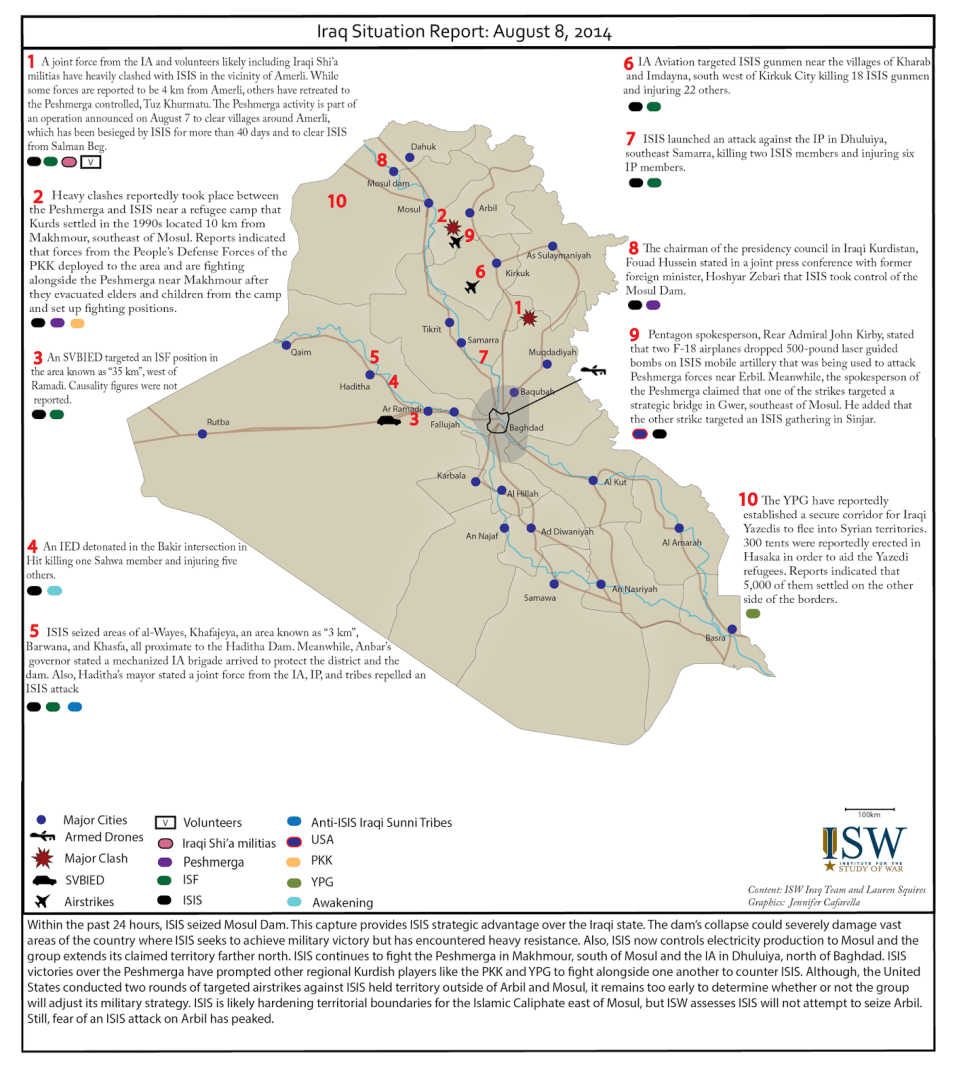
The Institute for the Study of War has published a fascinating graphic on the situation in Iraq as of 8 August. As one can see, the situation is far more complicated that the media is communicating. As we think about the consequences of American intervention in the war, it is useful to keep this complexity in mind.
Vice News reporter Medyan Dairieh spent three weeks with the Islamic State and has published two videos on his experience.
Guinea has closed its borders with Sierra Leone and Liberia in an effort to somewhat contain the Ebola virus outbreak in West Africa. The total number of Ebola cases currently stand at 1, 779, and there does not seem to be any progress in stemming the spread of the disease. New cases have been reported in Nigeria, but since the incubation period can be up to 21 days, there is really no way to know whether it is being spread widely. The Whorld Health Organization has declared an international health emergency, for only the third time in WHO history.
Stephen Walt is one of the most compelling analysts in the world today. He is a realist, but hardly an ideologue: his thoughts are consistent without being knee-jerk. He has written a blog entry that recommends that the US almost completely disengage from the Middle East. The policy sounds impossible given the commitments the US has to a large number of nations in the region, not to mention US interests. The essay is highly provocative, but there was a point in the essay that was particularly persuasive:
“To be sure, the course of action I’m sketching here is likely to leave the Middle East in a pretty messy condition for some time to come. But that is going to be the case no matter what Washington decides to do.”
I could not effectively respond to this point. It is difficult to figure out a better path.
On the other hand, it is impossible to turn away from the plight of the Yazidis who are trapped in Sinjar. Iraqi Kurdish MP from the Yazidi faith, Vian Dakhil, gave a powerful speech to the Iraqi Parliament, begging for aid for her people. It is astonishing to witness the impassive faces of the mostly male MPs as this powerful speech is being delivered.
The 3-day cease-fire in Gaza is over, but violence broke out before the deadline. Israel is demanding the demilitarization of Gaza before it will talk about ending the blockade; Hamas is demanding the end of the blockade before it lays down its arms. Neither side appears to be interested in peace right now, and there is virtually no likelihood that any agreement can be reached without further violence. The selection of Egypt as the sponsor of the negotiations was a serious mistake. Hamas has no confidence in the good offices of the Egyptian government. It is as if the negotiations were held in Iran–the Israelis would hardly be comfortable.
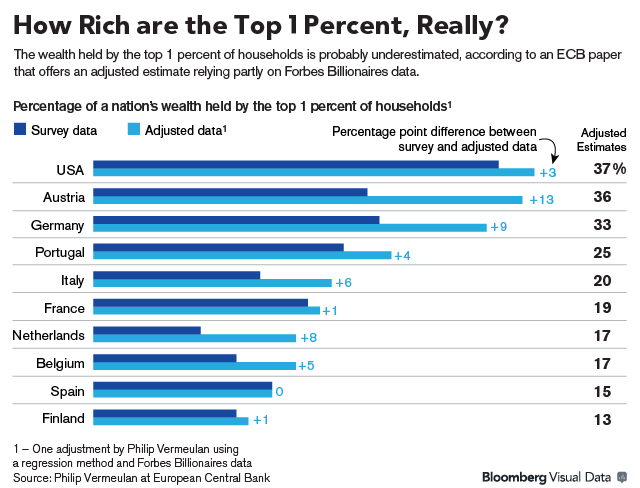
Income and wealth inequality is emerging as the most significant economic problem of our time. However, we have a very difficult time actually measuring income and wealth inequality because there are many ways to disguise income and wealth from official statistics. Research conducted by European Central Bank economist Philip Vermeulen and London School of Economics’ Gabriel Zucman demonstrates that the actual wealth of the very rich is significantly undercounted by official statistics. The chart below shows the extent of the errors. The significance of the data is that this money is not taxed in a way that treats all citizens fairly.
The US-Africa Summit ended yesterday, as the US tries to play catch-up to Chinese inroads to African economies. A serious point of contention was the issue of climate change and its effects on the continent as a whole. Africa currently contributes a negligible amount of greenhouse gases, yet it is likely to be hard-hit by climate change. Right now, there are few genuine energy alternatives to carbon fuels that could fuel economic growth in Africa. Hydropower is a real option because Africa has a large number of rivers that could be harnessed. Yet the deleterious effects of building dams on the environment and indigenous peoples are well known. Should Africans sacrifice their economic growth prospects (which are considerable) in order to avert climate change? Or should the growth be deferred until non-carbon energy sources are available? Who should make such a decision?
Anti-Semitism has been on the rise in Europe since the economic effects of the Great Recession in 2008-09 began to take hold. But the conflict in Gaza has unleashed the worst episodes of anti-Semitism since the days of Nazi power. Synagogues have been attacked and burned and Jewish establishments have been assaulted as well. Political leaders in Germany and France have condemned the hatred, but their efforts do not seem to be affecting the outbreaks so far. The world needs to be united, adamant, and unrelenting in its rejection of this development. No matter where one stands on the issue of Israel and the Occupied Territories, one should remember that the issue is one of power, not religion.
Today is the anniversary of the US atomic bombing of the city of Hiroshima in 1945, The attack effectively ended the World War II in the Pacific Theater. At the time, the sentiment was that it was an appropriate end to a horrific war; in retrospect, it was a war crime that eventually transformed the conduct of world politics. The world still struggles with the presence of nuclear weapons, but it is unlikely that we will ever see a completely nuclear-disarmed world. It is amazing to see how the short-term exigencies of war can lead to such dramatic long-run changes.
About 30,000 members of a minority group called the Yazidi are being besieged at the top of Mount Sinjar in Iraq by the Islamic State. The Yazidi are are one of the oldest ethnic groups in the world, but are considered devil-worshippers by the Sunni-inspired Islamic State. The prospect of the group being completely wiped out are not trivial. Kurdish forces from Kurdistan are trying to help, and American and British forces are trying to air-drop supplies to the besieged people. But many are dying of starvation and dehydration.
Another conflict has broken out in some of the former Republics of the USSR. Armenia, primarily a Christian nation, and Azerbaijan, primarily a Muslim nation, had renewed fighting over the status of Nagorno-Karabagh, an Armenian enclave completely within the state of Azerbaijan. A truce was concluded between the two states in 1994, but it has been an uneasy peace. The fighting was renewed principally because global attention has been fixated more on the dispute between Russia and Ukraine.