Tomorrow the British will vote in a general election, but the polls suggest that there will be no clear majority party or coalition in the next Parliament. It doesn’t happen very often, but when it occurs the phenomenon is known as a “hung” Parliament. In the election of 2010 the Conservatives and Liberal Democrats formed a majority coalition fairly quickly even though the coalition was a marriage of very different parties. The speed last time was a function of a clear fear in Great Britain that a hung Parliament would cause great financial distress given the economics of the Great Recession. This time around there a similar sense of urgency doesn’t really exist. So we can watch as the British parties try to come up with a governing majority. Israel has been going through intense bargaining since its general election and the deadline for forming a government there ends at midnight tonight.
For the first time since records have been kept the whole world averaged 400 parts per million Carbon Dioxide, a level long considered to be dangerously high. Parts of the earth’s atmosphere had reached that level in the past, but this time the global average topped 400 ppm. The levels have increased by 120 ppm since the beginning of the industrial revolution, and the rate of increase over 2012-2014 was 2.25 ppm, the highest rate ever recorded. In many respects, the planet has now crossed the point of no return: even if emissions of C)2 were to stop completely, the levels would continue to go up for years and will only decline very slowly.
The parliament of Belarus has just passed a law which requires all unemployed persons to pay an annual tax of about $250. The law is designed to prevent “social dependency” and encourage people to find employment and was passed on a vote of 100-2. The interesting aspect of the law is that it is designed to prevent a huge “shadow” economy in which a large number of people are not “officially” working in an attempt to avoid paying taxes.
This post is somewhat arcane and mysterious. It really should not be. The story is actually straightforward: A major bank is convicted of manipulating interest rates at the expense of those who borrowed money at those rates. One of the Commissioners for the Securities and Exchange Commission described the crime in these terms:
“Deutsche Bank’s illegal conduct involved nearly a decade of lying, cheating, and stealing. This criminal conduct was pervasive and widespread, involving dozens of employees from Deutsche Bank offices including New York, Frankfurt, Tokyo, and London. Deutsche Bank’s traders engaged in a brazen scheme to defraud Deutsche Bank’s counterparties and the worldwide financial marketplace by secretly manipulating LIBOR.[7] The conduct is appalling. It was a complete criminal fraud upon the worldwide marketplace.”
There is a punishment for such fraudulent action in a law called the Securities Offering Reform of 2005: the criminal entity should lose its special status as an offerer of capital and be forced to compete with offerers of capital without a large asset base or highly regarded reputation. Except in this case, the bank is a very large bank (Deutsche Bank) and is not penalized in this fashion because a special waiver is granted to the bank. In fact, no person is the bank is penalized either through jail time or fine.
Just make sure you don’t go for a walk in Baltimore. Or sell open cigarettes in New York City. For those crimes, one will be executed.
Russia has just paraded in public its newest tank, the T-14 Armata, which is designed to replace the current Russian tank, the T-90. Russian tanks, like Russian aircraft, are especially formidable and the Armata is considered to be the equal to the best in the NATO arsenal. The new tank was shown in parades in Moscow celebrating the 70th anniversary of the ending of World War II. Unlike earlier celebrations, many of Russia’s allies in the war are boycotting this year’s celebrations because of Russian actions in Ukraine. The Russian-NATO arms race heats up.

Expo 2015 opened in Milan, Italy on 1 May. The exposition is a celebration of architectural design and culture and shares an incredible legacy with historical world expos including the Eiffel Tower, the Statue of Liberty, and the Space Needle. There were, however, strong protests in Milan at the extravagance of the expo against the backdrop of the dismal European economy right now. The photographs in the Atlantic are stunning.
Happy Cinco de Mayo!!!!

Chrystia Freeland is a member of the Canadian Parliament and one of the most perceptive observers of world politics in the world today. She has written an essay with a particularly grim view of the state of the world entitled “The Disintegration of the World.” Interestingly, Freeland emphasizes the role of geopolitics, one of the more traditional approaches to the study of world politics. The underlying source of the pessimism is the stubborn refusal of the global economy to revive itself after the Great Recession.
There has been an incredible controversy in the US in the last few months over the number of people killed by police. Most of us, however, have no basis for assessing whether the number is large or small, although the reported incidents seem especially egregious. When one compares the US to other developed countries, the numbers are simply staggering. We do not have an accurate data base for fatalities caused by police action, but it is possible to make a very rough comparison. The numbers work out this way: in the US, police kill 35.5 people for every one million residents. In comparable countries the numbers are as follows:
- Denmark: 11 people — number of people killed per one million residents: .187 people
- Sweden: 13 people — .133 people
- Norway: 3 people — .060 people
- Finland: 2 people — .034 people
- Germany: 81 people — .089 people
- The Netherlands: 24 people — .137 people
- England/Wales: 25 people — .042 people
Tensions in the Baltic Sea between NATO and Russian forces have been growing for some time. The number of military incursions and activities in the region are the highest since the height of the Cold War. There really are no issues at stake in the region, but Russian and NATO forces continue to play cat and mouse games as a way of testing both strength and resolve. Military spending has also been growing dramatically among the countries in the region.

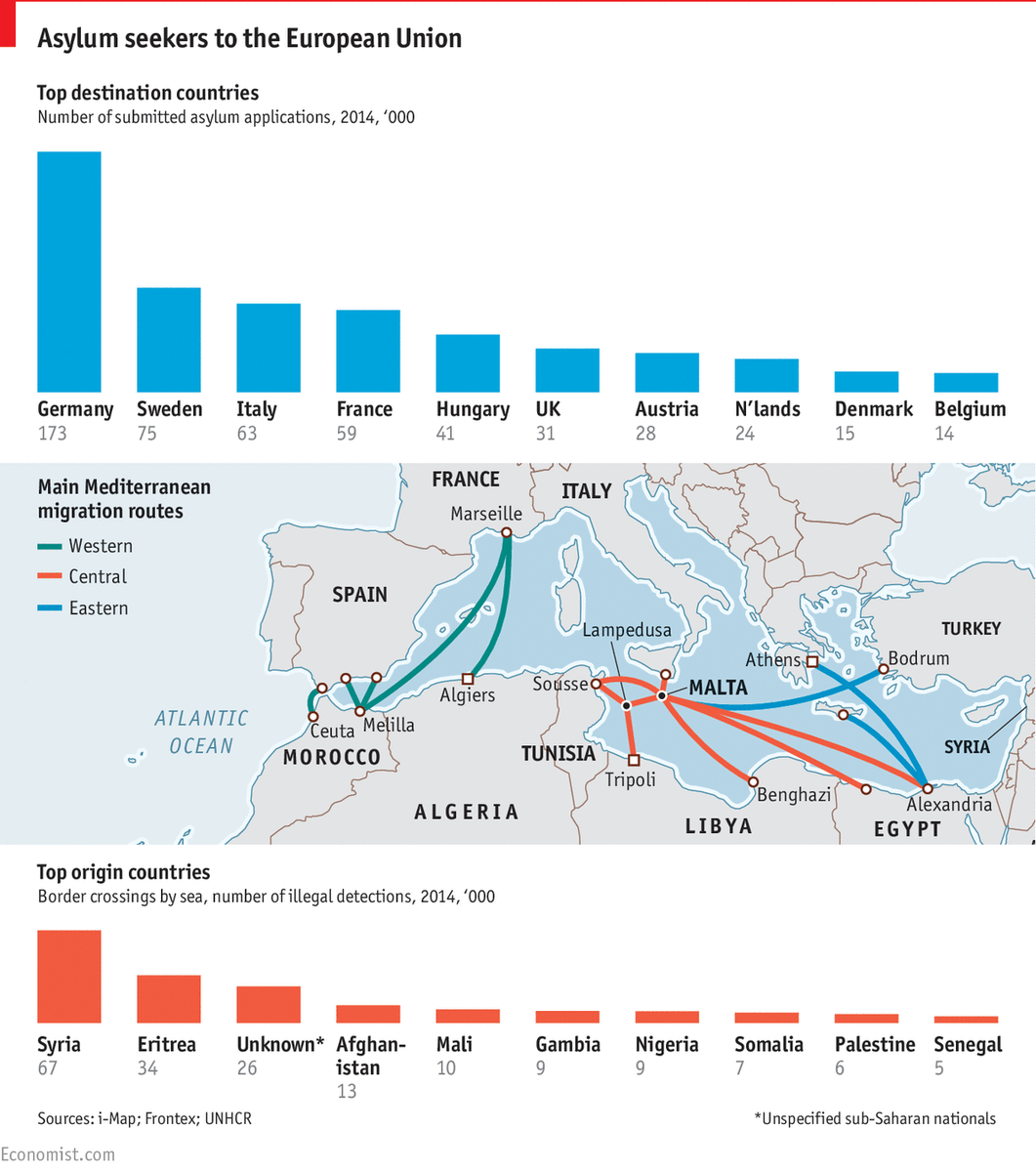
The Italian coast guard rescued almost 6,000 refugees from the Mediterranean last week. There does not seem to be any let up at all in the flow of migrants. Fortunately, the EU has decided not to abandon the refugees, although the EU still has not addressed the issue of what happens to asylum seekers in each European country.
Britain will hold general elections on 7 May and the two favorites, the Tory David Cameron and Labor’s Ed Miliband, are making an all-out effort to win the election. The election will be an important one as the fate of Britain’s role in the European Union seems to be the backdrop of many of the debates. Britain, like most other developed countries, is experiencing an significant widening of the gap between rich and poor, and that issue also pervades many of the discussions.
The Soviet Union employed a strategy called “Russification” in order to unite the many disparate nations comprising the Soviet Union. The process involved moving Russians into the many regions of the Socialist Republics in order to ensure loyalty to Moscow. After the breakup of the Soviet Union, however, these Russian speaking populations often do not share national loyalties to the newly independent states. These Russian speaking populations have created the problems in Crimea and eastern Ukraine. They are potentially a problem in the Baltic States of Latvia, Lithuania, and Estonia. And the are surfacing as a problem in Kazakhstan.

Burundian President Pierre Nkurunziza has roiled the politics of his country by seeking a third term as President, something which is prohibited by the Burundian constitution. Protests have been going on for five days in the capital city of Bujumbura. Nkurunziza became President in the midst of a serious crisis in 2005. Burundi, like Rwanda, is populated by both Hutus and Tutsis, the same ethnic groups involved in the 1994 Rwandan genocide. The fear is that the political protests could trigger off a spasm of ethnic violence. The dispute has been referred to the UN Security Council but Russia has adamantly opposed any intervention in the crisis.

The economic situation in Venezuela is one of the worst in the world today. The collapse in oil prices has aggravated an already sputtering economy plagued by mismanagement and corruption. Shortages of basic necessities such as toilet paper have become endemic, and the country’s pharmacy’s have been forced to adopt a rationing system, monitored by fingerprinting, in order to assure that sufficient medicines are available to the sick.
Venezuelan Inflation Rate

The BBC is reporting that the Islamic State has executed about 300 Yazidis in an area west of Mosul. The massacre is only the latest in a string of barbarities by the extremist group. But it also comes amid reports that the leader of the group, Abu Bakr al-Baghdadi, suffered severe injuries in an allied air attack earlier in the month of March. It does not appear as if the group has been hamstrung by the injury to the leader, indicating that the Islamic State has a robust chain of command.
1 May is a traditional holiday in many societies, but it was designated International Workers Day in 1886 by the Second International, an association of socialist and communist parties in Europe. The date commemorates the riot in Haymarket in Chicago. What began as a peaceful protest on that day in support of an 8-hour work day, exploded into a riot after a bomb was thrown. The riot marks the beginning of strong support for unions and for labor protections in general. The date is not observed in the US which instead selected the first Monday in September as Labor Day. In the US, there was a strong desire not to be associated with socialist or communist movements. In Turkey today, the day was observed by riots in Taksim Square.

The Nigerian military rescued 234 women and girls from Boko Haram. It is not clear if any of those women were those kidnapped last year, but the ability of the military to enter a stronghold area of Boko Haram in the Sambisa Forest is an encouraging sign. The move comes in the latter days of the presidency of Goodluck Jonathan before the new President Buhari takes office.
A new study suggests that as many as 1 in every six species may go extinct because of global warming. Studies have found that as the planet warms, some species have moved toward the poles at a rate of about 3.8 miles per decade. Some species will find themselves pushed out of environments that are necessary for their survival. Worryingly, some studies suggest that these findings may be too optimistic as the studies did not review tropical species as thoroughly as temperate species.
Today marks the 40th anniversary of what some call the fall of South Vietnam and others call the liberation of South Vietnam. The war was easily the most contentious in American history, and we are still learning much about the war that was never obvious at the time. But the war also marks a time of great change in the US. Today the US and Vietnam are working closely together on a number of fronts, although one could not accurately characterize them as allies.
Evacuation from the US Embassy in Saigon, 30 April 1975

Spiegel conducted an interview with Alexander Zakharchenko, the leader of the self-proclaimed Donetsk People’s Republic in eastern Ukraine. The interview is a fascinating window into the separatist mentality of the Russian-speaking rebels in Ukraine. Their rhetoric makes clear that they have no intention of backing down from their ultimate goal of integration with Russia.
According to Iran, the cargo ship MV Maersk Tigris was ordered into Iranian waters because of a monetary dispute between Iran and the cargo company. There very well may be a legal dispute, but commandeering a ship in transit is not typical legal recourse–one usually waits until the ship is docked and legal papers can be served. US naval vessels remain nearby but there does not seem to be an emerging crisis at this point. In case you wish to follow the voyage of the Tigris, you can follow its route on a fabulous website called Marine Traffic. From this site one can locate any registered vessel anywhere on the world’s oceans.
Timothy Phillips and Nir Eisikovits have written a commentary on the attractiveness of the Islamic State and why so many young people are traveling to the Middle East to join the group. The essay is highly provocative, essentially arguing that it is the sense of spirited and dangerous commitment to a cause that draws many to the Islamic State. The actual reality of living within the Islamic State is grim–we have no real sources for such information, but the little bit we get about life under the control of the Islamic State seems quite chilling.
For the first time in US history, a Japanese leader addressed the full houses of Congress. Prime Minister Shinzo Abe gave a speech to the Congress in which he pressed for the passage of the Trans-Pacific Partnership. He also offered his sincere condolences “to the souls of all American people that were lost during World War II.” The sentiment fell short of a formal apology for World War II and for the atrocities committed during that war. The US, as well, has never apologized for the use of atomic bombs during the war.
The Maersk Tigris, a Marshall Islands-flagged commercial craft, was intercepted by the Iranian navy in the Strait of Hormuz. We do not know what the Tigris was carrying nor why the Iranians intercepted the vessel. The US navy ordered the USS Farragut, a destroyer to follow the Tigris, but we do not know if the Farragut will follow it into Iranian waters. As is obvious in the map below, the Strait of Hormuz is both narrow and highly contested. The relationship between the US and the Marshall Islands is also somewhat opaque. According to the US State Department:
After gaining military control of the Marshall Islands from Japan in 1944, the United States assumed administrative control of the Marshall Islands under United Nations auspices as part of the Trust Territory of the Pacific Islands following the end of World War II. The Marshall Islands signed a Compact of Free Association with the United States in 1983 and gained independence in 1986 with the Compact’s entry into force. From 1999-2003, the two countries negotiated an Amended Compact that entered into force in 2004.
The Republic of the Marshall Islands (RMI) is a sovereign nation. While the government is free to conduct its own foreign relations, it does so under the terms of the Compact. The United States has full authority and responsibility for security and defense of the Marshall Islands, and the Government of the Marshall Islands is obligated to refrain from taking actions that would be incompatible with these security and defense responsibilities.
What we do not know is whether the US is obligated by the Compact to defend ships sailing under the Marshallese flag. A very curious and dangerous situation.

The Greek economic situation has not improved in the slightest, and a much more serious deadline is approaching. In June, the entire Greek government debt, estimated to be about 175% of the Greek GDP, will have to be renegotiated. John Cassidy in the New Yorker has a very pessimistic view of how those negotiations will unfold. The stubbornness of both sides is hard to fathom, particularly when the stakes are so high.
In discussions about climate change we often get confused between climate and weather. Weather is essentially a daily activity: we always have weather. Climate is a statistical probability of what kind of weather one might have at a certain time of the year. Sometimes we get cold days during summer and sometimes we get warm days during winter. Such events are not likely in any given summer or winter, but they do happen. Climate scientists wrestle with this distinction all the time. As climate models have improved, scientists believe that we can now assert that climate change will affect the probability of such unlikely events, making them more likely than was the case in the past. Since extreme events are ones for which we rarely prepare, the effects of these extreme events will likely be more noticeable and devastating. Until, of course, that we begin to expect them.
The US and Japan have clarified some aspects of their defense relationship that will undoubtedly trouble China. First, the US has stated unequivocally that the disputed Senkaku/Diaoyu Islands will be considered as the Senkaku Islands under Japanese sovereignty. This statement removes any doubts about whether the US will fill bound to defend the Japanese claim to the islands. Second, the Japanese will now interpret their constitution as allowing them to come to the aid of the US even if Japan itself is not threatened–in other words, the Japanese military will no longer be bound to a strict definition of “self-defense.” In foreign policy, clarity is often quite useful, particularly in alliance matters. Now the question is whether China wishes to test the strength of the US commitment to Japan.
As the deadline for Greek finances continues to come closer with no real resolution, the Greek Minister of Finance, Yanis Varoufakis, has been sidelined. Apparently, Varoufakis has embittered too many of his troika counterparts to be effective. It remains to be seen whether the troika will reward Greece for a more conciliatory approach. We could be watching a variation of the “good cop/bad cop” routine that is so often used in bad crime movies.

