Just as troubling as the rise of right-wing parties in the world is the rise of anti-establishment parties, such as the Pirate Party in Iceland or the 5 Star Movement in Italy. Anti-establishment parties exist in somewhat of a political vacuum–they reject traditional politics but have yet to coalesce around a positive political platform. The Pew Research Center has conducted polls on these movements and found that they have strong support in Europe and the US, but similar sentiments exist throughout the world. How these sentiments will ultimately affect broader politics is not clear.
The Syrian government and the Russian air force continue to pummel the city of Aleppo and it seems as if it is only a matter of time before the Syrian rebels will be forced to abandon the city. The human toll of the bombing will probably never be fully known, but it is hard to imagine that anyone could survive the relentless attacks. There is also another tragedy unfolding along the Turkish-Syrian border as the Turks refuse to take in any more refugees. The refugees are trapped along the border, with no humanitarian support and no real hope for safety. As many as 500,000 lives are hanging in the balance.
US President-Elect Trump has announced that he will appoint Oklahoma’s Attorney-General, Scott Pruitt, as the head of the Environmental Protection Agency (EPA). Pruitt is a climate change skeptic and has sued the EPA for enforcing federal rules over what he believes are issues to be settled by state, not federal, laws. Interestingly, Mr. Trump had his largest margins of support in the recent elections in the southern states which will most likely be most seriously affected by climate change of all the regions in the US. We will have to see if President Trump changes his opinion that climate change is a “hoax.”
Tomorrow is the 75th anniversary of the Japanese attack on the US naval base at Pearl Harbor, Hawaii, in 1941. It marked the beginning of the Pacific Theater of Operations of the Second World War, and stimulated the US to enter the war which had begun in Europe on 1 September 1939. The attack also propels the US into active engagement in world affairs, despite the reluctance of many Americans to become involved.
Angela Merkel has decided to run for a fourth term as Germany’s Chancellor. Although her party, the Christian Democratic Union (CDU) and its Bavarian sister party, the Christian Social Union (CSU) have strong support in the polls, Merkel faces a tough fight and has taken a harder line on the issue of immigration. She does, however, seem to be committed to upholding the liberal world order, unlike many of her counterparts in Europe and the US.
The US Congress has just given President Trump the right to send portable surface to air missiles to Syrian rebels. The Man Portable Air Defense Systems (MANPADS) are highly controversial because, in the wrong hands, they pose a serious threat to civilian airplanes. The new law contains struct language on how the weapons can be transferred, but there is little question that the distribution of the weapons to a non-state actor, no matter how thoroughly vetted, elevates the risk of proliferation.
For those who wish to learn more about the controversial telephone call from Taiwan to President-Elect Trump, the Washington Post has a very informative, historical article.
Relations between the US Federal government and Native American Nations have always been strained. The Supreme Court decided in 1831 that the Native American Nations were not “sovereign” in the sense of international relations. Rather, the Supreme Court ruled in the case, Cherokee Nation vs. State of Georgia that the Native American Nations were “domestic dependent nations”:
“Though the Indians are acknowledged to have an unquestionable and, heretofore, unquestioned right to the lands they occupy until that right shall be extinguished by a voluntary cession to our government, yet it may well be doubted whether those tribes which reside within the acknowledged boundaries of the United States can, with strict accuracy, be denominated foreign nations. They may more correctly, perhaps, be denominated domestic dependent nations. They occupy a territory to which we assert a title independent of their will, which must take effect in point of possession when their right of possession ceases. Meanwhile, they are in a state of pupilage. Their relation to the United States resembles that of a ward to his guardian.”
“Native American reservations cover just 2 percent of the United States, but they may contain about a fifth of the nation’s oil and gas, along with vast coal reserves.
“Now, a group of advisors to President-elect Donald Trump on Native American issues wants to free those resources from what they call a suffocating federal bureaucracy that holds title to 56 million acres of tribal lands, two chairmen of the coalition told Reuters in exclusive interviews.
“The group proposes to put those lands into private ownership – a politically explosive idea that could upend more than century of policy designed to preserve Indian tribes on U.S.-owned reservations, which are governed by tribal leaders as sovereign nations.”
The distinction between national and international could not be more stark.
China has responded to President-Elect Trump’s tweets concerning the telephone call he received from the President of Taiwan. The editorial was published in the People’s Daily which suggests that it represents the official position of the Chinese government. The editorial is quite measured, but also quite firm. First, it gives Mr. Trump the benefit of the doubt:
“Given that Trump hasn’t yet been inaugurated, this incident can be counted as nothing but a despicable and petty move. Nevertheless, political influencers in both the U.S. and Taiwan intend to blow it out of portion. DPP [the Democratic Progressive Party, the pro-independence party in Taiwan which is currently in power], pro-independence citizens and U.S. conservatives couldn’t wait to resume the old ruse of ‘manipulating Taiwan to influence China.'”
But that paragraph is followed by one with a clear warning to Mr. Trump:
“Though petty moves can change nothing in the big picture of China-U.S. ties, a growing number of such moves can hinder the bilateral relationship in a major way. This is an issuethat Trump and his transition team should take very seriously.”
We will see if Mr. Trump takes the warning seriously.
The Guardian has an absolutely chilling story on how information is manipulated on the internet and how that manipulation affects the search engines we often use to find information. I recommend the article in the strongest possible terms. As one who relies heavily on internet resources, I now find myself second-guessing everything I read, even from sources that I traditionally regarded as responsible. I am not sure how democracy can survive the pollution of information.
The American Museum of Natural History has produced a fascinatsing video on human population. It took humanity about 200,000 years to year one billion people; since then, it has taken 200 years to reach 7 billion. The explosive growth of population is unquestionably the most important reality governing world politics today event though we are only dimly aware of it.
Robert Walker is former chairman of the U.S. House Science, Space, and Technology Committee and he is slated to be appointed high up in NASA, the US space exploration agency. By all accounts, he is a gifted scientist and strongly supportive of space exploration. But he also a skeptic when it comes to NASA’s role as a monitor of the earth. In an op-ed for Space Newslast October he criticized NASA’s monitoring role:
“NASA was formed in the crucible of Sputnik and took this nation to the moon and stars. Today, it has been largely reduced to a logistics agency concentrating on space station resupply and politically correct environmental monitoring.
“NASA’s core missions must be exploration and science – and inspirational! These are the fundamental underpinnings of a Trump civilian space program.
“NASA should be focused primarily on deep space activities rather than Earth-centric work that is better handled by other agencies.”
Many scientists disagree with this view, arguing that the earth as a unified system can only be studied from space. Without NASA’s information, much of the research on climate change would be severely compromised.
Italian voters turned down a proposal to alter the Italian constitution and the Prime Minister, Matteo Renzi, resigned after the votes were tallied. The Italian government now faces a serious crisis. Rnezi’s party still controls a majority in the Parliament and elections are not scheduled until 2018. But if Renzi cannot be persuaded to create a caretaker government, then Italy faces the prospect of a major government change–the 63rd government in the last 70 years. The most likely candidate for a coalition government is the 5 Star Movement, an anti-establishment party, an outcome that will likely frighten the very fragile financial industry in Italy.
President-Elect Trump received a congratulatory telephone call from the President of Taiwan, Tsai Ing-wen. China, which regards Taiwan as a renegade province, reacted with anger. As far as if publicly known, no American President has spoken officially with the leaders of Taiwan since 1979 and the official stance of the US is that there is one China and Taiwan is part of China. In an editorial for the China Times, which represents the official government view, it seems as if China is willing to consider the incident as a “mistake”:
“Trump is not familiar with foreign relations and has been known for not playing by the rules since he started running for president. Before he gets sworn in, he faces some vague space to handle things. By answering Tsai’s call he may want to test how China would react and therefore prepare him for dealing with the country and gaining some advantage after he takes office.”
There is no question about how seriously China takes the matter. On the job training is not well-suited to diplomacy.
For the sixth straight week, South Koreans took to the streets to protest against President Park and charges of corruption within her administration. Park made a conditional offer to resign her office but the opposition party filed a motion to impeach her. The impeachment proceedings should therefore begin sometime next week, but members of her own party are encouraging her to resign before the trial. The opposition parties do not have enough votes to approve an impeachment motion, but some of her own party may vote for impeachment if she does not resign.
Protests in Seoul
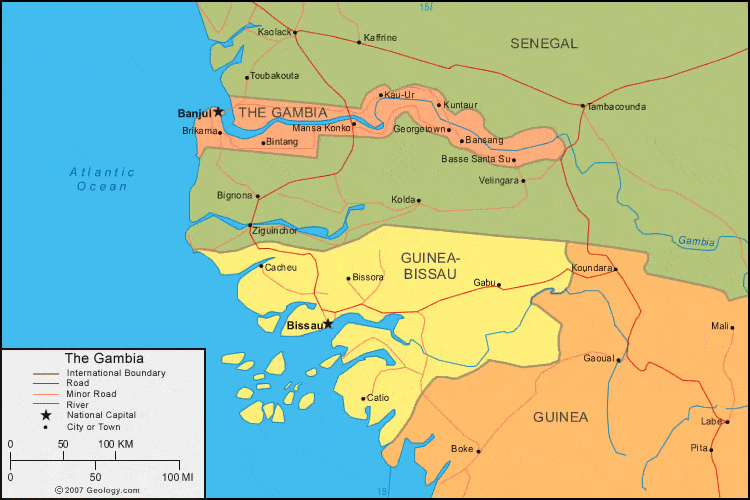
After 22 years of his tyrannical rule, voters in the Gambia finally voted against President Yahya Jammeh. Surprisingly, President Jammeh, although initially reluctant to accept the results of the votes, made a gracious concession speech, wishing the victor, Adama Barrow, good luck. The concession speech sharply contrasted with the brutality of Jammeh’s rule, and there was widespread disbelief at the outcome. But, slowly, Gambians have begun to celebrate their freedom.
Michael Gerson has written an op-ed piece about how North Korea will likely figure into President-Elect Trump’s foreign policy. Kim Jong-un is looking at a South Korea that is paralyzed by President Park’s scandal and at a completely untested American President. If there ever was a time to probe American foreign policy, North Korea could hardly find a better time. But President Trump would be loathe to back down at his first test as Commander in Chief. It should be an interesting first few months.
Iceland held parliamentary elections at the end of October but none of the seven parties achieved enough votes to form a majority government. Since that time, the right-wing and the left-wing parties have been invited to form coalitions to create a government. Iceland’s President, Guðni Jóhannesson, has now invited the anti-establishment Pirate Party to form a government. The Priate Party came in third in the elections, but only garnered 14% of the votes. Its platform is to create direct democracy with citizen input on virtually every government decision.
The Venezuelan economy is on its last legs as the value of its currency, the bolivar, has cratered. The mismanagement of the economy has been extraordinary, but the underlying problem is the total dysfunction of the Venezuelan government. With less than a month to go, it is not at all clear that President Maduro can be forced from office.
The McKinsey Global Institute has published a report on global migration. More than 90% of the world’s migrants travel voluntarily, usually in search of better jobs. And there is no question that the developed world benefits tremendously from these flows. According to the report:
“In fact, migrants make up just 3.4 percent of the world’s population, but MGI’s research finds that they contribute nearly 10 percent of global GDP. They contributed roughly $6.7 trillion to global GDP in 2015—some $3 trillion more than they would have produced in their origin countries. Developed nations realize more than 90 percent of this effect.”
The price of oil has gone up quite dramatically in the last few days. The increase is due to a decision by OPEC (the Organization of Oil Exporting Countries) and Russia to reduce production of oil to reduce supplies of oil. The agreement was reached only after Saudi Arabia agreed to make the largest cut in production. It had been reluctant to do so because Iran, Saudi Arabia’s enemy in the Middle East, refused to cut its production, claiming that it had to make up for lost sales during the boycott of Iranian oil over Iran’s nuclear program. Apparently, however, Russian President Putin was able to broker a face-saving agreement for both the Saudis and Iranians which essentially involved fudging the data. We’ll see how long the agreement lasts, but expect that the price of gasoline will go up in the next few days.
I do not always agree with David Ignatius, a columnist for the Washington Post, but he has written an op-ed piece which is truly unnerving. His argument is that social media and sophisticated government efforts to manage information have created what he calls a war on “truth”. In this new world, reality is completely plastic and the strategy of information is not to confront, but to undermine established institutions by spreading seeds of doubt. Combating this new element of our lives is difficult–it is a subversive idea that everything is nothing more than a social construct and that there is no essential reality. In many narrow respects, that observation is unquestionably true, but it appears that those narrow limits have been expanded to cover all aspects of our lives.
Roberto Stefan Foa and Yascha Mounk have written an essay for the Journal of Democracy which is also unsettling. Their findings can be summarized as follows:
“Over the last three decades, trust in political institutions such as parliaments or the courts has precipitously declined across the established democracies of North America and Western Europe. So has voter turnout. As party identification has weakened and party membership has declined, citizens have become less willing to stick with establishment parties. Instead, voters increasingly endorse single-issue movements, vote for populist candidates, or support “antisystem” parties that define themselves in opposition to the status quo. Even in some of the richest and most politically stable regions of the world, it seems as though democracy is in a state of serious disrepair.”
The data supporting this conclusion are interesting because it is age-dependent: younger cohorts have less of a commitment to democracy.
It also appears to be the case that income has an effect on support for democracy–the richer one is, the more likely it is that authoritarian rule is favored.
The conclusion to the essay is sobering:
“In a world where most citizens fervently support democracy, where antisystem parties are marginal or nonexistent, and where major political forces respect the rules of the political game, democratic breakdown is extremely unlikely. It is no longer certain, however, that this is the world we live in.”
“More than half of the world’s fresh water is frozen in Antarctica” and there is growing evidence that the ice sheets on the continent are melting from the bottom up. Warmer seawater is apparently intruding on the land upon which the ice sheets rest. The American Geophysical Union has released photographs which suggest that the ice sheets are breaking off in ways that were not fully anticipated. Because the melting occurs beneath the ice surface, it is very difficult to determine what the rate of melt is. But the evidence suggests that the rate of melt is higher than initial studies predicted.
Ian Buruma is an exceptionally insightful observer of world affairs. He has written an extended essay on his interpretation of the Brexit vote and the election of Donald Trump. He views these two events as indicative of what he calls “the end of the Anglo-American era”. He traces the beginning of that end to the elections of Ronald Reagan and Margaret Thatcher in the US and Great Britain in the 1980s. His observation of the extended effects of their policies concludes in this way:
“Radical economic liberalism did more to destroy traditional communities than any social-democratic governments ever did. Thatcher’s most implacable enemies were the miners and industrial workers. The neoliberal rhetoric was all about prosperity “trickling down” from above. But it never quite worked out that way. Those workers and their children, now languishing in impoverished rust-belt cities, received another blow in the banking crisis of 2008. Major postwar institutions, like the I.M.F., which the United States set up in 1945 to secure a more stable world, no longer functioned properly. The I.M.F. did not even see the crisis coming. Large numbers of people, who never recovered from the crash, decided to rebel and voted for Brexit — and for Trump.”
I encourage everyone to read this essay.
As we have suspected, Syrian officials have openly stated that they wish to take full control of the city of Aleppo before President-Elect Trump is inaugurated. The timing is important since the expectation is that Mr. Trump, if presented with a fait accompli, will not challenge President Assad’s control of all of Syria. Both Assad and Putin are certain that Mr Trump will not try to back the so-called “moderate” rebels in Syria who seek Assad’s overthrow but who also oppose Assad. The fate of the Syrian people appears to be sealed. What remains to be seen is how Assad will try to recover any legitimacy in the eyes of the Syrian people.
Fighting continues between Pakistani militants and the Indian Army in the disputed territory of Kashmir. Since last July the violence has been steady but relatively low-level. It is not clear whether the fighting signals an intent to escalate, but these sporadic attacks are clearly attempts to determine weak points in the Indian defense lines. There does not seem to be any high-level talks going on to resolve the tension and both sides seem willing to tolerate the violence. How long that tolerance will last is unknown.