US Secretary of Defense Mattis has publicly stated that the US recognizes Indonesia’s claim to an area of the South China Sea that China claims as part of its sovereign territory. The area is now called the “North Natuna Sea” by Indonesia and Indonesia asserts that the sea is within the Exclusive Economic Zone (EEZ) of Indonesia. All states have the right to regulate the resources within a 200-mile area from its territorial boundaries, and there is some evidence of oil and natural gas resources near Natuna Island. Mattis is on a trip to Vietnam and Indonesia to foster better ties with those countries and to counterbalance Chinese influence in the region–the balance of power game never rests.
North Korean vessels have visited Russian ports more frequently than Chinese ports in the second half of 2017, a marked change from traditional patterns. The shift reflects Chinese tightening of economic contacts with North Korea because of the UN Security Council contacts. But the Russians, who have also signed onto the sanctions, appear to be taking up the slack. Russia could easily supply North Korea with petroleum and coal, both of which are critical imports for North Korea. US President Trump has been quite critical of China’s support for North Korea, but he only called out Russia for its support on 17 January. The Russians deny that they have violated the sanctions.
“The partisan divide in Middle East sympathies, for Israel or the Palestinians, is now wider than at any point since 1978. Currently, 79% of Republicans say they sympathize more with Israel than the Palestinians, compared with just 27% of Democrats.
“Since 2001, the share of Republicans sympathizing more with Israel than the Palestinians has increased 29 percentage points, from 50% to 79%. Over the same period, the share of Democrats saying this has declined 11 points, from 38% to 27%.”
Support for Israel overall remains quite strong, but the poll results shows sharp difference based on age and religious affiliation. Israeli Prime Minister Netanyahu is a lightning rod for much criticism.
We usually associate the “good life” with having “things” that make our lives more comfortable. But there are many people in the world who lack many of these “things”. The Pew Research Center has conducted interviews with tens of thousands of people and usually starts out their interviews with a simple question: “How would you describe your day today – has it been a typical day, a particularly good day or a particularly bad day?” Over the years they have asked this question to over forty thousand people in 38 countries and their responses have revealed an interesting correlation:
“Perhaps surprisingly, responses to this question were negatively correlated with one measure of national well-being, the United Nations’ Human Development Index (HDI). Countries with higher HDI scores have, on average, higher gross national income per capita, longer expected lifespans and higher educational expectations and attainment. Yet people in countries with higher HDI scores are less likely to say their day has been particularly good. In 2014, we similarly found that a country’s GDP per capita was negatively correlated with the percentage of people who said their day was good.”
It appears as if “things” do not necessarily make us happier.
On the other hand, poverty is a miserable condition and while one should not believe that wealth makes one happy, it does not follow that the lack of wealth is the key to happiness. Accumulating waelth, however, does appear to be an objective for a large number of people on the planet. And that number seems to be getting smaller relative to the number of people alive. Oxfam is an advocacy group that works to ameliorate global poverty and is publishes an annual report on efforts to reduce poverty in the world. This year’s report focuses on growing wealth inequality in the world, and its conclusions are depressing:
“Last year saw the biggest increase in the number of billionaires in history, with one more billionaire every two days. There are now 2,043 dollar billionaires worldwide. Nine out of 10 are men. Billionaires also saw a huge increase in their wealth. This increase was enough to end extreme poverty seven times over. 82% of all of the growth in global wealth in the last year went to the top 1%, whereas the bottom 50% saw no increase at all.”
While one should be cautious about reports from advocacy groups, the Oxfam report is consistent with other studies on the problem of wealth inequality in the world.
US President Trump has approved an increase of tariffs on imported large residential washing machines and imported solar cells and modules. The move targets imports from China and will likely trigger a harsh response from China. The move also reflects Mr. Trump’s belief that trade deals have worked against US interests. The tariffs will help the manufacturers of solar panels in the US but will raise the cost of installing those panels and perhaps reduce incentives toward renewable energy. We should watch carefully to assess the Chinese reaction–a trade war would not be in the interest of either country.
Federal Reserve Bank of San Francisco economist Òscar Jordà and his colleagues have released an incredibly ambitious paper entitled “The Rate of Return on Everything, 1870-2015″. The paper builds on earlier work, primarily by Thomas Piketty, that suggests that the returns on wealth over time are greater than the returns on income. That finding suggests that those who rely on incomes–primarily those who sell their labor–are at a disadvantage to those who can rely on wealth–primarily the owners of capital. The dataset for the paper is remarkable:
“The dataset unveiled in this study covers nominal and real returns on bills, bonds, equities, and residential real estate in 16 countries from 1870 to 2015. The countries covered are Australia, Belgium, Denmark, Finland, France, Germany, Italy, Japan, the Netherlands, Norway, Portugal, Spain, Sweden, Switzerland, the United Kingdom, and the United States.”
Including housing in the analysis is unusual because of the idiosyncratic nature of property values, but it appears as if the researchers have addressed many of the data problems. The paper is yet another piece of evidence that market capitalism has a strong tendency toward inequality over time.
Germany’s Social Democrat Party (SPD) has agreed to enter coalition talks with Chancellor Angela Merkel. The SPD has been a coalition partner with Merkel’s Christian Democrat Party for the last 12 years, but many members were worried that the SPD had lost its identity because of the long partnership and that voters were turning away from it. The price of the partnership seems to be a willingness by the SPD for a harder line on immigration, likely brought about by concern that right-wing parties were getting stronger because of the issue. Like most other countries in the world, immigration issues is clearly pushing the political spectrum to the right.
US Vice-President Pence met with King Abdullah of Jordan, one of the US’s strongest allies in the Middle East. It was not a comfortable meeting as Abdullah made several pointed criticisms of the US decision to recognize Jerusalem as the capital of Israel. Jordan has a special role in Jerusalem because it is regarded as the guardian of the Holy Sites in the city and the US decision clearly undermines that role. Pence made no concessions to the King and it is not at all clear how the US can retain a role in any future peace negotiations between Israel and the Palestinians. Mahmoud Abbas, the leader of the Palestinian Authority, refused to meet Pence, but Abbas’s role as leader is clearly in jeopardy.
The US sent a destroyer, the USS Hopper, within 12 nautical miles of the Scarborough Shoal, a disputed islet in the South China Sea and the Chinese military ordered the destroyer to leave, claiming that the islet was Chinese territory. China built up the shoal over the last few years so that it now is permanently above sea level. International law does not allow such features as artificial islands to constitute sovereignty. Article 60, Section 8 of the Law of the Sea reads:
“Artificial islands, installations and structures do not possess the status of islands. They have no territorial sea of their own, and their presence does not affect the delimitation of the territorial sea, the exclusive economic zone or the continental shelf.”
Turkey has begun military operations against Kurdish forces in northern Syria. The move follows the US announcement last week that it was going to arm Kurdish and Arab rebels against the Syrian government of Assad. Turkey fears that US support for the Kurds will embolden them to demand an independent state in northwestern Syria which would only inspire Turkish Kurds to make similar demands. I suspect that the US promise to arm the Kurds is credible, but opposition to the US move is strong. According to The Independent:
“Recep Tayip Erdogan has promised to ‘suffocate’ this latest American proxy ‘terror army’, regarding it as a Kurdish force effectively controlled by the ‘terrorist’ Kurdish Workers Party, the PKK. Assad’s government called the enlistment of the new militia a ‘blatant assault’ on Syria’s sovereignty. Russia warned of partition.”
The Kurds will undoubtedly fight back. Whether the US will back them remains to be seen. I would advise them not to trust the Trump Administration’s words.
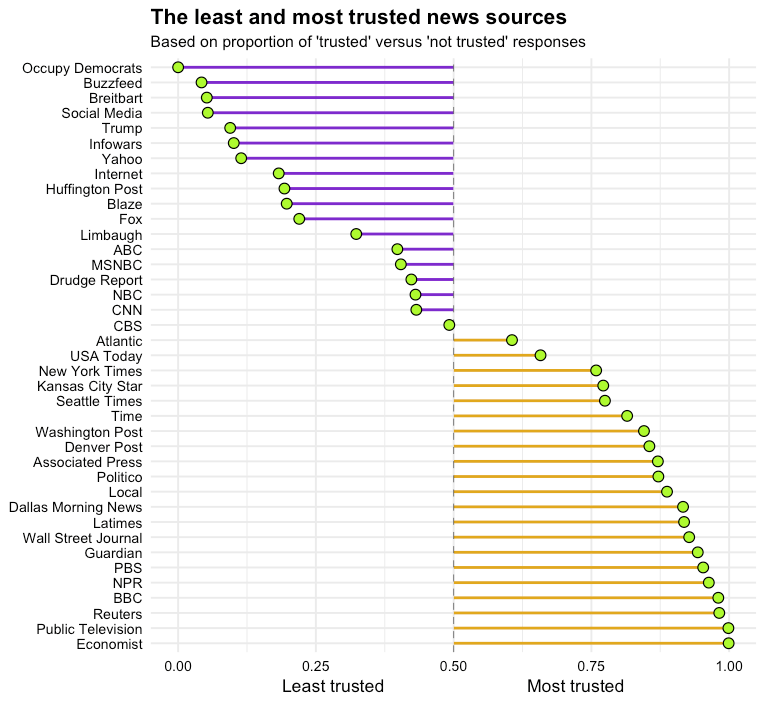
The Reynolds Journalism Institute (RJI) at the University of Missouri did a poll of trusted news sources in the US earlier in 2017. The results of the poll are fascinating, although it was limited to US media sources (except for The Guardian, The BBC, and The Economist–although it is instructive to note that the three British publications were highly regarded as trustworthy). Facebook is apparently trying to gauge trustworthiness and it will be interesting to see the results of that experiment.
The US National Aeronautics and Space Administration (NASA) has just released its data on global temperatures in 2017 and the year is the second hottest on record. Some had expected 2017 to be slightly cooler than average because there was no el Niño in the year, but even without the el Niño the temperatures exceeded expectations. The last four years have been the warmest ever recorded.
“Earth’s global surface temperatures in 2017 ranked as the second warmest since 1880, according to an analysis by NASA.
“Continuing the planet’s long-term warming trend, globally averaged temperatures in 2017 were 1.62 degrees Fahrenheit (0.90 degrees Celsius) warmer than the 1951 to 1980 mean, according to scientists at NASA’s Goddard Institute for Space Studies (GISS) in New York. That is second only to global temperatures in 2016.”
Tunisia was the first country to experience the protests that ultimately culminated in the massive protests throughout the Middle East in 2011 that became known as the Arab Spring. Tunisia went through the protests with less turmoil than was experienced in countries like Libya, Egypt, and Syria. But the situation in Tunisia was never really resolved and since 3 January Tunisia has been experiencing new protests, largely over the price of food, but inextricably linked to a variety of other issues including the lack of jobs. The recent protests were also the result of austerity policies imposed on Tunisia by the International Monetary Fund in 2012 and 2016 as the country’s debts increased dramatically. The IMF policies will undoubtedly make more protests increasingly likely as the austerity policies depress wages and subsidies to the poor.
The Gallup Organization has released a new report, “Rating World Leaders, 2018: The US vs. Germany, Russia, and China“. Gallup has asked this question every year for a number of years and therefore has a good baseline to assess changes in world opinion. The polled people in 134 countries and the conclusions of the report are straightforward:
“This year marks a significant change in our trends. Only 30% of the world, on average, approves of the job performance of the U.S.’s leadership, down from 48% in 2016. In fact, more people now disapprove of U.S. leadership than approve. This historic low puts the U.S.’s leadership approval rating on par with China’s and sets a new bar for disapproval.
“But more important is the shift this has created in the global balance of soft power and what that means for U.S. influence abroad. With its stable approval rating of 41%, Germany has replaced the U.S. as the top-rated global power in the world. The U.S. is now on nearly even footing with China (31%) and barely more popular than Russia (27%) — two countries that Trump sees as rivals seeking to “challenge American influence, values and wealth.”
There are concerns about a far-right group in Germany, called the Reichsbürger group, which has increased its membership by 56% this last year to about 15,600 members. The group, whose name means “citizens of the Reich” believe that the true boundaries of Germany are the ones in place in 1871 and that all governments since then, including the Nazis, were and are illegitimate. Some of the members are well-armed and are waiting for “Day X” which is a day when there will be an uprising against the German government. The group remains a fringe group in Germany, but its recent growth in membership mirrors the growth of right-wing groups in Europe and the US.
It is hard to describe the situation in Venezuela where prices are rising at the rate of 80% a month. Money is worthless and the economic system seems to be running on barter. But barter does not induce production nor does it pay for imported goods, so there is precious little to trade. Most stores have been stripped clean by looters and there is no way to restock the stores without money. There is no willingness on the part of the government to make any compromises with the opposition. It is hard to imagine a country as potentially rich as Venezuela being so close to total collapse and it is also hard to see what a total collapse of an economy looks like in the 21st century.
US President Trump has been sharply critical of Pakistan lately, claiming that the country was undermining US efforts to defeat the Taliban in Afghanistan. Apparently, however, there is a backchannel between the US Central Command (CENTCOM) and the Pakistani Inter-Services Intelligence (ISI). The ISI published a report on 12 January outlining a telephone discussion between Chief of Army Staff (COAS) General Qamar Javed Bajwa and Commander US Central Command (CENTCOM) General Joseph L. Votel. That report claims that
“The General said that US values Pakistan’s role towards war on terror and expected that on-going turbulence remains a temporary phase. He also conveyed COAS that US is not contemplating any unilateral action inside Pakistan but is seeking cooperation to tackle Afghan nationals who, in US view, use Pakistan’s soil against Afghanistan. This view, he felt, was undermining in Washington, Pakistan’s contributions in war against terrorism.”
It appears as if there is a discrepancy between the rhetoric coming out of Washington and the reality on the ground in Afghanistan.
Pakistani General Qamar Javed Bajwa
For many years, Freedom House has issued an annual report on the state of freedom in the world. The report uses 25 indicators of freedom (press freedom, elections, availability of government information, and others) and scores every country on a scale of 1-4. The process is subjective, so it is difficult to assess the accuracy of the conclusions. But the scoring has been done over many years and most of the indices can be quantified with plausible data. So the value of these reports is how countries score over time, not necessarily in how countries compare to each other. This year’s report is grim. The number of countries that experienced a decline in the number of freedoms protected was quite large. The report singles out the US as one of those countries:
“The past year brought further, faster erosion of America’s own democratic standards than at any other time in memory, damaging its international credibility as a champion of good governance and human rights.
“The United States has experienced a series of setbacks in the conduct of elections and criminal justice over the past decade—under leadership from both major political parties—but in 2017 its core institutions were attacked by an administration that rejects established norms of ethical conduct across many fields of activity. President Trump himself has mingled the concerns of his business empire with his role as president, appointed family members to his senior staff, filled other high positions with lobbyists and representatives of special interests, and refused to abide by disclosure and transparency practices observed by his predecessors.”
Jerry Chun Shing Lee was in the US military and then worked for the CIA for a number of years before he retired in 2007. He was a case officer in the CIA and had access to some of the most important secrets in the US government. He had been living in Hong Kong but was arrested on Monday for illegally holding on to highly classified documents. Lee could be the missing link for the loss of some 20 US spies in China. Since 2011 those operatives have either gone missing or imprisoned, depriving the US of important information about Chinese activities. The loss of those operatives was a mystery:
“According to the New York Times, Beijing launched a major assault on America’s intelligence operations in China between 2010 and 2012. During that time, Chinese officials murdered or jailed around 20 American assets and spies. One asset was reportedly shot in the courtyard of a Chinese government building.
“That proved a major setback for the US. It takes many years to build an intelligence network in a foreign country, and in 2010 the US had the best information on China it had in years. That’s partly because the US recruited informants from inside the Chinese administration, which helped the US better understand the inner workings of a highly secretive government.”
It remains to be seen if Lee was responsible for outing those spies, but that possibility is being pursued aggressively.
The grand canal in China is an extraordinary example of engineering. It is over 1,100 miles long and the earliest parts of the canal were built in the 5th century. It was built to connect the city of Beijing with the southern city of Hangzhou. It is also an example of the Chinese obsession with harnessing water power. Since the founding of the People’s Republic of China in 1949, it has built 86,000 dams, an average of one per day, including the world’s largest dam, the Three Gorges Dam. Its control of the Tibetan Plateau also gives it control over the major rivers in Southeast and South Asia, much to the consternation of its downstream neighbors. The Chinese are increasingly becoming more unilateral in terms of the headwaters of these rivers and controversy is building given the centrality of river resources to all nations in the region.
Van Jackson is senior lecturer in international relations at Victoria University of Wellington, New Zealand and he has written a well-informed essay on what an attack on North Korean nuclear facilities might involved. The level of detail is somewhat overwhelming, but nonetheless interesting. The bottom line of his analysis is that even a well-planned attack would be highly problematic and unlikely to achieve easily any limited goals. If an attack does occur (and at this point, the odds seem against that outcome), the essay provides a useful checklist of things to watch for in terms of assessing its effectiveness.
Paul Sagar is a lecturer in political theory in the Department of Political Economy, King’s College London, and he has written an essay on how Adam Smith’s great work, The Wealth of Nations, has been misunderstood and distorted by many who celebrate “free market” economics. Sagar recommends that Smith is better understood as a moral philosopher and that his first book, The Theory of Moral Sentiments, is a better guide to Smith’s views. Smith did not believe that the “invisible hand” of supply and demand would necessarily enhance social welfare. Rather, he believed that without government intervention to curb excessive greed on the part of producers and consumers, social inequities would be aggravated. The essay is a very good corrective to neoliberal arguments that advocate for a substantially reduced role of government in the economy.
Britain’s exit (Brexit) from the European Union (EU) has become more complicated as the EU has tightened up its demands on the free movement of individuals between the Union and Britain and insisted on British adherence to the EU fisheries policies. The two issues were important to those who voted for Brexit and British Prime Minister May will have a difficult time accommodating those concessions. Moreover, Norway, which is not a member of the EU but enjoys “associated” status with it, has been watching carefully to ensure that Britain does not get a better deal than it currently has. The jockeying among members of the EU for business that is leaving Britain in order to maintain full status within the Union is also causing friction in the Union’s decision-making process. It is difficult to see how the Brexit can be managed before the deadline in 2019 without a great deal of economic turmoil.
Palestinian Authority President Mahmoud Abbas delivered a fiery two-hour speech condemning the US and other states for abandoning the two state solution. Abbas spoke to the Palestinian Central Council and he made it clear that the US would no longer be regarded as an effective mediator between Israel and the Palestinians. The Council was considering what steps to take in response to the collapse of the two-state solution and the Oslo Accords and some measures being considered were “rescinding Palestinian recognition of Israel, pursuing Israel for war crimes at the International Criminal Court and advancing efforts for a Palestinian state to be recognized internationally.” The US is likely to cut off assistance to one of the main UN agencies offering help to the Palestinians very soon which will undoubtedly increase pressure on the Palestinian Authority to take strong action to change the status quo.
On Sunday, the US announced that it was assisting in arming a 30,000 soldier militia in northwestern Syria composed of Arabs and Kurds opposed to Syrian government Assad. Syria, Russia, and Turkey have condemned the move, but Turkey’s response was stunningly harsh given that the US and Turkey have historically been close allies. Turkish President Erdogan made the following statement in a speech in Ankara:
“A country we call an ally is insisting on forming a terror army on our borders. What can that terror army target but Turkey?
“Our mission is to strangle it before it’s even born.”
The Huffington Post has published a leaked draft of the Nuclear Posture Review for January 2018 (the full text of the draft is at the end of the Huffington Post article). The Review is an analysis of the future needs for nuclear weapons drafted by the US Defense Department, the final draft of which will likely be published after President Trump’s State of the Union Address. The draft calls for the building of many new, smaller nuclear weapons designed to build a credible deterrent at lower levels of violence. The proposal hearkens back to US nuclear policy in the Kennedy Administration that called for the ability to launch a “flexible response” to small strategic threats. The Union of Concerned Scientists published a critique of the proposal, pointing out the elevated risks for actually using nuclear weapons as well as the very high costs associated with the US nuclear weapons program already. David Barash has written a very insightful critique of the entire notion of nuclear deterrence, the fundamental underpinning for all nuclear doctrine. Deterrence is certainly flawed, but there seems to be little sentiment in the world for complete disarmament.
Turkey is preparing for an assault on Kurdish forces in northwestern Syria’s Afrin province. The attack is in response to the US supporting a 30,000 soldier force among various Syrian and Kurdish allies opposed to the government of Syrian President Assad. Turkey and the US are both NATO allies, but they have been working in strongly opposite directions as far as the Syrian Kurds are concerned. Turkey fears a separatist movement among the Kurds, not only in Syria but is Turkey as well. For its part, the US has a very confusing policy toward the Kurds. It supports the Syrian Kurds, but flatly opposed the Kurdish bid for independence in Iraq. The difference is easy to explain: the US considers Iraq an ally, and does not wish it to be torn apart by Kurdish independence; but Syria is an enemy, supported by Russia, and the US welcomes that friction. But, if one were a Kurd, the policies are contradictory.
RT is not a reliable news source. It is a media outlet controlled by the Russian government and makes little pretense of reporting news that portrays Russian actions that are the least bit unflattering. But it is sometimes useful to see how foreign sources use news from the US for propaganda purposes. Its reporting on US President Trump’s comments about immigrants from Africa and Haiti is instructive. The discussions in the US about those comments are meaningless to an international audience. The RT take on the comments is what the world will take away from this sordid incident and it is also what the world will remember.