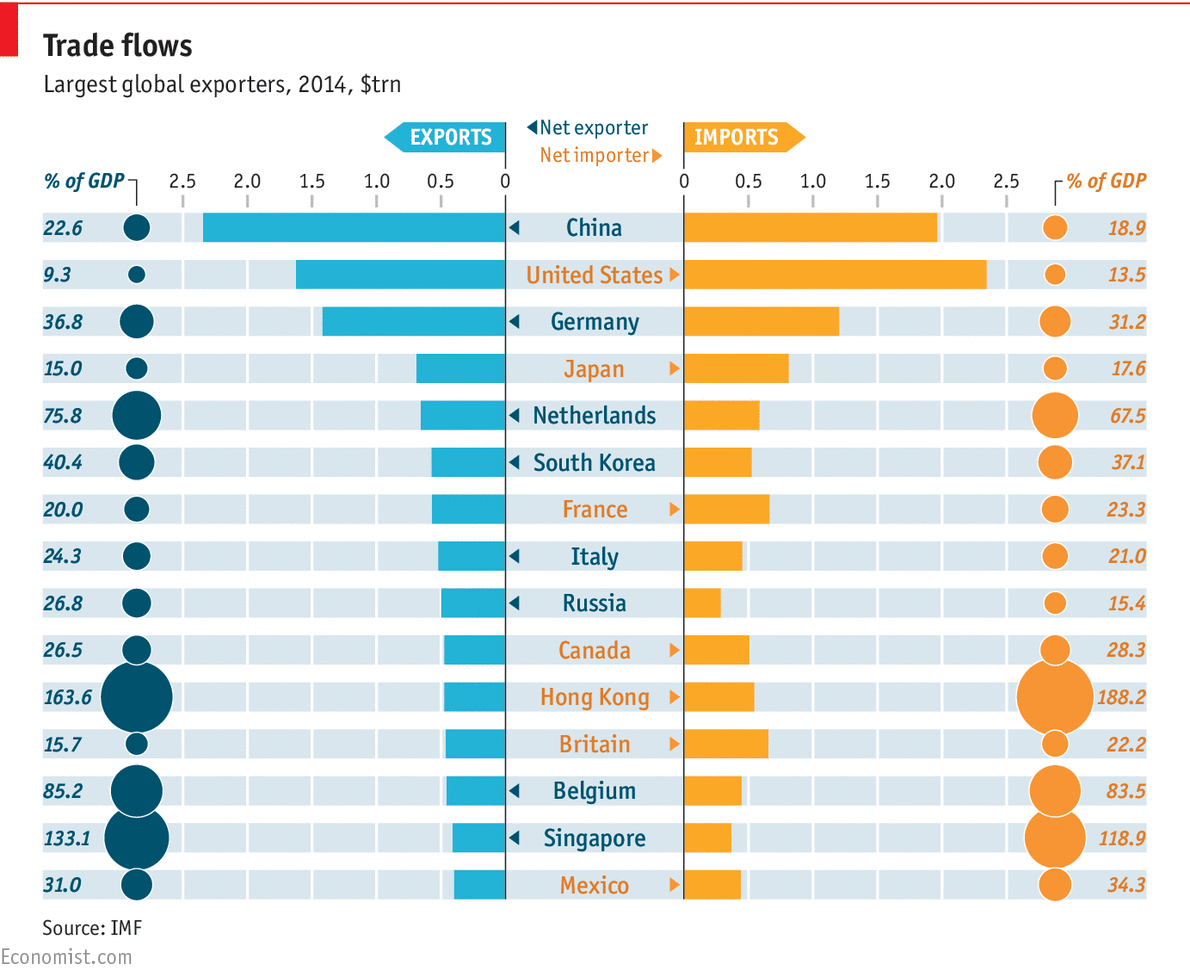
The possibility of a trade war between the US and China is posing difficult questions for other trading partners of both countries. In particular, the European Union has been placed in a difficult position. Like the US, the EU has many grievances against Chinese trading practices. Additionally, unlike China, Europe relies heavily on US support for security guarantees which requires it to maintain good relations with the US. But the Europeans also rely much more heavily on trade for its economic dynamism and has enjoyed the benefits of the rules-based trading system enforced by the World Trade Organization (WTO) and they are very concerned by the apparent abandonment of that system by US President Trump. So the Union has to decide whether to support the US or China in a possible trade war. Its preferred course of action would be to cultivate continued negotiations between the US and China so that choosing a side would not be necessary. But they may not be afforded that opportunity and it will be interesting to see where EU trade policy ends up.
Christine Emba has written an intriguing review of Patrick Deneen’s new book, Why Liberalism Failed. She points out that classical liberalism, which she interprets in this way–“liberalism defines humans as autonomous and rights-bearing individuals who should be freed up as much as possible to pursue their own preferences, goals and dreams”–has aspects which are attractive to both those on the right and the left in American politics. The argument, however, is that the ideology of liberalism has a central flaw:
“That’s the heart of it, really. Liberalism is loneliness. The state isn’t our sibling; the market won’t be our mate. And the more either the right or left’s solutions attempt to fill in the gaps — “more markets, for you to attempt to buy back what has been destroyed! More regulations, to protect you when you can’t!” — the more obvious it becomes that the entire concept is flawed. The institution of liberalism is caving in on itself, and we each individually feel the crush.”
This argument is not new. It has been a critique offered by many authors, such as: Erich Fromm, Escape from Freedom; David Reisman, The Lonely Crowd; and Philip Slater, The Pursuit of Loneliness. Whatever ideology emerges to replace liberalism, it will succeed only if it addresses this central concern of all humans.
“The United States for a second week in a row has blocked a U.N. Security Council statement supporting the right of Palestinians to demonstrate peacefully and endorsing Secretary-General Antonio Guterres’ call for an independent investigation into deadly protests in Gaza.
“Palestinian U.N. Ambassador Riyad Mansour told reporters at U.N. headquarters in New York Friday evening that 14 of the 15 council nations agreed to the statement, but the United States, Israel’s closest ally, objected.
“Mansour called the U.S. rejection ‘very irresponsible,’ saying it gives Israel ‘the green light to continue with their onslaught against the civilian population’ in Gaza.”
“In response, Israeli Ambassador to the UN Danny Dannon called on the Security Council to condemn Hamas, which he said is using Gaza’s children as human shields in the protests. He also urged council members to call on the terrorist organization to cease all provocations, saying that these only ‘increase the violence and tensions.’”
The US has issued sanctions on a number of Russian individuals and enterprises. According to the US Treasury Department, the sanctions are designed to isolate those individuals and enterprises from any assets located within US jurisdiction and to penalize non-US organizations from making any transactions with those entities:
“All assets subject to U.S. jurisdiction of the designated individuals and entities, and of any other entities blocked by operation of law as a result of their ownership by a sanctioned party, are frozen, and U.S. persons are generally prohibited from dealings with them. Additionally, non-U.S. persons could face sanctions for knowingly facilitating significant transactions for or on behalf of the individuals or entities blocked today.”
The justifications for the sanctions are quite broad and cover a range of Russian activities, including interference in the US presidential election of 2016:
“The Russian government engages in a range of malign activity around the globe, including continuing to occupy Crimea and instigate violence in eastern Ukraine, supplying the Assad regime with material and weaponry as they bomb their own civilians, attempting to subvert Western democracies, and malicious cyber activities. Russian oligarchs and elites who profit from this corrupt system will no longer be insulated from the consequences of their government’s destabilizing activities.”
The list consists of individuals very close to Russian President Putin, including his son-in-law, but does not include Putin himself, an inexplicable omission. The Russians usually reciprocate to these types of actions, and we should expect retaliation. But the US is less vulnerable to economic sanctions from Russia since, aside from oil and gas investments, there is relatively little US exposure in Russia. Much depends on whether Europe joins in on the sanctions, but Europe is far more susceptible to Russian retaliation.
Robin Wright is a distinguished analyst of Middle Eastern politics and she has written an essay for the New Yorker on the split between US President Trump and the US military on the wisdom of keeping troops in Syria. The US has little to show for its limited intervention in the civil war which has raged since 2011 and from that perspective a US withdrawal will not change the most likely outcome which is that Syrian President Assad will remain in office. But a US withdrawal will also make it easier for some of the players–specifically Russia, Turkey, and Iran–to impose their wills on the region. It is not at all clear what aspirations these countries have in Syria (some of those aspirations may in fact conflict). But a US withdrawal will also leave US allies–the Kurds, Israel, and Saudi Arabia– in the lurch. Wright points out the possible consequences:
“The U.S. decision came on the same day that the leaders of Russia, Iran, and Turkey met in Ankara to discuss their next steps on Syria. The troika has virtually hijacked a peace effort long led by the United Nations. At a press conference afterward, President Vladimir Putin of Russia said that the three nations had agreed to expand and consolidate their efforts in post-conflict Syria. U.S. officials have been concerned that an imminent U.S. withdrawal could clear the way for Russia and Iran, particularly, to control the future Syrian political landscape, with military bases and access to the Mediterranean—a geostrategic game-changer.”
It is very difficult for me to speculate on managing such a shift in the regional balance of power, but it is likely that Israel and Saudi Arabia will feel more threatened by it and therefore more likely to take action themselves to change the balance back into their favor.
Rana Dasgupta has written a fascinating essay for The Guardian on the coming demise of the nation-state. The end of the nation-state has been predicted many times over the last 50 years and thus far the nation-state has remained viable and, in some respects, grown stronger. Dasgupta makes an insightful argument about the possible “end-run” around the power of nation-states by financial elites who seek to deny resources to the state to maintain its power. The argument is intriguing, but hard to measure:
“For increasing numbers of people, our nations and the system of which they are a part now appear unable to offer a plausible, viable future. This is particularly the case as they watch financial elites – and their wealth – increasingly escaping national allegiances altogether. Today’s failure of national political authority, after all, derives in large part from the loss of control over money flows. At the most obvious level, money is being transferred out of national space altogether, into a booming ‘offshore’ zone. These fleeing trillions undermine national communities in real and symbolic ways. They are a cause of national decay, but they are also a result: for nation states have lost their moral aura, which is one of the reasons tax evasion has become an accepted fundament of 21st-century commerce.”
The denial of financial resources could in fact debilitate the nation-state, but regulating off-shore financial centers is not an impossible task. The question is whether nation-states have sufficient will to preserve themselves.
John Bolton will become the National Security Adviser in a few short days. He will likely be a dramatic change from H.R. McMaster, although it is always difficult to predict how the office may shape the views of the person who holds it. But Bolton remains a staunch supporter of the Iraq invasion in 2003, which I regard as the worst foreign policy decision made since the US emerged on the world stage after 1945. According to the New York Times:
“While Mr. Trump’s criticism of the Iraq war during the campaign raised the possibility that he might take a less aggressive stance on foreign policy, no one was a more vociferous proponent of that disastrous invasion than Mr. Bolton, a position he has not renounced. At the time, Mr. Bolton said Iraqis would welcome American troops. He also said the United States’ military role would be over quickly as Iraqis exercised their new freedom from Saddam Hussein and established a democracy. It was the sort of simplistic and wrongheaded position that he takes on most policies.”
Mr. Bolton has also played fast and loose with evidence to support his positions. On the issue of the Iranian nuclear program, he argued that Iran was well advanced in its nuclear program in 2004. Gareth Porter examined the evidence that Bolton used to support his position:
“Bolton’s strategy was based on the claim that Iran was hiding its military nuclear program from the IAEA, and in early 2004, he came up with a dramatic propaganda ploy: he sent a set of satellite images to the IAEA showing sites at the Iranian military reservation at Parchin that he claimed were being used for tests to simulate nuclear weapons. Bolton demanded that the IAEA request access to inspect those sites and leaked his demand to the Associated Press in September 2004. In fact, the satellite images showed nothing more than bunkers and buildings for conventional explosives testing.
“Bolton was apparently hoping the Iranian military would not agree to any IAEA inspections based on such bogus claims, thus playing into his propaganda theme of Iran’s ‘intransigence’ in refusing to answer questions about its nuclear program. But in 2005 Iran allowed the inspectors into those sites and even let them choose several more sites to inspect. The inspectors found no evidence of any nuclear-related activities.”
“But the whole story of the so-called ‘laptop documents’ was a fabrication. In 2013, a former senior German official revealed the true story to this writer: the documents had been given to German intelligence by the Mujahedin E Khalq, the anti-Iran armed group that was well known to have been used by Mossad to ‘launder’ information the Israelis did not want attributed to themselves.”
Bolton has also mapped out a way to force Iran itself to break the nuclear agreement. He wrote an article for The National Review in August of 2017 outlining a series of steps to take to provoke Iran to end cooperation. Most of those steps are highly provocative and close to a declaration of war. The steps include:
‐ End all landing and docking rights for all Iranian aircraft and ships at key allied ports;
‐ End all visas for Iranians, including so called “scholarly,” student, sports, or other exchanges;
‐ Demand payment with a set deadline on outstanding U.S. federal-court judgments against Iran for terrorism, including 9/11;
‐ Announce U.S. support for the democratic Iranian opposition;
‐ Expedite delivery of bunker-buster bombs;
‐ Announce U.S. support for Kurdish national aspirations, including Kurds in Iran, Iraq, and Syria;
‐ Provide assistance to Balochis, Khuzestan Arabs, Kurds, and others — also to internal resistance among labor unions, students, and women’s groups;
‐ Actively organize opposition to Iranian political objectives in the U.N.
The Washington Post published a story about the impact of the proposed Chinese tariffs on a variety of US agricultural and industrial sectors and the analysis suggests that the damage to certain sectors of the American economy could be significant. The Chinese tariffs are incredibly selective, targeting states that supported President Trump in the 2016 election, and the fact that the list was ready after only 12 hours after the US announced its tariffs on Chinese products suggests that the Chinese were anticipating the action. Global Times, which often acts as a outhpiece for the Chinese government, characterized the trade dispute in uncompromising terms:
“This is Beijing’s clear show of retaliation toward the proposed tariff list on Chinese products from the US. Beijing showed an impressive response time for its retaliation efforts, taking less than 12 hours to announce its trade countermeasures. Chinese officials agree that its country’s countermeasures match those imposed by the US and that they showcase China’s determination to win this trade war.
“It is worth noting that China strikes the US side by targeting its most valuable imports, such as soybeans, automobiles and chemical products. These aspects were targeted because they represent key pillars in the US imports and can create a massive weak spot for the US economy if their profitability is at risk.
“Although China will sustain financial losses thanks to the US’ Section 301 investigation tariffs, they will pale in comparison to the damage done to the US economy via China’s retaliations.
“China’s counter tariffs are a spectacular way of standing up to America’s bullying tactics, not only for itself, but for other countries threatened by the US’s new trade policies.
“Hawkish politicians in Washington have obviously overestimated the capability and endurance of the US economy in a trade war, since they believe they can do whatever they like. China has shown a great deal of restraint for now, but if the US persists in this trade war, China is ready to fight to the end.”
The tariffs are not yet implemented–the proposed US tariffs need to go through a 60-day review and comment period–and there is no question that the US and China will negotiate over the tariffs throughout that entire period. But, to take one example, soy beans need to be planted now if they are to be exported in the fall. But the proposed Chinese tariffs on soy beans will force US farmers to make some dicey decisions over how much to plant this spring. According to The Financial Times:
“Tariffs on soyabeans will be a big concern for US producers. China is by far the largest export market for American soyabean farmers, eight times large than Mexico, the second biggest buyer. Of a total of $22bn in US soyabean exports last year, about 56 per cent went to China. US soyabeans exports to China are worth the same as the next 10 export products on the tariff list combined.”
Today marks the 50th anniversary of the death of Martin Luther King, killed by an assassin’s bullet. I was finishing my first year in college and 1968 was a dizzying year. King’s death was discouraging to many of us, but it also served to make us promise to carry on his work, a task that remains incomplete. He stands among the greatest in the field of human rights, along with Gandhi and Mandela, and his message was relevant not simply to Americans but to everyone who believed that the fundamental worth of every human being should never be questioned. His speech in Washington, DC in 1963 is one of the most important speeches ever delivered by anyone and it never fails to move me to tears.
Outgoing National Security Adviser, H.R. McMaster, gave a speech to the Atlantic Council about what he regards as the Russian threat to world order. It was a very assertive speech and McMaster laid out serious charges against Russian conduct:
“So for too long some nations have looked the other way in the face of these threats. Russia brazenly and implausibly denies its actions. And we have failed to impose sufficient costs.
“The Kremlin’s confidence is growing as its agents conduct their sustained campaigns to undermine our confidence in ourselves and in one another. Last month, Russia used a military-grade nerve agent in an attempted murder that endangered the lives of over 130 people, including many children. This attack was the first offensive use of nerve agent in Europe since the Second World War. It was an assault on the United Kingdom’s sovereignty. And any use of chemical weapons by a state party is a clear violation of the Chemical Weapons Convention.
“Russia has also conducted numerous cyberattacks against free nations. On March 15th, the Trump administration released a report condemning the Russian government for malicious cyber intrusions that targeted U.S. critical infrastructure, including our energy sector. And we also know that Russia was behind the recent NotPetya cyberattack that caused billions of dollars in damage around the world.
“Further, over the past year Russia has conducted numerous intercepts of U.S., allied, and partner aircraft and vessels, including in the Nordic-Baltic region, threatening freedom of navigation and endangering our personnel.”
The rhetoric likely reflects McMaster’s sense of freedom since he is leaving the position on 9 April to be replaced by John Bolton. But the rhetoric differs radically from the rhetoric of President Trump on Russian matters. To his credit, President Trump did expel 60 Russian diplomats in tandem with similar expulsions by US allies in response to the chemical weapons attack in Great Britain. But President Trump did not eliminate 60 positions from Russian representation in the US–all the expelled diplomats will be replaced.
The US has just published a list of about 1300 products imported from China on which it may impose a tariff of 25%. The list is subject to a period of about two months of public comment before the tariffs can be imposed and one can be certain that there will be a concerted campaign by many lobbyists and consumers to both impose and block those tariffs. The value of the products comes to about $50 billion out of the approximate $500 billion trade deficit with China. The US and China will also have sustained negotiations about the list which may brings about substantial changes. The products on the list were chosen by algorithms that identified intellectual properties that the US wishes to protect.
There is confusion about the status of the US troops in Syria. President Trump has indicated that he wants the troops to be removed, arguing that ISIS has been defeated because it no longer controls territory in Syria. But at virtually the same time, his advisers gave a different story. According to the Washington Post:
“Just minutes earlier, the Special Presidential Envoy for the Global Coalition to Defeat ISIS, Brett McGurk, stressed that the job was not finished.
“‘We are in Syria to fight ISIS. That is our mission,’ McGurk said, standing alongside U.S. Army Gen. Joseph Votel, commander of the U.S. Central Command, at the U.S. Institute of Peace. ‘Our mission is not over. And we are going to complete that mission.'”
The world is beginning to understand the dynamics of climate in Antarctica better than it has in the past. For a long time, it did not seem as if the southern continent was affected by warming global temperatures, but that conclusion seems to be mistaken. Most recent research indicates that some glaciers, particularly in Western Antarctica, are melting 5 times faster than predicted. The melting is occurring on the underside of the ice as warm ocean water seeps between the land and the ice. It is hard to determine how much “land ice” is melting since the technology to find the lines between land ice and sea ice has not been around long enough. Land ice melting will contribute to a rise in the ocean levels, whereas sea ice does not.
Egyptian President Abdel Fatah al-Sisi won re-election with 97% of the votes cast. But turnout was only 41% of registered voters and voided ballots accounted for 7% of the total–more than the percentage of votes garnered by Sisi’s oppnent, Moussa Moustafa Moussa. With the victory, Sisi’s control over Egypt is complete and he has successfully repressed all opposition to his authority. ABC News described Sisi’s attitude toward human rights earlier this month:
“The Egyptian government is cracking down on journalists who report critically on the country’s security forces, saying it considered such “‘false'” journalism an act of “‘high treason.'”
“‘If someone defames the army or the police, he is defaming all Egyptians,'” warned President Abdel-Fattah El-Sisi last week. “‘This is not freedom of expression.'”
Boko Haram (“Western Education is Evil”) is a radical extremist group in northeastern Nigeria that has terrorized the people of Nigeria for several years. It has claimed allegiance to ISIS and has declared the territory under its control as part of the caliphate. Yesterday the group attacked two villages near the city of Maiduguri and killed 15 people and wounded more than 80 before the Nigerian army was able to intervene (local news puts the death toll at 29). The central government of Nigeria has not been effective in restoring control over the northeastern part of the country.
China released a statement today justifying the imposition of tariffs on 128 items imported from the US in retaliation for the US tariffs on imports of aluminum and steel from China. Global Times quoted from the statement from the Ministry of Commerce (MOFCOM):
“‘As a WTO member, China has the right to suspend tariff concessions on some US goods, and China hopes that the US would repeal all trade measures that go against WTO rules,'” the MOFCOM said.
“Cooperation is the only right choice for China and the US, and the two largest economies should discuss their concerns in negotiations, it added.
“MOFCOM spokesperson Gao Feng stressed on Thursday that ‘We do not want a trade war… but we definitely are not afraid of a trade war,’ adding that China will not abandon its legitimate rights and interests and will adopt all necessary measures to firmly defend them.”
The clashes between Palestinians and Israelis along the border of the Gaza Strip have led to recriminations about the number of people hurt during the demonstrations. According to National Public Radio: “The Palestinian Health Ministry in Gaza said 1,416 Palestinians were wounded during the demonstrations, including 758 hit by live Israeli fire.” The Israelis put the number in the tens of people. The protests seem likely to intensify over time, but there is no reason to believe that the situation will stabilize soon. The Israelis have rejected calls for an investigation into their response to the protests.
Richard Haas is the Director of the Council on Foreign Relations, an organization that has represented mainstream views of US foreign policy for many years. He has written an essay on the passing of the liberal world order, which he describes in these terms:
“The United States, working closely with the United Kingdom and others, established the liberal world order in the wake of World War II. The goal was to ensure that the conditions that had led to two world wars in 30 years would never again arise.
“To that end, the democratic countries set out to create an international system that was liberal in the sense that it was to be based on the rule of law and respect for countries’ sovereignty and territorial integrity. Human rights were to be protected. All this was to be applied to the entire planet; at the same time, participation was open to all and voluntary. Institutions were built to promote peace (the United Nations), economic development (the World Bank) and trade and investment (the International Monetary Fund and what years later became the World Trade Organization).”
Haas then outlines the forces that have led to the precipitous decline in support for this world order and argues that the world is returning to a balance of power system characterized by regional subsystems. His prognosis for the future is bleak:
“America’s decision to abandon the role it has played for more than seven decades thus marks a turning point. The liberal world order cannot survive on its own, because others lack either the interest or the means to sustain it. The result will be a world that is less free, less prosperous, and less peaceful, for Americans and others alike.”
France24 has released dramatic satellite photographs of the destruction of the city of Sanaa in Yemen. Since, 2015, Yemen has been wracked by a conflict largely engineered by Saudi Arabia over its concerns that Iran has a high degree of influence of an Yemeni ethnic group, the Houthis, that aided the overthrow of the government of Yemen. Tens of thousands of people have been killed, and the people of Yemen are suffering from malnutrition and disease as an embargo has prevented vital supplies from entering the country. The US has materially aided Saudi Arabia in its war effort and there was a bipartisan effort in the US Senate to stop that assistance, but it failed due to the opposition of the Trump Administration.
At least 12 Palestinian protesters were killed in the Gaza Strip as about 30,000 Palestinians set up an encampment along the border with Israel. The encampment was set up to conduct a six-week protest demanding the “right of return” for Palestinians who left their homes when the state of Israel was created in 1948. Palestinians refer to that exodus as al Nabka which translates as “the catastrophe”. According to Deutsche Welle: “….about 1.3 million of Gaza’s 2 million residents are refugees or the descendants of refugees, and the protest is calling for them to be allowed to return to land that has been taken by Israel.” That demand will not be met by Israel and it is difficult to predict how this protest will unfold over time. More than likely there will be more deaths.
US-Russian relations will probably become even more strained as Russia has tested a new intercontinental ballistic missile which purportedly has a longer range and can carry more warheads than previous ICBMs. The Russians call the missile Sarmat and NATO has code-named it the “Satan-2”. Russia released a video tape of the launch which can be found on euronews to make sure that the whole world was aware of the successful launch.The Russians claim that the new missile can fly over wither the North or the South Pole, flies at a faster rate of speed, and carries warheads that can evade anti-ballistic missiles. It is impossible to verify these claims but they are certain to set off a reaction in the US military.
Russia has responded to the expulsions of its diplomats by expelling Western diplomats in equal numbers. They expelled 60 US diplomats, exactly the same number of Russians expelled, and closed the US consulate in St. Petersburg in retaliation for the closure of the Russian consulate in Seattle. The calibrated response suggests that the Russians do not wish to escalate the crisis and are probably somewhat disconcerted by the unified front displayed by the Western powers. This move, however, does not mean that the matter is closed. The British remain quite angry by the use of military-grade chemical weapons on their soil and it is likely that they will take further steps.
The Commission for International Justice and Accountability has been accumulating huge troves of evidence documenting the war crimes of the government of Syria in the civil war that has been ongoing since 2011. The evidence is overwhelming, but it is unlikely that Syrian President Assad will ever be prosecuted for those crimes in an international tribunal which requires a unanimous recommendation from the UN Security Council and Russia and China both vetoed similar recommendations in 2014. It is also unlikely that the US will support efforts to bring Assad to justice. In a speech in Ohio today, US President Trump stated his interest in washing his hands of the situation in Syria:
“We’re knocking the hell out of ISIS. We’ll be coming out of Syria, like, very soon….Let the other people take care of it now. Very soon. Very soon, we’re coming out. We’re going to have a hundred percent of the caliphate, as they call it. Sometimes referred to as land, taking it all back. Quickly, quickly.”
The international community will regard its indifference to the slaughter of civilians in Syria with great shame in the very near future.
The Jerusalem Post is reporting on an article published in a Kuwaiti newspaper, Al-Jarida, that two Israeli F-35 fighter planes entered Iranian air space to conduct a reconnaissance mission. The report indicates that the planes were undetected by the sophisticated air defense system provided by Russia. It is impossible to confirm this report but it follows the disclosure by Israel that it destroyed the Syrian nuclear reactor in 2007 which was largely interpreted as a warning to Iran. The region is also being rattled by calls from Hamas for mass rallies in the Gaza Strip.




 World Politics News