The White House released the economic part of its peace plan for the Middle East, labeling it the “Peace Through Prosperity” plan. The plan will be discussed in the coming week at a conference in Bahrain where a number of states will be involved but not, crucially, representatives from the Palestinians. They have decided to boycott the meeting since they do not believe that the US is an unbiased party. Several of the Sunni Arab Gulf states, notably Saudi Arabia, will attend the conference, where it is expected that they will indicate whether they will contribute substantially to the proposal which is expected to cost about $50 billion over ten years. According to Politico:
“Funds for the international effort would be dispensed by a multinational development bank and controlled by an appointed board of governors, according to details of the plan shared by the White House. The $50 billion would come from a mix of grants, subsidized loans and private investments, and would be put toward infrastructure projects as well as initiatives involving telecommunications, tourism and healthcare.”
The second part of the peace plan, which involves a political settlement between Israel and the Palestinians, is expected to be released later on in the fall. The Palestinians believe that the economic cart is being put before the political horse. The Palestinian Authority (PA) has very little control over its finances and is incredibly dependent on foreign donors for revenues as well as Israel, which collects certain taxes on behalf of the PA. Unfortunately, Israel and the foreign donors often withhold the payments in response to decisions made by the PA:
” While the PA has relied more and more on taxes to fund its budget, what should be a straightforward matter of state finances has been anything but.
“The PA directly collects domestic taxes from its citizens, amounting to $764m in 2017 out of a total domestic revenue of $1.15bn.
“But under the Paris Protocol signed in 1994 as part of the Oslo Accords, Israel collects taxes on Palestinian imports and exports as well as VAT on behalf of the PA.
“In 2017, customs revenue transferred by Israel to the PA – also known as clearance revenues – amounted to $2.49bn.
“On average, Israel collects around $175m each month in taxes on Palestinian imports and exports on behalf of the PA.
“Like the rest of the Oslo agreements, what was intended to be a temporary arrangement pending the creation of a fully fledged Palestinian state remains until this day, shackling the Palestinian economy to a stalled peace process, US pressure and years of occupation that restrict the movement of goods and people, vital elements for any economy to grow….
“Moreover, Israel has yielded the Paris Protocol as a punitive tool against Palestinians, using the customs fees and taxes it collects on behalf of the PA as a means of pressure on the Ramallah-based government.
“The most recent case was in February, when Israel withheld $138m in tax transfers to the PA as retaliation over payments made by Palestinian institutions to Palestinian prisoners held by Israel, as well as to the families of Palestinians killed by Israelis.”
Middle East peace plans have a miserable record and there is little reason to think that this plan will be successful. The Sunni Arab Gulf states will likely support the plan in order to secure US support in containing Iran, but some of those states–like Saudi Arabia–are unsavory allies in any effort.
The Washington Blog has compiled an extraordinary list of “false flag” incidents that states have created in order to justify going to war. The list is well-documented although there are some incidents that I would probably dispute. But the list is an invaluable resource for those who believe that citizens are often manipulated into supporting wars that the ruling elites wish to conduct for their own purposes. The list is a sorry statement on how widespread the practice actually is, even as we often resist believing that we are being misled.
US President Trump ordered a military strike against Iran but called it off at the last moment, ostensibly because there would be many casualties. I am happy that he made that decision, but my relief is tempered by my certain knowledge that this crisis was entirely the result of President Trump’s decision to pull out of the Joint Comprehensive Plan of Action (JCPOA).
I am not certain about what Mr. Trump was trying to accomplish by pulling out the JCPOA. He made the argument that he thought that the JCPOA did nothing about Iran’s support for Hamas and Hezbollah or the Iranian missile program, neither of which were covered by the JCPOA. But it did halt Iran’s development of a nuclear weapon for at least ten years. It now appears as if Iran will restart its enrichment program, although I am not convinced that it wishes to develop a nuclear bomb. And I am certain that Ian will continue to support its allies and continue with its missile program, no matter how severe US sanctions might become. I am also certain, moreover, that if the US did attack Iran, then Iran would have little choice but to develop a nuclear bomb. In other words, Mr. Trump has changed nothing for the better and has likely weakened the US position tremendously.
The Iranian strategy has been evolving since the US decision to leave the JCPOA. Iran actually waited an entire year under serious sanctions before it decided to act. Its objective now is to reproduce the pain it has endured onto the rest of the world by making the export of oil through the Persian Gulf very expensive or impossible. What it learned from President Trump’s decision to cancel the military strike is that it can succeed in this mission as long as no one is killed. Thus, the tankers were attacked above the water line and no sailors were killed. And Iran attacked the drone and not the manned airplane accompanying it.
Obviously, the Iranian strategy is dangerous because it will alienate the rest of the world by raising oil prices. But the Iranians will try to persuade the world that the price for stopping the chokehold on the export of oil is for the rest of the world to no longer allow the US to enforce its extra-territorial sanction strategy. But if the world believes that the US will not use its military power to open up the Strait of Hormuz, then the cost of alienating the US is less than the cost of supporting the US sanctions.
The Iranian strategy is an intelligent response of a weaker power to a superior power that does not understand the dynamics of power. I think that President Trump proved the point today.
Iran shot down a US reconnaissance drone in the Strait of Hormuz. The RQ-4A Global Hawk high-altitude, long-endurance (HALE) drone is one of the most advanced drones in the US arsenal. Iran claims that the drone was in its airspace; the US claims it was flying in international airspace. The incident is a significant escalation of the recent tension. The information about the incident is still very limited and contested, so it is difficult to come to any conclusion. But it is important that the drone was unmanned, otherwise the political pressures for a response would be intense.
US Lieutenant General Joseph Guastella, who commands US air forces in the region spoke to the US press over a audio link and insisted that the drone was in international airspace: ” “At the time of the intercept the RQ-4 was at high altitude, approximately 34 kilometers from the nearest point of land on the Iranian coast.” Unfortunately, Guastella took no questions from the press.
The Iranian Foreign Minister, Javad Zarif posted a hand-drawn map of the route taken by the drone in the Persian Gulf.
At 00:14 US drone took off from UAE in stealth mode & violated Iranian airspace. It was targeted at 04:05 at the coordinates (25°59'43"N 57°02'25"E) near Kouh-e Mobarak.
We've retrieved sections of the US military drone in OUR territorial waters where it was shot down. pic.twitter.com/pJ34Tysmsg
“Trump called Iran’s move a big mistake in remarks to reporters before a meeting with Canadian Prime Minister Justin Trudeau, but kept open the possibility of talks with Iran.
“He also suggested that the shooting down of a US drone by Iran might have been a mistake.
“’I find it hard to believe it was intentional,’ Trump said at the White House in comments that appeared to downplay the incident, despite soaring tension in the strategic Strait of Hormuz area.
“’I have a feeling that it was a mistake made by somebody who should not have been doing,’ he said.”
The comments may have been an attempt to provide some wiggle room for the US as it considers its response. But the statement will only contribute to the confusion of the moment. Note that the Pentagon statement only says that the drone was intercepted in international airspace; it does not say that the drone was always in international airspace. Both the US and Iran would simultaneously be telling the truth.
The messages being sent by Iran thus far are both provocative and restrained. The earlier attacks on the oil tankers (if they were indeed done by Iran–that point has yet to be uncontested) were calibrated to ensure that the damage was above the waterline of the tankers and resulted in no causalities at all. Similarly, the attack on the drone avoided fatalities. If the Iranians wanted war with the US, they likely had more lethal options. It is also important to remember that the Iranians are the aggrieved party in this dispute: it has yet to violate the nuclear agreement but has nonetheless been targeted by crippling sanctions imposed by the US on all who trade with Iran, even those states that do not believe that Iran deserves to be sanctioned.
So the thing we should look for next is the response of the US which is inevitable. Will the US take action that results in the deaths of Iranian personnel or will it make sure that the only message is that further military actions by Iran will not yield any advantage–the most important element of deterrence. As indicated in earlier posts of this blog, there are strong voices in the Administration (Pompeo and Bolton) that are committed to regime change in Iran.
The second thing to look for is the Congressional response. The Trump Administration may seek to justify any retaliation against Iran as covered by the 2001 Authorization to Use Military Force (AUMF). That law authorized the President to use force to address the terrorist threat posed by al Qaeda. According to Lawfare:
“The Authorization for Use of Military Force (AUMF), Pub. L. No. 107-40, 115 Stat. 224 (2001), enacted shortly after the terrorist attacks of September 11, 2001, constitutes the main source of congressional authorization for the war on terror. The AUMF grants the President the authority to use all ‘necessary and appropriate force’ against those whom he determines ‘planned, authorized, committed or aided’ the September 11th attacks, or who harbored those persons or groups.”
Third, if the US does retaliate in a disproportionate manner, we should be prepared for deafening silence from US allies. There are very few states that have supported the US position on Iran, and there is virtually no chance that any of them would support US action that could potentially disrupt the global energy system and, consequently, the global economy. Such an outcome would clearly signal the end of the liberal international order that the US has supported since 1945, but which has been unraveling since 2001.
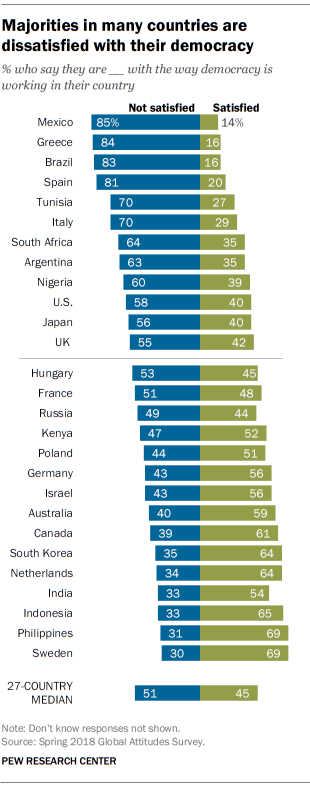
The Pew Research Center has released the results of a poll in 27 countries in 2018 on levels of satisfaction/dissatisfaction with democracy. The results are consistent with many specific examples of a more general loss of faith in democratic institutions. The results of the poll indicate that the state of the economy and perceived levels of corruption were the most important determinants of this loss of faith:
” And majorities in seven of the 12 countries most dissatisfied with democracy said that in their country, no matter who wins an election, things do not change very much. Skepticism in elections’ ability to change things ran highest among Greeks – 82% of whom doubted their elections led to much change – and was also common in Tunisia (67%), the UK (65%), Japan (62%) and South Africa (61%).
Between 2017 and 2018, dissatisfaction with democracy grew in 14 of the 27 countries surveyed, with the largest increases in India and Germany – as well as Brazil, where two-thirds of the public already had a negative view in 2017.”
This loss of legitimacy is deeply troubling since it suggests that many people are willing to give up their rights as citizens in order to secure what they regard as necessary change.
“The Special Rapporteur has determined that there is credible evidence, warranting further investigation of high-level Saudi Officials’ individual liability, including the Crown Prince’s. She warns against a disproportionate emphasis on identifying who ordered the crime, pointing out that the search for justice and accountability is not singularly dependent on finding a smoking gun and the person holding it. The search is also, if not primarily, about identifying those who, in the context of the commission of a violation, have abused, or failed to fulfill, the responsibilities of their positions of authority. ”
There seems to be a rather dramatic change in the foreign policy team of the Trump Administration. The Acting Defense Secretary, Patrick Shanahan, has dropped out of his confirmation, after 7 months of being in a temporary position. Shanahan was a corporate executive at Boeing and not a military person and the Defense Department has sorely missed the expertise of the first Defense Secretary, General Mattis. That vacuum at the Defense Department has allowed John Bolton, the National Security Adviser, and Mike Pompeo, the Secretary of State, to take on an outsized role in the decision-making process. Both of these men have been outspoken advocates of regime change in Iran for a very long period of time.
On Monday, Pompeo went to Central Command in Tampa, Florida which is the command center for all US forces in the Middle East. He was not accompanied by any member of the Defense Department. It is highly unusual for the Secretary of State to make such a visit and signals Pompeo’s primacy in US foreign policy–not a good sign for a productive relationship with Iran. Adam Weinstein notes the significance of the visit:
” When I asked State Department officials for any similar past trips by other secretaries of state, they provided none. I found one occasion when Secretary Condoleezza Rice visited the Tampa base in 2006—accompanying the commander-in-chief, George W. Bush—to greet Afghan and Pakistan leaders for a state summit. Secretary Hillary Clinton also visited the base, also not for operational reasons, to deliver a dinner address to a Special Operations Command gala in 2012.
“Neither of those visits came close to what appears to be the case this week: The United States’ top diplomatic officer, who is not in the military’s chain of civilian command, is traveling to a war headquarters to discuss prospects for military action with the generals there. He will not be without Pentagon minders at CENTCOM in Shanahan’s absence, State Department sources tell me, but if proximity is power, there’s a clear suggestion that Pompeo and Bolton are acting as primary movers behind military plans for Iran.”
The military now knows that it does not have a strong voice in the White House. It also knows that very few in the White House have a deep grasp of military capabilities, limitations, and culture.
What makes matters worse is that the US Iranian policy lacks coherence. President Trump insists that his primary objective is to prevent Iran from getting a nuclear bomb; his chief aides, however, have regime change as their primary objective–an objective that the most of the world would condemn and which is more than likely unattainable. Now that Iran has decided that it will no longer abide by all the terms of the agreement, President Trump finds himself trying to persuade Great Britain, France, Germany, China, and Russia to persuade Iran to continue to abide by the agreement that he himself disavowed. A very strange situation.
Paul Pillar is one of the most perceptive analysts of US foreign policy. While with the US CIA, he accused the BUsh Administration of “cherry-picking” evidence to justify the invasion of Iraq (Paul was also a personal friend of mine while we were students in College). He has written a short essay on the current tension between the US and Iran. He blames the US policy of “maximum pressure” on Iran as the reason for the spike in tensions:
“Despite the continued uncertainty, Iran may well have been the perpetrator. Assume for the moment what the administration wants everyone to assume, which is that the Iranian regime attacked the ships. It is in asking why Iran might have done so that Pompeo’s statement is most questionable. Twice Pompeo applied the term unprovoked to Iranian actions (“40 years of unprovoked aggression against freedom-loving nations” and “these unprovoked attacks present a clear threat to international peace and security”).
“Unprovoked”? The Trump administration reneged completely over a year ago on U.S. commitments under the Joint Comprehensive Plan of Action (JCPOA), the multilateral agreement that has restricted Iran’s nuclear program and closed all possible paths to a nuclear weapon. Since then the administration has waged economic warfare on Iran, despite Iran continuing for a whole year to observe its obligations under the JCPOA. The administration has piled sanction upon sanction in a relentless effort to cripple Iran’s economy, make life miserable for Iranians, and weaken Iran in every way possible. It has pressured countries around the world not to do any business with Iran. The administration has accompanied this campaign with unlimited hostility, threats of military attack, and saber-rattling that has included escalating military deployments in Iran’s backyard. If this isn’t provoking Iran, then the term provocation has lost all meaning.”
I doubt that the essay will receive the attention it deserves, but we should remember his words as the rhetoric against Iran increases in intensity.
The Guardian has started a special series called “Where does your plastic go? Global investigation reveals America’s dirty secret” It is a revealing investigation, tracking US exports of plastic to many different countries. China used to take most of US exports of plastic waste, but stopped importing it last year. Since then, the US has tried to find alternatives and is now sending its plastic waste to countries that are poor and have very weak environmental laws such as Bangladesh, Laos, Ethiopia and Senegal. The UN passed a new treaty last week regulating the export of plastic waste. According to the treaty: “Exporting countries – including the US – now will have to obtain consent from countries receiving contaminated, mixed or unrecyclable plastic waste. Currently, the US and other countries can send lower-quality plastic waste to private entities in developing countries without getting approval from their governments.” The treaty was signed by 187 countries, but the US was not among the signatories. The dangers of plastic waste and the process of recycling plastic waste are legion and well-documented by the NGO Gaia.
Plastic waste on the beach in Sihanoukville, Cambodia.
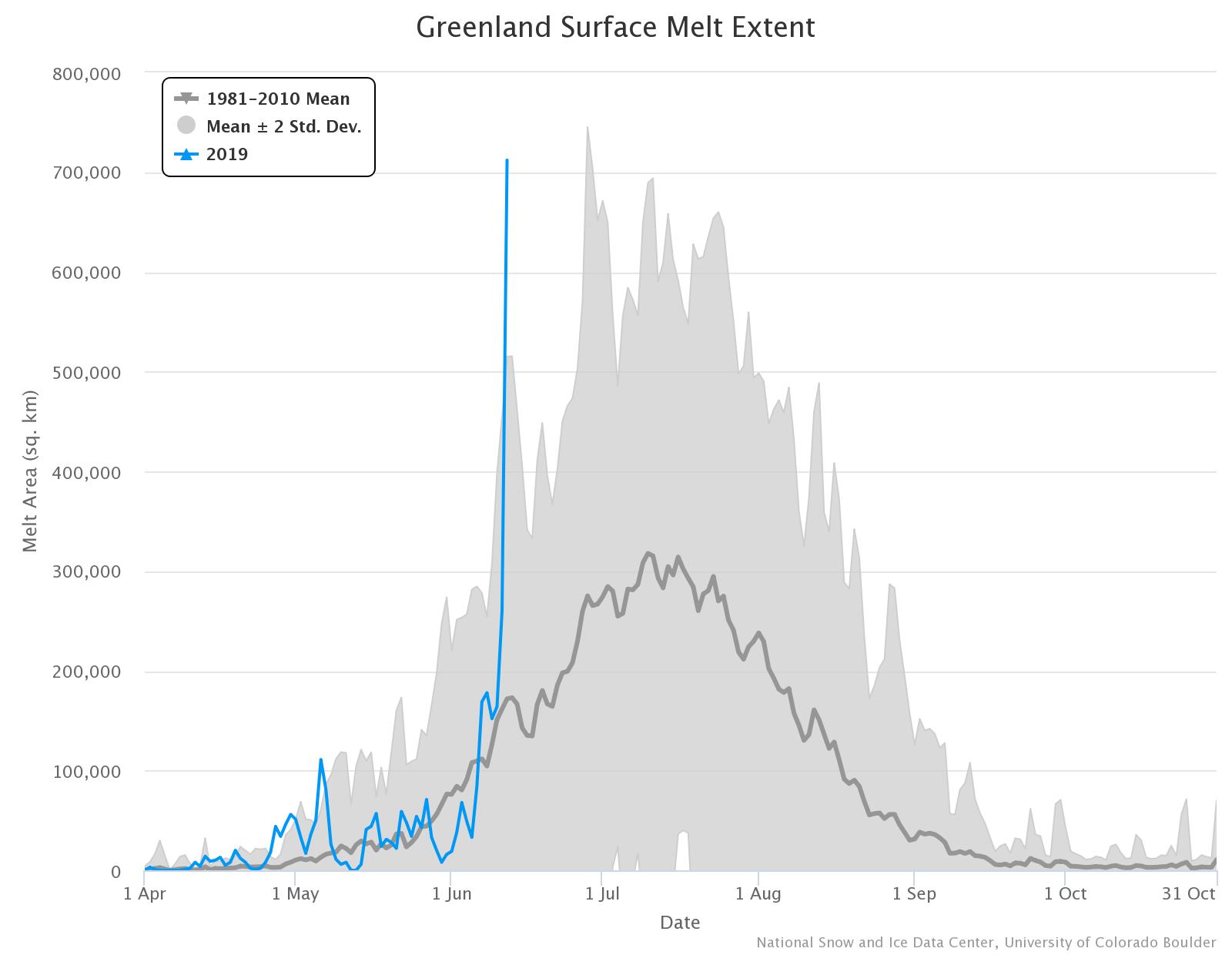
Temperatures in the Arctic have risen dramatically in the month of June, leading to a large ice melt in Greenland. Indeed, the rate of melt rivals that of the record ice melt in 2012. Temperatures are also very high in Alaska. The melting ice and permafrost will aggravate the situation by decreasing the albedo of the north pole and by releasing more methane, a powerful greenhouse gas. Science Alert explains the dynamic:
“Sea ice loss over the Chukchi and Beaufort seas along Alaska’s northern coast has been ‘unprecedented’ according to Rick Thoman, a climatologist based in Fairbanks.
“Labe [a climate researcher at the University of California at Irvine] said there’s sufficient open water that you could sail all the way from the Bering Strait into a narrow opening just north of Utqiagvik, Alaska’s northernmost city, clear into the Beaufort Sea. ‘It’s very unusual for open water this early in this location,’ he said.”
Fareed Zakaria has written a very good essay for Foreign Affairs entitled “The Self-Destruction of American Power”. The argument is straightforward but still complex: that the US lost its standing in world affairs because it did not remain true to its values:
“There is an analogy here with the United States. Had the country acted more consistently in the pursuit of broader interests and ideas, it could have continued its influence for decades (albeit in a different form). The rule for extending liberal hegemony seems simple: be more liberal and less hegemonic. But too often and too obviously, Washington pursued its narrow self-interests, alienating its allies and emboldening its foes. Unlike the United Kingdom at the end of its reign, the United States is not bankrupt or imperially overextended. It remains the single most powerful country on the planet. It will continue to wield immense influence, more than any other nation. But it will no longer define and dominate the international system the way it did for almost three decades.”
“It is the assessment of the United States Government that the Islamic Republic of Iran is responsible for the attacks that occurred in the Gulf of Oman today. This assessment is based on intelligence, the weapons used, the level of expertise needed to execute the operation, recent similar Iranian attacks on shipping, and the fact that no proxy group operating in the area has the resources and proficiency to act with such a high degree of sophistication.
“This is only the latest in a series of attacks instigated by the Islamic Republic of Iran and its surrogates against American and allied interests, and they should be understood in the context of 40 years of unprovoked aggression against freedom-loving nations.
“On April 22nd, Iran promised the world that it would interrupt the flow of oil through the Strait of Hormuz. It is now working to execute on that promise. In early May, the Revolutionary Guard Corps attempted the covert deployment of modified dhows capable of launching missiles.
“On May 12th, Iran attacked four commercial ships near the Strait of Hormuz.
“On May 14th, Iran-backed surrogates attacked by armed drones — struck two strategically important oil pipelines into Saudi Arabia.
“On May 19th, a rocket landed near the U.S. Embassy in Baghdad.
“On May 31st, a car bomb in Afghanistan wounded four U.S. service members, killed four Afghan civilians, and wounded bystanders.
“Yesterday, Iranian surrogates fired a missile into Saudi Arabia, striking the arrivals terminal of an international airport, injuring 26 people.
“Taken as a whole, these unprovoked attacks present a clear threat to international peace and security, a blatant assault on the freedom of navigation, and an unacceptable campaign of escalating tension by Iran.”
Mr Pompeo did not provide any information about the information upon which these judgments are made nor did he take any questions from the press. Note that the last four incidents mentioned by Mr. Pompeo are actions that occurred in an ongoing conflict and are hardly evidence of an unprovoked attack by any party to the conflict.
The first two incidents are indeed troubling because they threaten the flow of oil to world markets and because they were acts committed against civilian actors. But, even if they were committed by agents of the Iranian government, there is a context to these actions. The US has engaged in strict sanctions on the sale of Iranian oil despite the fact that there was no evidence that Iran had violated the terms of the Joint Comprehensive Plan of Action (JCPOA), commonly referred to as the Iranian nuclear deal. In that agreement, the US promise to lift sanctions if Iran adhered to the terms of the JCPOA.
The US did not use violence to cut off Iranian oil exports, but the effect of the sanctions is to cut off the most important source of revenues to Iran. If Iran is behind the attacks on the oil tankers, it may be using the only tools available to respond to the US economic sanctions: cutting off oil exports from the Persian Gulf may be the only way Iran may have to respond to what it regards as economic aggression. To shed light on this possibility it is instructive to read the press briefing between the State Department and the press today:
QUESTION: Okay. And then secondly, related to that, yesterday at the IAEA your ambassador said that Iran was out of compliance, or in violation of the JCPOA, of the nuclear deal, and that it should get back into compliance, and that the other – the remaining parties to the deal should make that a priority. This suggests to me that even though you guys say that this is the worst deal ever negotiated and a horrible failure, that you actually see some value in it. Why would you call for Iran to comply with a deal that you think is essentially garbage if —
MS ORTAGUS: Well —
QUESTION: Is it better than nothing? Is that what the position of the administration is?
MS ORTAGUS: Our position on the JCPOA has not changed. But we, of course, do not want Iran to get a nuclear weapon. We also want them to stop their malign activities, supporting terrorists. There’s a lot of news in the Middle East today, as you saw the Houthis – of course, with more potentially reported missile attacks on civilian Saudi infrastructure. So we look at – whether it’s the JCPOA or our maximum pressure campaign towards Iran – holistically. It’s not – it’s certainly about a nuclear weapon, and I know that our European counterparts would like the Iranians to stay in the JCPOA. We certainly do not want them to have a nuclear weapon.
But more broadly, I mean, can you imagine if all of you were getting ready to fly to Miami airport and there was a group like the Houthis, a militia like the Houthis, that were using – reportedly using missiles in order to attack an airport before you flew in? Can you imagine how the United States would respond to that, how Canada would respond if that was happening in Ottawa? I mean, these are common-sense things here that we want the Iranians to stop terrorizing innocent people.
QUESTION: I get that. But this is specifically about the nuclear deal —
MS ORTAGUS: Yeah.
QUESTION: — which only covered the nuclear deal, and that’s one of the issues that you have with it —
MS ORTAGUS: Sure.
QUESTION: — because you didn’t think it went far enough. But as it relates purely to the nuclear deal, to the nuclear aspect and the centrifuges, which is what the operation of advanced centrifuges, which is what you say they are violating – why do you care if the deal is – if the deal is bad? Saying that – demanding that Iran come back into compliance with a deal that you have withdrawn from because you see no value in it seems to be contradictory to me.
MS ORTAGUS: I don’t think it’s contradictory in the fact that we have stated very loudly since the beginning of this administration that we do not want the Iranian regime to get a nuclear weapon. We think it would be disastrous —
QUESTION: Well, fair enough. But are you saying, then —
MS ORTAGUS: — for the Middle East. I – we haven’t changed our position.
QUESTION: But this seems to me that you’re saying that some limits are better than no limits, and so therefore there is value in the requirements – limits that were placed on Iran in the deal.
MS ORTAGUS: Iran is headed in the wrong direction, as evidenced by this now public IAEA report. They pose a challenge to international peace and security, and we will continue this maximum pressure campaign as it relates to their nuclear weapons program, their terrorism and malign activities around the region.
The US position on the JCPOA is indeed ridiculous. Iran did not violate the JCPOA but the US did by ending its commitment without justification. The evidence suggests that the US is ramping up its actions against Iran and that it believes that Iran has no right to respond to those actions. I am not sure that there is any analog in diplomatic history that suggests that this is a workable plan of action.
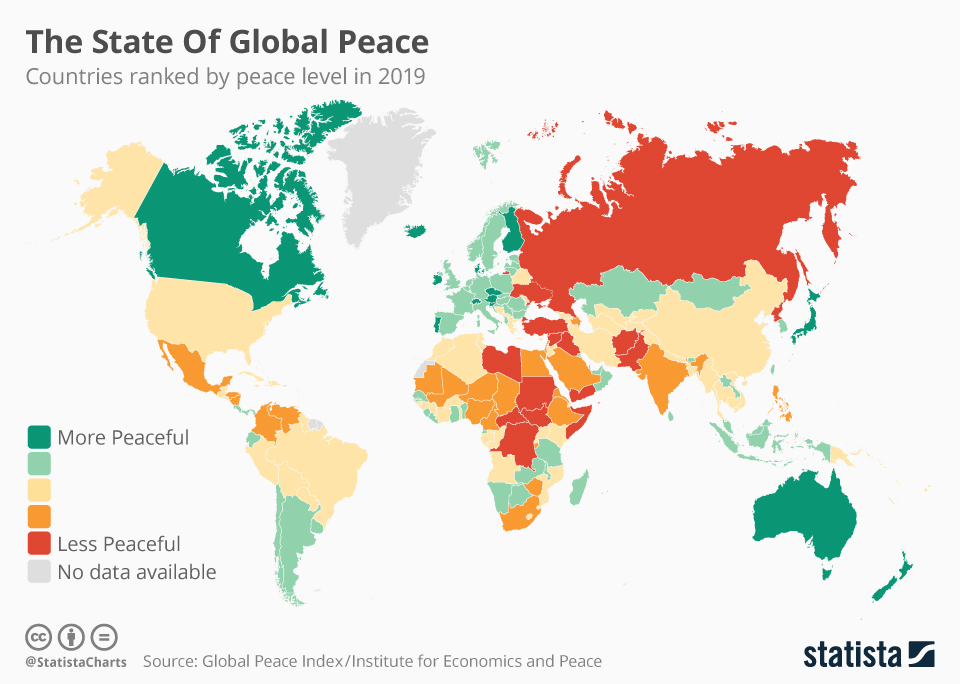
Vision of Humanity has released its Global Peace Index (GPI) for 2019. The index is a measure of the incidence of violence in societies based upon a number of variables. Like all such indices, one can quarrel with the metrics used, but the GPI uses ones that are familiar and can be measured quantitatively. According to the report:
“The average level of global peacefulness improved very slightly last year on the 2019 Global Peace Index (GPI). This was the first time that the index improved in the last five years. The average country score improved by -0.09 per cent, with 86 countries improving and 76 recording deteriorations.
“Iceland remains the most peaceful country in the world, a position it has held since 2008. It is joined at the top of the index by New Zealand, Austria, Portugal, and Denmark. Bhutan has recorded the largest improvement of any country in the top 20, rising 43 places in the last 12 years.
“Afghanistan is now the least peaceful country in the world, replacing Syria, which is now the second least peaceful. South Sudan, Yemen, and Iraq comprise the remaining five least peaceful countries. This is the first year since the inception of the index that Yemen has been ranked amongst the five least peaceful countries.”
The results are broadly consistent with a casual understanding of world affairs and the GPI is a very useful way to think systematically about trends in violence in the world.
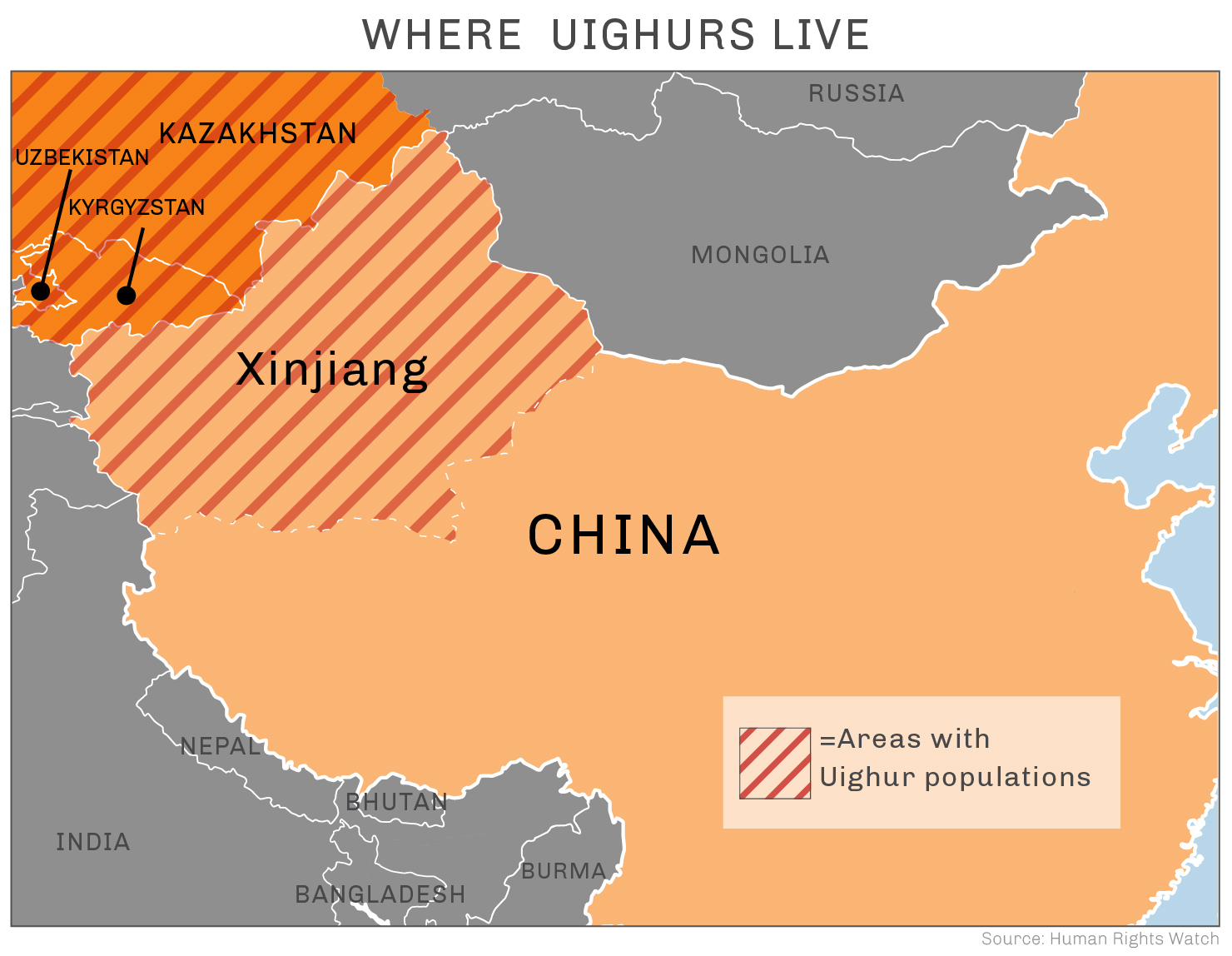
“Despite mounting international pressure and condemnation, the massive crackdown on the Uighur people and their shrinking culture here shows no signs of abating for the Muslim holy month.
“Widespread intimidation – from inside mosques to family homes – mean residents don’t dare utter the traditional Islamic greeting, “as-salaam alaikum”, while fasting is also banned, with restaurants forced to stay open.
“At schools and local authority offices, ‘the Chinese government provides water, food – lunch – to force you to drink and eat,’ said Dolkun Isa, president of the World Uyghur Congress, an advocacy group.
“Local officials are increasing checks to people’s homes, too, to make sure they aren’t secretly observing the practice, according to a government notice posted online.”
Police in Hong Kong fired tear gas and rubber bullets against protesters who are opposed to an extradition bill which might allow dissenters in Hong Kong to be tried in the more draconian courts in Beijing. The protesters believe that the bill is an attempt to erode the democratic freedoms guaranteed in the agreement by which Great Britain left its former colony in 1997 (an agreement that was supposed to last for 50 years). CNN outlines the supporters and opponents of the bill:
Who’s against the bill
Civil rights activists: Critics say the bill will leave anyone on Hong Kong soil vulnerable to being grabbed by the Chinese authorities for political reasons or inadvertent business offenses and undermine the city’s semi-autonomous legal system.
Businesses and trade unions: More than 100 firms said they would shut doors Wednesday to protest the bill and allow employees to join a rally outside the legislature. Trade unions have also suggested they might call on members to stop work in protest.
Journalists:Earlier this year, the Hong Kong Journalists Association said in a statement that the amendment would “not only threaten the safety of journalists but also have a chilling effect on the freedom of expression in Hong Kong.”
Taiwan’s Ministry of Foreign Affairs: Taiwan’s Foreign Minister Joseph Wu tweeted in support of the anti-extradition protests: “I stand shoulder to shoulder with the hundreds of thousands in #HongKong fighting the extradition bill & for rule of law. Please know you are not alone. #Taiwan is with you! The will of the people will prevail!”
European and US agencies: Representatives from the European Union have met with Hong Long leaders and expressed concern over the bill. Members of the US Congressional-Executive Commission on China have also spoken out against the bill, warning it could “negatively impact the relationship between the United States and Hong Kong.”
And who’s for it
Hong Kong’s leader: Hong Kong Chief Executive Carrie Lam has refused to withdraw the extradition bill, saying it is needed to plug loopholes to prevent the city from becoming a haven for mainland fugitives.
China’s Foreign Ministry: Chinese officials have supported the Hong Kong government as it attempts to table to the bill in Parliament.
The protests seem to be the next step for the pro-democracy protests that occurred in 2014. But the number of protesters is much larger and the demands seem to be more urgent. The US response to the protests has been mildly supportive to the demands, but a strong condemnation from President Trump over the treatment of the protesters is not likely.
The Wall Street Journal reported that North Korean leader Kim Jong-un’s half-brother Kim Jong Nam, who was assassinated in 2017, was an informant for the US Central Intelligence Agency (CIA). In an extraordinary statement, US President Trump said “I saw the information about the CIA, with respect to his brother, or half-brother. And I would tell him that would not happen under my auspices, that’s for sure. I wouldn’t let that happen under my auspices.” It is highly unusual for a governmental leader to admit that any foreign national worked with the national intelligence agency. And it is even more unusual for a leader to publicly eschew the ability to spy on an adversary. President Trump celebrates his unorthodox and disruptive style, but it is hard to figure out why he would cozy up to Kim Jong-un by giving up so much for so little in return. Indeed, President Trump continues to believe, despite all the available evidence, that he can work with leader Kim. The Washington Post quotes Mr. Trump today:
“President Trump said he received a ‘beautiful letter’ from North Korean leader Kim Jong Un, a note he said portended progress for his administration’s stalled denuclearization talks with the rogue regime.
“Trump, speaking to reporters outside the White House on Tuesday, said Kim’s letter came Monday.
“’I can’t show you the letter obviously, but it was a very personal, very warm, very nice letter,’ Trump said. ‘North Korea has tremendous potential, and he’ll be there. Under his leadership . . . And the one that feels that more than anybody is [Kim]. He gets it. He totally gets it.’”
US President Trump waved around a document today that he said was the agreement between the US and Mexico on Mexico’s response to the flow of migrants through its territory to the US. Mr. Trump refused to divulge the contents of the agreement, but a Washington Post photographer took photos of the document and then blew up the images to reveal a great deal of the agreement. The images raise many questions about the agreement, including the legal status of the agreement since it was not signed by either President Trump or Mexican President Andrés Manuel López Obrador. There are real questions about Mr. Trump’s claims about the agreement. He claimed that Mexico promised to buy more US agricultural products, a claim denied by Mexico. The New York Times has reported that much of the purported agreement was actually made last December, a report that the White House denies. The entire episode has a surreal atmosphere, and it is difficult to determine what was actually decided.

 World Politics News