Iran has announced that it will enrich uranium beyond the limits set by the Joint Comprehensive Plan of Action (JCPOA). The media continue to describe this decision as a “violation” of the agreement, but it is hard to describe it as a violation since the US pulled out of the agreement over a year ago. The Iranians have been slowly ratcheting up pressure on Europe (which wants the agreement to remain in force) to get the US to loosen the sanctions which the US is unilaterally enforcing despite the clear demand of the agreement that the sanctions should be lifted. The Iranian strategy really depends on whether the US uses the slight violations as a casus belli.
“Iran has said it is willing to go back to the deal if it is given the economic benefits it was promised. That will be difficult as long as the U.S. continues to enforce strict sanctions on the nation.
“But there is not another obvious way to stop Iran from accumulating dangerous levels of nuclear material. Sabotage efforts and assassinations have slowed the country’s program in the past, but such methods have been unable to stop Iran outright.
“Similarly, military action against Iran’s nuclear facilities would probably set the program back, but only temporarily. ‘You just can’t bomb their program out of existence,’ says David Albright, president of the Institute for Science and International Security. ‘I think what you’re left with is negotiations.'”
“In one of the most sensitive documents, Sir Kim writes: ‘We don’t really believe this Administration is going to become substantially more normal; less dysfunctional; less unpredictable; less faction riven; less diplomatically clumsy and inept.’
“He also says that he doesn’t think Trump’s White House will ‘ever look competent’.”
The British government did not dismiss the cables as published, insisting that “The British public would expect our Ambassadors to provide Ministers with an honest, unvarnished assessment of the politics in their country. Their views are not necessarily the views of Ministers or indeed the government. But we pay them to be candid.” The Conservative Party is poised to elect a new Prime Minister and it looks as if Boris Johnson is the leading candidate. If that occurs, it is likely that the British government will send an Ambassador significantly friendlier to President Trump.
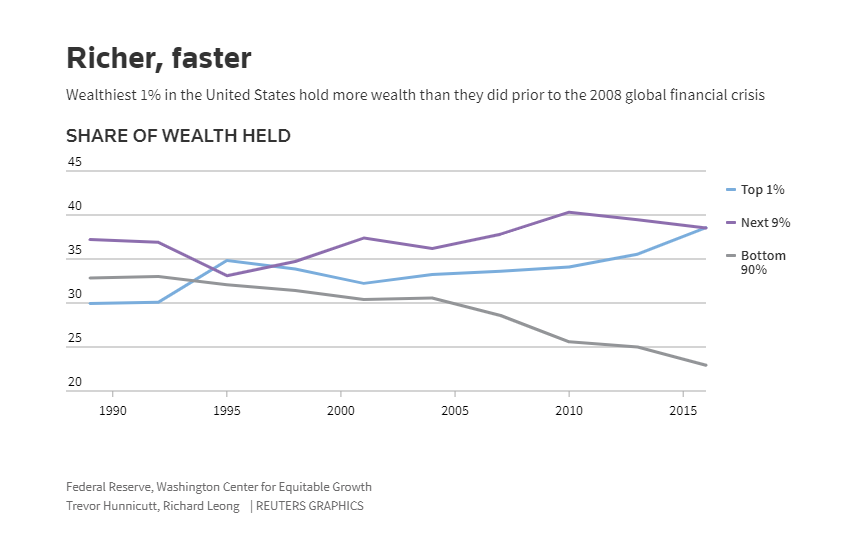
“Household wealth — the value of homes, stock portfolios and bank accounts, minus mortgage and credit-card debt and other loans — jumped 80% in the past decade. More than one-third of that gain — $16.2 trillion in riches— went to the wealthiest 1%, figures from the Federal Reserve show. Just 25% of it went to households in the middle- to upper-middle class. The bottom half of the population gained less than 2%.
Nearly 8 million Americans lost homes in the recession and its aftermath, and the sharp price gains since then have put ownership out of reach for many would-be buyers. For America’s middle class, the homeownership rate fell to about 60% in 2016 from roughly 70% in 2004, before the housing bubble, according to separate Fed data.”
The political implications of this inequality are clear: a loss of confidence in political systems and their legitimacy, leading to the rise of populist nationalism.
Turkish President Recep Tayyip Erdogan has fired the head of the Turkish Central Bank, Murat Cetinkaya and replaced him with his deputy. The Central Bank has been consistently raising rates in an attempt to stem the rise of inflation in Turkey, but raising interest rates has also led to a sharp slowdown in the Turkish economy. Erdogan unquestionably believes that the slower economic growth poses serious political risks as evidenced in the loss by his party of the mayoralty in Istanbul. Erdogan’s move reflects a sentiment that has been growing in a number of countries by political authorities that believe that monetary policy should not be independent of political control, a situation that would likely lead to easy money policies that lead to higher inflation. In the US, President Trump has also been calling for the Federal Reserve to lower interest rates in a move designed to keep economic growth high.
The New York Times ran a fascinating article today, written by two very reputable reporters, Michael Crowley and David Sanger. They assert that the Trump Administration is contemplating changing its objectives with regard to North Korea. For nearly two years the objective was defined as “the complete, verifiable, and irreversible denuclearization (CVID) of North Korea.” Now, according to the report, the objective may be a freeze of current capabilities. A freeze would enshrine North Korea’s status as a nuclear power with between 20 and 60 nuclear bombs and a an intercontinental ballistic missile.
That objective is far more realistic than denuclearization which was never possible and I would support the move as long as there are adequate safeguards to verify the freeze and as long as Japan and South Korea are comfortable with that situation. But we should not forget how we got to this point: backing down from an objective that was supported with threats of “fire and fury” is a strategy that corrodes the credibility of the US. That credibility was also challenged by the “truce” in the US-China trade war which included the US opening up its markets to Huawei, a company that had previously been blackballed by the US.
On the anniversary of the British handover of Hong Kong to the People’s Republic of China in 1997, protesters in Hong Kong rushed government buildings in protest over policies proposed by the Beijing government. The protests were extraordinary and finally suppressed by riot police using tear gas and rubber bullets. The Beijing government has two problems with the demonstrations. First, it does not wish to allow the protests to encourage similar behavior in other parts of China. Second, it does not wish to scare away those investors who have a crucial economic interest in protecting investments that are necessary for the capital needs of the country. Trying to balance these two objectives is very difficult, but at some point, to preserve order in the country, the state will have to prevent citizens from protesting in ways that challenge the authority of the Communist Party and the Chinese state.
Jeffrey Sachs has written a very thought-provoking essay on the interventionist nature of President Trump’s foreign policy. President Trump made it very clear that he is opposed to further military interventions, but that has not meant that he does not wish to use US power to achieve certain objectives. Sachs argues that Mr. Trump has substituted economic power for military power.
“While Trump has so far eschewed a new war, he has continued US regime-change efforts by other means. Trump is often called an isolationist, but he is as interventionist as his predecessors. His strategy, at least so far, has been to rely more heavily on US economic power than military might to coerce adversaries, which creates its own kind of cruelty and destabilization. And it constantly risks flaring into outright war, as occurred with Iran this month.
“The Trump administration currently is engaged in three attempts at comprehensive economic blockades, against North Korea, Venezuela, and Iran, as well as several lesser blockades against countries such as Cuba and Nicaragua, and an intensifying effort to cut off China’s access to technology. The blockade against North Korea is sanctioned, at least in part, by the UN Security Council. The blockade against Iran is in direct opposition to the Security Council. And the blockade against Venezuela is so far without Security Council engagement for or against. The US is attempting to isolate the three countries from almost all international trade, causing shortages of food, medicines, energy, and spare parts for basic infrastructure, including the water supply and power grid.”
The US made two concessions to the Chinese to persuade them to return to the bargaining table. First, the US will allow the Chinese company Huawei to purchase US technological products. The US had banned such sales because it believed that Huawei products compromised national security because of its close ties to the Chinese government. Second, the US decided to ease up on visa restrictions on Chinese students attending US universities. The truce does not resolve any of the major issues between the two states. We shall see if the future talks are productive.
Russian President Putin gave an interview at the G-20 meeting in which he asserted that liberalism had “outlived its purpose”. Implicitly, Putin was arguing that personal freedom was not a human right. According to Time:
“Putin told the Financial Times that liberal governments have ‘pursued a mindless multiculturalism’ by embracing sexual diversity, among other things. Echoing views expressed by other right-wing populists, such as Poland’s Law and Justice leader Jaroslaw Kaczynski and Hungary’s Prime Minister Viktor Orban, Putin said ‘[LGBTQ persons] must not be allowed to overshadow the culture, traditions and traditional family values of millions of people making up the core population.’
With regards to Russia’s own LGBTQ rights record, Putin told the newspaper that ‘we have no problem with LGBTQ persons. God forbid, let them live as they wish … But some things do appear excessive to us. They claim now that children can play five or six gender roles.’”
Putin’s description of LGBTQ rights does not correspond with the anti-gay legislation which has been passed during his tenure as Russian leader. Moreover, the attack on liberalism is more generally an endorsement of authoritarian rule, one consistent with the rise of ethnic and racial nationalism that is being revived in many parts of the world. For his part, US President Trump seems to have missed the point of Putin’s remarks.
“President Donald Trump joked with Russian President Vladimir Putin about meddling in the US elections.
After the two leaders met on the sidelines of the G20 summit on Friday, a reporter shouted a question at Trump about whether he’d warned Putin not to interfere in US democracy.
The US president replied, ‘Yes, of course I will.’ He then turned to Putin, with a slight smirk, and told him: ‘Don’t meddle in the election, President.’ He then pointed toward the Russian delegation and repeated, ‘Don’t meddle in the election.’”
The attempt at humor indicated that President Trump still does not believe that Russia interfered in the 2016 election even though his intelligence services and Special Counsel Mueller’s report proved widespread meddling. Given that there is evidence that Russia intends to intrude in the 2020 election, one can only conclude that President Trump does not take the threat seriously and that he does not care.
But the second exchange was more jaw-dropping. Both leaders joked about the problem of “fake” news in their respective countries.
“And in addition to his comedic riff about election meddling, Trump joked with Putin about the threat of ‘fake news.’
“Bloomberg News reported that Trump commiserated with Putin about journalists, telling him: ‘Get rid of them.’
“’Fake news is a great term, isn’t it? You don’t have this problem in Russia, but we do.’
“Putin laughed and replied that, yes, Russia does actually have that problem.
I find it incomprehensible that President Trump would miss the opportunity to compare freedom of the press with the leader of a country that has seen many journalists killed. Since 1992, when Putin begin his tenure as the leader of the country, 58 journalists have been killed. I am not sure President Trump knows anything about the country he leads, and I cannot shake the feeling that Putin has something on Trump that explains his indifference or complicity.
A heat wave has enveloped parts of Europe and temperatures have reached 40 degrees Celsius (104 F), levels rarely seen on the continent. The temperatures are reminiscent of the heat wave in 2003: “the 2003 heat episode was the deadliest natural disaster in Europe in the last 50 years, with a death toll exceeding 30,000.” A French meteorologist named Ruben Hallali compared the map of heat in Europe to the painting by Edvard Munch, “The Scream”. It is impossible to make a direct connection between the heat wave and climate change, but “…a climatology institute in Potsdam, Germany, says Europe’s five hottest summers since 1500 have all been in the 21st Century.”
Alida R. Haworth, Scott D. Sagan and Benjamin A. Valentino have published the results of a very interesting poll they conducted on the attitudes of American citizens about the use of nuclear weapons against North Korea. The authors constructed several different scenarios posing different probabilities of success in the use of conventional or nuclear weapons against different North Korean conventional and nuclear capabilities. Parsing through the scenarios requires close reading but the effort is worthwhile. The results offer some encouragement in that most Americans do not favor a preventive war against North Korea. But some of the results suggest that there is a sizable minority of Americans who do favor the use of nuclear weapons and that most Americans have an overly optimistic view of the efficacy of US missile defense systems against a North Korean nuclear attack.
“The first piece of disconcerting news, however, is that a large hawkish minority lurks within the US public; over a third of respondents approve of a US preventive strike across the scenarios and appear insensitive to informational cues that most security experts would expect to reduce such levels of support.
“Second, preference for the strike does not significantly decrease when the story says that the United States would use nuclear weapons in its attack; 33 percent preferred a preventive nuclear first-strike. Even more disturbing: There is no significant change in the percentage who would prefer or approve of a US nuclear strike when the number of estimated North Korean fatalities increases from 15,000 to 1.1 million, including 1 million civilians. As we have previously found, the US public exhibits only limited aversion to nuclear weapons use and a shocking willingness to support the killing of enemy civilians (Sagan and Valentino 2017 Sagan, S. D., and B. A. Valentino. 2017. “Revisiting Hiroshima in Iran: What Americans Really Think about Nuclear Weapons and Killing Noncombatants.” International Security 41 (1): 41–79.”
The authors also looked at how political preferences affected the attitudes of Americans.
“Across all scenarios, Republicans expressed greater preference for the use of military force than Democrats. This trend becomes even more stark when we tease out those who support President Trump specifically. A majority of Trump supporters prefer the US strike in every scenario, except when confidence in the effectiveness of the US conventional strike is 50 percent. Still, it is important to note that preference for the strike even in this scenario remains at 44 percent among Trump supporters, compared to only 8 percent among non-Trump supporters.”
One of the more depressing results of the poll is that it seems clear that the majority of Americans are deeply misinformed about the nature of nuclear weapons. There are a number of illusions–most notably concerning the effectiveness of missile defense systems–that make relying on public opinion in making nuclear decisions a highly problematic tactic.
A conference on Middle East peace began today in Bahrain and it was hosted by Jared Kushner, President Trump’s son-in-law. The plan represents two years of work by Mr. Kushner, but very few Israelis or Palestinians were present. It is a two part plan. Today was the unveiling of the economic part of the plan, labeled “Peace Through Prosperity” which calls for $50 billion investments (for the Palestinians, Jordanians, and Egyptians) over ten years. The source of the funds was not identified. The second part of the plan is political, but apparently a Palestinian state is not part of that plan.
The proposals are ridiculous and it is insulting to think that anyone would consider them seriously. To comprehend fully how unlikely the success of the plans is one need only read the op-ed written by the Israeli Ambassador to the US, Danny Danon. It is entitled “What’s Wrong With Palestinian Surrender?” Anyone with even the slightest knowledge of world politics would know that there are some things that money cannot buy.
The war of words between Iran and the US reached depths that have rarely been seen in diplomatic history. The Associated Press reports:
“Iran warned Tuesday that new U.S. sanctions targeting its supreme leader and other top officials meant ‘closing the doors of diplomacy’ between Tehran and Washington amid heightened tensions, even as President Hassan Rouhani derided the White House as being ‘afflicted by mental retardation.’
“President Donald Trump called that a ‘very ignorant and insulting statement,’ tweeting that an Iranian attack on any U.S. interest will be met with ‘great and overwhelming force … overwhelming will mean obliteration.’ His secretary of state said the Iranian statement was ‘immature.’”
Winston Churchill once defined diplomacy this way: “Tact is the ability to tell someone to go to hell in such a way that they look forward to the trip.” The current situation between Iran and the US hardly fits with that definition, but the US naively believes that there is a diplomatic course of action. The US National Security Adviser, John Bolton, made this comment: “The president has held the door open to real negotiations to completely and verifiably eliminate Iran’s nuclear weapons program, its pursuit of ballistic missile delivery systems, its support for international terrorism and other malign behavior worldwide,” Bolton said in Jerusalem. “All that Iran needs to do is to walk through that open door.”
I cannot even begin to measure Bolton’s chutzpah. After all, Iran maintained strict adherence to the JCPOA, but the US violated the agreement by pulling out. Why would Iran even think that the US would keep its end of a new agreement, particularly one that would demand that Iran abandon its allies, Hamas and Hezbollah, and unilaterally disarm by ending its missile program even though there has not been any lessening of the threats to Iran by the US, Saudi Arabia, and Israel?
Iran’s only strategy is to remind the world–particularly France, Great Britain, Germany, China, and Russia, the other partners to the JCPOA–that a US-Iranian conflict would completely destabilize the global oil market and consequently the global economy. These other states would therefore have to decide whether they think the US reasons for going to war justify that horrific outcome. Given that the JCPOA was preventing Iran from getting a nuclear weapon, it is highly likely that they would decide that going to war with Iran is a far less desirable method for obtaining that objective.
In reality, the US is negotiating from a very weak position, despite its overwhelming military superiority. Its objectives are actually limited, even though Iran would never agree to them. American allies in the region–Israel and Saudi Arabia–, however, have more ambitious objectives–the overthrow of the Iranian regime–which can only be attained with US military power. Whether they can persuade President Trump to do their dirty work remains to be seen. And whether the rest of the world can persuade Trump to back off from the threat of war.
In a stunning defeat for the AK Party of President Erdogan of Turkey, the opposition candidate, Ekrem Imamoglu, won a decisive victory in the election for the Mayor of Istanbul. Imamoglu narrowly won the election in March, but the government decided to hold another election because the margin of victory was alleged to have been too narrow. The results of yesterday’s election was decisive, with Imamoglu winning 54% of the votes. The results as seen as a challenge to the increasingly authoritarian conduct of President Erdogan and it is difficult to anticipate what his reaction will be. The Turkish economy is weakening and Turkey’s relationship to NATO and the US has been frayed over the situation in Syria and the Turkish purchase of an advanced air-defense system from Russia.

 World Politics News