The US State Department has launched a new initiative on religious freedom and persecution. It appears to be a part of a larger initiative on human rights which US Secretary of State Pompeo called the Commission on Unalienable Rights. It’s objective, according to Pompeo is to “provide the intellectual grist of what I hope will be one of the most profound re-examinations of inalienable rights in the world since the 1948 Universal Declaration.” The Commission is headed by Mary Ann Glendon, a Harvard Law School professor, who, at the 1995 U.N. World Conference on Women in Beijing, succeeded in preventing abortion to be listed as a human right.
But there appears to be a fundamental lack of knowledge about these issues in the Trump Administration. US President Trump hosted some victims of religious persecution at the White House and the conversations were astonishing. Zeeshan Aleem recounts some of the conversations for Vox:
” Mohib Ullah, a Rohingya man who had escaped violence in Myanmar, explained that he was staying in a refugee camp in neighboring Bangladesh and asked the president what his plans are to help his beleaguered people. Trump replied by asking, “And where is that, exactly? Where?”
“It was unclear if Trump was referring to the country that Ullah had fled or was staying in, but Ullah repeated that he was staying in Bangladesh, and Sam Brownback, the US ambassador-at-large for international religious freedom, attempted to intervene by explaining that Bangladesh is ‘next to Burma [an older term for Myanmar]’ and that ‘the Rohingya have been run out.’
“The president replied, ‘Thank you, appreciate it,’ and moved on without ever answering Ullah’s question….
“Trump also seemed almost entirely unacquainted with the oppression of Uighurs, China’s predominantly Muslim minority.
‘When Jewher Ilham, a Uighur woman, said that millions of her people have been locked up in ‘concentration camps’ and that she hadn’t seen her detained father since 2013, Trump again replied as if he was hearing about the crisis for the first time.
“’Where is that? Where is that in China?’ he asked….
“The president also had an awkward exchange with Nadia Murad, a Yazidi refugee from Iraq who escaped captivity by ISIS. Trump again did not appear to pay close attention to her testimony, asking Murad where her family members were right after she’d told the president they had been killed.”
It is difficult to see how anything substantive can come out of a Commission that lacks informed leadership.
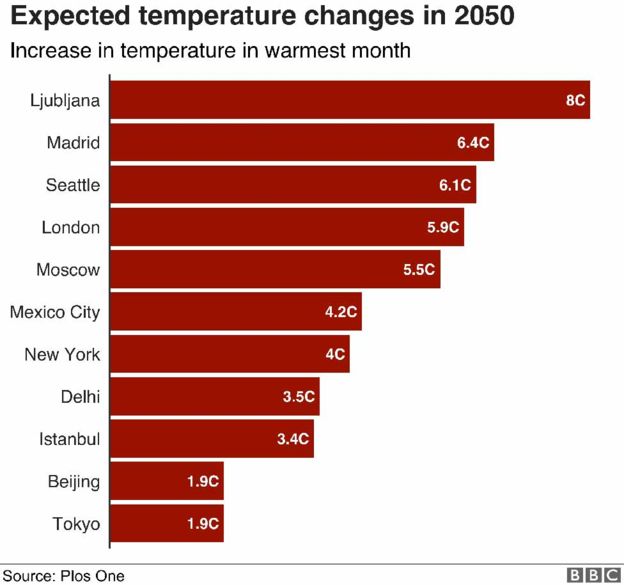
Umair Irfan, Eliza Barclay, and Kavya Sukumar have written an article for Vox which highlights the changes in temperatures for various cities in the US by 2050. The graphics in the article are interactive and the site takes a reader’s location and gives data for the nearest large city. In my case, the estimates were for Springfield, MA. According to the data, the summer highs for Springfield will rise by 5.2 degrees F and the winter average will rise by 5.1 degrees F, from an average of 20.3 degrees F to 25.4 degrees F. I likely will not be around to verify the forecasts (I would be 101 years old in 2050).
Iran has seized a British oil tanker in the Strait of Hormuz. It had threatened to do so after Great Britain seized an Iranian oil tanker off Gibraltar which it accused of smuggling oil to Syria. Iran also released another British oil tanker which it claimed had requested assistance. The moves represent a significant escalation of tension and Britain is currently considering its options. But it is unlikely that Britain will take any action without strong support from the US. US President Trump answered a question about the seizures before he departed for his country club in New Jersey:
“Q Mr. President, Iran seized at least one oil tanker today with British oil. What is your reaction? Have they crossed the line? You said that would be a foolish thing to do.
“THE PRESIDENT: Well, as you know, we have a very close alliance with the UK, and we always have. We heard that. The United States has very few tankers going in because we’re using our own energy now. We’ve made a lot of progress over the last two and half years. So we don’t have very many tankers going in, but we have a lot of ships there that are war ships. And we’ll talk to the UK. And we have no written agreement, but we have an agreement. They’ve been a very great ally of ours.
“So, we heard about it. We heard it was one; we heard it was two. And we’ll be working with the UK. They’ll have a new Prime Minister soon, which is a good thing. And we’ll be working with the UK. But we have no written agreement, but I think we have an agreement which is longstanding.”
The statement is curious. First, because he indicated that the US has no direct interest in keeping the Strait of Hormuz open: “… we don’t have very many tankers going in, but we have a lot of ships there that are war ships.” That statement is a far cry from the doctrine articulated by US President Jimmy Carter in 1979 as described in the Washington Monthly:
“Carter asserted that any nation trying to control the Persian Gulf or restrict the free-flow of oil through the Straits of Hormuz was acting against America’s ‘vital interests.’ Carter articulated this message near the end of his presidency and at a time when revolutionary Iran held the United States hostage and the Soviets militarily occupied Afghanistan.
“The message to Iran and the USSR was clear: Make a move on the neighborhood, mess with shipping, slow the flow of oil and risk going to war with the United States.”
It may be the case that the Carter Doctrine should definitely be scrapped, but changing the defined national interests of the state on the fly is not conducive to predictable foreign policy. I suspect that the Israelis and Saudis are wondering what the President’s statement implies.
Second, the cavalier reference to Great Britain, one of the US’s strongest allies–“we have no written agreement”–is astonishing, and even more so because it was referenced to an anticipated change of government in Great Britain. Commitments are made to states, not governments. President Trump may be unpleasantly surprised if Boris Johnson becomes Prime Minister (Mr. Trump’s preference) and requests a strong military commitment from the US. But I suspect that the British are trying to figure out whether the US will stand by their interests.
We will get a better read on US intentions early next week. Iran’s actions may trigger financial responses in the oil markets if people think that conflict in the Strait is likely. If that occurs, then stock markets will respond accordingly and we will see how Mr. Trump assesses that response to his political future.
The US and Iran continue to exchange low-level attacks in the Strait of Hormuz. Iran seized a small oil tanker that was smuggling fuel out of Iran, a profitable criminal enterprise since Iran heavily subsidizes fuel prices. The seizure, however, emphasized how vulnerable passage through the Strait can be. And the US claims to have shot down an unmanned drone which had come too close to a US warship in the Strait. It remains unclear what the US strategy in the Strait may be, whether it is content to simply provide safe passage for oil tankers or whether it wishes to test Iranian naval capabilities. The US announced that it is sending an additional 500 troops to a base in Saudi Arabia. Steven Simonand Jonathan Stevenson have written an analysis for the New York Review of Books entitled “Iran: The Case Against War”. It is a wide-ranging review of the options available to the US and it concludes that a war would be disastrous:
“The administration appears to be dusting off the tanker war concept and pressuring European allies to join the US Navy in protecting oil tankers from attack, though maritime operations would fall short of close individual escorts. If the administration were to take a harder look at the tanker war, it might observe that Iran, while still vastly weaker than the United States, is in a better position to resist now than it was thirty years ago, when it had been drained by the long war of attrition with Iraq. Although economically anemic today, it is not bankrupt. And thanks to the Trump administration’s abrupt withdrawal from the JCPOA and its humiliations of European allies, Tehran is less isolated diplomatically. Furthermore, it possesses old-style asymmetric means of response, such as terrorism, and new ones, including cyber capabilities and missiles.4 A tit-for-tat exchange of attacks and counterattacks could widen and intensify the conflict. Iran, for example, could retaliate against US partners in the Gulf. For the US, the escalation could ultimately reach so-called Iranian ‘leadership targets.’”
The essay is worth a very close read. It is thoughtful and well-evidenced. As tensions may continue to rise in the Strait of Hormuz, we would all be well-advised to know as much as possible about various conflict scenarios.
Economic relations between Japan and South Korea are deteriorating, as Japan has announced some onerous trading rules on South Korean importers. The roots of the dispute are historical, not economic, as South Korea has argued that Japan has reneged on some of its promises concerning apologies and restitution for its conduct during the occupation of Korea from 1910-1945. The dispute will affect the trade of semiconductors and other technologies that are integral to the global supply chain. So the dispute, if it escalates, will quickly spill over into the economies of many other states. The current US-China trade dispute has weakened the strong norms against tariffs, and the US is now considering actions against Vietnam which has benefited from producers shifting from China to Vietnam because of the tariffs.
The World Health Organization (WHO) has declared the outbreak of the Ebola virus in central Africa to be a “public health emergency of international concern.” The designation comes after a case of Ebola was found in the city of Goma in the Democratic Republic of Congo. Central Africa is currently experiencing the second-largest outbreak of the virus in recent years. The largest outbreak was in West Africa in 2014-16 with more than 28,600 cases and 11,325 deaths. The declaration is being made because Goma is a large city and an important transit point and the possibilities for spreading the virus has increased dramatically without strong intervention. The virus has been located in rural areas of Congo that have been troubled by extreme violence which has made containing the outbreak very difficult.
“Turkey was set to buy about 100 of the Lockheed Martin-built F-35s and its pilots have been training in the United States. The pilot training program is set to end at the end of July if Turkey went ahead with the S-400 sale, according to a letter from the Pentagon last month.
“Turkey also manufactures more than 900 parts for the F-35, and the Pentagon will have to find an alternative among other partners on the multinational program. That could cause significant delays in the program, according to Soner Cagaptay, the director of the Turkish Research Program at the Washington Institute for Near East Policy.”
Vali Nasr has written a short article for The Atlantic on how China is filling the vacuum in Iran created by the Trump Administration. As many companies, both in the US and Europe, pull out of their investments in Iran to avoid US sanctions, China and its companies are moving in. Moreover, the US strategy is pressuring India, which has cultivated many economic ties to Iran, to leave the country. China’s strategy is risky because it runs the risk of additional US sanctions, but it seems clear that China believes that Iran is worth the risk. Iran has a large, well-educated population and sits in one of the most strategic locations in the Middle East. It is an open question whether the Trump Administration itself can risk alienating China even more given that the trade war has made the US-China relationship quite fragile.
The US and South Korea have announced that they will be conducting joint military exercises in August. North Korea regards this move as a violation of the agreement reached by US President Trump and North Korean leader Kim last year in Singapore in which North Korea agreed to suspend bomb and missile testing in exchange for a cessation in military exercises. The US is in a very difficult situation. North Korea has made no steps toward denuclearization, but suspending the military exercises places the US-South Korea in jeopardy. How long can the US leave the South Korean alliance hanging before there are some tangible results from the cessation? If, however, North Korea resumes testing, President Trump will feel obliged to respond somehow. President Trump may think that he is not bound by his statements to US citizens, but he may find out that leaders of other states have a different understanding of how important credibility actually is.
Over the weekend, US President Trump tweeted some highly offensive and inappropriate comments about four Congresswomen: Reps. Ayanna Pressley (Mass.), Rashida Tlaib (Mich.), Alexandria Ocasio-Cortez (N.Y.) and Ilhan Omar (Minn.). The Express summarizes the content of those tweets:
“US President Donald Trump has relaunched his attack on four Democratic congresswomen of colour, accusing them of ‘hating our country’. During a heated news conference outside the White House, Mr Trump said: ‘If you are not happy, if you are complaining all the time, you can leave. These are people that in my opinion hate our country.’ The latest attack on the congresswomen came after the US President called on the women, who are from ethnically diverse backgrounds to ‘go back’ to the ‘crime-infested places from which they came’”.
“During Monday’s news conference, Mr Trump also said: ‘As far as I’m concerned if you hate our country, if you’re not happy here, you can leave.
“’You can leave right now. I don’t know who’s going to miss ‘em.’”
The tweets and comments are like nothing I have ever heard from any public official in my lifetime. They are unfortunately the words of some Americans throughout American history but, fortunately, words that most Americans consider to be inconsistent with the highest aspirations of the nation.
Americans will have to decide how they wish to address the fact that the US President does not share or even comprehend the most fundamental values of the country. But foreign leaders have weighed in on the matter, and their assessment of the President’s words is truly extraordinary. Even though there have been many times when other countries have strongly disagreed with American foreign policy, their leaders have always been careful not to personalize the disagreements. In this particular case, the heads of many European states have stated strong condemnations of President Trump’s language. It is safe to say that many of the most important US allies no longer consider the US to be the leader of liberal values in the world.
MIT’s Technology Review has a very short article which suggests that global spending on renewable energy sources is slowing dramatically. According to the report:
“Worldwide funding of clean-energy projects fell to its lowest level in six years, in a staggering blow to the battle against climate change.
“The findings: BloombergNEF found that global investments in solar, wind, and other clean energy sources added up to $117.6 billion during the first half of 2019, a 14% decline from the same period last year and the lowest six-month figure since 2013.
“China saw a 39% drop in investments, as the nation eases up on its aggressive solar subsidies to get costs under control. But spending also declined 6% in the US and 4% in Europe, part because of policies that are being phased out and weak demand for additional energy generation in mature markets.
The US has tried very hard to assure that its sanctions against the sale of Iranian oil are universal. It has threatened to sanction any state or company that purchases Iranian oil, even if those states do not agree with the US policy of “maximum pressure”. By and large, most entities have decided that the US market is more important to them than Iranian oil and have grudgingly gone along with the US sanctions. But China seems to be purchasing Iranian oil which creates a serious problem for the US. Sanctioning China would jeopardize the trade talks that are going on, as well as a number of other issues about which the US and China disagree. Politico reports:
“But Beijing is a tougher customer. In June, a tanker carrying up to a million barrels of Iranian oil docked near the Chinese port city of Qingdao, drawing complaints from Republican lawmakers, who demanded the Trump administration pressure China to stop. China has also reportedly welcomed a second batch of Iranian oil since its previous waiver expired in May — this one a 2-million barrel shipment that docked in Tianjin.
“China’s continuing defiance would seem to undercut the Trump administration’s claim that its efforts to squeeze Iran are working. In a recent speech, national security adviser John Bolton announced that ‘all significant reduction exceptions on Iranian oil sales have gone to zero.’”
European states have been debating new taxes on technology companies but so far only France has gone so far as to propose one. That proposal has elicited a sharp response from the Trump Administration which believes that the new tax unfairly singles out US Companies such as Google and Apple. The Washington Post reports:
“In an unusual move that threatens to worsen trade tensions with Europe, the Trump Administration said it will investigate whether a proposed French tax on tech companies discriminates against U.S. business, a step that could lead Washington to impose trade penalties.
The 301 investigation — the same type of probe that led the United States to slap tariffs on China last year — is a rare tool for Washington to use against a close ally, underscoring the Trump administration’s intent to continue playing tough on trade.
The investigation illustrates growing alarm among U.S. officials and industry executives about the prospect of new taxes on technology giants spreading beyond France. A number of other countries are considering similar levies, on the belief that wealthy U.S. tech giants aren’t paying enough in taxes worldwide.”
The use of tariffs to address the tax issues in another state is very unusual and it the move is likely to trigger off a number of issues not only with France, but also with the EU.
The British Ambassador to the US, Sir Kim Darroch, has resigned, saying that he could no longer perform effectively with the Trump Administration. Reuters characterizes the circumstances, which stem from the leak of highly unflattering memos written by Darroch about the Trump Administration:
“‘We don’t really believe this Administration is going to become substantially more normal; less dysfunctional; less unpredictable; less faction-riven; less diplomatically clumsy and inept,’ Darroch wrote in one cable.
“It led to a scathing tirade from the U.S. president.
“’The wacky Ambassador that the UK foisted upon the United States is not someone we are thrilled with, a very stupid guy,’ he tweeted, describing Darroch as a ‘pompous fool’”.
Darroch really had no alternative, but his resignation made it seem as if the British Government had capitulated to President Trump. The US-British “special relationship” is looking less special every day.
Moody Analytics has published a study entitled “The Economic Implications of Climate Change” which forecasts the differential effects of climate change on a number of different states. Statista outlines the study succinctly:
“A recent analysis by Moody’s Analytics focused on the economic impact of climate change. The research looked at four different scenarios, entailing temperature increases of 1, 1.9, 2.4 and 4.1°C up to 2100. For example, global economic damage is expected to $54 trillion in 2100 under a 1.5°C warming scenario while 2°C would entail a cost of $69 trillion.
There would be winners and losers in the most dire scenario, a 4°C temperature increase. If that came to pass, it is estimated that India would suffer the biggest blow to its GDP in 2048 out of all of the world’s biggest economies, with a 2.45 percent contraction. Given its lower share of service industry employment, India suffers greatly from the heat stress impact channel. China also suffers from negative heat stress but it is not as badly impacted as India due to benefits from tourism and agricultural activity.
Canada, the UK, Germany, France and the U.S. would see very modest increases in GDP under a worst-case scenario. Moody’s does note that the research does not factor in several climate change metrics that are also likely to affect the economy such as the increasing likelihood of expensive natural disasters.
The likelihood that climate change will negatively affect those states that did not emit substantial amounts of greenhouse gases until the early 21st century is a profound inequity. Whatever solutions the world comes up with to address the issue of climate change, only the ones that address this inequity have any chance of success.
Alex Ward has written an article for Vox entitled “‘A nasty, brutal fight’: what a US-Iran war would look like”. At this point I believe that a war between Iran and the US is extremely unlikely: neither side has any substantial benefit from a war. Nevertheless, it is clear that in both countries there are constituencies that have an interest in such a war and have been arguing in favor of one. So it is instructive to think systematically about what such a war would involve. Ward does a good job of describing the various scenarios that might lead to war. Even though the US has superior firepower (as it did in the Vietnam and Iraqi wars), the Iranians have capabilities that would make the idea of a US “victory” moot:
“In other words, Tehran can’t match Washington’s firepower. But it can spread chaos in the Middle East and around the world, hoping that a war-weary US public, an intervention-skeptical president, and an angered international community cause America to stand down.
That may seem like a huge task — and it is — but experts believe the Islamic Republic has the capability, knowhow, and will to pull off such an ambitious campaign. ‘The Iranians can escalate the situation in a lot of different ways and in a lot of different places,’ Hanna [a Middle East expert at the Century Foundation in New York] told me. ‘They have the capacity to do a lot of damage.’”
There are no outcomes to a war that would leave either side better off.
What used to be on of the most important investment banks in the world, Deutsche Bank, has announced extensive layoffs in an effort to avoid insolvency. It was founded in 1870, largely at the behest of Otto von Bismarck, as Germany tried to extricate itself from the control of British finance. Throughout the many years since, Deutsche Bank has been a central pillar of Germany’s rise to global economic power. However, it did not manage the economic stress of the Great Recession in 2008-09 well, and has been in steady decline since. Since that time, moreover, it has been embroiled in illegal and unethical business conduct. It was also one of the very few financial institutions to have any business dealings with Donald Trump before he became president. The bank will probably survive in one form or another, but it will be many, many years (if ever) for it to regain its former status.


 World Politics News