Iran offered the world a good example of war diplomacy in its response to the US strike that killed Qassem Suleimani. First, Iran demonstrated its capabilities by using ballistic missiles instead of rockets. Ballistic missiles are far more accurate and devastating than rockets and represent a greater threat to an adversary. In essence, Iran was sending the message that it had the capability to inflict great losses on US forces. Parenthetically, I wonder why the US did not use its vaunted anti-missile systems to shoot down the incoming missiles–it lost the ability to prove that it could defend its forces. Apparently those anti-missile systems are not as effective as we have been led to believe.
But the far more important message was that Iran did not wish to escalate the conflict. First, it sent messages to Iraq and to the US through the Swiss intermediaries to warn of the attack. The messages gave the US and Iraq three hours to protect their forces. Second, the missiles were sent to areas in which there were no US or Iraqi troops. The deliberate intent to avoid human casualties was an important measure to reduce the need to retaliate. Third, Iran clearly indicated that it did not wish to take any actions that would justify a counter-attack on the Iranian homeland. Iran is well aware of the fact that some members of the Trump Administration, such as the Secretary of State, Mike Pompeo, support a larger policy of regime change in Iran. The restrained Iranian response was likely a major disappointment to those hawks.
National Public Radio conducted an interview with Senator Mike Lee (R-UT) on the briefing he received from the Administration on the reasons for the assassination of Iranian General Qassem Suleimani. He had earlier described the briefing as one of the worst he had ever received: “probably the worst briefing I have seen, at least on a military issue, in the nine years I’ve served in the United States Senate….What I found so distressing about the briefing is one of the messages we received from the briefers was, ‘Do not debate, do not discuss the issue of the appropriateness of further military intervention against Iran,’ and that if you do ‘You will be emboldening Iran.’”
But in the interview he described an attitude of absolute contempt for Congressional war powers:
“As I recall, one of my colleagues asked a hypothetical involving the supreme leader of Iran. If at that point, the United States government decided that it wanted to undertake a strike against him personally, recognizing that he could be a threat to the United States, would that require authorization for the use of military force? The fact that there was nothing but a refusal to answer that question was perhaps the most deeply upsetting thing to me in that meeting. I think it was unprofessional, inappropriate and reflective of a certain cavalier attitude toward the Constitution to refuse to make a commitment on that front.”
If the assassination of the highest political leader of a state is not an act of war, there are few other circumstances that would meet that criteria. It also seems clear that Senator Lee did not think that the briefing justified the characterization of Suleimani’s threat as “imminent”. If the threat was not imminent, then the justification that the US acted in self defense is not at all persuasive. If the threat was not imminent, then the act of war requires Congressional authorization.
The House of Representatives voted for a War Powers Resolution today which may have the effect of restraining further actions by the US in Iran. The vote was 224 to 194, mostly along party lines. The measure was passed as a concurrent resolution, not as a law. Such a resolution is “considered to be enacted once both chambers approve it and is never presented to the president for his signature — rather than a joint resolution, which Mr. Trump could veto.” A concurrent resolution would not have the force of law. It is not clear whether there are enough votes in the US Senate to pass a regular bill and it is likely that, even if it does pass, President Trump would veto the bill. But the resuscitation of the war powers of the Congress is a development that is long overdue.
The political environment is completely surreal. I have read the news about the Iranian missile strike against the military base in Iraq and am now wondering what the US response might be. I am afraid to speculate and apologize tonight because I do not have the patience to try to analyze this situation dispassionately.
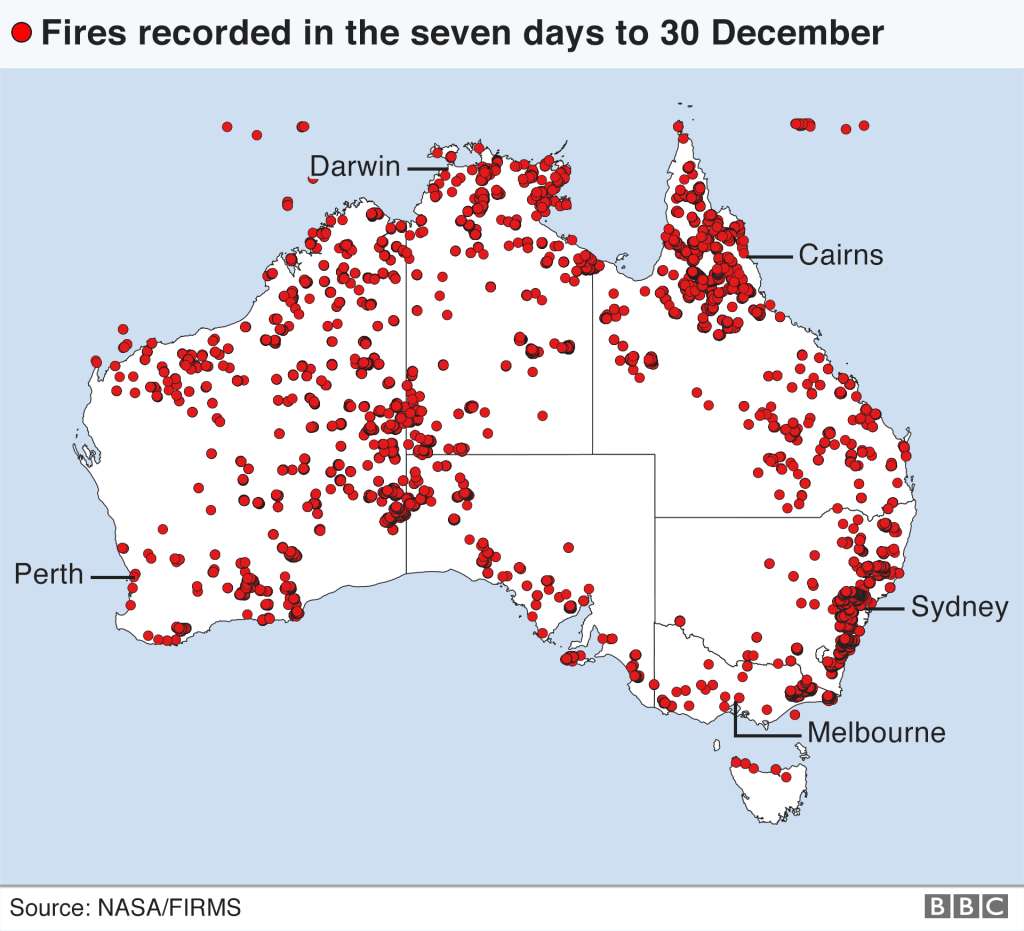
There are wildfires in Australia which have burned 20 million acres, killed perhaps a billion of the continent’s wildlife, and killed 25 people so far. And yet the world continues to pretend that climate change is not an urgent matter.
There were earthquakes in Puerto Rico which have devastated parts of the island which has yet to recover from hurricane damage, and American citizens are suffering with little acknowledgment from their government.
We have an American President making threats about disproportionate military responses and destroying cultural centers in Iran. A war is starting because a single defense contractor was killed in a war zone.
I am not sure how we got to the situation where one death in a combat area which has experienced nothing but war for 17 years and 500,00 deaths may lead to a more general war. But we should also consider the following:
1) the US invaded Afghanistan in October 2001 and is still fighting there;
2) the US invaded Iraq in March 2003 and is still fighting there ;
3) the US sent troops into Syria in September 2014 and is still there guarding oil wells.
Is there any evidence at all that the exercise of US military power has attained any strategic objective in any of these conflicts? Have the US military efforts led to peace? Is there any reason (other than wishful thinking) at all to believe that US military actions against Iran will produce an outcome favorable to either the US or to Iran?
Was the US successful in Vietnam?
Was the Soviet Union successful in Afghanistan?
Decisions are being made by a President with no military experience and one who most likely could not identify Iran on a map. And the Congress is unwilling to exercise any of its constitutional powers to declare war. And the American public seems unwilling to force the government to pay attention to the myriad of social and economic problems making life difficult for all but the richest.
“He looked at her as a man might look at a faded flower he had plucked, in which it was difficult for him to trace the beauty that had made him pick and so destroy it” ― Leo Tolstoy, Anna Karenina
I confess that I am overwhelmed with the amount of information flying around on the crisis between the US and Iran. So I will simply make some observations about where we are right now.
First, I have indicated previously that I believe that the assassination of Suleimani was an attempt to distract attention away from the new evidence concerning the decisions about withholding aid from Ukraine. That belief was buttressed today by a report in the Daily Mail (not a source that I use very often, but this article has a great deal of corroborating evidence) that Suleimani was in Baghdad, not to plan an attack against the US, but rather to explore an overture to Saudi Arabia, an enemy of Iran. The article asserts:
“[Iraqi Prime Minister] Abdul Mahdi suggested that the Iranian military leader was in Baghdad as part of Iraqi-mediated negotiations with Iran’s main regional rival, Saudi Arabia.
“He said that Soleimani was going to meet him on the same day that he was killed.
“‘He came to deliver me a message from Iran, responding to the message we delivered from Saudi Arabia to Iran,’ Abdul Mahdi told The Washington Post.”
If true, then the Trump Administration’s claim that Suleimani was planning an “imminent” attack on American forces seems much less persuasive since the Administration has yet to provide any intelligence details on its assertions.
Second, President Trump tweeted, and later reaffirmed to journalists, that the US would consider attacking Iranian cultural centers. We have had situations in which cultural centers have been attacked during war. Perhaps the most pertinent example is the German destruction of Belgian cultural centers in 1914. The Germans thought that the wanton destruction would force the Belgians to capitulate; it rather stiffened their willingness to resist the German invasion. Additionally, such destruction is outlawed by the Hague Cultural Property Convention to which the US is a signatory. Such destruction would be condemned by virtually every state in the world. And, I suspect, the US military would refuse to carry out such an order.
Third, the US media continues to insist that Suleimani was a “bad” man, deserving of assassination. The argument leaves me speechless. Suleimani was a soldier, carrying out the orders of his state. It is true that he fostered the use of Improvised Explosive Devices (IEDs) that killed many US soldiers in Iraq and one could argue that IEDs are unethical weapons of war. But Soleimani did not command forces that had the ability to confront the US military directly. And one could also argue that drones, such as the one that killed Suleimani, are ethically compromised as well. But Suleimani was a “good” Iranian soldier and perhaps that is why he should have been killed–not because he was a “bad” man (although the political repercussions suggest that killing him was a mistake). We should keep this in mind as we reward our own soldiers for killing in our name.
Fourth, Iran announced that it would no longer adhere to the number of centrifuges limited by the Iranian nuclear agreement (although it did not say that it would enrich uranium beyond the level specified by the agreement–a more important consideration). A number of media outlets have characterized this move as breaking the nuclear accord. The Iranian nuclear agreement was broken by the US in 2018 and then further shredded when the US announced that it would enforce unilateral sanctions on any country purchasing Iranian oil. That Iran adhered to the agreement well after the US left the agreement does not necessarily mean that the agreement was still alive. Remember: Iran signed the agreement because it meant that sanction against it would be lifted. Those sanctions were reimposed even when there was no evidence that Iran had violated its obligations. The Iran nuclear deal was dead and it was killed by the US.
These are just some of the considerations we need to keep in mind as this debate continues to unfold. The degree to which muddy thinking has corrupted the discussion is extraordinary.
“Iran has been nothing but a problem for many years,” Trump tweeted. “Let this serve as a WARNING that if Iran strikes any Americans, or American assets, we have targeted 52 Iranian sites (representing the 52 American hostages taken by Iran many years ago), some at a very high level & important to Iran & the Iranian culture, and those targets, and Iran itself, WILL BE HIT VERY FAST AND VERY HARD. The USA wants no more threats!”
I am not sure why Mr. Trump would signal US war plans to an adversary or why he thinks that threats would induce Iran to stop threatening. The tweet is reminiscent of the “fire and fury” threats he once issued to North Korean leader Kim Jong-un which had all the power of a damp squib. But we should be very clear about how this crisis evolved.
Iran signed an agreement with the US, France, Russia, China, Germany, and Great Britain that ensured that Iran would halt its nuclear program in exchange for a halt to the UN and US sanctions that were put in place to persuade Iran not to develop nuclear weapons. That agreement was signed on 25 July 2015 and every monitoring agency agreed that Iran had observed the terms of the agreement. Nonetheless, on 8 May 2018, President Trump violated the agreement by ending US compliance without any evidence that Iran had broken its promises. In August of 2018 the US re-imposed the sanctions and in April of 2019 the US placed sanctions on any state purchasing Iranian oil. This extra-territorial extension of US policy was the functional equivalent of total war against Iran since oil revenues comprise a significant percentage of the government’s revenues.
For the entire year, Iran adhered to the terms of the nuclear agreement despite the US actions, but warned that it not continue to do so unless the other signatories of the agreement made arrangements to assure that Iranian oil could be sold. Those arrangements were never made and in May of 2019 Iran began small violations to the agreement, none large enough to make Iran capable of producing a nuclear bomb. In addition, Iran began harassing and hijacking oil tankers through the Strait of Hormuz to demonstrate to the world that if Iranian oil could not be sold, then Saudi Arabian, Kuwaiti, and UAE oil would not be sold as well.
USA Today provides a timeline of events since that point:
July 4
Gibraltar and British marines seize the Iranian oil tanker Grace 1 at the request of the United States. The ship is suspected of illegally transporting oil to Syria.
July 18
Trump says a U.S. Navy vessel shot down an Iranian drone that came within 1,000 of the ship.
July 20
Iran seizes the British-owned oil tanker Stena Impero near the Strait of Hormuz.
July 22
Iran says it’s arrested 17 Iranians and charged them with spying for the United States. News reports say some of the Iranians were executed.
Dec. 27
A U.S. civilian contractor is killed and several troops injured in a rocket attack in Kirkuk. The Iran-backed militia group Kataeb Hezbollah is blamed.
Dec. 29
U.S. planes bomb three sites in Iraq – one of them in Al-Qaim – and two sites in Syria. Twenty-five people are killed. The sites are tied to Kataeb Hezbollah.
Dec. 31
Militia-backed protesters attack the U.S. Embassy in Baghdad.
Jan. 2
Iranian military leader Qasem Soleimani and five others are killed in a U.S. drone strike at Baghdad airport. U.S. officials call it a “defensive action,” saying Soleimani planned attacks on U.S. diplomats and troops.
This sequence of events is the basis for my belief that the US provoked the war. Iran is hardly an innocent state, but one should ask this counterfactual question: “Would we be in this current situation if all parties had continued to observe the terms of the Iranian nuclear agreement?” States can always concoct pretexts for war, but, from my point of view, it was the US that initiated economic war against Iran.
The US drone attack that killed Iranian military commander Qasem Soleimani and Iraqi militia leader Abu Mahdi al-Muhandis was an act of war. Soleimani was a clear enemy of the US and has been for a very long time. But others–including Presidents George W. Bush and Barack Obama as well as Israeli Prime Minister Netanyahu–resisted the urge to assassinate him because he was so highly regarded in Iran and Iranian allies. All three had plenty of opportunities to kill Soleimani but all three were wise enough to know that creating a martyr would not advance their country’s interests.
The Trump Administration chose this moment to kill Soleimani and we are justified in asking why. US Secretary of State Pompeo claimed that the assassination was justified because US intelligence suggested that Soleimani was planning an “imminent” attack against American forces. If true, then the attack would be legal under the US Constitution since the US Commander in Chief is obliged to provide self-defense for US service members. But Pompeo provided no evidence for his claim and it would be strange if the Administration started to suddenly believe the intelligence services it has descried over their findings regarding Russian intervention in the 2016 presidential election.
My own initial belief is that the attack was an attempt to divert attention from the release of documents that indicate that the Trump Administration was well aware that its decision to withhold military aid from Ukraine was illegal. Frida Ghitis writes about the emails that were released yesterday under a Freedom of Information Act court order that the Trump Admionistration had previously refused to release:
“Pentagon lawyers and others appeared to grow increasingly anxious. Duffey later writes, “Clear direction from POTUS to hold,” again making it clear this was the President’s doing.
“On July 26, the “Ukraine Deputies Small Group” met. The National Security Council’s top Ukraine experts — Trump’s own team — declared ‘unanimous support‘ for restarting military funding as Russia’s allies continued their assault on eastern Ukraine.
“As the clock ticked toward a disbursement deadline, aides increasingly raised the legality of the issue.And rightly so. The decision didn’t just run against national security, it violated the law.
“Under the Impoundment Control Act (ICA), the administration is obligated to spend the money as directed by Congress. If it doesn’t, it is required to inform Congress that it is doing so and why.
“In a draft letter by the Pentagon to the OMB, top Defense Department officials noted, ‘We have repeatedly advised OMB officials’ that the suspension of aid jeopardizes ‘the Department’s ability’ to comply with the ICA.”
Not surprisingly. this information was buried under the avalanche of news concerning Soleimani.
I still need more time to think this through, however. I will be watching to see what the Iraqi Parliament decides. I would not be surprised if the Parliament asked the US to leave, fulfilling Suleimani’s main objective. The Iranians will undoubtedly respond, but I suspect that their response will be calibrated so that an American attack on Iranian soil cannot be justified. But my main emotion right now is deep sorrow over the stupidity of the US actions. I will try tonight and tomorrow to see if I can discern any strategic objective that is served by the attack on Suleimani.
The immediate crisis over the US Embassy in Iraq seems to have subsided. The protesters who breached the compound–with the apparent complicity of Iraqi security forces–have pulled back after US President Trump talked with the Iraqi government and send additional troops to Iraq. But that clam is entirely misleading. Dov S. Zakheim has written a short essay for The National Interest which argues that the protesters, who are proxies for the Iranian government, seem to be intent on forcing the US to respond militarily to their provocations. The belief among the protesters is that the use of force will give greater legitimacy to the presence of Iranian forces in Iraq. Zakheim asserts that the American people will not tolerate the necessary military presence to pose a real threat to the Iranian militias who operate in Iraq and that President Trump will ultimately be obliged to back down.
Both the US and Iran have stepped up their hostile rhetoric:
“US President Donald Trump and other top US officials have blamed Iran for attacks on US forces and for storming the embassy compound.
“’They will pay a very BIG PRICE! This is not a Warning, it is a Threat,’ Trump wrote on Twitter, adding ‘Happy New Year!’
“Iran’s supreme leader Wednesday condemned US strikes on Iraq and warned that his country was ready to hit back.
“’I and the government and the nation of Iran strongly condemn this American crime,’ Ayatollah Ali Khamenei said in a speech broadcast on state television.
“’If the Islamic Republic decides to oppose or fight against a country, it will do this explicitly,’ he said.”
The US State Department has released its annual report, “World Military Expenditures and Arms Transfers, 2019 edition”. It is a very valuable resource for those who wish to analyze how much the world is spending on military power. By way of summary:
” From 2007 through 2017, in constant 2017 U.S. dollar terms, the annual value of world military expenditures appears to have risen about 11% – 33%, from about $1.51 – 2.15 trillion in 2007 to about $1.77 – 2.88 trillion in 2017, and to have averaged between $1.72 and $2.61 trillion for the 11-year period….
“During the eleven-year period, for the world, the share of GDP to which military expenditure was equivalent – an indicator sometimes called “the military burden” – appears to have averaged between 1.9% and 2.5%, peaking at between 2.2% and 2.8% in 2009 and trending downward thereafter to between 1.7% and 2.2% in 2017….
“From 2007 to 2017, the global annual value of international arms transfer deliveries appears to have averaged about $181 billion in constant 2017 U.S. dollar terms, and to have risen by about 65%, from about $119 billion to about $195 billion, despite declining after 2012 from a peak of $206 billion in that year. The arms trade’s share of world trade in goods and services appears to have ranged from about 0.6% to about 0.9%, averaging about 0.8% and trending upward until 2009 but thereafter declining, recovering and staying at its 2009 level of about 0.9%. During the eleven-year period, about 79% of the world arms trade, by value, appears to have been supplied by the United States, about 10% by the European Union, about 5% by Russia, and less than 2% by China. There was no clear trend in either the U.S., the Russian, or the Chinese market share during the period.”
There are a very large number of tables and charts, broken down by geographic region, economic status, and political groupings. The charts and tables are in spreadsheet format and easily accessible.
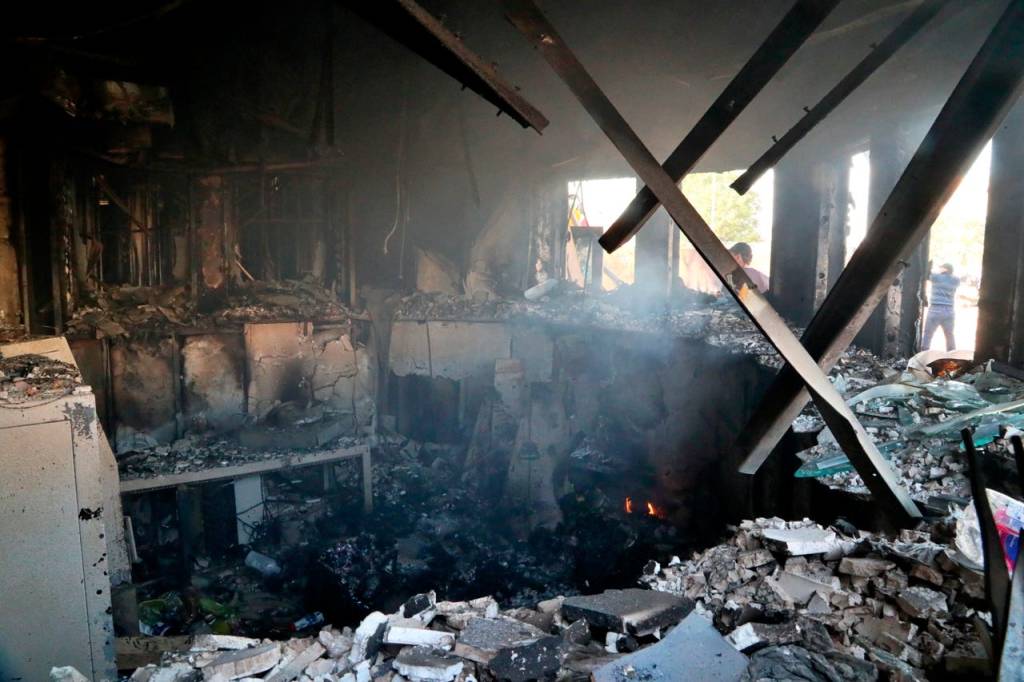
Protesters broke into the US Embassy compound in Baghdad, Iraq as Iranian-backed militias protested against the US strikes against Iranian militia positions in Syria and Iraq two days ago. The US strikes were in retaliation for militia ambushes which killed a US defense contractor and wounded 4 US soldiers. The Embassy protests raised memories of the US hostages which were held in the US Embassy in Tehran, Iran from 1979-80 as well as the attacks against the US consulate in Benghazi, Libya in 2012. But tensions between the US and Iran have been rising ever since the US pulled out of the Iranian nuclear agreement and imposed crippling sanctions on Iran in 2018.
The responsibility for protecting Embassies falls on the host government (even though the land upon which the Embassy is built is considered the sovereign territory of the country represented). The Iraqi security forces did not prevent the protesters from entering the compound and the US brought in Apache helicopters to aid in the defense of the compound. The US has had a military agreement with Iraq ever since the US overthrew the government of Saddam Hussein in 2003. The agreement was modified to allow some US forces to remain in Iraq in the conflict with ISIS in Syria and Iraq. But Iranian forces also joined in the fight against ISIS and those forces cooperated with US forces against that common enemy.
But now that ISIS has been deprived of a sustained territorial base in Syria, the differences between Iran and the US have returned to the fore. There are some Iraqis who are quite sympathetic to Iran and there are others who consider Iran to be an uninvited meddler. But there are few Iraqis who wish to see US troops stay in Iraq and there has been growing antipathy toward those forces. So the Iranians have a clear advantage in provoking actions against the American presence in Iraq. One must admit that the lack of support for the US is depressing since the US has had almost 17 years to build up solid support for its presence. But that opportunity has been squandered and Iraq seems to increasingly fragile despite US military and economic support.
I suspect that there will be more protests and the US will be confronted with a very difficult choice: to keep its representatives in Baghdad by intervening more decisively (a long-term loser) or to withdraw its Embassy staff to avoid a Benghazi scenario. There is no good alternative for the US and that summarizes current US Middle East policy.
William Burns has written an essay for Foreign Affairs, entitled “The Demolition of US Diplomacy” which looks at the serious harm the US State Department has suffered over the last three years. From his point of view the damage has been both immediate and long-term:
“Even before the Ukraine mess, the Trump administration had been waging a war on diplomacy for nearly three years. The White House regularly pushes historic cuts to diplomacy and development spending, which is already 19 times smaller than the defense budget. Career diplomats are sidelined, with only one of 28 assistant secretary-rank positions filled by a Foreign Service officer, and more ambassadorships going to political appointees in this administration than in any in recent history. One-fifth of ambassadorships remain unfilled, including critical posts.
“Not coincidentally, applications to join the Foreign Service have declined precipitously, with fewer people taking the entrance exam in 2019 than in more than two decades. The pace of resignations by career professionals is depressing, the pernicious practice of retaliation against individual officers just because they worked on controversial issues in the last administration is damning, and the silence from the department’s leadership is deafening.”
The same point of view is echoed by Steven Kashkett, a Foreign Service officer of 35 years in an op-ed published in USA Today. The hollowing out of the State Department only serves to enhance the influence of the Pentagon.
“The fires have already killed at least 10 people, torched more than 11.3 million acres, and destroyed more than 900 homes since September. The blazes made breathing the air in Sydney as bad as smoking 37 cigarettes and have killed 480 million animals, environmental officials told the Times in the United Kingdom, including nearly one-third of the koalas in one of Australia’s most populated koala habitats in an area 240 miles north of Sydney.”
There have been a strong of anti-Semitic acts of violence in the US over the last month, culminating with an attack on a Hanukkah celebration at a rabbi’s home in Monsey, New York. But the violence in the US has also been mirrored by acts in Europe:
“In Europe and the United States, Jews have been repeatedly assaulted on the street. Tombstones were desecrated in Slovakia. In London, anti-Semitic graffiti was painted on synagogues and Jewish-owned stores. A Belgian daily newspaper accused a lawmaker who is Jewish of being a spy for Israel. A Polish town refused to install small brass plates that commemorate Holocaust victims. In Italy, the town of Schio did the same because, the mayor said, they would be “divisive.” (Divisive to whom?) This intolerance is coming from right-wing extremists, progressive leftists, and other minorities who, themselves, are often the object of persecution. Anti-Semites seem to think it is open season on Jews. And maybe, given the many incidents, they are right.”
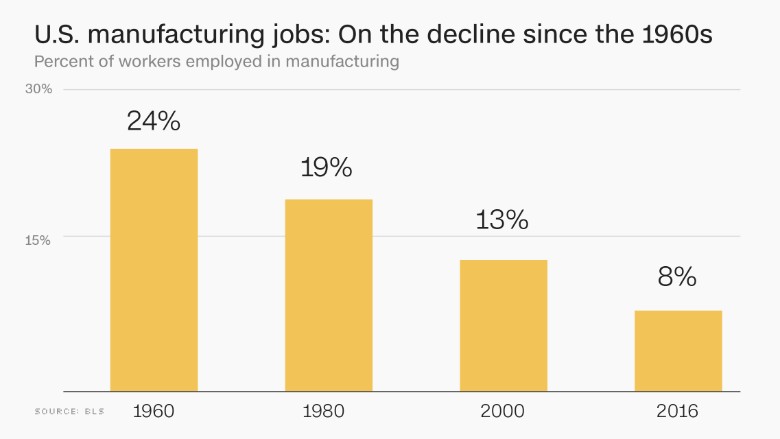
The US Federal Reserve has released a research paper which analyzes the effects of the tariff increases in the US on the manufacturing sector in the domestic economy. The tariffs were justified as an effort to “level the playing field” for manufacturers who suffered from unfair trade practices in China. There is little question that the manufacturing sector in the US has been substantially reduced because many firms stopped producing in the US and moved their facilities abroad in search of lower labor costs and more relaxed environmental regulations. According to the US Department of Labor:
“Today’s manufacturing output is at least 5 percent greater than it was in 2000, but it has become much more capital intensive and much less labor intensive. Accordingly, workers in the sector are more likely to have at least some college education than their counterparts of years past. But there are far fewer manufacturing workers overall, with about 7.5 million jobs lost since 1980. These job losses have likely contributed to the declining labor force participation rate of prime age (between the ages of 21 and 55) U.S. workers. In “The transformation of manufacturing and the decline of U.S. employment,” (National Bureau of Economic Research, Working Paper 24468, March 2018), economists Kerwin Kofi Charles, Erik Hurst, and Mariel Schwartz examine the factors that have played a role in the decline of prime age manufacturing workers since 1980 and focusing in the 2000s.
“Before examining the factors that have led to job losses, the authors discuss two periods that saw manufacturing employment fall sharply—1980 to 2000 and 2000 to 2017. Two million jobs were lost between 1980 and 2000 and 5.5 million jobs were lost between 2000 and 2017. The authors note that these losses have affected the employment rates of prime age workers, finding that a ’10 percentage point decline in the local manufacturing share reduced local employment rates by 3.7 percentage points for prime age men and 2.7 percentage points for prime age women.'”
The new research indicates that the tariff increases have not had the desired effect and that they have in fact damaged the manufacturing sector. The abstract to the paper summarizes the findings:
“Since the beginning of 2018, the United States has undertaken unprecedented tariff increases, with one goal of these actions being to boost the manufacturing sector. In this paper, we estimate the effect of the tariffs—including retaliatory tariffs by U.S. trading partners—on manufacturing employment, output, and producer prices. A key feature of our analysis is accounting for the multiple ways that tariffs might affect the manufacturing sector, including providing protection for domestic industries, raising costs for imported inputs, and harming competitiveness in overseas markets due to retaliatory tariffs. We find that U.S. manufacturing industries more exposed to tariff increases experience relative reductions in employment as a positive effect from import protection is offset by larger negative effects from rising input costs and retaliatory tariffs. Higher tariffs are also associated with relative increases in producer prices via rising input costs.”
Russia claims to have deployed the first hypersonic missile. A hypersonic missile flies at least 5 times the speed of sound and the Russian version, known as Avangard, also claims to be maneuverable. It is difficult to assess the truth of these claims, but, if true, such missiles would render anti-missile systems obsolete. Since the Reagan Administration, the US has been developing anti-missile systems and the Russians feared such systems, believing that anti-missile systems would nullify their nuclear weapons. Hypersonic missiles could potentially make the US investments in anti-missile systems a wasted effort. Both the US and China are also developing hypersonic missiles and we can expect that a new arms race will unfold. The US left the Intermediate-range Nuclear Force Treaty this year, and the only remaining arms control treaty still in force, START 2, will expire in February 2021.
 World Politics News