As the COVID-19 plague spreads over the US, the evidence is accumulating that the poorer countries in the world are being overwhelmed and are not well prepared to deal with the crisis. Ecuador is one of those countries that have been seriously affected. Its most populous city, Guayaquil, has dead bodies in the streets because the medical system has been swamped by people seeking help. CNN reports:
“The coronavirus pandemic is overloading the public services in the country’s most populous city to a point of collapse. Hospitals have no beds left to accept sick patients, and morgues, cemeteries and funeral homes are straining. With no place left to put them, some residents say they have no choice but placing them outside.It’s unclear how many of the deceased are dying because of Covid-19. Many families say their loved ones had symptoms of the virus, while others only know the ill were unable to be treated at Guayaquil’s overwhelmed hospitals.”
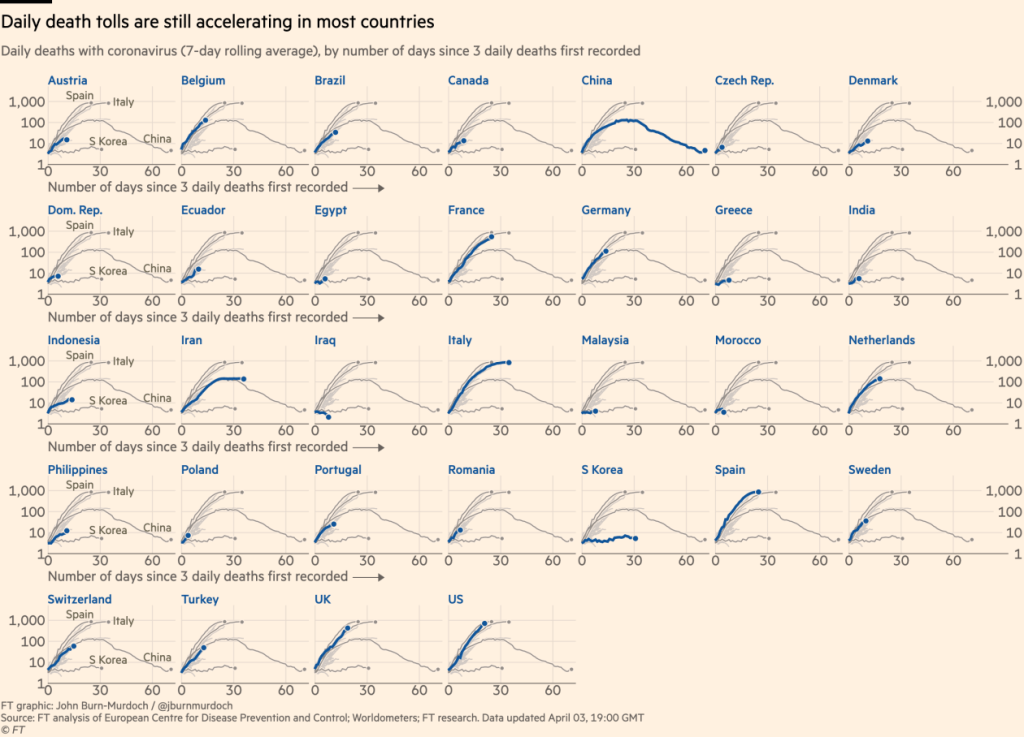
Ecuador is expecting as many as 3500 deaths in the city. The intensity of the situation in Ecuador is due to the large traffic between it and Spain, which itself has seen many deaths. The Financial Times has published graphs on the growth of coronavirus cases in various countries in the world.
The graph shows that some countries continue to see rapid growth in the number of cases, while others, such as Malaysia and South Korea, have been able to arrest the rate of growth. Clearly, effective governmental action can have a huge effect on how rapidly the virus spreads.
But there is an additional complicating factor. An effective response also requires the necessary medical supplies to take care of the sick. But the world is witnessing an extraordinary scramble for those supplies, pushing the cost of some of those supplies are too expensive for poor countries. Politico gives a sense of how the market is favoring rich countries:
“The coronavirus pandemic is pushing countries around the world into a cutthroat competition for medical resources — and the United States is being cast as a leading villain.
“President Donald Trump’s administration stands accused of effectively hijacking shipments of masks and additional crucial supplies meant for other countries, including U.S. allies, and strong-arming private firms to prioritize America over other parts of the world.On Friday, Trump announced he was invoking the Defense Production Act to restrict U.S. exports of key medical gear.
“Developing countries, where Covid-19 has yet to fully wreak havoc, are terrified of being left behind in the race for personal protective equipment, or PPE, and other materials because they cannot match the purchasing power of the U.S. and other wealthy countries.
“Independent aid organizations that cater to the neediest corners of the globe are finding themselves competing for attention from medical goods manufacturers. The Trump administration has even asked aid groups to share those supplies with the U.S. government, in a bizarre reversal of the usual dynamic between the world’s leading power and those it typically helps.
“’It’s ‘Lord of the Flies: PPE Edition’,’ said Jeremy Konyndyk, a former U.S. official who specializes in disaster response. ‘We need some global solidarity, and instead we have global competition.'”
Over time we shall all witness the rising number of deaths in the world that could have been avoided if the world had decided to work cooperatively. The rise of nationalism in the world is making that response impossible. The tragedy demands more than a Darwinian response.
the New York Times is reporting that there is serious discussion within the Trump Administration for taking stronger actions to confront Iranian backed militias in Iraq. Since the US assassinated Iranian General Qassim Soleimani last January, the US and Iran have been engaged in tit-for-tat actions in Iraq, despite the Iraqi protests against being a battlefield between the two antagonists. The recent discussions in the US government suggest a dramatic escalation of that tension. The article points out the relationship between Iraq and Iran:
“Beyond that, it would most likely put the Iraqi leadership and especially its military in the position of having to choose between its American allies — whose leaders are far away — and the Iranians, whom many senior Iraqis do not like but believe they have to live with because they are neighbors.
“’Iraq cannot be a victim of the Iranian-U.S. conflict, because that would end up going in favor of Iran,’ said Karim al-Nuri, a senior figure in the Badr Organization, an Iranian-backed militia, meaning that it would force Iraq closer to Iran.
“Iran has long used Shiite militia groups in Iraq as proxy forces both to battle American and Iraqi troops and to exert political influence inside the government. Like Lebanese Hezbollah, Kataib Hezbollah has both military components and political operations, and links to Iraq politicians, businesses, charities and a web of other networks, several regional specialists said.
“‘It’s like a shadow state,’ said Michael Knights, an analyst at the Washington Institute for Near East Policy, who has studied the group for more than a decade.
“As a result, carrying out any large-scale plan to destroy Kataib Hezbollah poses huge political and security risks for the Trump administration, and practical challenges for the military.’
The shift in US tactics seems to be spearheaded by Secretary of State Pompeo and National Security Adviser O’Brien. The report suggests that Defense Secretary Espey was initially opposed, but has changed his position. The New York Times catalogs the changes in the US arsenal on the ground in Iraq:
“Any campaign against Kataib Hezbollah is likely to draw from the roughly 70,000 American military personnel currently deployed around the Middle East, including in Saudi Arabia and other Persian Gulf nations. More than 14,000 of those troops have moved into the region since last May amid rising tensions with Iran.
“The Pentagon has also sent Patriot air and missile defense batteries, B-52 bombers, a carrier strike group, armed Reaper drones and other engineering and support personnel.
“Commanders are still rushing more Patriot antimissile batteries and other weaponry into Iraq, but are still a week or two away from having the additional defensive systems in place there, a senior U.S. military official said.”
The US commander in Iraq, Lt. General Robert White. has written a memorandum to his commanders arguing against the planned escalation in Iraq. According to the Times: “The United States’ top commander in Iraq has warned that such a campaign could be bloody and counterproductive and risks war with Iran. In a blunt memo last week, the commander, Lt. Gen. Robert P. White, wrote that a new military campaign would also require thousands more American troops be sent to Iraq and divert resources from what has been the primary American military mission there: training Iraqi troops to combat the Islamic State”.
Iran has suffered substantial deaths from COVID-19 and it may be the case that the US thinks that the pandemic may complicate and possibly hamstring Iranian decision making. But an article in the Teheran Times has a defiant tone:
“A member of the Iraqi Parliament Mohammad Albeldawi referred to this issue and maintained that based on evidence, the US seeks to orchestrate a coup in Iraq by activating ISIS in the Iraqi Governorates of Nineveh, Saladin, and Diyala.
“According to the Iraqi MP, what is currently being reported in the media affiliated with the Arab States of the Persian Gulf is a beginning for the US Plot. Moreover, US efforts to pressure the Iraqi government to release ISIS prisoners with the excuse of coronavirus outbreak is considered another proof.
“Meanwhile, a Kuwaiti newspaper quoted an informed source on Sunday saying that the US is planning a military coup in Iraq to seize power and it has informed its allies in Baghdad.
“Alquds Alarabi Newspaper also quoted a special source and noted, “The upcoming attacks against US troops prompted them to withdraw from some of their bases and focus on special ones. These forces have not fully withdrawn and have left some military advisors behind.’”
It may also be the case that the US might think that military action against Iran in Iraq would divert attention away from the COVID-19 crisis in the US. US President Trump tweeted this message at 1 pm today: “Upon information and belief, Iran or its proxies are planning a sneak attack on U.S. troops and/or assets in Iraq. If this happens, Iran will pay a very heavy price, indeed!” The tweet seems designed to begin conditioning the US public for possible conflict.
We should keep in mind that the US has one less aircraft carrier at its disposal. The USS Theodore Roosevelt, currently docked at Guam, is battling an outbreak of COVID-19 and may not be able to be deployed in the event of a conflict. The aircraft carrier might have been useful in a confrontation with North Korea which recently tested two ballistic missiles in violation of the Singapore Agreement with the US. It appears, however, that the US has decided to ignore this provocation.
The Parliament of Hungary has given the Prime Minister, Viktor Orban, extraordinary powers. The legislation, passed by Orban’s party, Fidesz, gives Orban the right to rule by decree and the legislation does not specify a date by which the emergency legislation must end. The law goes even further. According to the New Statesmen: “It declares a state of emergency; it allows him to rule by decree; it ensures there will be no new elections; it renders misinformation, presumably as defined by the Hungarian government, punishable by up to five years in prison; and it makes disobeying quarantine or isolation punishable by five to eight years in prison.” Ostensibly, the law was passed to protect the country from the coronavirus, but the consolidation of power in Orban’s hands has been going on since Fidesz achieved a supermajority in the Parliament. Orban himself has celebrated Hungary’s status as an illiberal democracy, insisting that Hungary is a Christian nations and that other religions should not share the same rights in Hungary. The European Union has raised serious concerns about Hungary’s standing within the Union, and the primary concern is that the coronovirus could be used as an excuse to abandon democratic norms. Daniel Baer expresses those concerns in Foreign Policy:
“Orban’s power grab is shocking but not surprising: Hungary’s democratic backsliding has been going on for well over a decade. Orban—who started in politics as part of the wave of young leaders who planted new democracies in Central and Eastern Europe after the collapse of communism—and his right-of-center Fidesz party have long engaged in a systematic dismantling of the institutional protections that secured an independent judiciary and free media in Hungary. They have used these and other institutional changes to secure and accumulate political power. Orban’s exploitation of the current coronavirus moment is less reflective of the chaos caused by the pandemic than of the collective failure of democratic actors and institutions—including the EU and NATO—to have put a check on Orban’s anti-democratic moves over the last 10 years.
“Too many in the international community have been unwilling to confront Orban, in part because they have seen him (and because he has presented himself) as the more acceptable version of Hungarian right-wing populism. ‘Look,’ Orban and his cronies would tell concerned Europeans and Americans behind closed doors, ‘would you rather see Fidesz or Jobbik in charge?’ For many years, Hungary’s neo-Nazi Jobbik party has been instrumentalized by Orban both domestically and internationally to achieve his own political objectives. (Other European leaders on the right have similarly attempted to embrace the far-right populists in their countries but none with the cunning cynicism or disastrous constitutional consequences of Orban.)”
As long as the Hungarian people continue to vote so heavily in favor of Fidesz, it is hard to imagine that Orban would eschew the powers he has been granted. But the change is a serious threat to the integrity of the European Union and to the international community as a whole. Let us hope that it is not a harbinger of changes excused by the deadly virus.
Nick Bryant, a correspondent for the BBC, has written a thoughtful essay entitled “Coronavirus: What this crisis reveals about US – and its president“. It is a sweeping review of the US response to the COVID-19 crisis from an outsider’s perspective–although there is no such thing as an outsider’s perspective to the pandemic. But it is useful to have a non-American view. Bryant does not mince words:
“Consequently, America’s claim to global pre-eminence looks less convincing by the day. While in previous crises, the world’s most powerful superpower might have mobilised a global response, nobody expects that of the United States anymore. The neo-isolationism of three years of America Firstism has created a geopolitical form of social distancing, and this crisis has reminded us of the oceanic divide that has opened up even with Washington’s closest allies. Take the European travel ban, which Trump announced during his Oval Office address to the nation without warning the countries affected. The European Union complained, in an unusually robust public statement, the decision was ‘taken unilaterally and without consultation’.
“Nor has the United States offered a model for how to deal with this crisis. South Korea, with its massive testing programme, and Japan have been exemplars. China, too, has shown the advantages of its authoritarianism system in enforcing a strict lockdown, which is especially worrying when the western liberal order looks so wobbly. Hopefully, nobody will forget how officials in China tried to cover up the virus for weeks and silenced whistleblowers, showing the country’s ugly autocratic side even as the outbreak was spreading. But whereas Beijing managed to build a new hospital in just 10 days, the Pentagon will take weeks to move a naval hospital ship from its port in Virginia to New York harbour.”
That critique is echoed by an American academic, Daniel Drezner, who wrote in The Washington Post:
“Analysts are focusing intently on whether this accelerates a hegemonic transition or a great power conflict between China and the United States. China has tried to seize on being seen as a provider of key global public goods. The United States has blown opportunity after opportunity to play a leadership role — a fact Spoiler Alerts will discuss later this week. A key source of soft power is the demonstration of policy competence. No one beyond President Trump thinks that the United States has been competent in its policy response.”
It will be a very long time before we can accurately assess the full impact of the pandemic. But I suspect that few states will come through the crisis with the full confidence of their citizens. Some analysts believe that China has not provided accurate information about the deaths from COVID-19. Few believe the reports coming out of Russia. The greatest test of legitimacy, however, will likely be India, as the country prepares a lockdown of 1.3 billion people, many of whom have no place to go for shelter. Few governments will be regarded as trustworthy, even as it is likely that a second wave of coronavirus victims is likely in the fall.
The Guardian has published an article about the time lost in the US before there was an adequaste response to the spread of COVID-19. The newspaper is a lefty newspaper and its critique of the Trump Administration is biting. It would be a mistake, however, to dismiss the article because of possible bias–there are too many specific dates and events cataloged in the article to argue that its critique is unfair.
The first documented case of COVID-19 in the US occurred on 20 January 2020 (I posted about the coronavirus on 22 January–one did not have to be an expert to know that something significant was going on in China). The New York Times documents the fact that the Director of the US Center for Disease Control, Dr. Robert Redfield, knew about the seriousness of the virus early on:
“The first time Dr. Robert Redfield heard about the severity of the virus from his Chinese counterparts was around New Year’s Day, when he was on vacation with his family. He spent so much time on the phone that they barely saw him. And what he heard rattled him; in one grim conversation about the virus days later, George F. Gao, the director of the Chinese Center for Disease Control and Prevention, burst into tears.”
NBC News provides evidence of how the US intelligence agencies warned the Trump Administration about the threat of COVID-19 and how those warnings were ignored by the Trump Aministration:
“According to The Washington Post, ‘U.S. intelligence agencies were issuing ominous, classified warnings in January and February about the global danger of the coronavirus while President Trump and lawmakers played down the threat and failed to take action that might have slowed the spread of the pathogen.’ Almost a year before that, an annual threat report from the Office of the Director of National Intelligence by Dan Coats, then its director, stated, ‘The United States will remain vulnerable to the next flu pandemic or large-scale outbreak of a contagious disease that could lead to massive rates of death and disability, severely affect the world economy, strain international resources, and increase calls on the United States for support.’ Coats stepped down last year after he was reported to have angered the president with unwelcome intelligence assessments.
The Guardian article compares the US and South Korean response to the virus:
“When the definitive history of the coronavirus pandemic is written, the date 20 January 2020 is certain to feature prominently. It was on that day that a 35-year-old man in Washington state, recently returned from visiting family in Wuhan in China, became the first person in the US to be diagnosed with the virus.
“On the very same day, 5,000 miles away in Asia, the first confirmed case of Covid-19 was reported in South Korea. The confluence was striking, but there the similarities ended.
“In the two months since that fateful day, the responses to coronavirus displayed by the US and South Korea have been polar opposites.
“One country acted swiftly and aggressively to detect and isolate the virus, and by doing so has largely contained the crisis. The other country dithered and procrastinated, became mired in chaos and confusion, was distracted by the individual whims of its leader, and is now confronted by a health emergency of daunting proportions.”
The article then goes on to point out that the US government did not even take the testing process seriously until 29 Fenruary:
“Those missing four to six weeks are likely to go down in the definitive history as a cautionary tale of the potentially devastating consequences of failed political leadership. Today, 86,012 cases have been confirmed across the US, pushing the nation to the top of the world’s coronavirus league table – above even China.
“More than a quarter of those cases are in New York City, now a global center of the coronavirus pandemic, with New Orleans also raising alarm. Nationally, 1,301 people have died.
“Most worryingly, the curve of cases continues to rise precipitously, with no sign of the plateau that has spared South Korea.
“’The US response will be studied for generations as a textbook example of a disastrous, failed effort,’ Ron Klain, who spearheaded the fight against Ebola in 2014, told a Georgetown university panel recently. ‘What’s happened in Washington has been a fiasco of incredible proportions.’”
The article goes on:
“Jeremy Konyndyk, who led the US government’s response to international disasters at USAid from 2013 to 2017, frames the past six weeks in strikingly similar terms. He told the Guardian: ‘We are witnessing in the United States one of the greatest failures of basic governance and basic leadership in modern times.’
“In Konyndyk’s analysis, the White House had all the information it needed by the end of January to act decisively. Instead, Trump repeatedly played down the severity of the threat, blaming China for what he called the ‘Chinese virus‘ and insisting falsely that his partial travel bans on China and Europe were all it would take to contain the crisis.”
It is instructive to note that other countries have been remarkably effective in keeping the death rate from COVID-19 down. National Public Radio cites Germany, another liberal democracy, that faced the same issues that the US did, but with completely different outcomes: “In Italy, the fatality rate from the virus is around 10%; in France, 5%. But in Germany, only a tiny fraction of people with the virus have died – just 0.5%.” There are many resons why Germany has been more successful than other states, but the principal difference seems to be the willingness of the state to embrace testing of everyone–not just those who were sick–in order to enforce social distancing. The New York Times echoes the singular importance of testing:
“But as the deadly virus from China spread with ferocity across the United States between late January and early March, large-scale testing of people who might have been infected did not happen — because of technical flaws, regulatory hurdles, business-as-usual bureaucracies and lack of leadership at multiple levels, according to interviews with more than 50 current and former public health officials, administration officials, senior scientists and company executives.
“The result was a lost month, when the world’s richest country — armed with some of the most highly trained scientists and infectious disease specialists — squandered its best chance of containing the virus’s spread. Instead, Americans were left largely blind to the scale of a looming public health catastrophe.”
Snopes did a fact check of all the times US President Trump seemed to downplay the significance of the virus. The list is quite long, so I will not reproduce it here, but Snopes carefully documents every source of the remarks. The failure of the US to respond effectively to the crisis will be studied in great detail after the crisis is over. But one point should be crystal-clear: effective governance can make a huge difference in protecting the well-being of citizens.
The United Nations Security Council has been debating a resolution calling for the cessation of hostilities among nations because of the impact of COVID-19 on societies globally. According to NBC News:
“Although the U.N. has a separate public health body — the World Health Organization — the Security Council has sought to warn how ongoing global conflicts could exacerbate the crisis and undermine the response.
“France, a permanent member of the council, proposed a version demanding a ‘general and immediate cessation of hostilities in all countries,’ including a 30-day humanitarian pause in conflicts, to allow coronavirus-related supplies to flow, according to a text reviewed by NBC News.
The debate on the resolution has been stymied by the US insistence that the resolution contain language that identifies China as the source of the virus: “the outbreak of the coronavirus disease (COVID-19) in Wuhan, Hubei province in the People’s Republic of China (PRC) in November 2019.” The US and China have been engaged in a bootless contest over the origins of the coronavirus with the Chinese claiming that the US military brought the virus into China and the Americans wanting to blame China for a slow response to the spread of the virus. The German media outlet, Der Spiegel, also reports that the G7 meeting (which was held electronically–a bizarre circumstance given that the 7 countries span 13 different time zones) did not issue a final communique because the US insistence that the COVID-19 virus be called the “Wuhan” virus. In a press conference about the health crisis, US Secretary of State, Mike Pompeo, made the following statement: “The Chinese Communist Party poses a substantial threat to our health and way of life, as the Wuhan virus outbreak clearly has demonstrated”. Nancy LeTourneau, writing in The Washington Monthly, argues that the tactic of blaming China for the crisis is a way of shielding US President Trump from criticism over his handling of the crisis. Politico has obtained a copy of the “playbook” on handling a pandemic that was issued by the Obama National Security Council in 2016. It is 69 pages of a step-by-step process to contain and minimize the effects of a pandemic on the US population. One cannot say if the playbook would have been effective, but, upon reading it, I can confidently say that the Trump Administration did not take a majority of the steps outlined. It is dry reading, but it seems to be quite comprehensive.
The US Senate passed a huge bill designed to mitigate the effects of the pandemic on the US economy and it is expected that the House of Representatives is scheduled to vote on the bill tonight. There is one part of the bill that is quite interesting: the money allocated to support the cruise line industry. Much of that industry is not registered in the US. The industry flies “flags of convenience”, such as Liberia or Panama, in order to avoid paying US taxes and to avoid safety and environmental regulations. It is estimated that only about 5% of the workers for the industry are American.
“Despite many of them being based in Florida, major cruise lines conveniently rely on legal loopholes by registering their companies in low tax jurisdictions. Their cruise ships also fly the flags of other countries so that they do not have to abide by US labor laws, a loophole known as a “flag of convenience”.
“Carnival, the largest cruise company in terms of market share, is incorporated in Panama according to Panama’s registry and the other two major companies in the industry employ similar tactics. Norwegian is incorporated in Bermuda, and Royal Caribbean has been incorporated in Liberia since 1985.
“Despite the fact that all three of their corporate headquarters are in Miami, annual filings show that these companies are part of an industry that paid an average tax rate of under 1%, which is well below the required 21% corporate tax rate in the United States.”
We should seriously ask why the industry will receive tax money derived from US citizens even though it has contributed very little to that pool of money. The passage of this part of the bailout bill will benefit only the owners of the cruise ships and not the American people. In fact, the American people will be poorer as a result.
COVID-19 raises all sorts of questions about world politics. It is a disease that respects no national borders and is in many respects similar to the threats to global stability posed by climate change. In particular, the virus creates a backlash against the process of globalization which mirrors the populist challenge to globalization which has rattled world politics since the Great Recession of 2008. US President Trump made this abundantly clear in his remarks to the press on 24 March:
“We should never be reliant on a foreign country for the means of our own survival. I think we’ve learned a lot. We’ve learned a lot. This crisis has underscored just how critical it is to have strong borders and a robust manufacturing sector.
“For three years, we’ve embarked on a great national project to secure our immigration system and bring back our manufacturing jobs. We brought back many jobs — records numbers — record numbers of jobs.
“And this really shows — this experience shows how important borders are. Without borders, you don’t have a nation.
“Our goal for the future must be to have American medicine for American patients, American supplies for American hospitals, and American equipment for our great American heroes.
“Now, both parties must unite to ensure the United States is truly an independent nation in every sense of the word. Energy independence — we’ve established that. That’s something incredible that we have established. We’re energy independent, manufacturing independence, economic independence, and territorial independence enforced by strong, sovereign borders.
“America will never be a supplicant nation. We will be a proud, prosperous, independent, and self-reliant nation. We will embrace commerce with all, but we will be dependent on none.”
This view is profoundly myopic. It may be the case that Mr. Trump does not want to be dependent on resources coming into the US. But the perspective ignores the fact that much of American prosperity rests upon other states buying US resources such as agriculture, airplanes, and high technology. The US would be a significantly poorer country in the absence of a globalized economy. The more productive approach to globalization is to cushion the harmful aspects of the process by investing in an infrastructure that supports those who suffer and guide them into more productive employment.
Virtually all my news feeds are related to the COVID-19 crisis. There’s a lot to think about and the crisis is clearly going to command our attention for an extended period of time. I am not going to pretend that I have any original insight into the crisis, and, at this moment, there does not seem to be any other issue in the world that seems to be more urgent. We are all hunkered down and keeping as safe as we can, but it is discouraging to get news reports that some governments in the world have yet to respond effectively. So here are some diversions to help alleviate some of the discouragement.
The have been many press reports about the state of preparedness in the US for the onset of a pandemic such as the country is experiencing currently. It is, to my mind, a curious question since there are many historical examples of plagues which completely transformed daily life in many societies. The real question is why, given the evidence, most societies were completely unprepared for such a devastating possibility. The question is even more perplexing because there is substantial information about systematic studies that were offered to governmental officials about what needed to be done to more effectively address the potential for a pandemic. Those studies, however, failed to elicit any response to this glaring threat to the security of citizens.
The New York Timespublished today a report about the information the Trump Administration had about the US government’s preparedness for a pandemic. The report was issued by the Health and Human Services agency on a simulation of a pandemic outbreak, entitled “Crimson Contagion” in October 2019. The simulation was run in January, April, and May of 2019. According to The New York Times:
“The draft report, marked ‘not to be disclosed,’ laid out in stark detail repeated cases of ‘confusion’ in the exercise. Federal agencies jockeyed over who was in charge. State officials and hospitals struggled to figure out what kind of equipment was stockpiled or available. Cities and states went their own ways on school closings.
“Many of the potentially deadly consequences of a failure to address the shortcomings are now playing out in all-too-real fashion across the country. And it was hardly the first warning for the nation’s leaders. Three times over the past four years the U.S. government, across two administrations, had grappled in depth with what a pandemic would look like, identifying likely shortcomings and in some cases recommending specific action.
“In 2016, the Obama administration produced a comprehensive report on the lessons learned by the government from battling Ebola. In January 2017, outgoing Obama administration officials ran an extensive exercise on responding to a pandemic for incoming senior officials of the Trump administration.”
To its credit, the Obama Administration created a position on the National Security Council dedicated to coordinating federal resources to address the possibility of a devastating pandemic. That office briefed the incoming Trump Administration in January 2017. But that office was eliminated in January 2018.
It is clear that pandemics should be considered as national security threats as devastating as any threat posed by states or non-state actors. And we should fund defenses against pandemics (as well as climate change, by the way) to the same degree that we currently find defenses against more traditional acts of war. And we should assess the failure of anticipating such threats as egregious failures of the state.
Barry Posen has written a very insightful essay on the relationship between the US and Iran, a relationship that continues to escalate in an uncertain way. Posen details the more recent history of the US-Iranian relationship, paying particular attention to the significance of the Joint Comprehensive Plan of Action (JCPOA), more commonly known as the Iranian nuclear deal. The re-imposition of sanctions, as well as the secondary sanctions imposed by the US on the other signatories to the agreement, have placed the Iranians in a desperate situation. Posen describes the attitude of the Iranians:
“In its eyes, the sanctions are particularly malevolent, because Iran had agreed, after long negotiations with the Obama administration and the European Union, to constrain its nuclear ambitions in return for enhanced economic exchange with its negotiating partners. The Trump administration defected from this agreement, dubbed the Joint Comprehensive Plan of Action (JCPOA). So long as Iran adhered to its obligations under the JCPOA, other states were ostensibly committed to trade with Iran. But other guarantors did not hold up their end, even though Iran initially adhered to the terms. The European Union, in particular, has done essentially nothing to fulfill its part of the JCPOA bargain, because the United States has threatened punishing secondary sanctions on foreign banks and companies if they do so. Russia and China, the other co-guarantors of the JCPOA, have been somewhat more willing to help Iran, but the help is furtive and insufficient to ameliorate the U.S. sanctions effort.”
Posen believes that the Iranians are currently holding out for a new US President. But if Trump is re-elected, the Iranians will be forced to figure out a way to break the US control over likely Iranian trading partners. That course of action would involve continuing the incremental attacks on US forces in Iraq as well as attacks on US Arab allies in the Gulf. THat course of action would require a US response, but Posen believes that US military action would not achieve US objectives:
“The United States could try to end such a war quickly and cheaply by bombing Iran’s diverse capabilities out of existence, though this would probably take more time than many expect and probably would not fully succeed. The U.S. air campaigns against Serbia and Libya took much longer than anyone expected; both adversaries managed to continue military operations while under aerial pressure. Both were much weaker than Iran. At some point, the United States would ask Iran if it is ready to capitulate. And if Iran is unwilling, as is likely, then the United States would have five options: negotiate an end to the war that includes compromises on U.S. objectives; stop bombing and hope that the Iranians also stop fighting; settle in for a long, grinding blockade and attrition war; escalate the bombing to civilian targets, a war crime that the president has already hinted at in one of his tweets; or invade Iran with ground forces. None of these options look good. War would be costly, and probably unwinnable in the traditional sense without an invasion of Iran.”