Today is the anniversary of the assassination of the archduke Franz Ferdinand and his wife, Sophie, by Gavrilo Princip, a member of the Serbian group known as the Black Hand. The Black Hand was dedicated to freeing Serbia from control of the Austro-Hungarian Empire. The assassination triggered events that led to World War I, although the political dynamics in Europe since 1901 had been leading up to that catastrophic war. It is also the anniversary of the French signing the Treaty of Versailles in 1919 which ended that phase of the war (which picked up again in 1939 and only ended in 1945).
Gavrilo Princip in his prison cell at the Terezín fortress, 1914. The same year, Princip had killed Archduke Franz Ferdinand of Austria and his wife Sophie of Hohenberg. On 28 June 1914, Princip and five more assassins of the Black Hand society planned to kill Franz Ferdinand for the creation of a Yugoslavian state. The result, however, led to the First World War with Austria-Hungary’s declaration of war on Serbia. Princip was too young to receive the death penalty, so received the maximum sentence of twenty years in prison. Because of being held in harsh conditions, he contracted tuberculosis and died on 28 April 1918 at Terezín short before the war had ended.
Alexander Cooley and Daniel H. Nexon have written a fascinating essay entitled “How American Hegemony Ends” for Foreign Affairs. They persuasively argue that the liberal world order established by the US and its allies after 1945 was based upon a number of highly contingent circumstances, most notably the absence of any alternative system being plausibly supported because of the devastation of the war. That circumstance allowed the US to pursue a patronage system which induced support for the American hegemonic system. Cooley and Nexon note that that patronage no longer is as attractive to other states as it once was:
“The very forces that made U.S. hegemony so durable before are today driving its dissolution. Three developments enabled the post–Cold War U.S.-led order. First, with the defeat of communism, the United States faced no major global ideological project that could rival its own. Second, with the disintegration of the Soviet Union and its accompanying infrastructure of institutions and partnerships, weaker states lacked significant alternatives to the United States and its Western allies when it came to securing military, economic, and political support. And third, transnational activists and movements were spreading liberal values and norms that bolstered the liberal order.
“Today, those same dynamics have turned against the United States: a vicious cycle that erodes U.S. power has replaced the virtuous cycles that once reinforced it. With the rise of great powers such as China and Russia, autocratic and illiberal projects rival the U.S.-led liberal international system. Developing countries—and even many developed ones—can seek alternative patrons rather than remain dependent on Western largess and support. And illiberal, often right-wing transnational networks are pressing against the norms and pieties of the liberal international order that once seemed so implacable. In short, U.S. global leadership is not simply in retreat; it is unraveling. And the decline is not cyclical but permanent.”
The question is what will replace the liberal world order or if it will be replaced at all. The world has had experience with the absence of hegemonic power: the interwar period between 1918 and 1945 was marked by the inability of the European powers to enforce their imperial world order and the unwillingness of the US to enforce a liberal world order. That period was devastating. It witnessed horrific violations of human rights–the Holocaust, the Italian invasion of Ethiopia, and the Japanese atrocities in China. It saw the rapid retreat of the burgeoning democratic movement with the rise of Soviet totalitarianism and German, Italian, and Japanese fascism. And it permitted the total collapse of the global economic order with the Great Depression. The world is a vicious place without any cops on the beat.
But it seems unlikely that the authoritarian rule of Russia, China, the US, Brazil, India, the Philippines, Poland, Saudi Arabia, and Hungary will be attractive to young people used to the freedoms of social media and the creative arts. The large protests in the US against police brutality and systemic racism in the US have been mirrored abroad and stand as testimony to the willingness of many people to resist stronger governmental powers. We will see which way the pendulum swings.
I weep for the Republic. According to today’s Miami Herald:
“A record week of surging coronavirus numbers was only heightened on Friday, as state health officials confirmed 8,942 cases, nearly doubling the previous record of cases reported in a single day, two days earlier.
“Florida’s Department of Health on Friday morning confirmed the cases, bringing the state total to 122,960. The state also announced at least 39 new deaths, bringing the total of COVID-19 deaths north of 3,360.”
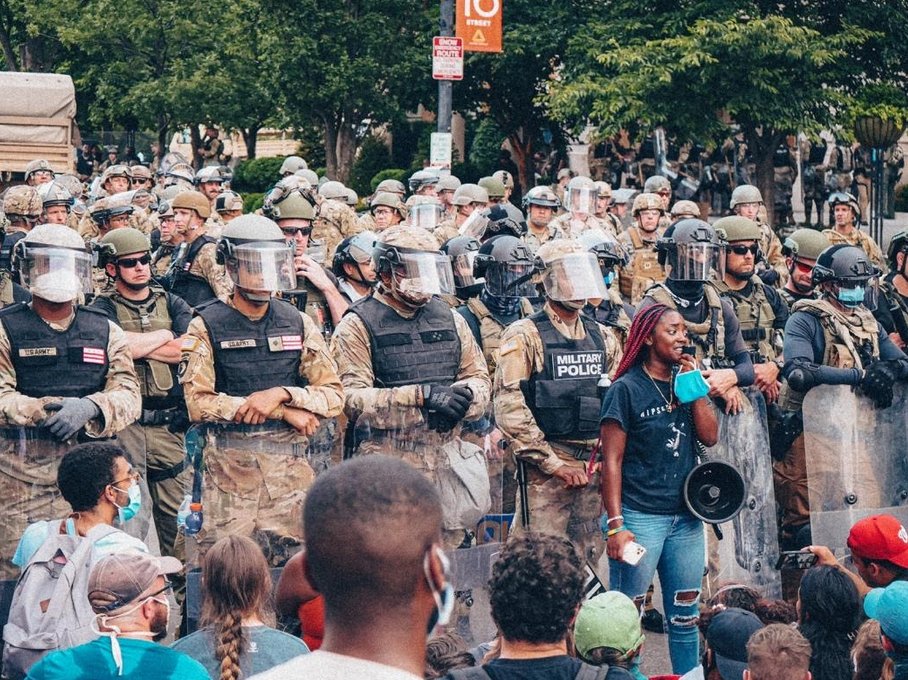
A Mount Holyoke College alumna, Jenna Ruddock-Franzini, has published a photographic essay on the protests over systematic racism in the US in Washington, DC . She has an extraordinarily keen eye for a moment that captures the passions and motivations of people who are protesting injustice. She also has captured the degree to which law enforcement in the US has been excessively militarized. The essay was published in The Progressive and I encourage readers to look at the photographs closely.
June 3, 2020 — Arianna Evans, an organizer with the newly established group Freedom Fighters DC, speaks to a crowd of seated protesters a block north of the White House as the already significant military presence behind her grows.
Tom McTague has written an essay for The Atlantic entitled “The Decline of the American World”. It is worthy of a very close read. McTague raises the issue of how differently US allies are assessing Mr. Trump’s foreign policy from previous Presidents. The US has been a dominant power in world affairs since the end of World War II and it enjoyed the support of strong allies even when those allies disagreed with some US actions. That general support continued despite active opposition from France over the US role in the Vietnam War and opposition from Germany over the Iraq War of 2003, to name just a few examples. McTague suspects that this general support came from broad agreement over the rules-based liberal world order to which US rhetoric aspired. The persistence of that general support is something that McTague views as significant:
It is hard to escape the feeling that this is a uniquely humiliating moment for America. As citizens of the world the United States created, we are accustomed to listening to those who loathe America, admire America, and fear America (sometimes all at the same time). But feeling pity for America? That one is new, even if the schadenfreude is painfully myopic. If it’s the aesthetic that matters, the U.S. today simply doesn’t look like the country that the rest of us should aspire to, envy, or replicate.
“Even in previous moments of American vulnerability, Washington reigned supreme. Whatever moral or strategic challenge it faced, there was a sense that its political vibrancy matched its economic and military might, that its system and democratic culture were so deeply rooted that it could always regenerate itself. It was as if the very idea of America mattered, an engine driving it on whatever other glitches existed under the hood. Now, something appears to be changing. America seems mired, its very ability to rebound in question. A new power has emerged on the world stage to challenge American supremacy—China—with a weapon the Soviet Union never possessed: mutually assured economic destruction.”
That general support seems to have evaporated as President Trump has jettisoned the idea of a liberal world order and has instead pursued a world order based upon balance of power rules that elevates a narrow definition of the national interest as the only determinant for foreign policy. In so doing, the US divested itself of any responsibility to conduct its foreign policy along lines that demonstrated common values and interests. McTague correctly identifies Mr. Trump’s interview with Bill O’Reilly of Fox News in 2017 as the clearest example of this shift: “In an interview with Bill O’Reilly on Fox News in 2017, Trump was asked to explain his respect for Putin, and he replied with the usual generalities about the Russian president leading his country and its fight against Islamist terrorism, prompting O’Reilly to interject: ‘Putin’s a killer.’ Trump then responded: ‘There are a lot of killers. We’ve got a lot of killers. What, do you think our country is so innocent?’” With that statement, the US eschewed the role of a world leader and became just another ordinary power.
But it is not easy for the world to give up on the aspirations of a rules-based world order. After all, none of the problems facing the world, such as climate change or the sputtering world economy or the need to protect human rights, can be addressed without multilateral cooperation. And American citizens are still insisting on the protections of human rights for all. It is not coincidental that it was the sight of Americans pulling down statues honoring Confederate soldiers that led Belgian citizens to pull down the statue of King Leopold, the genocidal ruler of what was once known as the Belgian Congo. Liberal aspirations are unlikely to be pursued by Russia or China so those who wish to see those values protected must turn to those countries that are willing to defend them. McTague observes:
“By 1946, when Winston Churchill arrived in Fulton, Missouri, to deliver his famous Iron Curtain speech, the might of the United States was obvious. The U.S. had the weapons to destroy the world, the military reach to control it, and the economy to continue growing rich from it. Churchill opened his speech with a warning: ‘The United States stands at this time at the pinnacle of world power. It is a solemn moment for the American democracy. For with primacy in power is also joined an awe-inspiring accountability to the future. If you look around you, you must feel not only the sense of duty done, but also you must feel anxiety lest you fall below the level of achievement.’
“America’s problem is that the rest of the world can see when it has fallen below its achievements. In moments such as the current one, it is hard to dispute some of the criticisms leveled by the country’s most vociferous critics from abroad: that it is irredeemably racist or overly ambivalent to poverty and violence, police brutality and guns. The rights and wrongs don’t appear particularly complicated in this dilemma, even if the country itself is.
“Yet this is also a nation that is not Russia or China, as much as its own leader would have us all believe. In Moscow and Beijing, for starters, it would not be possible to protest in such numbers and with such vehemence. From a European perspective, it is also striking to see the energy, oratory, and moral authority once again bubbling up from below—the beauty of America, not the ugliness. To listen to an Atlanta rapper address a press conference, or a Houston police chief speak to a crowd of protesters, is to watch a more accomplished, powerful, and eloquent public speaker than almost any European politician I can think of.”
It is impossible for the US to return to its previous role of a dominant superpower–the world has changed too dramatically from the unique conditions of 1945. But Americans and the rest of the world need to think more seriously about how to maintain a liberal world order without the constant intervention of the US in world affairs.
American exceptionalism is a phrase often used to describe the unique role in the world that Americans often ascribe to themselves. It is a phrase that suggests that Americans are “different” from citizens of other states. Usually that difference is determined to be “better”. In a number of important ways, the US is better positioned than many countries: it has easy access to both the Atlantic and Pacific Oceans which also serve as a defensive moat from foreign invasion; it has the Great Plains, the most productive agricultural land on the planet; and it came into being at a decisive time, allowing it to implement the political and economic ideas of the Enlightenment without having to address the legacies of feudalism simultaneously. The belief in American exceptionalism has been a constant theme in American foreign policy and the almost constant flow of immigrants into the country served to reinforce that special sense.
“Unlike many other countries, particularly compared to Russia, China and the European powers, the U.S. came into being as an experiment in nation-building, underlining the importance of secular, cosmopolitan, universal and multicultural values, uniting a diverse people around the political project of American nationalism.
“Being part of the American nation has long been considered as subscribing to the core tenets of the American creed, which has been in abject contradiction with examples of ethnic, religious and racists nationalism in other societies. Americans have thought of themselves so unique that promoting universal American values to other parts of the globe has long shaped American foreign policy practices. Americans have thought of themselves as an exceptional nation that has a God-given mandate to civilize and transform other societies in the image of American values.
“The four-year Trump presidency seems to have dented that image severely by contributing to the erosion of American soft power. We knew that Trump was a nativist politician, disparaging and belittling American exceptionalism. He said many times that it was not the U.S.’s business to teach others how to rule themselves and with him in power, the U.S. would no longer engage in nation-building exercises abroad.
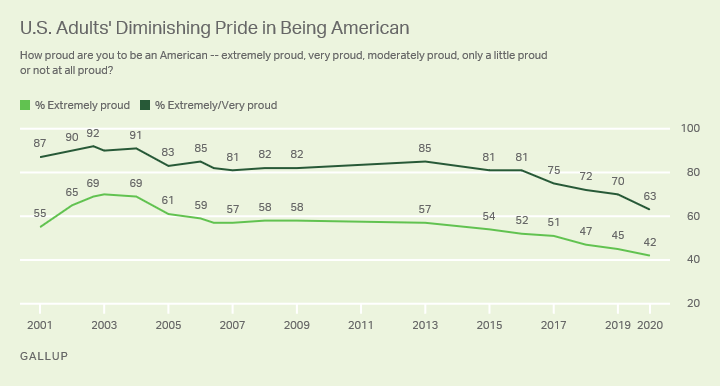
Exceptionalism is a convenient ideology that is invariably used by imperial powers, largely to justify interventions in weaker powers as There is a great deal of evidence that has begun to undermine American exceptionalism. On 15 June, I posted information from the Gallup poll that indicated that the number of Americans who take great pride in being American has declined over time. Catherine Rampell wrote an op-ed for The Washington Poston how belief in American exceptionalism has been shattered by the handling of the COVID-19 pandemic.
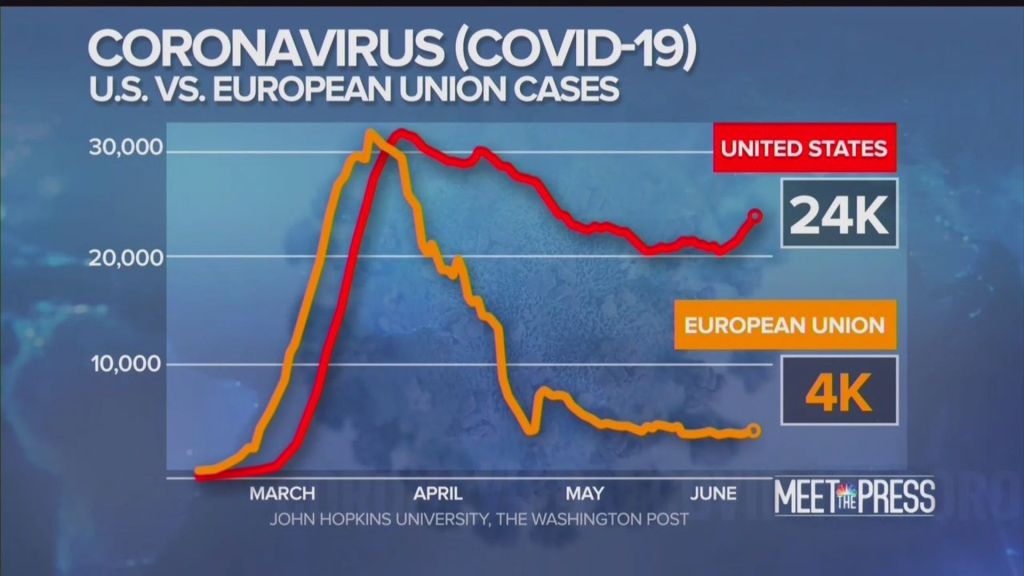
The comparison between the success of US efforts to contain the COVID-19 pandemic and the EU’s efforts indicates a degree of incompetence that is breathtaking. The EU does not have any tools that are not also available to the US–it is a matter of effective governance.
“The world has seen through the veneer of American exceptionalism. Corruption, government mismanagement, systematic injustices, police brutality and civil strife have exposed a dark underbelly that arguably represents at least one foundational element of US society.
“While many observers have associated this shift with the Trump presidency, this is a good time to reflect on whether that is truly the cause, or merely a reflection of a deeply rooted social malaise that has gone untreated.
“Ultimately, the global outrage over Floyd’s killing suggests that the idea of ‘America’, however much it contrasts with reality, remains something that many around the world are willing to believe in.
Similar sentiments have been expressed in Iranian and Chinese media. The real question is whether American citizens are willing to give up the vanity of American exceptionalism. There is plenty of evidence to suggest that the US is just an ordinary country. Karen Greenberg writes:
“With Covid-19, the very idea of American exceptionalism may have seen its last days. The virus has put the realities of wealth inequality, health insecurity, and poor work conditions under a high-powered microscope. Fading from sight are the days when this country’s engagement with the world could be touted as a triumph of leadership when it came to health, economic sustenance, democratic governance, and stability. Now, we are inside the community of nations in a grim new way—as fellow patients, grievers, and supplicants in search of food and shelter, in search, along with so much of humanity, of a more secure existence.”
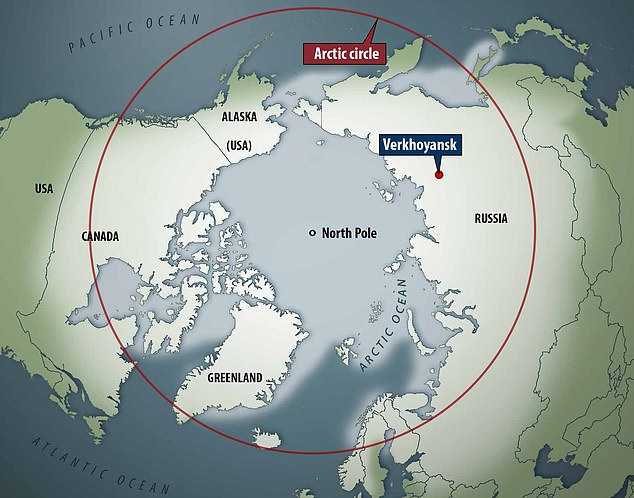
The Russian town of Verkhoyansk in Siberia and north of the Arctic Circle registered a temperature of 100.4 degrees F, the highest temperature ever recorded in the Arctic Circle. According to Vox:
“The town of Verkhoyansk is one of the coldest towns on Earth — temperatures dropped to nearly 60 degrees below zero there this past November — and the average June high temperature is 68 degrees.
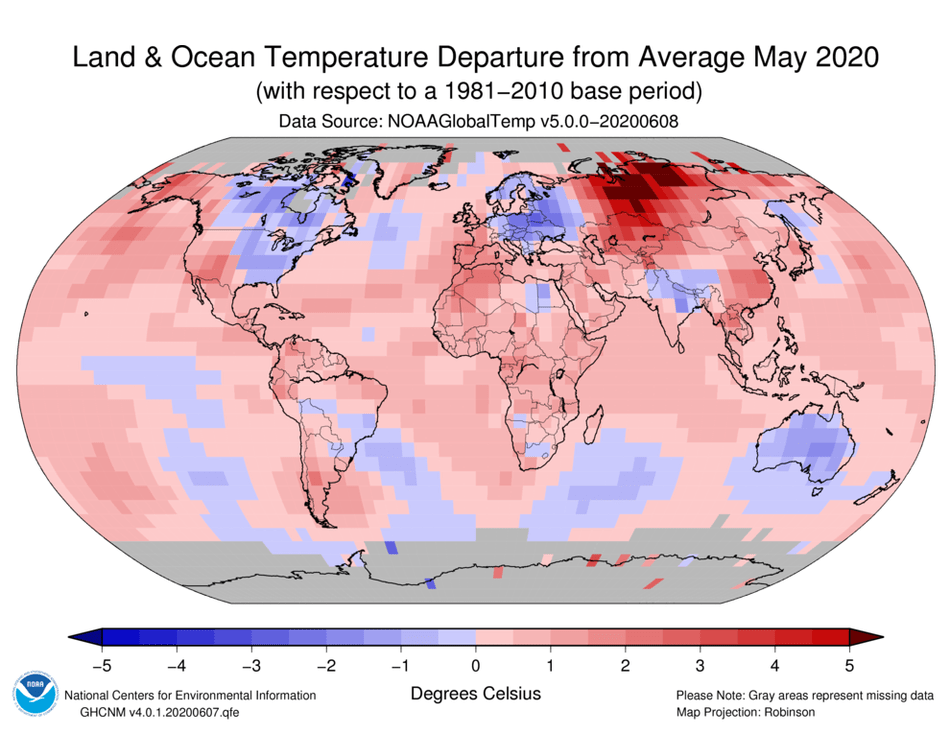
The temperature anomaly represents a trend in the Arctic which is linked to climate change. The article quotes a climate scientist on the significance of the temperature:
“Climate scientist Martin Stendel said on Twitter that the temperatures recorded in northwestern Siberia last month would be a 1-in-100,000-year event — if not for climate change.
“Berardelli [CBS News meteorologist and climate specialist Jeff Berardelli] said the average heat across Russia between January and May actually matches what current models project to be normal for the region in 2100, if carbon emissions continue.
“’Due to heat trapping greenhouse gases that result from the burning of fossil fuels and feedback loops, the Arctic is warming at more than two times the average rate of the globe,’ he explained in his analysis of the Verkhoyansk reading. ‘This phenomenon is known as Arctic Amplification, which is leading to the decline of sea ice, and in some cases snow cover, due to rapidly warming temperatures.’”
The warming will undoubtedly accelerate the thawing of permafrost which will emit significant amounts of methane, a potent greenhouse gas although one not as long-lived as carbon dioxide. Aviva Jogani writes in The Statesman:
“Permafrost comprises 25 per cent of the land in the Northern Hemisphere. It consists of rock, soil, sediments and ice that binds all the components together. While permafrost is defined as ground that has remained frozen for two or more consecutive years, in most areas permafrost has been frozen for thousands of years.
“Susan Natalie, an associate scientist at WHRC, found that permafrost holds an estimated 1,500 billion tonnes of carbon. This is almost double the carbon that is currently in the atmosphere. Apart from carbon, permafrost also stores large amounts of methane. When permafrost thaws upon heating up of the region, it releases vast amounts of this carbon and methane back into the atmosphere.
“In other words, rising temperatures result in permafrost – that is primarily a storage room for carbon and methane – becoming the cause of these gases being emitted back into the atmosphere. Thawing of permafrost is a reality. If it persists, it could result in pervasive global warming. Some scientists find it difficult to determine the relative proportion of carbon emission that might result from permafrost thawing because such a phenomenon has never occurred in human history.
“Studies conducted by Nature Climate Change estimate that carbon loss from permafrost regions could increase by 41 per cent if greenhouse gas emissions by humans continue at their current pace. Another study conducted by WHRC in 2017 estimates that if global temperatures rise by 1.5°C, thawing of permafrost could release 68 to 508 gigatons of carbon. Needless to say, these figures indicate catastrophic impacts on climate change from melting of permafrost.”
Libya has been in a constant state of conflict since the overthrow of Muammar Gaddafi in 2011. The country has a number of different factions, but there are two large contending powers in Libya: the UN backed Government of National Accord (GNA) based in Tripoli and a rebel group led by Khalifa Haftar known as the Libyan National Army (LNA) based in the eastern city of Benghazi. For the last 14 months, Haftar, backed by the United Arab Emirates (UAE), France, Russia and Egypt, has led a campaign to take the city of Tripoli. But in the last few days, the GNA, backed by Turkey, has launched a counterattack that has re-established its control over western Libya.
The US had backed Hafter in 2019, but changed its position after the intervention of Turkey. According to AlJazeera:
“Last week, Turkish President Recep Tayyip Erdogan announced ‘some agreements’ had been reached with US President Donald Trump, which could usher a ‘new era between the US and Turkey regarding the [Libya] process’.
“US policy has seen a significant shift from April 2019 when Trump telephoned Haftar and expressed encouragement for his military operation to seize Tripoli.”
“‘I think we can expect to see a greater diminishing of any US hope that Haftar can be a unifying figure for the country, or obviously achieve victory,’ Wehrey (Frederic Wehrey, a senior fellow at the Carnegie Endowment for International Peace) said.”
Interestingly, Turkey and Russia are opposed in Libya along the same lines of their opposing positions in Syria. Russia is looking to expand its influence in the Middle East after it successfully support President Assad in Syria. Russia is also interested in the oil fields which are largely in the eastern part of Libya. Turkey is also interested in establishing a sphere of influence in the Mediterranean, reminiscent of the rule of the Ottoman Empire. There are also other powers interested in assuring that their interests in the region are well protected. All these outside powers are making the situation in Libya even more unstable.
Even proposals for ending the violence have been undermined by outside powers. Egypt brokered what is called the Cairo Declaration with Haftar on 6 June which suggested that the negotiations between the GNA and the LNA should be direct. But an alternative approach, using the UN as a mediator, has been endorsed by several states who agreed upon a multilateral framework last January in what is known as the Berlin Conference. The US finds itself now working with Turkey and its Islamist agenda against the Russians. But the shift in US policy suggests that the Libyan policy is still being actively debated and that there is no set policy at this time.
“Russian towns in the Arctic circle have recorded extraordinary temperatures, with Nizhnyaya Pesha hitting 30C on 9 June and Khatanga, which usually has daytime temperatures of around 0C at this time of year, hitting 25C on 22 May. The previous record was 12C.
“In May, surface temperatures in parts of Siberia were up to 10C above average, according to the EU’s Copernicus Climate Change Service (C3S). Martin Stendel, of the Danish Meteorological Institute, said the abnormal May temperatures seen in north-west Siberia would be likely to happen just once in 100,000 years without human-caused global heating.
“Freja Vamborg, a senior scientist at C3S, said: ‘It is undoubtedly an alarming sign, but not only May was unusually warm in Siberia. The whole of winter and spring had repeated periods of higher-than-average surface air temperatures.”
We tend to think of climate change as something that will happen in the future, but the article notes how some of the effects of the warmer temperatures are immediately obvious:
“Thawing permafrost was at least partly to blame for a spill of diesel fuel in Siberia this month that led Putin to declare a state of emergency. The supports of the storage tank suddenly sank, according to its operators; green groups said ageing and poorly maintained infrastructure was also to blame.
Wildfires have raged across hundreds of thousands of hectares of Siberia’s forests. Farmers often light fires in the spring to clear vegetation, and a combination of high temperatures and strong winds has caused some fires to burn out of control.
“Swarms of the Siberian silk moth, whose larvae eat at conifer trees, have grown rapidly in the rising temperatures. ‘In all my long career, I’ve never seen moths so huge and growing so quickly,’ Vladimir Soldatov, a moth expert, told AFP.“
The Reuters Institute and the University of Oxford have conducted a poll in 40 countries on how seriously people are taking the problem of climate change. They found that: “Climate change really matters to most people. On average, across all markets, around 69% of respondents stated that they consider climate change to be an extremely or very serious problem. Less than one in ten (9%) of our respondents does not see climate change as serious while around one in five (19%) said they were somewhat concerned. There is some variation across countries. Around 90% of respondents in Chile, Kenya, and South Africa view climate change as very or extremely serious. Chile and some countries in Africa have historically shown high levels of concern (Pew 2015), and the high figure for Chile could also have been related to its first internal population displacements last year as a result of a ten-year drought.2 In Africa too, many countries are already severely affected by the consequences of climate change.3 However, in Sweden, Norway, and the Netherlands, only around half (or less) think that climate change is a severe problem.”
The countries that have the largest percentage of people who do not believe that climate change is a serious problem is revealing:
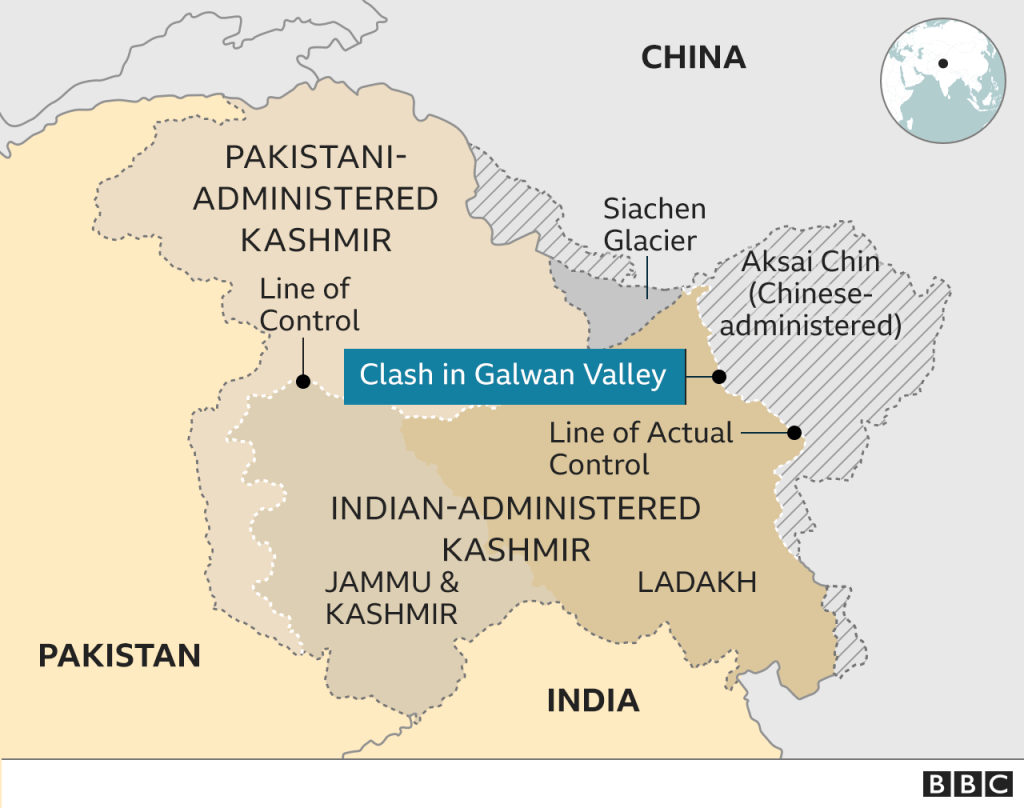
The tension between India and China in the disputed Galwan Valley region has escalated from rock-throwing to (perhaps–it is not clear at this point) an exchange of fire. The India government is reporting that 20 of its soldiers were killed on Tuesday night. The Indian media claims that there were 43 Chinese casualties, but that claim cannot be independently verified. Given the inhospitable conditions in the Valley and the tight control that both sides exercise there, it is unlikely that there will be any independent press coverage of what is actually going on. The two states have not agreed on an actual border in the Valley but this is the first time shots have been exchanged in the Valley for 45 years. The nub of the probelm is control over Pangong Tso, a lake that has a number of land “fingers” that intrude into the water–the dispute is which of these “fingers” demarcates Indian or Chinese territory. The two states did fight a war in Ladakh in 1962 and the Indians suffered a humiliating defeat.
The recent clashes are due to increased Indian building along the line of control. The Chinese have enjoyed superior military infrastructure in the area and the Indians are trying to match Chinese capabilities by building roads and airfields. The two states are negotiating to resolve their differences and I suspect that neither side wants to see the fighting escalate. Both states are dealing with significant COVID-19 issues and can scarcely want to divert attention from that immediate problem. But both sides are led by governments that have stoked nationalist feelings within their populations, and those passions might be difficult to control.
The Gallup Poll has found that the number of Americans who feel proud of their country has declined to the lowest point in the two decades that Gallup has asked the question. The finding is intriguing since it also seems as if there are many in the US who support President Trump’s policy of “America First”. But the beginning of the decline predates Trump’s election. I hard to determine what is exactly responsible for the decline. Perhaps it is American fatigue of its role in world affairs. Or perhaps it stems from a seeming inability to address long-term problems such as the issue of race or the slow degradation of the nation’s infrastructure. Or it could be grwoing unease over the steady increase of inequality in the US. No matter what the cause, it is an unusual trend in American history and one that needs to be addressed if the legitimacy of the US state is to be sustained. It is unsettling to see that among Americans aged 18-29, only 20% are “extremely proud”.