“To the extent the Trump administration is condoning, turning a blind eye toward, or even colluding with Israeli attacks on Iran, this is bad news for U.S. interests. U.S. interests are different from those of Israel, and even more different from those of the current Benjamin Netanyahu-led government.
“That government has an interest in perpetuating high tension with Iran to keep Iran as a bête noire blamable for all the ills of the Middle East, to preclude any rapprochement between Washington and Tehran, to promote Israeli relations with the Gulf Arab states, and to distract attention from issues that bring international scrutiny and criticism on Israel. At the moment, Netanyahu’s incentives in this regard are stronger than ever, which may help to explain the timing of the recent wave of attacks. The distraction value of stoking the conflict with Iran has increased as Netanyahu contemplates formal annexation of parts of the West Bank and the international condemnation that will come with it.
“Netanyahu also, like the Iranians, is aware of the U.S. electoral calendar and American opinion polls. He may see the next few months as an optimum and limited time for stirring the regional pot even more than Israel has in the past, while his friend Donald Trump is still in power. To the extent the stirring helps his friend’s re-election chances, so much the better from his point of view.
“Netanyahu is unlikely to be worrying about escalation into a bigger war, which would serve his purposes even more dramatically. Goading Iran into retaliating in a way that would spark such a war may have been one of the objectives of the recent attacks. And it would not be Netanyahu’s job to count the ensuing American casualties. “
It is unlikely that US President Trump is aware of the divergent interests of Israel and the US. But it also seems clear that both Netanyahu and Trump are motivated more by personal, rather than national interests. The challenges to Iran are continuing: the press is reporting that Israeli or US jets harassed an Iranian passenger plane over Syria today. Over the last few months, Iran has significantly increased its contacts with both Russia and China. And Iran is far closer to building a nuclear weapon than it was when the Iranian nuclear agreement was being observed. US policy toward Iran has been nothing short of a disaster.
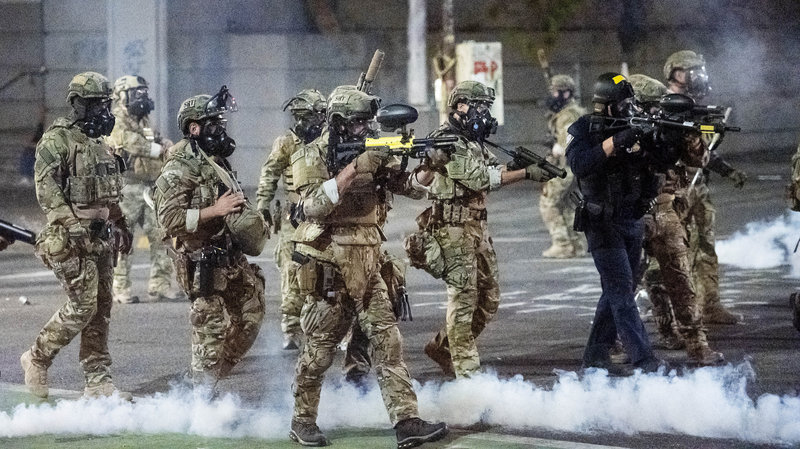
Like many others, I have been deeply disturbed by the deployment of security officials from the Department of Homeland Security dressed in camouflage, with no identifying insignia other than the simple word “police”, driving unmarked rental cars, and arresting people in Portland, Oregon. These individuals are dressed to look like combat troops, designed to intimidate protesters. The protests in Portland have been going on for almost two months and are focused on the Multnomah County Justice Center which serves as the Portland Police Bureau center.
As is the case with most protests, there is no central organizing group directing the protesters activities. The absence of such a group means that the protests have been relatively unorganized and there is no single spokesperson who can speak for the thousands of protesters. The protest narrative is therefore fragmented and partial. There is no question, however, how the Federal Government views the protests and US President Trump labels the protesters as “anarchists” who hate America. Free lance journalists are among the few sources of information that does not come from official sources.
Robert Evans, writing in his blog, has constructed a meticulous narrative of what has happened in Portland, poking holes in the official narrative that conjures up the specter of mass violence. It is a long post, with many video disturbing video excerpts of police misbehavior. But the conclusion is that the protesters have unquestionably defaced the Federal building and have hurled firecrackers and bottles at the security forces. But there is little evidence that the protests have become a major threat to life in Portland.
The Federal actions are dangerous and counterproductive. James Comey, the former Director of the FBI, writes in The Washington Post:
“With some protesters itching for street confrontations with officers in full tactical gear, federal officials are giving a small group of violent people what they want. And they are giving the citizens of Portland — and the rest of us, no matter our politics — what we don’t want: the specter of unconstrained and anonymous force from a central government authority. It has been the stuff of American nightmares since 1776.
“Fairly or unfairly, visions of Department of Homeland Security officers in camo without apparent identifying insignia dragging people into unmarked vans are now seared into the collective memory. Federal law enforcement, like all parts of the justice system, depends upon the faith and confidence of the American people, a credibility now being spent, recklessly, by the Trump administration. And the Department of Homeland Security, a key element of this administration’s chaotic and often immoral immigration enforcement, had precious little credibility left to spend in the first place. Thanks to Portland, its cupboard is now empty.
“And even if it weren’t behavior inconsistent with American values and self-defeating for the agencies involved, it is also just plain dumb to give protesters another sinister embodiment of the feds to rail against.”
Mr. Trump has indicated that he will be sending additional Federal forces to other cities, including Chicago which has experienced a dramatic increase in gun-related violence. These deployments will only fuel greater resentment, and it is interesting that the right-wing supporters of Mr. Trump fail to see the danger of Federal overreach. The scenes and actions of the Federal forces in Portland augurs ill for the future of democracy in the US. Militarizing local security is a step toward a totalitarian state.
Federal agents use crowd control munitions to disperse Black Lives Matter protesters at the Mark O. Hatfield United States Courthouse in Portland, Ore. on July 20, 2020. Officers used teargas and projectiles to move the crowd after some protesters tore down a fence fronting the courthouse. (AP Photo/Noah Berger)
“In the early 2000s, Israeli spy chiefs hatched a plan to assassinate Iranian nuclear scientists, a campaign Jerusalem has never formally acknowledged. In 2012, a top official at Natanz — Mostafa Ahmadi Roshan — was killed in a mysterious explosion. His death followed two other suspected killings over the previous two years.
“But that wasn’t all: In 2009, Israel joined the US in using a cyber weapon, known as Stuxnet, to destroy about 1,000 of Iran’s 6,000 centrifuges.
“Why would Israel resort to such bold methods? Simply put, officials in Jerusalem worry Iran could more credibly threaten Israel’s existence if it had a nuclear weapon. There’s real justification for that concern: Just last year, for example, a top Iranian general told local reporters, ‘Our strategy is to erase Israel from the global political map.’”
Iran has slowly been shedding the constraints of the nuclear agreement that US President Trump abrogated two years ago, and these attacks will certainly slow down the nuclear program. But the attacks also confirm that developing a nuclear weapon may be the only way for Iran to deter a more open attack on Iran by either Israel or the US–lessons learned from Saddam Hussein of Iraq and Muammar Gaddaffi of Libya. However, Iran is greatly suffering from the economic turmoil unleashed by the US sanctions as well as by the COVID-19 pandemic which has taken hold in Iran. I sincerely doubt that Iran wishes to be involved in any armed confrontation with either the US or Israel.
There are, however, limits to the insults to sovereignty the attacks pose. Prime Minister Netanyahu wishes Iran to react so that Israel and the US would have a legitimate casus belli. US President Trump was a willing ally to forcing a confrontation, and his recent slide in the polls is a genuine cause for concern. It is unlikely that a President Biden would be so willing to provoke Iran. We can expect these attacks on Iran to escalate as the US election comes nearer.
The New York Times is reporting that the US and Israel have decided upon low-level attacks on the Iranian nuclear infrastructure as a way to slow down a possible path toward nuclear weapons capability. There have been a number of attacks on such facilities and the level of sophistication of these attacks seem far beyond the capabilities of a domestic opposition group. The possibility of attacks by either Israel or the US raises problems for any Iranian response. So far, the Iranians have been quite restrained in the face of similar attacks, focusing on missile attacks against US forces in Iraq. But the safest course of action by Iran would be to wait for the results of the US election in November. If President Trump is not re-elected, the US stance may soften slightly which would further weaken the Israeli position given the vulnerabilities of Prime Minister Netanyahu. But there is a limit to the degree of damage the Iranians may be willing to suffer. Borzou Daragahi assesses the conundrum for Iran:
“So far, the Iranians appear to be biding their time. In addition to the November elections, Iran is nervously awaiting the October expiration of a decade-long United Nations arms embargo. Washington is attempting desperately to get the rest of the Security Council to extend the ban while Iran is trying to be on its best behavior.
“’Staying patient is what we’ve been saying to the Iranians for years,’ said the Western diplomat. ‘They could have chosen to react in various ways. They have been pretty calm and restrained. My gut tells me they don’t want to be sucked into anything in the run-up to September and October.’
“While losing the Natanz facility, which was only made operational in 2018, was a loss, the Iranians will likely choose to hold off on any response for now. Even the perpetrators of the alleged bombing appear to have refrained from taking credit in a likely attempt to discourage reprisal. If a response comes, it will likely come after the elections—perhaps, in the weeks before inauguration day.”
“’They need first of all to make up their minds [on] what caused this,’ the former Israeli Defense Force military intelligence chief General Yossi Kuperwasser said in an interview. ‘They would probably rather wait until Trump is over to respond. The major goal they have in their mind is to see Trump disappear. Natanz is one of the problems out of many Iran has to face, the main problem is the ‘maximum pressure’ campaign from the Americans. It causes them much more problems.'”
Let’s hope that there is no major escalation in this particular crisis.
I won’t be posting this coming week. I am off to see my beautiful granddaughters. I will return to posting next Saturday.
Jeremy A. Greene and Dora Vargha have written an essay for the Boston Review entitled “How Epidemics End“. They make an important distinction between the biological and the social roots of an epidemic. The biological roots can ultimately be identified through scientific investigation and then the question is whether there is sufficient expertise to disarm the biological agent (bacteria or virus). The social roots identify the ability and willingness of the social, political, and economic system to respond to the biological threat.
In both cases, the authors suggest that there is never a clear end to an epidemic. We tend to think of a vaccine as the silver bullet to a pandemic, but history suggests otherwise. The authors use polio vaccines as an example. The first vaccine, developed by Jonas Salk, was an important, but not conclusive, response to polio. The second vaccine, developed by Sabin, was much more effective, but its adoption was sporadic at the beginning:
“The development of the polio vaccine is relatively well known, usually told as a story of an American tragedy and triumph. Yet while polio epidemics that swept the globe in the postwar decades did not respect national borders or the Iron Curtain, the Cold War provided context for both collaboration and antagonism. Only a few years after the licensing of Jonas Salk’s inactivated vaccine in the United States, his technique became widely used across the world, although its efficacy outside of the United States was questioned. The second, live oral vaccine developed by Albert Sabin, however, involved extensive collaboration in with Eastern European and Soviet colleagues. As the success of the Soviet polio vaccine trials marked a rare landmark of Cold War cooperation, Basil O’Connor, president of the March of Dimes movement, speaking at the Fifth International Poliomyelitis Conference in 1960, proclaimed that ‘in search for the truth that frees man from disease, there is no cold war.’
“Yet the differential uptake of this vaccine retraced the divisions of Cold War geography. The Soviet Union, Hungary, and Czechoslovakia were the first countries in the world to begin nationwide immunization with the Sabin vaccine, soon followed by Cuba, the first country in the Western Hemisphere to eliminate the disease. By the time the Sabin vaccine was licensed in the United States in 1963, much of Eastern Europe had done away with epidemics and was largely polio-free. The successful ending of this epidemic within the communist world was immediately held up as proof of the superiority of their political system.
“Western experts who trusted the Soviet vaccine trials, including the Yale virologist and WHO envoy Dorothy Horstmann, nonetheless emphasized that their results were possible because of the military-like organization of the Soviet health care system. Yet these enduring concerns that authoritarianism itself was the key tool for ending epidemics—a concern reflected in current debates over China’s heavy-handed interventions in Wuhan this year—can also be overstated. The Cold War East was united not only by authoritarianism and heavy hierarchies in state organization and society, but also by a powerful shared belief in the integration of paternal state, biomedical research, and socialized medicine. Epidemic management in these countries combined an emphasis on prevention, easily mobilized health workers, top-down organization of vaccinations, and a rhetoric of solidarity, all resting on a health care system that aimed at access to all citizens.”
At this point in the COVID-19 pandemic, these lessons are clear. There is a wide discrepancy among states in effective responses. The most dramatic evidence of the social basis of the pandemic will become very obvious when a vaccine is developed: Which states will have access to the vaccine? Who will profit from the vaccine? How will the vaccine be distributed? The answers to these questions will highlight the power dynamics of the pandemic.
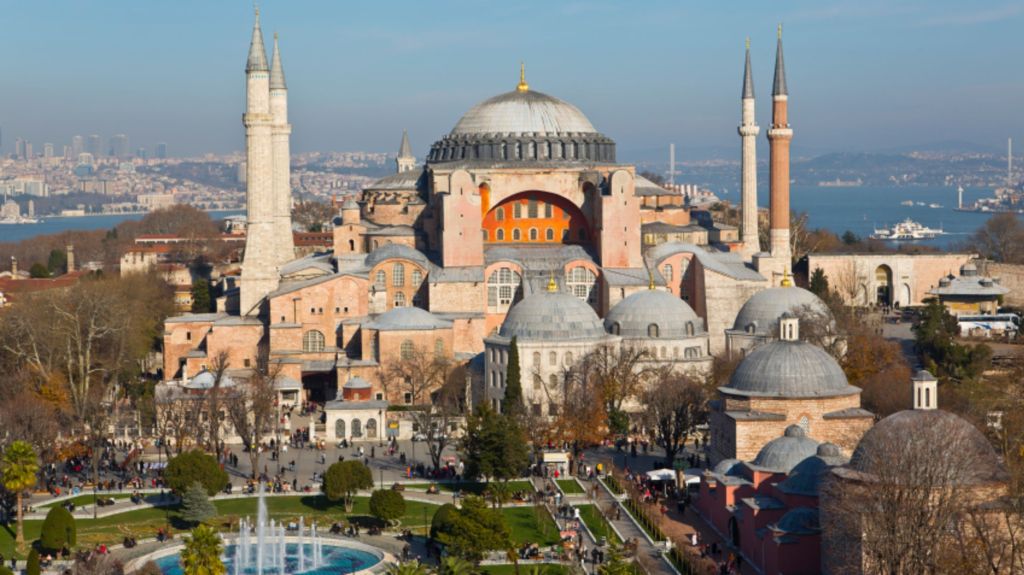
Turkish President Erdogan has signed a decree converting Hagia Sophia back to a mosque from its current status as a museum. Hagia Sophia was built in the 6th century by the leader of the Byzantine Empire, Justinian I. It is widely regarded as a architectural triumph and is one of the world’s great monuments. It was converted to a mosque after the Turkish capture of Constantinople by Mehmet II in 1453 (and the city’s name was changed to its current name, Istanbul). Mehmet II closed the city to European traders (mostly Venetian and Genoese) which ended the highly lucrative Silk Road trade. That closure stimulated the Europeans to find an alternative route to Asia–cue in Columbus. In 1934, Ataturk, who had a clear vision of Turkey as a secular state, converted the mosque into a museum.
The decision cements the Islamist turn of the Erdogan government. We will have to see how the Turks respond. There is no doubt that Putin will be quite angry since he regards the Eastern Orthodox church to be an important part of his right to rule. We’ll see if the decision has any effect on the Russia-Turkish standoff in Syria.
On 1 July, the government of Israel self-declared the authority to annex substantial parts of the Occupied West Bank. Most governments and international law do not recognize that right. Since the West Bank was occupied by Israel in the 1967 war, the world determined that the region was only occupied because the UN Charter, which Israel signed, no longer recognizes a right of “conquest”. Since 1967, Israel has slowly exercised sovereignty over some of those Occupied Territories such as the Golan Heights (taken from Syria) and East Jerusalem (taken from Jordan). And there are about 400,000 Israeli citizens living in settlements in the West Bank (also taken from Jordan in the 1967 war).
Prime Minister Netanyahu has pushed hard for the annexation, but plans have been delayed because of Netanyahu’s legal troubles as well as the outbreak of the COVID-19 pandemic in Israel. Most of the European states are opposed to the annexation, largely because it vitiates the possibility of a two-state solution, the preferred course of action for most of the European governments. The US has indicated that it does not yet favor outright annexation because it is waiting to see a resumption of the Israeli-Palestinian negotiations. The US position is disingenuous because there is no possibility that the negotiations will resume nor will the Trump Administration oppose an outright Israeli annexation.
We do not know how the annexation will proceed–Israel has not made its plans clear. Jonathan Kuttab has written a speculative, but well-reasoned, essay on some possible implications of the Israeli annexation, but the map below clearly indicates that a viable Palestinian state is impossible after annexation. Beyond that matter are other serious issues such as the status of Palestinians living in annexed areas. Prime Minister Netanyahu has already declared that those Palestinians will not be offered Israeli citizenship. They will, nonetheless, be ruled by Israeli law.
That outcome is illegitimate, but also unsustainable. Political, economic, and social control over a people who have no equal voice in their governance is wrong and cannot be supported. The proposed annexation will undermine Israeli democracy and other states, including the US, should question whether they can continue to support the Israeli government.
Map showing region of the Jordan Valley which Israeli Prime Minister Benjamin Netanyahu has vowed to annex, if he wins the September elections, along with the Israeli settlements in the West Bank.
Iran has suffered three explosions at facilities associated with its nuclear program over the last few weeks. According to the BBC:
Since 26 June alone, there have been several such incidents:
26 June: Blast at a liquid fuel production facility for ballistic missiles in Khojir, close to Parchin, near Tehran; fire at power plant in Shiraz, causing a blackout
30 June: Explosion at a medical clinic in Tehran, 19 people killed
2 July: Blast and fire at Natanz nuclear site
3 July: Large fire in Shiraz
4 July: Explosion and fire in power plant in Ahwaz; chlorine gas leak at Karoun petrochemical plant in Mahshahr
The most recent explosion was at the facility in Natanz, at which advanced centrifuges were produced. There has been no official explanation for the explosions, but a previously unknown group, calling itself the Homeland Cheetahs, has taken credit. The group claims to be comprised of dissident members of the Iranian military and defense establishment, and they provided the BBC with photographs buttressing their claim. It is hard, however, not to suspect that the US and Israel were involved in some way. The US launched a cyberattack against the facility at Natanz in 2007 with a computer virus called Stuxnet. And the Israeli statement was ambiguous. The Guardian describes the response:
“Israeli cabinet officials spoke publicly for the first time on Sunday about the rumours. Neither the defence minister, Benny Gantz, nor the foreign minister, Gabi Ashkenazi, confirmed any Israeli role, including in the latest fire at a power plant in the south-west of the country on Saturday. But their careful statements did little to douse suspicions that at least some incidents were not accidents.
“’Not every incident that happens in Iran is necessarily connected to us,’ Gantz told Israel Radio on Sunday morning. ‘All those systems are complex, they have very high safety constraints and I’m not sure [the Iranians] always know how to maintain them.’
“Asked about Natanz, Ashkenazi told a forum in Jerusalem that Israel had a long-term policy not to allow Iran to obtain nuclear weapons, adding: ‘It is better not to mention our actions in Iran.’”
Iran’s nuclear program has been set back for many months because of the explosions. The centrifuges being produced at Natanz were highly advanced, giving the Iranians the capability to produced highly enriched uranium quickly. The Natanz facility was not active because of the nuclear agreement reached under the Obama Administration. After President Trump pulled out of the agreement, the Iranians, after waiting a year to see if the agreement could be restored, announced that it would resume uranium enrichment. I have no doubt that the Iranians will respond after they assess the damage and the likely agents responsible for the explosions. That that response will be is unknown, but it is likely to be quite dramatic.
Satellite photo of the damage to the Natanz facility
Carl Bernstein has written a fairly long and well-documented article for CNN on US President Trump’s telephone conversations with foreign leaders. The article is highly disturbing and is based on interviews with “former secretaries of state and defense, two national security advisers and his longest-serving chief of staff”. Bernstein concludes that “the President himself posed a danger to the national security of the United States” in the eyes of these former advisers. According to Bernstein:
“The calls caused former top Trump deputies — including national security advisers H.R. McMaster and John Bolton, Defense Secretary James Mattis, Secretary of State Rex Tillerson, and White House chief of staff John Kelly, as well as intelligence officials — to conclude that the President was often “delusional,” as two sources put it, in his dealings with foreign leaders. The sources said there was little evidence that the President became more skillful or competent in his telephone conversations with most heads of state over time. Rather, he continued to believe that he could either charm, jawbone or bully almost any foreign leader into capitulating to his will, and often pursued goals more attuned to his own agenda than what many of his senior advisers considered the national interest.”
Bernstein continues:
“Two sources compared many of the President’s conversations with foreign leaders to Trump’s recent press “briefings” on the coronavirus pandemic: free form, fact-deficient stream-of-consciousness ramblings, full of fantasy and off-the-wall pronouncements based on his intuitions, guesswork, the opinions of Fox News TV hosts and social media misinformation.”
There are also many examples of how deferential Mr. Trump is with Russian President Putin and Turkish President Erdogan. The calls with Erdogan were especially disturbing:
“Two sources described the President as woefully uninformed about the history of the Syrian conflict and the Middle East generally, and said he was often caught off guard, and lacked sufficient knowledge to engage on equal terms in nuanced policy discussion with Erdogan. ‘Erdogan took him to the cleaners,’ said one of the sources.
“The sources said that deleterious US policy decisions on Syria — including the President’s directive to pull US forces out of the country, which then allowed Turkey to attack Kurds who had helped the US fight ISIS and weakened NATO’s role in the conflict — were directly linked to Erdogan’s ability to get his way with Trump on the phone calls.”
After three and a half years as President, it still seems to be the case that Mr. Trump does not fully understand what a President is supposed to do. He remains a reality TV actor.