In the wake of the reports that he disparaged members of the military as “suckers” and “losers”, President Trump used a left-wing argument to defend himself: “I’m not saying the military’s in love with me — the soldiers are, the top people in the Pentagon probably aren’t because they want to do nothing but fight wars so that all of those wonderful companies that make the bombs and make the planes and make everything else stay happy”. The argument, commonly referred to as the “military-industrial complex”, a phrase coined by President Eisenhower in his last message to the American people as President.
The argument is difficult to prove and the Harvard economist, Joseph Schumpeter, made the first systematic case for it. Schumpeter, in his short essay, “Imperialism and Social Classes“, reviews a number of cases in which military action is taken by states not for any specific reasons but in order to satisfy the interests of the military and corporations that produce instruments of war. His argument is complex:
“This new social and political organization was essentially a war machine. It was motivated by warlike instincts and interests. Only in war could it find an outlet and maintain its domestic position. Without continual passages at arms it would necessarily have collapsed. Its external orientation was war, and war alone. Thus war became the normal condition, alone conducive to the well-being o£ the organs of the body social that now existed. To take the field was a matter of course, the reasons for doing so were of subordinate importance. Created by wars that required it, the machine now created the wars it required. (emphasis in original)
“The Committee finds, under the head of sales methods of the munitions companies, that almost without exception, the American munitions companies investigated have at times resorted to such unusual approaches, questionable favors and commissions, and methods of ‘doing the needful’ as to constitute, in effect, a form of bribery of foreign governmental officials or of their close friends in order to secure business.
“The committee realizes that these were field practices by the agents of the companies, and were apparently in many cases part of a level of competition set by foreign companies, and that the heads of the American companies were, in cases, apparently unaware of their continued existence and shared the committee’s distaste and disapprobation of such practices.
“The committee accepts the evidence that the same practices are resorted to by European munitions companies, and that the whole process of selling arms abroad thus, in the words of a Colt agent, has ‘brought into play the most despicable side of human nature; lies, deceit, hypocrisy, greed, and graft occupying a most prominent part in the transactions.’
“The committee finds such practices on the part of any munitions company, domestic or foreign, to be highly unethical, a discredit to American business, and an unavoidable reflection upon those American governmental agencies which have unwittingly aided in the transactions so contaminated.
“The committee finds, further, that not only are such transactions highly unethical, but that they carry within themselves the seeds of disturbance to the peace and stability of those nations in which they take place. In some nations, violent changes of administration might take place immediately upon the revelation of all details of such transactions. Mr. Lammot du Pont stated that the publication of certain du Pont telegrams (not entered in the record) might cause a political repercussion in a certain South American country. At its February 1936 hearings, the committee also suppressed a number of names of agents and the country in which they were operating, in order to avoid such repercussions.
“The committee finds, further, that the intense competition among European and American munitions companies with the attendant bribery of governmental officials tends to create a corrupt officialdom, and thereby weaken the remaining democracies of the world at their head.
“The committee finds, further, that the constant availability of munitions companies with competitive bribes ready in outstretched hands does not create a situation where the officials involved can, in the nature of things, be as much interested in peace and measures to secure peace as they are in increased armaments.
“The committee finds also that there is a very considerable threat to the peace and civic progress of other nations in the success of the munitions makers and of their agents in corrupting the officials of any one nation and thereby selling to that one nation an armament out of proportion to its previous armaments. Whether such extraordinary sales are procured through bribery or through other forms of salesmanship, the effect of such sales is to produce fear, hostility, and greater munitions orders on the p art of neighboring countries, culminating in economic strain and collapse or war.
“The committee elsewhere takes note of the contempt of some of the munitions companies for those governmental departments and officials interested in securing peace, and finds here that continual or even occasional corruption of other governments naturally leads to a belief that all governments, including our own, must be controlled by economic forces entirely.”
Senator Nye (R-ND) was not a left-winger. He was an arch isolationist who would have found great comfort in the slogan “America First”. The Nye Committee was the last time the US Congress ever investigated the links between corporations who supply military equipment and foreign policy. The omission is curious since there are plenty of examples which raise serious questions about the military-industrial complex and decision-making in the US. During the Iraq War of 2003, the Vice-President, Dick Cheney, had been a chief executive of the Halliburton Corporation which provided military services to the US. The current Secretary of Defense, Mark Esper, had previously served as Vice President for Government Relations at the Raytheon Company.
It is also curious that President Trump would make such an accusation, given his very strong defense of arms sales to Saudi Arabia. In October 2018, after the murder of journalist Jamal Khashoggi, New York Magazine ran an article which described Trump’s defense of those sales:
“Last week, Saudi Arabia almost certainly murdered Washington Post columnist Jamal Khashoggi. Asked about the apparent murder last night on Fox News, President Trump expressed the requisite disapproval he musters for events that do not anger him in any visceral way but which he is expected to condemn (‘It would not be a positive. I would not be happy at all’). But when asked if the United States should retaliate by withholding future arms sales to Saudi Arabia, Trump immediately pumped the brakes.
“’Well, I think that would be hurting us,’ he said. ‘We have jobs, we have a lot of things happening in this country. We have a country that’s doing probably better economically than it’s ever done before. Part of that is what we’re doing with our defense systems, and everybody’s wanting ’em, and frankly I think that that would be a very, very tough pill to swallow for our country.’”
Additionally, Mr. Trump has made his defense budgets a point of pride. In a speech to the graduating cadets at West Point, Mr. Trump made this statement:
“To ensure you have the very best equipment and technology available, my administration has embarked on a colossal rebuilding of the American Armed Forces, a record like no other. After years of devastating budget cuts and a military that was totally depleted from these endless wars, we have invested over 2 trillion — trillion; that’s with a “T” — dollars in the most powerful fighting force, by far, on the planet Earth. We are building new ships, bombers, jet fighters, and helicopters by the hundreds; new tanks, military satellites, rockets, and missiles; even a hypersonic missile that goes 17 times faster than the fastest missile currently available in the world and can hit a target 1,000 miles away within 14 inches from center point.”
I, for one, believe the reports about Mr. Trump’s comments about the military. It is certainly possible for the US to be spending almost $800 billion a year to enrich corporations, not to support soldiers in the field.
Bill McKibben has written as review of Our Final Warning: Six Degrees of Climate Emergency by Mark Lynas for the New York Review of Books. The review is devastatingly grim. Even though the world agreed to try to limit temperature increases to 1.5 degrees Celsius in the Paris Accords, it is clear that that objective will not be reached. Many states have not taken necessary steps and some, like the US, have pulled out of the agreement completely. McKibben quotes Lynas:
“If we stay on the current business-as-usual trajectory, we could see two degrees as soon as the early 2030s, three degrees around mid-century, and four degrees by 2075 or so. If we’re unlucky with positive feedbacks…from thawing permafrost in the Arctic or collapsing tropical rainforests, then we could be in for five or even six degrees by century’s end.”
McKibben continues:
“As we head past two degrees and into the realm of three, ‘we will stress our civilization towards the point of collapse.’ A three-degree rise in temperature takes us to a level of global heat no human has ever experienced—you have to wind time back at least to the Pleistocene, three million years ago, before the Ice Ages. In his last volume, Lynas said scientists thought the onset of the collapse of the West Antarctic ice sheet would take place at four degrees; now, as we’ve seen above, it seems a deadly concern at two, and a certainty at three. Higher sea levels mean that storm surges like those that marked Superstorm Sandy in 2012 could be expected, on average, three times a year. The record-setting heatwaves of 2019 ‘will be considered an unusually cool summer in the three-degree world’; over a billion people would live in zones of the planet ‘where it becomes impossible to safely work outside artificially cooled environments, even in the shade.’ The Amazon dies back, permafrost collapses. Change feeds on itself: at three degrees the albedo, or reflectivity, of the planet is grossly altered, with white ice that bounces sunshine back out to space replaced by blue ocean or brown land that absorbs those rays, amplifying the process.
“And then comes four degrees:
“Humans as a species are not facing extinction—not yet anyway. But advanced industrial civilisation, with its constantly increasing levels of material consumption, energy use and living standards—the system that we call modernity…is tottering.
“In places like Texas, Oklahoma, Missouri, and Arkansas, peak temperatures each year will be hotter than the 120s one now finds in Death Valley, and three quarters of the globe’s population will be ‘exposed to deadly heat more than 20 days per year.’ In New York, the number will be fifty days; in Jakarta, 365. A ‘belt of uninhabitability’ will run through the Middle East, most of India, Pakistan, Bangladesh, and eastern China; expanding deserts will consume whole countries ‘from Iraq to Botswana.’
“Depending on the study, the risk of ‘very large fires’ in the western US rises between 100 and 600 percent; the risk of flooding in India rises twenty-fold. Right now the risk that the biggest grain-growing regions will have simultaneous crop failures due to drought is ‘virtually zero,’ but at four degrees ‘this probability rises to 86%.’ Vast ‘marine heatwaves’ will scour the oceans: ‘One study projects that in a four-degree world sea temperatures will be above the thermal tolerance threshold of 100% of species in many tropical marine ecoregions.’ The extinctions on land and sea will certainly be the worst since the end of the Cretaceous, 65 million years ago, when an asteroid helped bring the age of the dinosaurs to an end. ‘The difference,’ Lynas notes, ‘is that this time the ‘meteor’ was visible decades in advance, but we simply turned away as it loomed ever larger in the sky.’
“I’m not going to bother much with Lynas’s descriptions of what happens at five degrees or six. It’s not that they’re not plausible—they are, especially if humanity never gets its act together and shifts course. It’s that they’re pornographic. If we get anywhere near these levels, the living will truly envy the dead….”
The wildfires in California today are just one example of how climate change is already occurring. It will also affect our supplies of water and large parts of the Arctic north. Future generations will wonder why the world remained so passive in the face of this crisis.
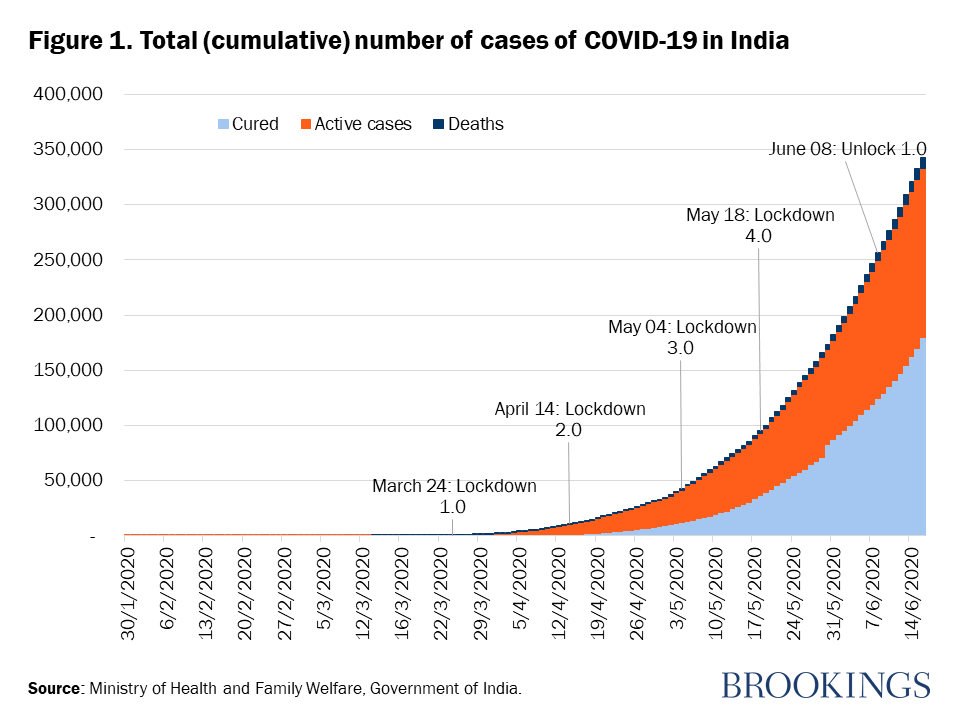
India has been very hard-hit by the COVID-19 pandemic and will likely become the country with the second largest number of COVID cases (the US remains the most infected country with 6 million cases). It will overtake Brazil for the second slot. The pandemic is derailing India’s aspirations to become economically more powerful and frustrate its desire to lift millions out of poverty. The New York Times reports:
“Not so long ago, India’s future looked entirely different. It boasted a sizzling economy that was lifting millions out of poverty, building modern megacities and amassing serious geopolitical firepower. It aimed to give its people a middle-class lifestyle, update its woefully vintage military and become a regional political and economic superpower that could someday rival China, Asia’s biggest success story.
“But the economic devastation in Surat and across the country is imperiling many of India’s aspirations. The Indian economy has shrunk faster than any other major nation’s. As many as 200 million people could slip back into poverty, according to some estimates. Many of its normally vibrant streets are empty, with people too frightened of the outbreak to venture far.”
It does not appear as if the situation is going to improve anytime quickly. Indeed, according to The Voice of America, India “recorded 90,632 new COVID-19 infections in the previous 24-hour period, setting a world record for a one-day tally of new cases.” The country instituted a very stringent lockdown, but after two months it seems that fewer Indians are observing those regulations. The Irish Times reports:
“In rural Maharashtra, the worst-affected state with 863,062 cases and 25,964 deaths, doctors said measures like wearing masks and washing hands had now largely been abandoned.
“’There is a behavioural fatigue now setting in,’ said Dr SP Kalantri, the director of a hospital in the village of Sevagram.”
Like most other countries, India suffered a very sharp drop in its Gross National Product because of the lockdowns, but it now faces higher inflation (unlike most other countries so far) which is running about 7% a year. So far the health system has been able to cope with the pandemic, but many fear that that situation will change as many more people in rural areas seem to be infected. India was making progress in addressing poverty, but those gains are now threatened.
I posted on 19 August about Turkey’s increasing assertiveness in the Middle East and the Mediterranean. Yaakov Amidror has written on this topic for The National Interest, and his analysis reinforces my views that Turkish President Erdogan is intent on increasing Turkish influence in regional affairs that in many respects mimics the policies of the Ottoman Empire. He writes:
“What motivates Turkey? While the country is recovering relatively well from the coronavirus pandemic, it continues suffering from an ongoing economic crisis. Erdogan appears to feel that his aggressive policies, which are reminiscent of Ottoman behavior, have broad domestic support. He seems to sense the weakness of other powers in the region, especially the EU, and he wants to expand his country’s influence at the expense of others in the Mediterranean—which, without U.S. backing, are left largely defenseless.”
Significantly, Turkish policies seem to be diametrically opposed to Russian interests in Syria, Libya, and in the Eastern Mediterranean. But the Turkish actions have also antagonized two members of NATO, France and Greece, in ways that threaten the alliance itself. Moreover, Erdogan is a supporter of the Muslim Brotherhood, which threatens Egypt which regards the group as a terrorist group. In other words, Turkish policies are disruptive to the interests of many in the region.
The US has strong connections to all these states, but the US has been strangely silent on the possible confrontations. The Brookings Institute has published an article which has taken note of this absence:
“The United States considers this area one of great strategic interest, especially for containing Chinese and Russian interference through regional alignments and allies. The policy objective is to keep the main maritime trade routes — first of all the Suez Canal — safe. In this sense, the goal is to minimize the opportunities for confrontation between the countries of the region, especially with two NATO members involved, Turkey and Greece, and potentially now France.
“The void left by the United States in the political dynamics of the Mediterranean has been filled, to a growing extent, by China and Russia. The two powers are able to maneuver well in the region, taking advantage of the increasing systemic disorder and growing tensions between states. America should act to prevent this.”
The US could easily take the stance on the Eastern Mediterranean that it has taken in the South China Sea: a strict adherence to the international law of the sea. Turkey has been conducting seismic tests for oil in waters that Greece considers within its legal jurisdiction. Other European states have come to Greece’s defense, as noted by CNN:
“‘The Eastern Mediterranean has transformed into a space of tensions,’ French Defense Minister Florence Parly tweeted Wednesday. “The respect of international law should be the rule and not the exception. With our Cypriot, Greek and Italian partners we will start military exercises from today with maritime and air methods.
“The Italian navy said in a statement calling for ‘stronger cooperation and dialogue’ that it would be taking part in an exercise off Cyprus, with the naval units of France, Cyprus and Greece, between August 26-28. The Italian ship involved in that also took part in a four-hour exercise with the Turkish navy on Wednesday.”
The US Geologic Survey has estimated that there are about “1.7 billion barrels of recoverable oil and 122 trillion cubic feet of gas in the Levant Basin section of the Eastern Mediterranean” so there is a lot of interest by many states in those resources. In earlier times, the US would have taken a strong role in trying to mediate these tensions, but there does not appear to be any interest by the US in such a role in this dispute. Without a strong mediating presence, it seems unlikely that these issues can be resolved without conflict.
The Trump Administration has decided not to cooperate with the initiative led by the World Health Organization (WHO) to develop a vaccine against the COVID-19 infection. The Hill reports:
“The United States will not join a global effort led by the World Health Organization (WHO) to develop, manufacture and distribute a vaccine against the coronavirus, the White House said Tuesday.
“The decision represents a gamble by the Trump administration — one that could threaten to leave the country behind if the first viable vaccine candidate is developed by another country.
“Almost every nation in the world is participating in initial talks on the joint COVAX project involving the WHO, the European Union, Germany, Japan and several major nongovernmental organizations.
“The project, announced by the WHO earlier this year, would distribute an eventual vaccine candidate to countries around the world based on the number of high-risk residents in each nation.”
The ostensible reason for the US non-participation is President Trump’s belief that WHO is biased in favor of China. Even if the accusation were true, it really ignores the other 170 countries which will be cooperating with WHO. The real reason for the US decision is the ideology of “America First”. The US wants to be able to charge whatever it wants for the vaccine, a position likely pushed by the private companies who are developing vaccines in the US. Additionally, the US does not want any interference in any decisions about how it will be distributed, likely because the US vaccine will be used as a political tool to reward allies and punish enemies. The crassness of the US position is a disgrace. China’s media outlet, China Times, points out the hypocrisy of the US decision to not cooperate with the rest of the world:
“Li Haidong, a professor at the Institute of International Relations of the China Foreign Affairs University, said the US not participating again reflects its selfishness which is that no other country can gain advantages from it for free, and the country apparently has no intention to share its coronavirus information and vaccine information with others.
“The US’s back-out is in part because the White House does not want to work with the WHO, which President Trump has chastised, for what he characterized as its ‘China-centric’ response to the pandemic, the Washington Post said.
“Judd Deere, a spokesman for the White House, said that “we will not be constrained by multilateral organizations influenced by the corrupt World Health Organization and China.’Li said that such a move is the US’old trick to resist China-linked plans and incite certain other countries to boycott them, which can be described as US-style “political correctness.’
“The current US diplomatic policy is indeed, extreme egocentrism and nationalism. The Trump administration now totally regards vaccine development, which is essentially a key topic close to public health and the safety of human life, as a political weight.
“Who will win the race for a vaccine remains unclear, but the result will influence the US’ health diplomacy policy and its role in the international community, Chinese experts said.
“With the US’ decision to skip over the global vaccine effort, if none of its vaccine candidates are viable, the country would be left behind with no options.”
It is hard to appreciate how quickly the US has lost the capability and will to contribute to a stable world order. The pandemic has revealed that it is apparently willing to let many people die in order to preserve its ability to distance itself from the rest of humanity.
I generally try to avoid direct references to US President Trump and focus instead on specific policies or directives issued by him. But he was interviewed by Laura Ingraham on Fox News and made statements that I regard as quite troubling. Alex Ward writes in Vox:
“On Monday, Trump told Fox News’s Laura Ingraham a wild story he’d heard about a supposed plane full of “thugs” who had traveled together on a commercial flight to an unnamed American city to stage protests during the Republican National Convention. These same thugs, in Trump’s telling, are secretly pulling Biden’s strings from the ‘dark shadows.’
“These are ‘people that you’ve never heard of, people that are in the dark shadows,’ Trump said. ‘They’re people that are on the streets. They’re people that are controlling the streets. We had somebody get on a plane from a certain city this weekend, and in the plane it was almost completely loaded with thugs wearing these dark uniforms, black uniforms with gear and this and that.’
“The president wouldn’t offer any more specifics because he said the whole incident is under investigation — another claim for which there’s no public evidence — but added ‘a lot of people were on the plane to do big damage.’
When a leader starts talking about “dark shadows”, it is probably time to get very worried. Even Ingraham, usually a staunch supporter of Mr. Trump, seemed taken aback by the statement. Snopes provides the context of the statement:
“Trump is picking up on unproven conspiracy theories that began spreading earlier this year during protests for racial justice. One of the first public Facebook posts suggesting a similar conspiracy theory appears to have been made in May when Idaho resident Russell D. Wade wrote on Facebook that a plane was transporting protesters from Seattle to Boise, Idaho.
“’Be ready for attacks downtown and residential areas,’ Wade wrote in a post that has been shared more than 3,500 times. Wade, who lost a bid for local sheriff earlier this year, urged his followers to arm themselves. A social media message sent to Wade on Tuesday was not immediately returned.
“Local police departments from Sioux Falls, South Dakota, to Payette County, Idaho, were forced to knock down similar social media rumors in June that ‘busloads’ of rioters were coming to town. Other social media posts claimed that throngs of ‘antifa,’ a term for leftist militants, were plotting to violently disrupt cities and towns.
“In Michigan, a limousine businessman had to refute online rumors that his buses were purchased by liberal financier George Soros to coordinate protests after Facebook users manipulated images of his white charter buses to show the words ‘Soros Riot Dance Squad’ emblazoned on the sides.
“In Facebook and Twitter posts earlier this summer, Trump also blamed antifa for violence that broke out during racial justice protests. But an Associated Press analysis of court records, employment histories and social media posts for 217 people arrested in Minneapolis and the District of Columbia, cities at the center of the protests earlier this year, found evidence that only a few of those arrested indicated they were involved in left-leaning activities. A few others expressed support for the political right and Trump himself.”
Chris Cillizza for CNN parses the many misleading statements made by the President in the interview. The list of false statements in just 36 minutes is rather stunning. The Times of India expresses the bewilderment that probably represents the views of many people in the world on the upcoming national election. We will see if the Republican Party has any insight into the President’s state of mind.
Several hundred protesters stormed into the German Reichstag building, breaking through a security barrier before they were finally repulsed by police. Many of the protesters were demonstrating against the restrictions imposed upon them to held stem the spread of COVID-19. But many of the protesters were members of the Reichsbürger movement which denies the legitimacy of the modern German state. The movement is difficult to define:
“As matters stand now, Reichsbürger cannot be classified as an organization — not yet. So far, the group is loosely structured with multiple autonomous groups, including “Königreich Deutschland” (The German Kingdom), “Das deutsche Polizeihilfswerk” (The German Police Relieve Agency) or “Reichsbewegung- neue Gemeinschaft von Philosophen” (Reichsmovement – new community of philosophers).
“Because the movement is made up of various splinter groups, it is difficult to assess the actual number of Reichsbürger members. The BfV classified around 18,000 individuals as Reichsbürger in 2018, and recent years have observed increased activity online suggesting that the number of adherents to the Reichsbürger ideology is growing.
“What unites the Reichsbürger is their shared system of belief. A large part of their ideological foundation revolves around the narrative that the Federal Republic of Germany does not exist and is not an actual state. To them, the German Reich did not perish in 1945 and remains the legitimate German authority, while the Federal Republic as an illegitimate creature of foreign occupation and exploitation. They believe that because there has never been an official peace treaty, the occupation continues until this day, with the Federal Republic an instrument of the Allied powers that allows Germans the illusion of independence and democracy. According to the Reichsbürger, Merkel, her cabinet, as well as parliament, the judiciary, and the security agencies are all puppets installed and controlled by foreigners.”
The movement was not taken seriously until 2016 when one of its members killed a German police officer. It represents an extreme version of nationalism, a position which is becoming increasingly common in many countries: Brexit is one such manifestation, as is the BJP in India, and in the Sovereign Citizens Movement in the US. At this time, German authorities estimate that there are about 16,000 members of the Reichsbürger movement, but the numbers seem to be increasing every year.
The retreat into “blood and soil” nationalism in many countries in the world is deeply troubling, although it is in many respects a countermovement to globalization. But these intense nationalist movements usually have a bad end since they tend to be deeply paranoid and exclusive.
One of the many Reichsbürger flags–a chilling image
Congress has been informed by the Office of the Director of National Intelligence that there will no further briefings on foreign election interference in the 2020 national elections. The halt was purportedly due to the fear that there would be unauthorized leaks of classified information by members of Congress. The move comes after William Evanina, the director of the National Counterintelligence and Security Center, briefed Congress that China, Russia, and Iran were taking steps to interfere with the election. According to Evanina, China would like Biden to win because it regards Trump as unreliable, Russia wants Trump to win because he is sympathetic to Russia, and Iran simply wishes to cause chaos in the US.
The idea that Congresspeople are likely to leak information is not far-fetched, but these intelligence reports are mandated by law. The Director of National Intelligence, John Ratcliffe, was a close ally of Mr. Trump when he was in Congress, and he indicated that he would supply written reports that summarize the intelligence findings. But Congressional leaders indicated that they do not wish to lose the opportunity to ask questions in an oral briefing.
One should not take the fear of leaks as a sufficient justification to stop the briefings. Mr. Trump himself has been a prodigious leaker of classified intelligence. Wikipedia has a very nice (and very well sourced) list of those occasions:
“President Donald Trump discussed classified information provided by a U.S. ally regarding a planned Islamic State operation during an Oval Office meeting on May 10, 2017 with the Russian Foreign Minister Sergey Lavrov and the Russian Ambassador Sergey Kislyak, providing sufficient details that could be used by the Russians to deduce the identity of the ally and the manner in which it was collected, according to current and former government officials. The meeting had been closed to the U.S. press, although a photographer from the Russian press contingent was present. The disclosure was first reported in The Washington Post on May 15, 2017. White House staff initially denied the report, but the following day Trump defended the disclosure, stating that he has the “absolute right” to “share” intelligence with Russia….
“In an April 29, 2017, phone call, Trump told Philippines President Rodrigo Duterte that the U.S. had positioned two nuclear submarines off the coast of North Korea. This was during a time when Trump was warning of a possible “major, major conflict” with North Korea. The locations of nuclear submarines are a closely guarded secret, even from the Navy command itself. ‘As a matter of national security, only the captains and crew of the submarines know for sure where they’re located.’
On May 24, 2017, Britain strongly objected to the United States leaking to the press information about the Manchester Arena bombing, including the identity of the attacker and a picture of the bomb, before it had been publicly disclosed, jeopardizing the investigation. British Prime Minister Theresa May issued a public rebuke, and British police said they would stop passing information to U.S. counterparts.
“In July 2017, after a private meeting with Russian president Vladimir Putin at the 2017 G20 Hamburg summit, Trump took the unusual step of confiscating and keeping his interpreter’s notes. This led U.S. intelligence officials to express concern that Trump ‘may have improperly discussed classified intelligence with Russia.’
“On August 30, 2019, Trump tweeted a reportedly classified image of recent damage to Iran‘s Imam Khomeini Spaceport that supposedly occurred as a result of an explosion during testing of a Safir SLV. Multiple concerns were raised regarding the public release of what appeared to be a surveillance photo with exceptionally high resolution, revealing highly classified U.S. surveillance capabilities. Within hours of the tweet, amateur satellite trackers had determined the photograph came from National Reconnaissance Office spy satellite USA-224. Before Trump’s tweet, the only confirmed photographs from a KH-11 satellite was leaked in 1984 by a U.S. Navy analyst who went to prison for espionage. Trump defended the tweet by saying he had ‘the absolute right’ to release the photo.”
The decision to halt the in-person briefings is simply an attempt to prevent the American people from learning about foreign interference in their national elections, largely because Mr. Trump believes that information undermines his legitimacy.
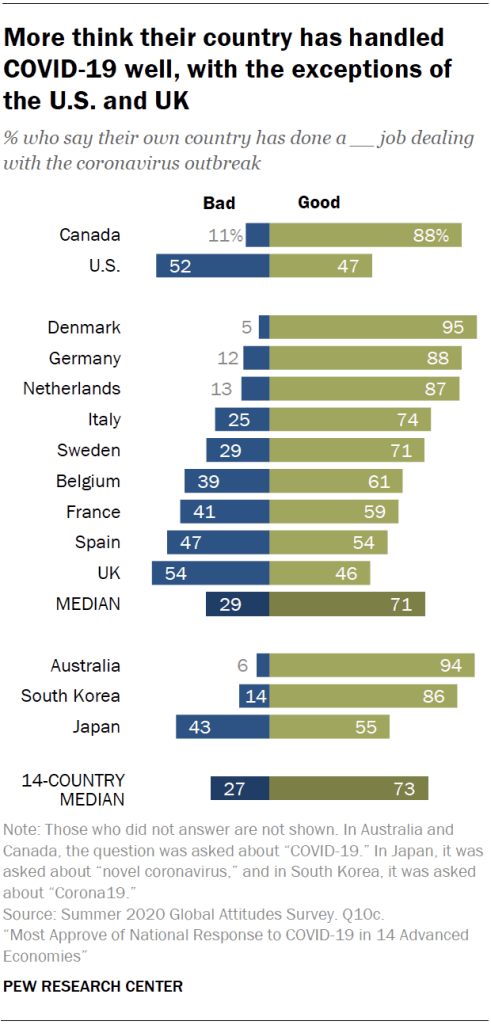
The Pew Research Center has conducted a poll in several countries on how citizens rate their government’s response to the COVID-19 pandemic. The range of results is huge, but not especially surprising. The Center reports:
“Across the 14 countries surveyed, a median of 73% say that their own country has done a good job dealing with the coronavirus outbreak. Just 27% believe their country has handled it poorly. However, there is some variation by country on this assessment.
“About seven-in-ten or more give their nation’s coronavirus response a positive review in Denmark, Australia, Canada, Germany, the Netherlands, South Korea, Italy and Sweden. And more than half in Belgium, France, Japan and Spain share this sentiment.
“In two countries – the United Kingdom and the United States – people are divided in their beliefs when it comes to rating their government’s performance responding to the coronavirus. These two nations also have high levels of political polarization on views of the government’s handling of this crisis. In the U.S., 76% of Republicans and independents who lean to the Republican Party say the government has done a good job, while just a quarter of Democrats and Democratic leaners agree, a 51 percentage point difference. A majority of right-leaning Britons (55%) give a positive rating to their country’s handling of the pandemic, led by Prime Minister Boris Johnson’s Conservative government, but just 26% on the left hold the same opinion.”
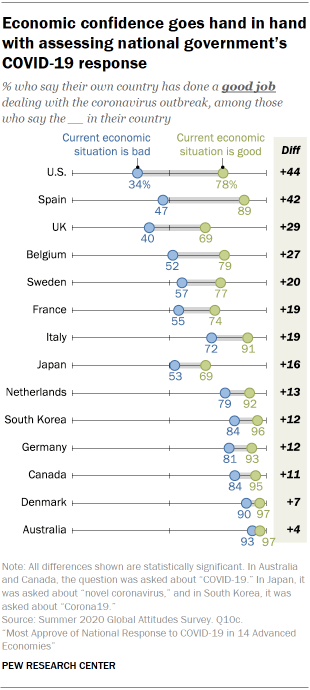
Another finding of the poll is quite striking: there is a strong correlation between those who think their government has done a good job in addressing the pandemic and their assessment of the economy in their country:
“Economies around the world have contracted due to the unprecedented nature of the coronavirus outbreak, and the U.S. Congressional Research Service reports that the global economy could grow between 3% and 6% less in 2020 compared with previous projections. These economic effects also relate to how people assess their own nation’s handling of the pandemic. Across all 14 nations included in the survey, those who think their current national economic situation is good are also more likely than those who believe the economy is bad to say their country has done a good job of dealing with the coronavirus outbreak.
“This divergence is especially pronounced in the United States. Among those with a more optimistic view of the economy, 78% report that they approve of the way the U.S. government has dealt with the virus. But those who think the American economy is currently in poor shape are less than half as likely to give the government response a positive rating.”
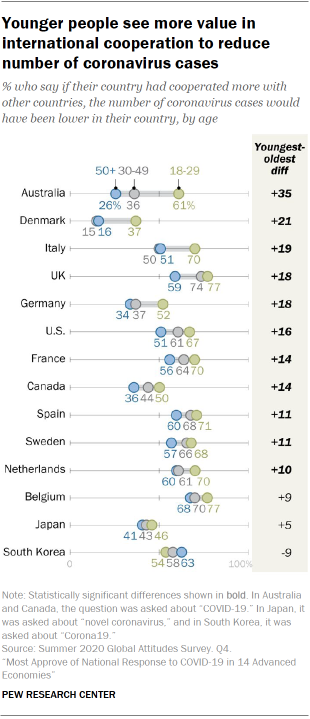
One surprising result of the poll is that younger Americans tend to think that there would have been fewer coronavirus deaths if the US had cooperated with other countries and international organizations such as the World Health Organization (WHO).
“Americans on the whole say that more cooperation could have limited the number of coronavirus cases. A majority (58%) of U.S. adults say that if the U.S. had cooperated with more countries, the number of American coronavirus cases would have been lower.
“Much as younger people globally tend to have more favorable opinions of the UN and younger Americans give higher approval ratings to the WHO for its handling of the coronavirus outbreak, those ages 18 to 29 are more likely than those 50 and older to say that more cooperation would have reduced the number of coronavirus cases in their country.”
The views of people in the European Union (EU) on the coronavirus also reflects the different opinions that many in Europe have of the Union itself. It seems as if it is impossible to view the pandemic from a non-political point of view. That conclusion is dispiriting.
Tensions between the US and China have ratcheted up because the US sent a U-2 surveillance plane into an area China designated as a “no-fly” zone because it was conducting live-fire military exercises in the region. The US insists that its flights were perfectly legal because they were conducted in strict accordance with international law. The surveillance flight might have been legal, but sending an aircraft into a live-fire zone is problematic. In response, the Chinese launched two missiles into an area of the South China Sea. According to The South China Morning Post:
“One of the missiles, a DF-26B, was launched from the northwestern province of Qinghai, while the other, a DF-21D, lifted off from Zhejiang province in the east.
“Both were fired into an area between Hainan province and the Paracel Islands, the source said.
“The landing areas were within a zone that Hainan maritime safety authorities said on Friday would be off limits because of military exercises from Monday to Saturday.
“The DF-26 dual-capable missile is a type of weapon banned by the Intermediate-Range Nuclear Forces Treaty treaty signed by the US and Soviet Union towards the end of the Cold War. When the US withdrew from the treaty last year, it cited China’s deployment of such weapons as justification.
“The DF-26 has a range of 4,000km (2,485 miles) and can be used in nuclear or conventional strikes against ground and naval targets.
“The DF-21 has a range of around 1,800km, with state media describing the most advanced in the series, the DF-21D, as the world’s first anti-ship ballistic missile.”
The missiles were clearly intended to send a message to the US which has routinely sent its naval vessels into the South China Sea to assert freedom of navigation rights. The aircraft carrier is the most dramatic example of what military analysts call “projective power”–the ability to exert military force independently of naval bases and contiguous territory. But there are many questions about the viability of aircraft carriers as missile technology continues to improve.
But the increased tension is also based upon a new policy articulated by US Secretary of State Pompeo on US policy toward the South China Sea. The new policy rejects China’s claims in the sea, a dramatic shift from its previous position that those claims have to be negotiated between China and the other states with maritime claims.
“The PRC has no legal grounds to unilaterally impose its will on the region. Beijing has offered no coherent legal basis for its “Nine-Dashed Line” claim in the South China Sea since formally announcing it in 2009. In a unanimous decision on July 12, 2016, an Arbitral Tribunal constituted under the 1982 Law of the Sea Convention – to which the PRC is a state party – rejected the PRC’s maritime claims as having no basis in international law. The Tribunal sided squarely with the Philippines, which brought the arbitration case, on almost all claims.
“As the United States has previously stated, and as specifically provided in the Convention, the Arbitral Tribunal’s decision is final and legally binding on both parties. Today we are aligning the U.S. position on the PRC’s maritime claims in the SCS with the Tribunal’s decision. Specifically:
“The PRC cannot lawfully assert a maritime claim – including any Exclusive Economic Zone (EEZ) claims derived from Scarborough Reef and the Spratly Islands – vis-a-vis the Philippines in areas that the Tribunal found to be in the Philippines’ EEZ or on its continental shelf. Beijing’s harassment of Philippine fisheries and offshore energy development within those areas is unlawful, as are any unilateral PRC actions to exploit those resources. In line with the Tribunal’s legally binding decision, the PRC has no lawful territorial or maritime claim to Mischief Reef or Second Thomas Shoal, both of which fall fully under the Philippines’ sovereign rights and jurisdiction, nor does Beijing have any territorial or maritime claims generated from these features.
“As Beijing has failed to put forth a lawful, coherent maritime claim in the South China Sea, the United States rejects any PRC claim to waters beyond a 12-nautical mile territorial sea derived from islands it claims in the Spratly Islands (without prejudice to other states’ sovereignty claims over such islands). As such, the United States rejects any PRC maritime claim in the waters surrounding Vanguard Bank (off Vietnam), Luconia Shoals (off Malaysia), waters in Brunei’s EEZ, and Natuna Besar (off Indonesia). Any PRC action to harass other states’ fishing or hydrocarbon development in these waters – or to carry out such activities unilaterally – is unlawful.
“The PRC has no lawful territorial or maritime claim to (or derived from) James Shoal, an entirely submerged feature only 50 nautical miles from Malaysia and some 1,000 nautical miles from China’s coast. James Shoal is often cited in PRC propaganda as the “southernmost territory of China.” International law is clear: An underwater feature like James Shoal cannot be claimed by any state and is incapable of generating maritime zones. James Shoal (roughly 20 meters below the surface) is not and never was PRC territory, nor can Beijing assert any lawful maritime rights from it.
“The world will not allow Beijing to treat the South China Sea as its maritime empire. America stands with our Southeast Asian allies and partners in protecting their sovereign rights to offshore resources, consistent with their rights and obligations under international law. We stand with the international community in defense of freedom of the seas and respect for sovereignty and reject any push to impose “might makes right” in the South China Sea or the wider region.
By branding China’s activities in the South China Sea as “illegal” the US effectively vitiates negotiated settlements, a challenge that China cannot ignore.
The dispute simply adds more tension to an already rattled relationship. The current disputes between the two states includes trade, Taiwan, the status of Hong Kong, the treatment of the Uighurs in Xinjiang Province, and the controversy over the origins of the COVID-19 virus. Given the context, military actions by either side are incredibly dangerous.