Even though the Greek elections were in some sense indeterminate, one message seemed clear on 17 June: the Greeks may have been divided about whether they wished to stay in the eurozone, they were united against continuing austerity policies. That shoe has now dropped, and the Greeks are asking for a two-year delay in implementing the bail-out plan laid out by the EU. The response of the EU will likely be a qualified “no.” Then hard bargaining will begin.
There have been on-and-off-again violent acts between Israel and residents in the Gaza over the last few weeks. The violence, however, seems to be more regular and sustained as the summer goes on. It is not clear why the violence is escalating, but much has to do with the Israeli desire to delegitimize the policies of Mahmoud Abbas and Fatah in the West Bank. If true, then it’s unlikely that a cease-fire could be easily brokered as long as Abbas pursues some sort of recognition at the UN.
It’s often hard to find humor in world politics. But this blog post from Foreign Policy about life in the Syrian army is hysterical. Makes one wonder how the Turkish fighter plane was downed.
The violence in Syria has been spilling out into the region for some time (Lebanon and Turkey), but there was a dramatic escalation of violence with the downing of a Turkish fighter plane by Syrian forces. We still do not know all the details and Turkey has been diplomatically circumspect so far. Syria claims that it was a “mistake” but such an admission accomplishes little. There will be domestic pressure for Turkey to respond, and it will be a test of Erdogan’s political ability to restrain a nationalist impulse.
The protests in Egypt continue, with both sides claiming victory in the recent presidential election. There are also conflicting reports about whether former President Mubarak is still alive. It seems likely that the military will only tighten its control in the face of the growing protests, but it is unlikely that those measures will be effective. One wonders how long the stalemate can last.
The Rio+20 Earth Conference issued its final report and the universal reaction to the report is disappointment. Think Progress has issued an analysis of why the summit failed and how the report could have been stronger. It is hard, however, to imagine how the summit could have been more successful given the economic weakness that seems to be pervading the global economy.
The negotiations between the P5+1 and Iran in Moscow ended without making much progress at all. The response of Israel’s government was swift: it will not wait much longer for negotiations to succeed. This statement follows a report in the New York Times that suggests that many diplomats believe that Iran is simply pursuing a waiting game so that it has more time to develop its capabilities. The NYTimes is not an especially reliable source on Middle Eastern matters, but many suspect that this particular charge is valid.
Violence has slowly been building up again in central Nigeria. The ostensible cause of the violence is a cleavage between Christians and Muslims and the pattern of deaths follows those lines fairly clearly. But the issues are significantly more complex than that and efforts to limit the violence, such as curfews, do not appear to be very successful.
Much has been made about growing inequality in the world. Perhaps an appropriate example of how extreme matters have become is the purchase of the Hawaiian island, Lanai, by Oracle CEO, Larry Ellison.
The situation in Egypt is massively unclear and uncertain. Both presidential candidates have claimed victory, but most observers believe that Mohammed Morsi, the Muslim Brotherhood candidate won. We should get the official results on Thursday. Clearly, however, the race will be contested. Meanwhile, thousands have gathered in Tahrir Square to protest the military’s actions to assume political control and to dissolve the Parliament. Battlelines are being drawn between the secularists and the supporters of the Muslim Brotherhood, although it is unclear to what extent the Muslim Brotherhood wants to establish a theocratic state. One can only hope that the Egyptian people remain firm in their demands for an effective voice and that violence is kept at a lowest level possible given the uncertainty.
The U.N. Conference on Sustainable Development began on Monday with about 50,000 participants. It has been 20 years since the first meeting in Rio de Janeiro and, unlike the first meeting which was full of promise, this meeting is rife with pessimism. The current economic crisis has overwhelmed the willingness of many states to undertake commitments that could compromise economic growth in the short run. Most analysts expect little progress from the current meeting–a great tragedy.
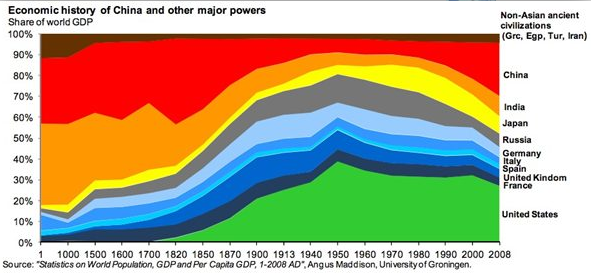
Angus Maddisson is perhaps the world’s most influential economic historian–he is a true wizard when it comes to economic data. Here is his visual portrayal of global economic grwoth from the year 1 to the present.
I was wrong–Syriza did not get the largest plurality of votes in the Greek election. New Democracy, a conservative party that is pro-Europe, got the largest number of votes, but still not enough to get a majority in Parliament. So we will watch how New Democracy woos PASOK, the socialist party which came in third to Syriza, to form a coalition. These are the two parties that brought Greece to this sorry state, so it’s hard to be optimistic about the future. Unfortunately, the neo-Nazi party got enough votes to get seats in the Parliament.
In other election news, the Egyptian military issued a new constitution on its own as soon as the election was over. Essentially, it declared martial law and gave itself the right to write a new permanent constitution. Nothing good can come of this move–we will have to see how violent the reaction to the coup is.
In the third election of the day, French Socialists won an absolute majority in the Parliament, giving President Hollande a very strong hand to deal with Germany. The politics of the European Union have decidedly swung toward a less austere economic policy, and Chancellor Merkel’s own position within Germany seems to be weakening as well. We’ll see how the G-20 meeting in Mexico starting on Monday interprets these political results.
By this time tomorrow (8:30 pm, EDT) we should be beginning to get some sense of how the Greek elections went. Right now, the consensus seems to be that the election will not yield a strong government which would simply prolong the agony of the euro. The European Central Bank, the Bank of England, and the US Federal Reserve all appear to be ready to flood the world with money if the euro starts to tank. I have begun to think that the Radical Left Coalition (Syriza) will win the largest number of votes, primarily as a protest vote against Germany.
We will also be getting some results from Egypt, although the meaning of the election will be difficult to interpret. The military’s dissolution of the Parliament generally means that Egypt will have a President without a constitution or Parliament. If Shafiq wins, it will be almost as if Mubarak never left. I imagine that more protests are highly likely, no matter who wins the election.
On Monday the G20 will be meeting in Mexico and the countries will have much to talk about. I expect the IMF to get promises of more money to lend to indebted countries in Europe. More money is certainly necessary, but what is most important are the conditions attached to the money. I doubt that the European states can endure more austerity without some political fallout.
I try not to link to New York Times articles because of the paywall, but Floyd Norris has written a very provocative essay which has been a strong, unspoken undercurrent to the entire European economic crisis: that Germany maintains its hard-line position because those policies benefit Germany at the expense of its partners in the eurozone. In essence, the argument is that Germany is making sure that all the possible private losses within Germany are shifted to the governments of the indebted countries. In addition, the weakening of the euro benefits German exporters. While no one should underestimate the extent to which German history dictates German policies (the hyperinflation of 1933 and the costs of reunification in 1992), there is a large element of truth to the alternative explanation.
The political situation in Egypt seems even more precarious. The dissolution of the Parliament raises all sorts of questions about who will write the new constitution, and the military has ordered new regulations designed to stifle dissent prior to the elections next week. This essay in Foreign Policy is particularly pessimistic about Egypt’s future.
Brad DeLong and Barry Eichengreen, two of the premier economists in the world, have written a new preface to Charles Kindleberger’s magisterial work, The World in Depression. I recommend it in the strongest possible terms–it is a superb analysis of what’s going on the Europe right now and how we are all perilously close to replicating all the failures of the 1930s. If you want to know why things in Europe look so bleak, then read this essay.
The Egyptian presidential elections are scheduled for Sunday and Monday, and the Supreme Constitutional Court has dissolved the Parliament and ruled that the once close ally of Hosni Mubarak, Ahmed Shafiq, must be allowed to run for President. The ruling is a blow to the Muslim Brotherhood, but Shafiq had already qualified as one of the two top vote getters in the preliminary election. He now can legally run which will make the election more legitimate. But since the Constitutional Court is backed with former associates of Mubarak, the legitimacy of its rulings will now be seriously questioned.
The Senate Banking Committee had Jamie Dimon, the head of JP Morgan, as its chief witness today. Ostensibly, the hearing was held to investigate whether the risky investments that led to a near-financial collapse in 2007-08 are being continued in light of the least $2 billion (more likely $7 billion) loss experienced by JP Morgan this year on what it claims was a “hedge” investment. The idea that the Senate Banking Committee could investigate JP Morgan in any serious way is a sick joke: 16 of the 22 Senators on the committee received campaign contributions from the firm (2 current Senators are retiring and are therefore not collecting any campaign contributions). ProPublica did an investigation on how deeply in JP Morgan’s pocket the Committee actually is. This phase of American democracy is a sick farce.
Revolving Door
One current staffer on the Senate banking committee, Dwight Fettig, is a former lobbyist for JP Morgan. In 2009, the bank hired him to work on “financial services regulatory reform.” Meanwhile, JP Morgan is stacked thick with former committee staff.
· Naomi Camper – Currently a lobbyist for JP Morgan. Prior to that, from 2001-2004, she was an aide to Senator Johnson.
· Kate Childress –A JP Morgan lobbyist since 2008, she is also a former aide to Chuck Schumer, D-N.Y., who sits on both the Senate Banking and Finance committees.
· Steven Patterson –A JP Morgan lobbyist and formerly a staff director for economic policy for the Banking committee.
· Nate Gatten— A JP Morgan lobbyist based in London who was reportedly called back to Washington recently to help with the company’s damage control. He is a former lobbyist for Fannie Mae, and, in the 1990s, was a banking aide to former Senator Robert Bennett, R-Utah, who also sat on the committee.
· P. Michael Nielsen – A lobbyist with a firm run by former Senator Bennett, he hasbeen retained by JP Morgan for help with federal probes, according to Bloomberg. He was also a senior policy adviser to the committee from 2007 to 2010.
American Banker also reported that three other outside lobbyists currently working for JP Morgan were once affiliated with the committee:
· Jason Rosenberg – A lobbyist at The Glover Park Group and formerly an aide to Jon Tester, D-Mont., who sits on the committee.
· Jenn Fogel-Bublick – A lobbyist at McBee Strategic Consulting and formerly a Democratic counsel on the committee.
· Mike Chappell – A lobbyist for Fierce, Isakowitz & Blalock and a former press assistant to Senator Roger Wicker, R-Miss., another committee member.
A former senator on the committee, Mel Martinez, R-Fl., is also now the JP Morgan exec in charge of Florida, Central America, and the Caribbean. Martinez waselected to the Senate in 2004 and went to the bank in 2010. Bloomberg reported that he was called to Washington after the losses were reported.
Lobbyists for JP Morgan appear to be keeping busy. The bank spent $7.6 million on lobbying last year, according to the Center for Responsive Politics.
Campaign Contributions:
JP Morgan has also been a generous donor to banking committee members, both Republican and Democratic.
· JP Morgan is the second largest campaign contributor to Johnson, the committee chair, and to the top Republican on the committee, Richard Shelby of Alabama,over the past twenty years, according to a tally from American Banker.
· JP Morgan employees have donated more than $80,000 to Johnson since 1998 and more than $136,000 to Shelby since 1990.
· So far in 2012, Dimon has personally donated to committee members Bob Corker, R-Tenn., and Mark Warner, D-Va. In 2008, he gave $2,000 each to Johnson and Shelby.
· Six of the 22 members of the banking committee have not received any money from JP Morgan PACs or employees in recent election cycles. Two of those members are retiring and aren’t collecting campaign funds.
Despite tough new laws against political protests, the Russian people came out to protest against the government of Vladimir Putin. The people are still angry about what they regard as a stolen election, and the widespread belief that the government is corrupt. As I have indicated before, I believe that the many protests that are going on in the world are all loosely connected by a general dissatisfaction with the connection between governments and the people.
The sense that the European economy is poised toward a major crisis is growing, and it is precisely that belief that accelerates the process of collapse. The belief that Greece will be forced to leave the eurozone means that everyone who currently has Greek assets priced in euros wants to convert those assets into a currency that is beyond Greek control. If Greece drops the euro and converts to the drachma, the actual value of the drachma will be about 70% less than the value of the current euro. The desire to convert currency creates a process of capital flight, which simply makes the economy even weaker. So governments try to prevent capital flight by not allowing conversion. But as soon as those new controls are implemented, the desire of people to convert their assets becomes even more intense. We are currently witnessing the deepening of panic in Europe.
A poll run by TrustLaw that asked almost 400 experts on gender equality about which countries have the highest degree of gender equality came up with this ranking: 1. Canada 2. Germany 3. Britain 4. Australia 5. France 6. United States 7. Japan 8. Italy 9. Argentina 10. South Korea 11. Brazil 12. Turkey 13. Russia 14. China 15. Mexico 16. South Africa 17. Indonesia 18. Saudi Arabia 19. India. Obviously, the poll emphasized the questions of legal definitions of gender equality, but the results are quite interesting.