The Economist, one of the worlds most respected journals and one whose point of view is one with which I have serious disagreements, ran an editorial condemning the prison at Guantanamo Bay, calling it “a deeply un-American disgrace.” If America’s friends feel this way, one can only imagine how isolated the United States is on the matter. The prison belies all the American rhetoric about respecting human rights. President Obama argues that it is the responsibility of the Congress to close the base. I respectfully disagree–it was a Justice Department ruling that established the presumed legality of the prison.
President Obama is visiting Mexico, and there are a host of issues to discuss, such as drugs and immigration reform in the US. The backdrop of the visit is the impressive rise in manufacturing capability in Mexico, as Mexico begins to compete effectively with Chinese exports to the US. The stage is set for a new relationship between the two countries, and we should hope that the more volatile issues do not obscure the mutual interests that are incredibly important.
The National Front Party in Malaysia has ruled in that country since 1957. The current Prime Minister Najib Razak, however, faces a hotly contested election with Anwar Ibrahim, a long-time rival to the National Front. The issues in the country are incredibly complex, but there is, apparently, as general sense of dissatisfaction with the long-ruling party and that it might be time for a change. If the opposition does win the election, it will be a telling statement about the weakening power of incumbency.
The recent factory disaster in Bangladesh killed more than 400 workers, all of whom were working on clothes they could never afford. The clothes were sent to richer countries, whose citizens were able to purchase the clothes far more cheaply than in their own country. It does not appear as if many consumers of these clothes have gone through a serious rethinking of whether being able to buy cheaper clothes is worth jeopardizing the lives of those who produce them. Such a rethinking is long overdue. Bangladesh should deal harshly with those who refused to protect their workers from needless death; consumers of those products should think about whether they are profiting at the expense of some very vulnerable people.
People in the US can be forgiven if they did not know that today was International Workers’ Day: I’m not aware of any media outlet that called anyone’s attention to the holiday. Globally, however, that day was celebrated in a variety of different ways. Unfortunately, some of the observances were violent as many workers protest against the rising rates of unemployment in many countries.
The Pew Forum on Religion and Public Life interviewed more than 38,000 Muslims in 39 countries and asked many questions of great relevance to the study of world politics. One of the more interesting chapters is the one on how Muslims around the world view the rights of women. The survey, not surprisingly, reveals a remarkable diversity of opinion, a result that should undermine the common misconception about a monolithic consensus within Islam.
Three years ago, the US Congress directed the Securities and Exchange Commission to publish information showing the ratio of a company’s Chief Executive Officer’s total pay and compensation to the pay and compensation of the average worker in the company. The SEC has yet to publish that information, but Bloomberg has collected and published the data (it is incomprehensible to me that the SEC has delayed for so long) and it is eye-opening. The top of the list is the J.C. Penney Co, whose CEO, Ronald Johnson, earned 1,795 times what the average worker at J.C. Penney earned. The really sad part is that Johnson was recently fired after the price of J.C. Penney stock dropped by almost 50% during his tenure.
President Obama has promised to renew his effort to close the prison at Guantanamo Bay. Over half of the 166 prisoners at the facility are engaged in a prolonged hunger strike, a fact that has been ignored by the American press. Apparently, President Obama became quite defensive when questioned about his inability to close the prison, an act he promised would be his first official act when elected in 2008. The prison should have been closed years ago–indeed, it should never have been opened at all. It has no place in the American legal system.
The fate of the Hazara Shia community in Pakistan receives only sporadic media attention, largely because the city of Quetta is considered too dangerous for Western reporters. But the Hazara are one of the most persecuted groups in the world. The Pakistani government has failed repeatedly to protect its citizens, and it seems unlikely that the upcoming election will change that dire situation.
Economic data often miss capturing the true state of affairs–the things that can’t be measured are called ‘externalities. These externalities are often the things we care about the most. One example is our health. Researchers have found that there is a clear link between austerity programs and bad health–depression, suicides, and the like. If we required such issues to be included in a country’s GDP statistics, we might have a far different idea of what the state of an economy actually is.
There is a report circulating the web right now that Israel has bombed sites in Syria believed to contain chemical weapons. These reports are as yet unconfirmed. I’ll update this post when I get some additional information.
As the world figures out more and innovative ways to tap hydrocarbon resources, many are relieved that there won’t be an energy crisis any time soon. But one also needs to ask the question about whether these new reserves are indeed a good thing. Some would argue that a shortage is precisely what the world needs to move away from an energy system that is both costly and dangerous.
One of the issues raised by the prospect of climate change is the melting of the polar ice cap. Here’s a great video that gives a good sense of the rate at which Arctic sea ice is melting.
Prime Minister Shinzo Abe continues his nationalist line in Japan with the first-ever celebration of the “Return of Sovereignty” day. The celebration commemorates the end of the American occupation after World War II, and it has never been recognized in Japan before. Needless to say, the countries that were victims of Japan’s aggression during the war are hardly comforted by this display of nationalism, and the tensions in East Asia continue to rise.
Professor Stephen Walt has a great essay on the significance of whether Assad has used chemical weapons in Syria. He asks some very pointed questions about the significance of those weapons and whether they deserve the special attention they have received. These questions need to be answered before the US decides to intervene in the Syrian civil war.
The signs that the emphasis on “austerity” in Europe is waning is unmistakable. The Italian election, the Cyprus crisis, and the questions concerning the Rogoff-Reinhart hypothesis have all undermined the focus on budget cutting. In fact, European Union officials don’t use the word austerity to describe their policies. The new catch-phrase is “differentiated, growth-friendly fiscal consolidation.” But the inclusion of the words “fiscal consolidation” should serve as a signal that there are some in the Union who still wish to see large budget cuts. Ending austerity is not the same as fostering stimulus. We’ll have to see if there is anyone in the Union who believes in Keynes.
The controversy over the use of chemical weapons–sarin gas–in Syria continues, with doubts arising from the validity of some of the evidence being reviewed by the US and Great Britain. Sarin gas is an incredibly toxic weapon, and has been used in the past, in Iraq and by a terrorist group in Japan.
The sea surface temperature off the North Atlantic coast is the highest recorded in 150 years. It is hard to draw any substantive conclusions from this reading, but it will have an effect on the spawning and migratory patterns of many marine species. This new evidence will need to be analyzed for a long period of time before we can really figure out what it means, but the temperatures bear monitoring.
Carmen Reinhart and Kenneth Rogoff have responded to some of the criticisms they have received since three University of Massachusetts economists noted some errors and discrepancies in their research on the relationship between debt and economic growth. The response in in the form of an op-ed piece in the New York Times. As such, it is not a full-fledged defense of their work, but an effort to set the terms of the debate over their findings. It is an intelligent defense, but one that does not really respond to the overall thrust of the criticisms. But it is an effective opening statement. In other op-ed piece, Paul Krugman looks at the political reasons why austerity seems to be such a popular policy choice and offers some interesting observations about the role of ideology and interest.
Evidence is still accumulating that chemical weapons were used in Syria. The evidence is still far from conclusive, nor is there any solid evidence as to who used those weapons. Nonetheless, given President Obama’s statement concerning the use of such weapons in Syria (he called it a red line), he now runs the risk of having his bluff called. However, we need to remember that action against chemical weapons does not necessarily equate with a humanitarian mission. There are a variety of ways that the US could honor its hegemonic responsibilities with respect to chemical weapons, while at the same time avoiding its hegemonic responsibilities to the Responsibility to Protect.
Protests in Spain are increasing in frequency as unemployment rises. French unemployment continues to rise to very high levels, closing in on previous records. Now that the emphasis on austerity programs is easing up, it may be the time for these governments to initiate stimulus programs. But this summer is likely to be a difficult one for European society,
Unemployment in Spain has passed 6 million, or roughly 27% of the working population. Under 24 years old, the rate is close to 57% These numbers will not decline for at least a year, as Spain continues to implement austerity measures. These numbers far surpass the worst levels of the Great Depression.
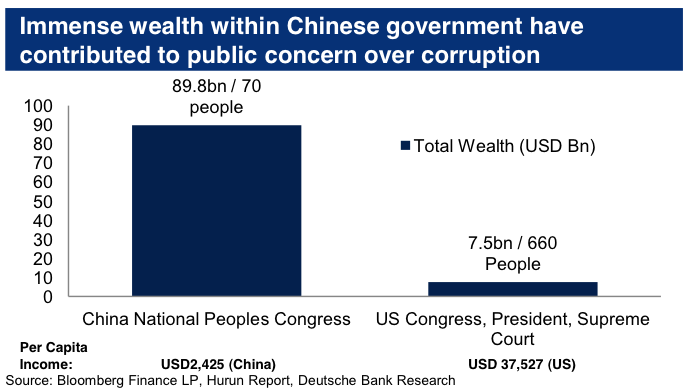
We worry about the influence of money on American politics, as a large number of people in Congress are millionaires. But the problem is far worse in China. Here’s a graph of the wealth represented in the National’s People’s Congress. Mao must be turning over in his grave.
E
Earlier this month I posted a quick blurb on the finding of a new influenza virus in China (H7N9) and suggested that I would keep an eye on it. Many others have also kept an eye on the virus, and a note of concern is creeping into the discussions. The flu has spread in ways that don’t involve chicken to human transmission, but we don’t know how. That strange anomaly is disquieting. Once again, I don’t think this is yet an item for great concern, but perhaps we should keep both eyes on it now.
European Commission President Barroso’s recent comment that austerity programs had reached their “political limits” caused quite a stir. The Germans, in particular were dismayed by his defection from the cause (along with, apparently, Christine LeGarde of the IMF). Here’s the German take from Der Spiegel.
Both Human Rights Watch and Amnesty International leveled a broadside against Russian President Putin, calling his regime the worst on the issue of human rights since the Soviet period. The charge is partially motivated by Putin’s crackdown on Non-Governmental Organizations in Russia, but there is little doubt that civil liberties are being seriously compromised by the government. The key thing to watch is whether the small middle class in Russia begins to protest more vigorously against Putin’s heavy hand. Antoher sign to watch is the health of the economy which will determine the degree of latitude that the middle class gives Putin. I seriously doubt that Putin himself cares very little about the criticism.
The new Mexican President, Enrique Pena Nieto, scored a major victory early in his term by taking on the very powerful teacher’s union and introducing some very important reforms to a decrepit educational system. The union has now responded with violence and it appears as if political war has been joined in Mexico. It remains to be seen how long Pena Nieto can withstand these types of protests and strikes.
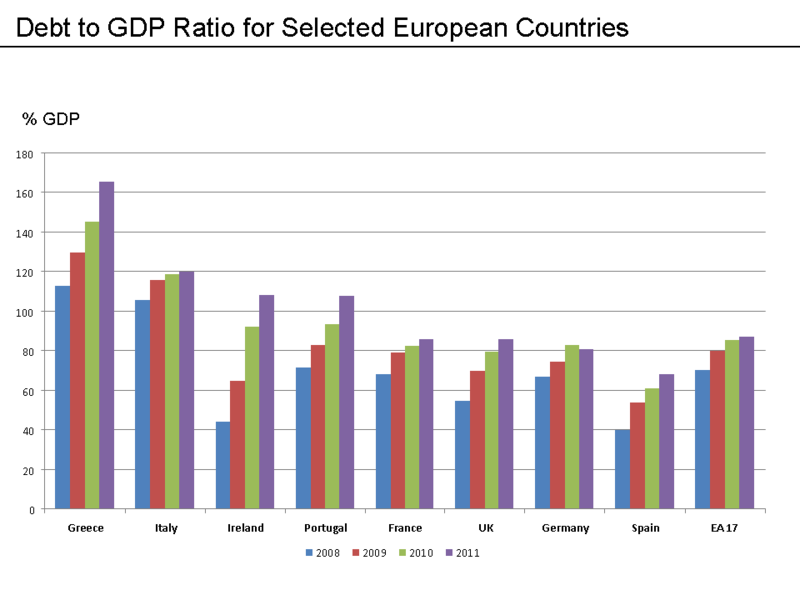
The European Commission President, José Manuel Barroso, indicated in a recent speech that Europe may be reaching the political limits of austerity programs. The combination of the Italian elections and the Cypriot crisis have suggested that the Troika may have to agree to move toward more stimulus and less belt-tightening. Indeed as the graph below suggests, the austerity programs have not succeeded in reducing the debt to GDP ratios in any countries with the single exception of Germany in the most recent year.
Israel is claiming that Syria used chemical weapons against rebel forces. If true, that action crosses a “red line” announced by President Obama, possibly signaling American intervention in the civil war. We need to be very careful about the claim and we should wait for multiple verification of the charge. I am personally very suspicious of every claim of “weapons of mass destruction” since the invasion of Iraq in March 2003. I am not at all certain, moreover, that it should be considered a cause for intervention since I am not clear as to how an intervention might affect the future use of those weapons and do not believe that there is any useful basis for armed intervention in a civil war.
A long quiescent border dispute has flared up again between India and China as Chinese troops have entered the Depsang valley in the Ladakh region of eastern Kashmir. India and China has frosty relations as they both compete for great power status, and the border disputes between the two countries remain a persistent irritant. We will have to see if the Chinese respond effectively to the Indian protest.