Tensions have been rising in the South China Sea as China has stepped up its defense of what it regards as its territory. At this time, the main confrontation seems to be between China and the Philippines, but there are many other claims by different states. The stakes are unknown, but there is some belief that there are significant reserves of oil and natural gas in the contested areas. The most difficult issue in resolving the territorial claims is China’s claim that it owns virtually the entire expanse of the sea, as evidenced by this map indicating China’s claims.
Scientists have published a paper in the British journal, Nature, that indicates that the process of climate change could be vastly accelerated by the melting of permafrost in the Arctic and Antarctic regions. The melting releases methane which is a more potent greenhouse gas than carbon dioxide, but which was underrepresented in earlier climate change models. The worst case projections for the release of the methane are truly worrisome, and underscore the need to take more effective action as quickly as possible.
Protests against corruption in Bulgaria have taken quite a turn as thousands of protesters trapped several parliamentarians in the legislative building. The political situation in Bulgaria has been tense since last May, when a new socialist coalition took power with 120 seats out of 240 possible seats. The appointments for cabinet posts are invariably controversial under such circumstances, and it is clear that many in Bulgaria do not believe that the government represents their interests well or fairly. Interestingly, China has banned the construction of new state buildings because of public anger for wasteful and extravagant government spending. The anger against government corruption is truly global.
The Turkish government has launched a variety of punitive measures against the protesters in Taksim Square a month ago. Some human rights groups believe that as many as 3,000 people have been arrested, including journalists. Repression is not typically productive under the circumstances facing the Erdogan government unless it is sustained and systematic. We’ll have to see what the reaction of the Turkish people to these measures will be. The reaction will not be immediate, but will build slowly over a period of months. Se we will keep our eye on Turkey.
The US CIA is closing down many of its operations in Afghanistan in preparation for the US troop pullout in 2014. The drawdown reflects the diminished strategic significance of Afghanistan as well as the growth of hostile groups in other areas of the world. The American withdrawal thus seems to be rather complete. Unfortunately, we have no idea how the US intends to help the Afghans reconstruct their country after the withdrawal. If Iraq is any guide, there likely will be no sustained American effort.
We’ve been waiting for any details on the purported “negotiations” between Israel and the Palestinian Authority, but there aren’t any that appear to be forthcoming. Aaron David Miller, a keen analyst of Middle Eastern affairs, has written a piece on the things we should look for to determine whether both sides are serious about negotiating. My reading of his essay is that much depends on the willingness of President Obama to take chances to provide assurances to both sides–they clearly will not trust each other on any matter.
Eurostat has just released the latest data on debt-to-GDP ratios in the Eurozone. For some countries, the debt crisis is getting much worse:
Euroarea: 92.2%, up from 88.2% a year ago
Greece: 160.5%, up from 136.5% a year ago
Italy: 130.3%; up from 123.8% a year ago
Portugal: 127.2%, up from 112.3% a year ago
Ireland: 125.1%, up from 106.8% a year ago
Spain: 88.2%, up from 73.0% a year ago
Netherlands: 72.0%, up from 66.7% a year ago
The data suggest that the austerity programs have clearly failed to stimulate economic growth. The political pressures on these countries to try an alternative approach, even a debtor’s cartel, is growing–after all, what good is a hostage who threatens to commit suicide?
The Japanese elections have given Prime Minster Shinzo Abe and his Liberal Democratic Party solid control of both houses of the Japanese Parliament. The victory means that Abe will be able to pursue his economic reforms designed to shake Japan out of its two decade economic slump. It also means, however, that Abe will be able to move toward a more assertive foreign and military policy, a direction sure to rattle Japan’s neighbors in East Asia.
Violence continues to spike in Iraq as the power vacuum created by the US invasion in March 2003 continues to reverberate throughout the country. The American occupation of Iraq after the invasion did little to establish a viable political system as the political balance between Shia, Sunni, and Kurds remains elusive. More than 2700 people have died in Iraq in 2013, a number similar to the worst months of the American occupation. Unfortunately, there does not appear to be any progress toward reconciliation among the groups as they jockey for power.
We often come across information which may or may not be significant. The US and Israel have just begun two weeks of joint military maneuvers. Such operations are usually scheduled long in advance and are meaningless from a policy point of view. However, given the recent rhetoric from Israel on the seriousness of the Iranian nuclear program, this operation may be more significant. Obviously, there’s no way to know. But it’s always useful to have such information tucked away in worst cases. And while there is an expectation that the Israelis and Palestinians will begin negotiations this coming week, there are reasons to be skeptical that anything tangible will come about as a consequence.
There have been two days of violent protests in some of the suburbs of Paris, triggered by police identity checks of Muslims. It is hard to say at this point whether the protests represent deeper grievances, but France experienced a long siege of political protests in 2005 over similar issues. Unquestionably, the economic difficulties of French youth are the fundamental underpinning of these protests.
Victor Davis Hanson is a prominent military scholar (although one who provokes controversy often) and he has written a book review for the Times Literary Supplement on how weapons have changed war. He looks at Saltpetre (an early necessary component of gunpowder), Napalm, and what he calls “post-human” weapons (robots, and other horrifying developments on the horizon). Hanson shows the interaction of these weapons and the society that spawns them. It is a highly interesting essay.
As many of you know, I have been trying to find the common links among all the protests we have been witnessing across the globe over the last three years. One common theme is, of course, corruption in government. But there doesn’t seem to be any overarching political thread to these protests–they are all locally based and don’t seem to be working in any self-conscious way together. Chris Hedges is a well-known socialist who writes for the Nation and in an interview with The Real News, a self-avowedly leftist media outlet, gives a possible answer to the question. You need to listen to the interview with a questioning mind, but I also think that you will find many of the issues he raises to be worth thinking about.
Researchers from Abo Academy University in Finland have conducted a study of isolated peoples living in different parts of the world over the last century. In the study, the researchers found that “war”, as an institution, accounts for very few of the deaths in such societies. By analogy, the researchers speculate that, since these peoples live out lives that are roughly comparable to the early days of human societies, that war was not a common feature of human life. The conclusion is an interesting insight into the famous “nature-nurture” debate: that human aggression is a learned and not an innate behavior.
Most states conveniently forget previous foreign policies when the tide of history proves that those policies were, in fact, abhorrent. In my lifetime, the most egregious case (thus far) of historical revisionism in the US is on the issue of US-South African relations. Most people do not know how powerfully the US supported the apartheid regime in South Africa, and one would never guess given the current strong support for the new governments. The posted article gives an insight into parts of that revisionism, but it is a serious mistake to think that it was just Republicans that supported the racist regime. In the formulation of foreign policy, all statespeople should try to determine, as much as is possible, not only what is morally correct, but in what direction the arc of justice points.
US Secretary of State Kerry announced today that the moribund negotiations between Israel and the Palestinians would restart next week. The announcement comes after four months of diplomacy, and all the leaks surrounding those negotiations tended to downplay the prospect of renewed negotiations. The announcement was very cautiously worded, and it is unclear what the terms of the negotiations are. Nonetheless, any negotiations are to be welcomed. We will learn much more next week.
The European Union has announced that it will no longer allow the sale of goods or services produced in Israeli settlements in the Occupied Territories. The settlements violate most interpretations of international laws governing Occupied Territories (most specifically the Geneva Convention which prohibits the Occupying Power from transferring its population to the occupied territories). The ruling affects only a mall part of the international trade between Israel and the EU–the ruling only refers to those things produced within the settlements. But it is a clear message to the Israelis that there are consequences to systematically violating international law. We will have to see if US Secretary of State Kerry raises the issues in his current negotiations with the Israelis and the Palestinians.
This photograph is of the Zaatari refugee camp in northern Jordan. It is home to about 115,000 refugees from Syria. One can only imagine how difficult the circumstance of life must be for the residents.
The world of the 1% is incredibly complex. Trying to capture this complexity visually is very difficult, but an amazing website, OpenCorporates, succeeds in blowing one’s mind. Through interactive maps, it shows how corporate structures are disguised, hidden, and designed to stupefy. It is overwhelming at first glance, but stick with it and things become very obvious.
Greece has agreed to the terms of the troika (the European Central Bank, the European Commission, and the International Monetary Fund) to secure a large loan in order to prevent a sovereign default. The Greek government will receive $9.2 billion in return for firing 25,000 government workers including police and teachers. With unemployment of around 27% it is difficult to see how laying off more workers will improve the economic situation in Greece. I suspect we will be seeing more protests in Greece in the coming days.
India is not immune to the general global economic slowdown. Its economic growth in recent years has been truly impressive, but that growth was in some respects dependent upon a vibrant world economy. Now, like China and Brazil, India is slowing down and not creating nearly enough jobs for its young people. And, like many of the richer countries, its government seems sclerotic and unable to act decisively. Thus far, there have not been nation-wide protests in the country, but there are many signs of discontent.
A North Korean ship has been detained by Panama after it was discovered that it was secretly carrying Cuban weapons. The ship’s captain attempted suicide after the discovery, and the transfer of weapons to North Korean definitely violates the arms embargo against North Korea ordered by the UN Security Council. We have been hoping for some sort of reconciliation between the US and Cuba for many years now; it is unclear whether this incident will set back those efforts.
Italy’s first black minister, Cecile Kyenge, was greeted by nooses hanging from lampposts in the city of Pescara. Posters proclaiming “Immigration, the noose of the people!” were alongside the nooses and the group putting up the posters was a far-right group known as Forza Nuova. We can put that group in the same hateful category as the Golden Dawn in Greece. Earlier, an Italian senator compared Ms Kyenge to an “orangutan.” In virtually every country of the world there is an unsettling explicit merging of the issues of race and immigration–a highly volatile mix in an economic slowdown.
Israeli Prime Minister, Benjamin Netanyahu, has given an interview on Face the Nation in which he claimed that Iran was “weeks away” from developing a nuclear bomb capability. Although the new Iranian President, Rouhani, has made some conciliatory statements to the P5+1 (the five Permanent members of the UN Security Council and Germany), the Prime Minister believes those statements to be dilatory and not significant enough to warrant more time for negotiations. There is no indication that the US has changed its position, but the pressure from Israel toward military action against Iran seems to be increasing. But an Israeli attack on Iran would only stiffen the power of the government of Iran, and likely lead to a far more rigid and dangerous pattern.
The revelation that the US National Security Agency (NSA) has been collecting information on communications of virtually anyone who uses a telephone and the internet was astonishing, not because of the fact of the spying, but because the scale of the spying was incomprehensible. Apparently, the amount of information being collected is even larger than we had initially thought. A British program, Tempora, collects 21 million gigabytes per day and stores the data for a month. This information is also shared with the NSA. The idea of privacy has become a naive relic.
The Chinese reported that their economy grew by 7.5% last quarter–an enviable rate given that the US is likely to grow at less than 1%. Nonetheless, the Chinese economy has slowed in 11 out of the last 13 quarters, and many are beginning to become apprehensive about whether the Chinese economy might be beginning to stall–a consequence that would shake the global economy. The Washington Post ran a short essay on how to interpret the Chinese data. It is not doom and gloom, but it is definitely cautious.
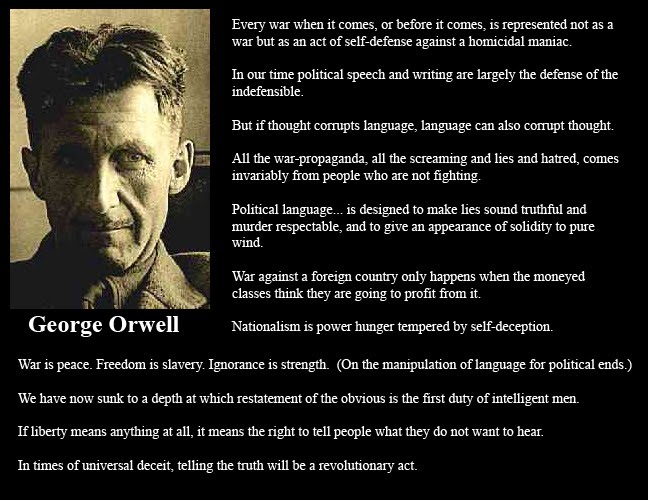
I generally post articles on current events, but I recently read an essay in Salon written by Andrew O’Hehir which offered a great deal of food for thought about the direction of American society. It takes a wide-lens view and uses President Dwight Eisenhower, George Orwell, and Aldous Huxley as foils for thought. It is a highly intelligent and perceptive read, and in the light of the long-term effects of the misbegotten “war on terror” it is a sobering read. If you wish to read Eisenhower’s military-industrial complex speech, you can access it here. For a quick insight into Orwell’s view of politics:
The Israeli strike against Russian-made anti-ship missiles in the Syrian port of Latakia has finally made it to the pages of the New York Times. But the story continues to get limited coverage. RT (formerly the Russian Times) is reporting that the strike was carried out by the Israelis using a Turkish military base. Using the base in Turkey, the Israelis were able to attack the port city without going through Syrian airspace. The Israeli press is reporting that the attack was carried out by Israeli submarines. The idea that the US and Turkey might be coordinating attacks against Syria is highly explosive. But right now, we know virtually nothing about what actually happened.