Hamas has taken responsibility for firing more than 40 rockets into southern Israel from the Gaza Strip. Hamas asserts that the rocket fire is in response to Israeli attacks in Gaza that killed 6 Hamas members. There is no moral defense for firing indiscriminate weapons into civilian areas, no matter what the provocation. Fortunately, there are no reports of any deaths from the rockets. Israel has announced that it is mobilizing 1500 reservists and it is likely that there will be further violence in the Gaza. At this time, there does not appear to be any movement toward de-escalation.
Propaganda is an intrinsic part of world politics, and governments use many different tactics to communicate their basic ideology. In the 1930s, the Nazi Party in Germany used the photograph of the perfect “Aryan” child to reinforce their ideology of race superiority. Unbeknownst to the Nazis, the photograph they used was actually the photograph of a young Jewish child. No one knew at the time, but the parents knew the truth of the propaganda.
The Organisation for Economic Cooperation and Development (OECD) has just published it forecast of global economic growth to 2060. It forecasts a slowing growth pattern from previous years, and growing stresses due to environmental degradation. In particular, its forecast on how that economic growth will be distributed is sobering:
With growth increasingly driven by knowledge and skills, growth in itself could keep generating rising tensions and inequalities. On current trends, earning inequality in the average OECD country may have risen by more than 30% in 2060 and would then face almost the same level of inequality as is seen in the United States today. Moreover, structural adjustment will continue, especially across firms within sectors (e.g. from low to high productivity and from polluting to less polluting firms) and in emerging economies, and the consequences for workers’ wellbeing will have to be managed. If left unaddressed, such increases in inequality and costs of adjustment could eventually backlash on stability and growth.
There has been another violent attack in Kenya, and, once again, there is confusion about who is responsible for nearly 30 deaths. Most analysts believe that Al-Shabab, an Islamist group from neighboring Somalia, is responsible for the attacks, but the government blames a local political group for the attack. The Kenyan government appears to be highly reluctant to admit that Al-Shabab can operate so freely in Kenya, and prefers to treat the matter as a domestic affairs. Al-Shabab insists that it is carrying out the attacks in retaliation for earlier Kenyan incursions into Somalia.
The US is “profoundly troubled” by reports that an American citizen, Tariq Khdair, was brutally beaten while in Israeli police custody in East Jerusalem. Khdair is a cousin of the Palestinian youth, who was recently abducted and burned alive in the West Bank. We will have to wait for complete information on the incident but a video taken of Khdair’s arrest is deeply unsettling. Whether Khdair was involved in violation of Israeli law so serious that he had to be brutally restrained remains to be seen. The photos of Khdair taken after the beating are horrific.
Wars have a deeply unsettling effect on the domestic politics of a nation. Such was the case for the US in World War I. We tend to forget how much things change because of the emotional demands of a war, but those changes were also clearly evident during the Vietnam War and the War on Terror after 11 September 2001. Rarely, however, are those changes totaled up when the costs of war are tallied.
I have been visiting with friends, celebrating the 4th of July holiday, so I have not been posting–my apologies. During this time, I’ve been trying to sort out the recent upsurge in violence in the Occupied Territories. The immediate source of the violence was the brutal kidnapping and murder of three Israeli teenagers, followed by the murder of a Palestinian youth. Much is not known about the circumstances of these savage acts, but the subsequent violent protests may spiral out of control. The larger context for this violence is the failure of the recent peace negotiations, and the sense that there are no prospects for change in the immediate future. We will have to keep an eye on events in the region for some time to figure out the true depths of the crisis.
Indonesia is in the final stages of its Presidential election, and the race has turned ugly at the end. Joko Widodo, 53, the populist governor of Jakarta, is running against Prabowo Subianto, 62, and the race pits a member of the old guard against a young populist. Mr. Joko has a comfortable lead in the polls so far, but this election is incredibly important to the future of Indonesia.
The Oxford Research Group has published an insightful analysis of the threat posed by Boko Haram to Nigeria. It is a nuanced piece that weaves together the north vs. south and Christian vs. Muslim dynamics of the crisis in Nigeria. Ultimately, the root cause of the violence is the question of who holds the power. In order to defuse the crisis in the Christian south (where most of Nigeria’s oil is located), the government diverted resources to buy off the violent group known as the Movement for the Emancipation of the Niger (MEND). The tactic worked, but the diversion of resources to the south alienated the primarily Muslim population of the northeast. According to the report: “Northern Nigeria is three times poorer than the mainly Christian south, and the northeastern heartland of Boko Haram is the poorest part of the north.” Once again, do not be misled by the religious overlay of the conflict: conflict is invariably over the issue of power.
The leader of the newly declared Islamic State (formerly ISIS), Abu Bakr al-Baghdadi, issued a videotaped message to all Muslims to defend the newly established Caliphate. In the message, he said:
“It is a state where the Arab and non-Arab, the white man and black man, the easterner and westerner are all brothers,” he said, trying to broaden his base beyond the Middle East. “Muslims, rush to your state. Yes, it is your state. Rush, because Syria is not for the Syrians, and Iraq is not for the Iraqis. The Earth is Allah’s.”
Al-Baghdadi’s movement has already attracted a number of people from the US and Europe, leading to increased security concerns as these individuals will have passports that will make it easier for them to re-enter countries and perhaps plan terrorist attacks.
Thousands marched in Hong Kong in favor of democracy in an annual demonstration marking the turnover of Hong Kong back to China in 1997. Demonstration supporters estimated the crowds at around 510,000 while the Chinese government estimated the crowd at 98,600. The demonstration comes as fears mount in Hong Kong that the democratic procedures and institutions implemented in the British agreement with China are being eroded. In that agreement, “China agreed to govern Hong Kong under the principle of ‘one country, two systems’, where the city would enjoy ‘a high degree of autonomy, except in foreign and defence affairs’ for 50 years.”
The announcement of a new Islamic State (IS) to replace the Islamic State of Iraq and Syria (ISIS) was made over the radio. The transcript of the announcement has been made available through the Middle East Media Research Institute, and it is a remarkable document. It establishes a new Caliphate and names Abu Bakr Al-Baghdadi as the Caliph. The announcement explicitly repudiates most of the logic currently governing the world order:
“So rush O Muslims and gather around your caliph, so that you may return as you once were for ages, kings of the earth and knights of war. Come so that you may be honored and esteemed, living as masters with dignity… By Allah, if you disbelieve in democracy, secularism, nationalism, as well as all the other garbage and ideas from the west, and rush to your religion and creed, then by Allah, you will own the earth, and the east and west will submit to you. This is the promise of Allah to you…”
This is the first time since the dissolution of the Soviet Union in 1991 that the guidelines for a genuine alternative to the Western world order has been articulated.
Ukrainian President Petro Poroshenko has ended the cease-fire against the Russian-speaking separatists in eastern Ukraine. The cease-fire has been in place for several weeks, but there has been no reciprocal action, and Poroshenko has vowed to restore the sovereignty of Ukraine. Both sides are clearly prepared for a spike in violence, and it remains to be seen how Russia and the West will react to the outbreak. But Poroshenko has signaled his desire to move Ukraine closer to the West.
Japanese Prime Minister Shinzo Abe has made it clear that he intends to modify Article 9 of the Japanese Constitution in which Japan renounces war. That clause was inserted into the Japanese Constitution after World War II in order to reassure Japan’s neighbors that Japanese militarism would not resurface. There have been huge protests against Abe’s plans and most polls indicate that the Japanese people do not wish to change the constitution. The growth of Chinese power in the region, however, makes it difficult for Japan to defend its interests in a traditional balance of power manner. It seems unlikely, however, that Abe is interested in trying alternative methods of defending Japanese interests.
Indonesia has overtaken Brazil as the nation with the highest rate of deforestation in the world. Its previous rate had been significantly understated, and it appears as if tree-cutting on purportedly government-protected areas is largely responsible for the misstatement. The error also signals the difficulty in addressing the problem of deforestation–the lack of an effective governmental infrastructure and capacity to enforce the laws designed to protect the forests.
ISIS has declared itself to be “The Islamic State,” re-establishing a form of political governance last seen 100 years ago in the Ottoman Empire. The announcement signaled the establishment of a Caliphate, stretching from Iraq’s Diyala province to Syria’s Aleppo. The Caliphate is a genuine alternative to the more traditional nation-state, and relies much less heavily of territory that is bounded and delimited. The two states that previously controlled the territory, Syria and Iraq, will obviously contest the claim. The original Caliphate was the greatest extent of Muslim political control in the 8th century.
The European Commission of the European Union has designated Jean-Claude Juncker as its next President. Mr. Juncker is a former Prime Minister of Luxembourg and is in favor of a more integrated Union. He was strongly opposed by Prime Minister Cameron of Great Britain, and his designation will undoubtedly cause political problems in Great Britain. A British referendum on continued membership in the Union is scheduled and there is a real possibility that Britain will choose to leave the Union.
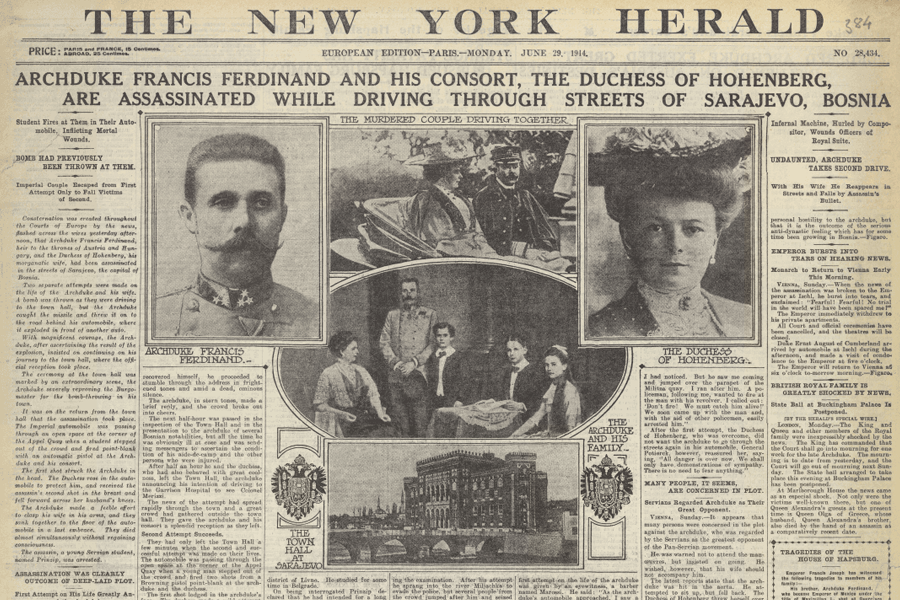
Today is the 100th anniversary of the assassination of Archduke Ferdinand of the Austro-Hungarian Empire. His death, at the hands of a young Serb nationalist, Gavrilo Princip, set into motion the chain of events that led to World War I. Here is a copy of the headline in the New York Herald about the assassination.
The war that ensued was the turning point in world history, eventually leading to the collapse of the European control of most of the planet. Europe itself changed dramatically. Here is a map of pre-war Europe:
This is the map in 1919:
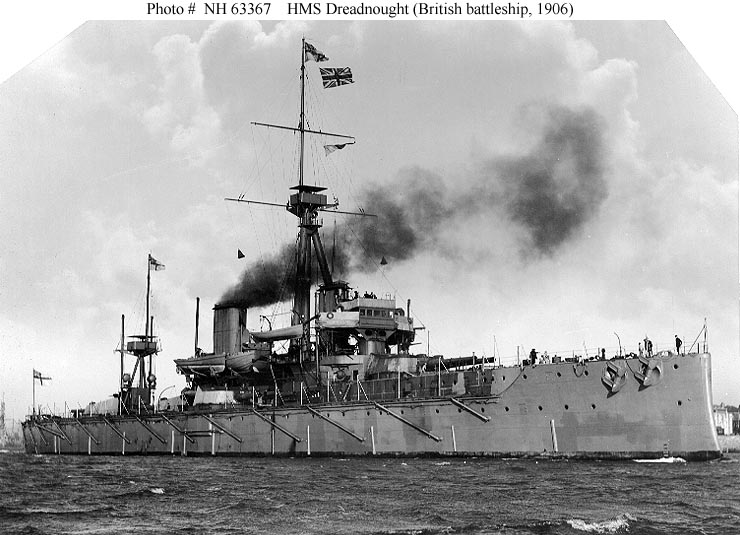
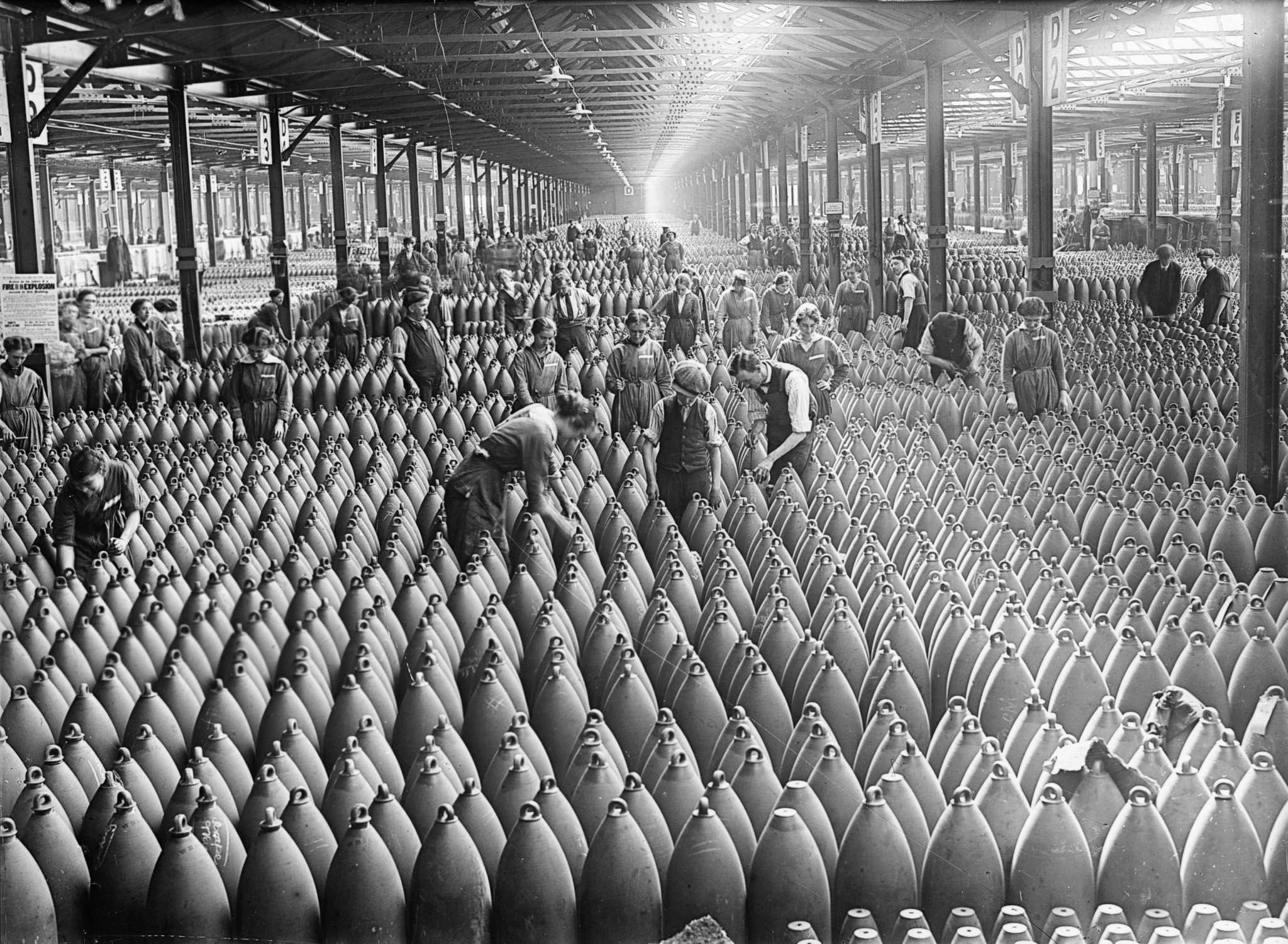
The devastation caused by the first truly industrial war was impossible to grasp. The soldiers were mindlessly ordered by generals who had little idea of how the new technologies had transformed the conduct of war. The soldiers followed their orders and suffered casualties that were unprecedented. The new weapons included the Dreadnaught:
The tank:
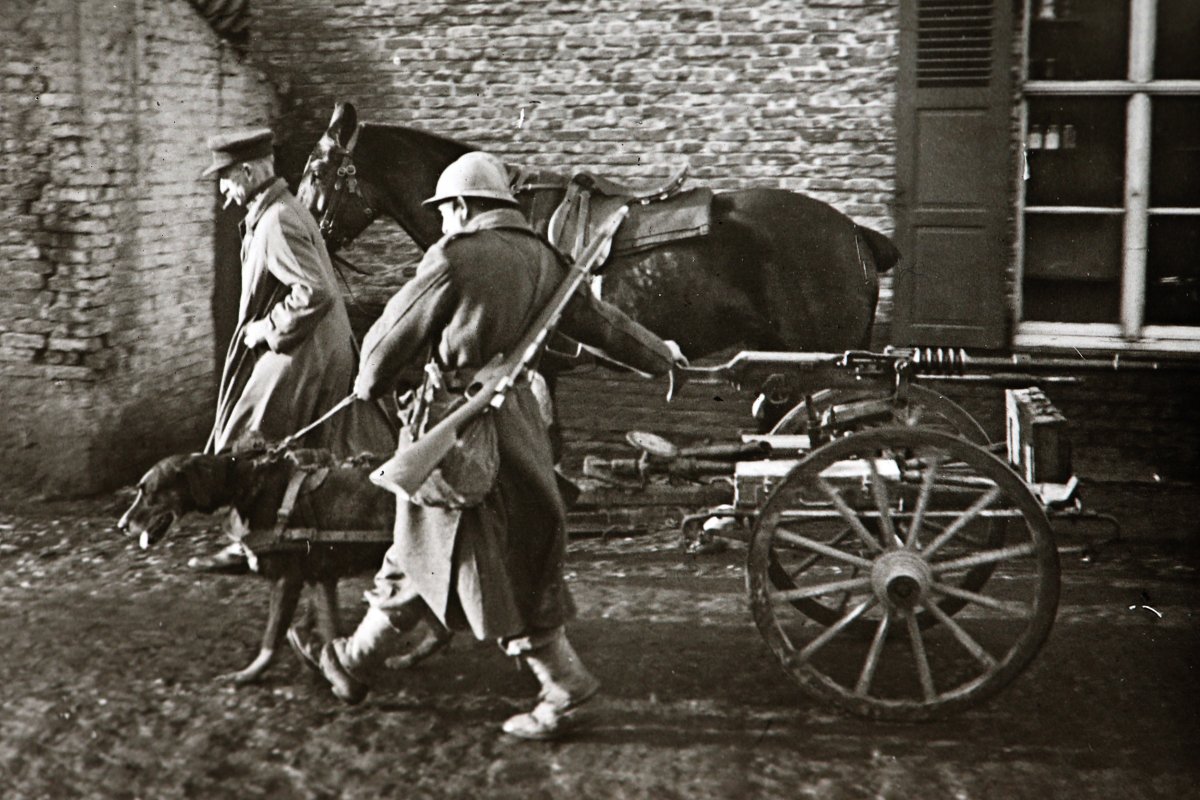
The Machine Gun (note the dog pulling the cart):
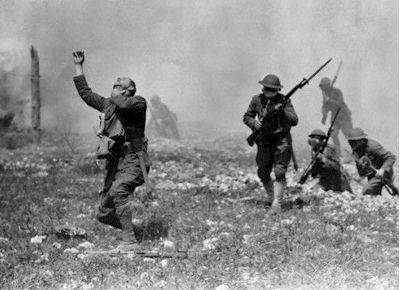
Mustard Gas:
And the largest artillery ever built:
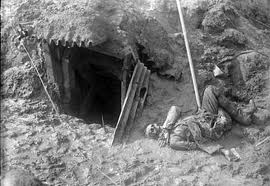
The killing was nothing less than slaughter.
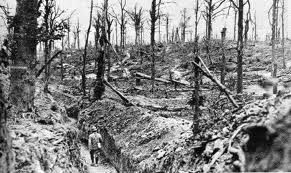
And the landscape was decimated:
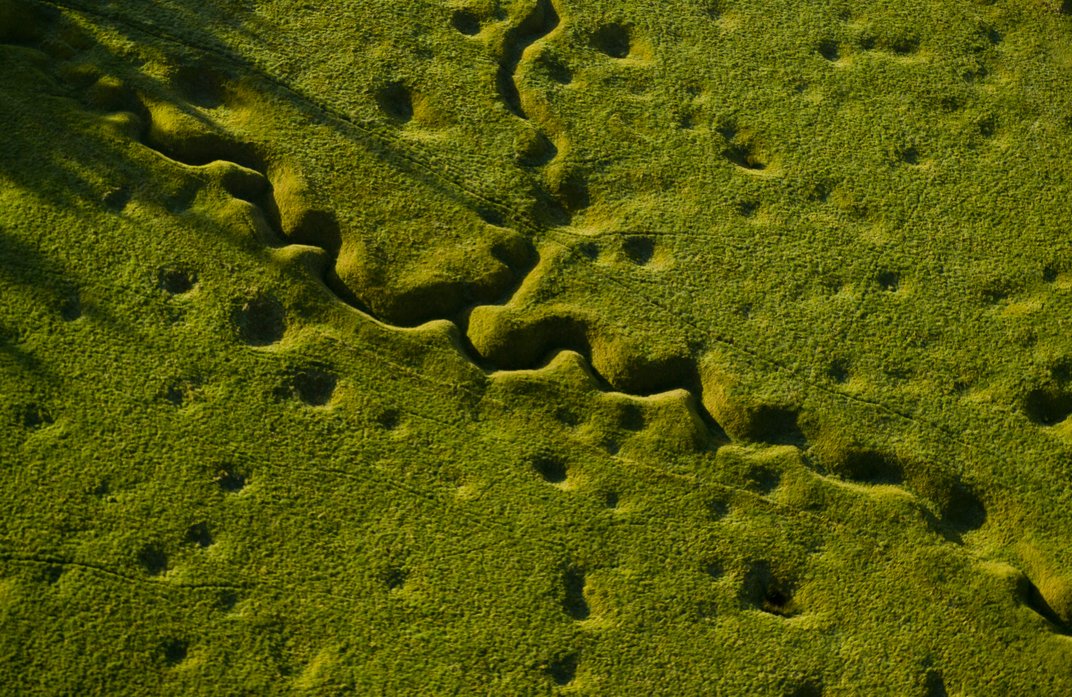
Even today, one can see evidence of the trenches of 100 years ago. These are from the Battle of the Somme:
The war changed everything. And the effect on the minds of people in the world were best captured in the poem, “The Second Coming,” by William Butler Yeats.
William Butler Yeats (1865-1939)
THE SECOND COMING
Turning and turning in the widening gyre
The falcon cannot hear the falconer;
Things fall apart; the centre cannot hold;
Mere anarchy is loosed upon the world,
The blood-dimmed tide is loosed, and everywhere
The ceremony of innocence is drowned;
The best lack all conviction, while the worst
Are full of passionate intensity.
Surely some revelation is at hand;
Surely the Second Coming is at hand.
The Second Coming! Hardly are those words out
When a vast image out of Spiritus Mundi
Troubles my sight: a waste of desert sand;
A shape with lion body and the head of a man,
A gaze blank and pitiless as the sun,
Is moving its slow thighs, while all about it
Wind shadows of the indignant desert birds.
The darkness drops again but now I know
That twenty centuries of stony sleep
Were vexed to nightmare by a rocking cradle,
And what rough beast, its hour come round at last,
Slouches towards Bethlehem to be born?
The problem of growing income inequality is global, and it continues to become more serious as the divide between rich and poor deepens. Nick Hanauer, a venture capitalist with a strong record of productive investments, gave a short TED talk on the problem. He focuses on the political implications of this process.
There is little question that China is a great power, but the question remains as to how much of China’s resources will be allocated to military power. David Shambaugh, writing in the National Interest, argues that China is unlikely to become a military superpower. He thinks that the Chinese government is far more concerned about regional issues, rather than international matters. Moreover, the pressing domestic concerns of the Chinese people will constrain China’s international interests. I think he underestimates the degree to which Chinese power will evolve (much of what he says about China accurately describe pre-1945 US), but the essay is definitely worth a read.
The Obama Administration has decided to use armed drones in Iraq. They are supposed to be used to protect the 300-odd military personnel that the US is sending to Iraq, but the definition of “protection” is so vague that the drones could be used in a variety of circumstances. Thus, the US is once again militarily engaged in Iraq, protecting a government that does not appear to have broad support against an enemy that remains quite small (ISIS), even though it seems to wield a great deal of power right now.
Argentina is in a desperate financial situation. It owes a hedge fund $1.5 billion which a US court has ruled is a legitimate debt. But it has already reached agreement with other bondholders of the debt to pay only a fraction of the original debt. If Argentina obeys the US court and pays the full debt to the hedge fund, then it is likely that the other debt holders will demand full payment as well. Full payment of the entire debt will use up almost half of Argentina’s current foreign currency reserves, a reduction that would probably trigger panic for everyone to whom Argentina has a financial commitment. Argentina must decide by 20 July, and there are few decisions it can make that will not harm its economy, and perhaps rattle global debt markets.
Ukraine has signed the agreement with the European Union that was at the center of the turmoil in Ukraine earlier in the year. The agreement is a free trade pact that triggered off sharp opposition from Russia. The agreement is a victory for pro-Western forces in the country, but Russia signaled its displeasure almost immediately. The EU also signed similar agreements with Georgia and Moldova, also states that were once part of the former Soviet Union.
Sometimes the stupidity of politicians baffles even the most cynical observers. Such is the case in the decision made by the US House of Representatives to pass a bill renaming the street in DC on which the Chinese Embassy sits to “Liu Xiaobo Plaza.” Mr. Liu won the Nobel Peace Prize in 2010 for his pursuit of human rights in China, and there is little question that he deserves recognition as he remains in prison for his efforts. But now ““[E]very piece of incoming mail to the embassy would bear the name of the imprisoned Nobel laureate,” said Rep. Frank Wolf, the Congressperson who proposed the change. There are probably many streets in DC that would proudly bear the name–there still is no “J” Street–and Congress has shown that there is no limit to petulance.
Some residents of Detroit, Michigan, have appealed to the United Nations, after the city cut off water to about 3,000 homes and businesses because of unpaid water bills. In 2008, the United Nations established a Special Rapporteur on the human right to safe drinking water and sanitation, acknowledging that access to clean and affordable water is a human right. Detroit is a city in bankruptcy, and its economic problems are well-known. Nonetheless, all governments have the obligation to protect the health and safety of their citizens.
The outbreak of the Ebola virus in West Africa has been labelled as “out of control” by Doctors Without Borders. There have been about 600 confirmed cases and 360 deaths from this outbreak. The virus usually surfaces in remote areas of East and Central Africa, and this time is the first time it has been confirmed in West Africa, affecting Guinea, Sierra Leone, and Liberia. The outbreak in areas near the heavily urbanized area of Guinea has contributed to its rapid spread. The World Health Organization is mobilizing its forces to contain the outbreak before it spreads further.