The world is depleting its underground water aquifers at an alarming rate. New research indicates that virtually every major source of groundwater is being depleted at rates that make the replenishment of the aquifers impossible. The aquifers tudies are the California’s Central Valley aquifer, the southern portion of the High Plains Aquifer in the U.S. Midwest, the North China Plains aquifer, an aquifer in northwestern India, an aquifer in the northern Middle East, Australia’s Canning Basin and the Guarani aquifer in central South America. Aquifers are notoriously difficult to measure, and the new research used satellite data to show how ground levels have increased as a result of underground water depletion.

A suicide bomber killed 54 people at the Wagah border crossing between India and Pakistan. The explosion occurred on the outskirts of Lahore, and it is not clear what the attack signals. Some believe that the bombing was timed to attack Shiites celebrating Ashura, a 10-day ritual to commemorate the death of Imam Hussain, the grandson of Prophet Muhammad. Militant Sunni Muslims consider the Shias to be heretical Muslims. The bombing, however, could signal the rise of tensions between India and Pakistan.
Britain and Germany are on a collision course on European Union migration policy. The free movement of labor is one of the essential four freedoms of the Union: the free movement of people, goods, services and capital. The British government, however, is feeling a great deal of political pressure on the issue of immigration, and British Prime Minister David Cameron wishes to restrict migration from EU countries. German Chancellor Angela Merkel is adamantly opposed to the violation of EU policy. We will have to see which side blinks first. Given the growing strength of the United Kingdom Independence Party, which is pushing for a British exit from the EU, is is likely that Cameron will be reluctant to concede to EU policy.
The UN has issued a stark climate report, arguing that humans must stop consuming fossil fuels entirely by 2100 or face irreversible and unlivable climate change. The evidence suggests that 2014 could end up being the hottest year on record, and there is little evidence that carbon emissions have declined appreciably across the planet. Sadly, only 54% of Americans believe that climate change is due to human behavior: the willful disregard of the science on the issue is a deeply troubling political obstacle to effective change.
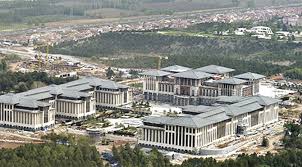
Turkey has a new residence for its President–an edifice that spreads over 50 acres and boasts 1000 rooms. The new residence is called Ak Saray (White Palace) and dwarfs Buckingham Palace, the White House, and the Kremlin. The estimated cost of the residence is about $350 million. Turkish President Recep Tayyip Erdogan unveiled the residence in celebration of the 91st anniversary of the founding of the Turkish Republic. The architecture is modern, but contains strong elements of the architectures of the Seljuk and Ottoman Empires, and reflects Erdogan’s aspirations for the new role of Turkey in world affairs.
Two weeks ago, we noted that an agreement had been reached between Boko Haram and the Government of Nigeria for a cease-fire and the release of hostages being held by the radical group. The good news was too good to be true, and Boko Haram now denies that any agreement had been reached, and that the 200 girl hostages had already been sold off or married. The failure to reach an agreement or to take effective action against the group will undoubtedly lead to more kidnappings in the future.
UNICEF, the arm of the UN entrusted with the welfare of children, has issued a report on the rate of poverty for children in developed countries since 2008. The report is grim: more than 2.6 million children entered poverty than left poverty. The Guardian reports that: “Norway has the lowest child poverty rate, at 5.3% (down from 9.6% in 2008), and Greece has the highest, at 40.5% (up from 23% in 2008). Latvia and Spain also have child poverty rates above 36%. In the US, the rate is 32%.” Many of these children will be trapped in poverty for their entire lives.
Bangladesh suffered a nation-wide electricity blackout on Saturday. A transmission line from India failed and the entire electrical network collapsed. Bangladesh is no stranger to electricity shortages, but the scale of this failure was unprecedented. Fortunately, it occurred on a weekend, or the economic consequences of the blackout would have been quite serious.
When Ireland went through a very serious banking crisis in 2008, it needed money from the European Union to finance its government debt. In return, the EU demanded that the Irish government implement a whole range of austerity measures to raise government revenues, including a new separate charge for water (which had been traditionally funded out of the general tax revenues of the government). The new charges have been implemented and the oppositions to the new tax has been furious. The protests in Ireland have been very large and very noisy, and it is likely that the Irish government will have to back down.
Burkina Faso’s President, Blaise Compaore, resigned after a storm of protests over his attempt to extend his 27-year rule of power. His resignation led to a power struggle among members of the military. General Honore Traore dissolved the Parliament after the resignation, but junior military officers insisted that, under the Constitution, the head of the National Assembly should replace the President. Unfortunately, Burkina Faso has a long history of military intervention in political affairs, and delegates from the African Union and the UN are attempting to restore normal political order in the country.
The German publication, Speigel, was able to conduct an interview with a member of the Islamic State. The interview is both fascinating and revealing. The non-liberal perspective of the Islamic State is apparent in this statement:
“Democracy is for infidels. A real Muslim is not a democrat because he doesn’t care about the opinions of majorities and minorities don’t interest him. He is only interested in what Islam says.”
The representative also goes on to justify taking any actions in support of the IS:
“It is every Muslim’s duty to fight those of a different belief until only Allah is worshipped around the world. Everybody has the opportunity to accept Allah and to change to the right path.”
But it is Halloween, and everyone should have a good scare:

And a good laugh:
Tensions are rising in the city of Jerusalem as Israeli authorities blocked all access to what Jews call the Temple Mount and what Muslims call the Noble Sanctuary. The move came after an attempted assassination attempt against a noted Jewish activist, Yehuda Glick, who has long argued for unfettered Jewish access to the site. The move also comes after a string of violent actions in Jerusalem between Israelis and Palestinians. The Islamic Jihad issued a statement saying that Glick “got what he deserved.” Right-wing politicians in the Israeli Knesset called for a march to the site to demand unfettered access by Jews to the site. The situation is becoming increasingly volatile.
Meanwhile, relations between the US and Israel have reached a low point as an unnamed Administration official labeled Israeli Prime Minister Benjamin Netanyahu a “chickenshit” minister. Comments such as these usually have some sort of official approval–anyone in the White House talking with Jeffrey Goldberg about Israel knows that the comments will be published. One would imagine that this is a way to put pressure on Israel as the deadline for the negotiations with Iran come closer to the 24 November deadline: signs of a rift with Israel’s most important ally would unnerve everyone in Israel except for Netanyahu’s closest supporters.
The United Nations has issued a report that suggests that more than 15,000 people have gone to Syria and Iraq to join the Islamic State. People from more than 80 countries have joined the movement, but the breadth and depth of the migration is difficult to assess. We really do not have any idea of how many of the migrants have gone out of a commitment to the stated objectives of the IS. The real question is how many of the 15,000 will contribute substantially to the military power of the IS.
A fascinating story from the Financial Times:
Heba Saleh in Cairo, “Western female jihadis deploy the ‘soft-power’ of Isis online,” Financial Times, 28 October 2014
They cheer on beheadings, defend rape and the enslavement of women, and yearn to revive oppressive centuries-old traditions that
many of their female co-religionists in Muslim countries are struggling to shake off.
Hundreds of young Muslim women from the west who travelled to Syria to marry fighters of the Islamic State in Iraq and the Levant,
known as Isis, are part of what experts call, the “soft-power” of the militants. Isis has used social media to attract new recruits and
build an image of the group as a reincarnation of the just and righteous state to which many Muslims aspire.
Umm Mu’awiyah, who tweets in English and appears to be British, is a recent arrival in Raqqa, the
Syrian capital of the Islamic state proclaimed by Isis. Despite the US-led strikes against the group, she tweeted on October 8 that she
has finally “made it to Dar al-Islam”, or the land of Islam, and exhorted others to “rush” over while there was still a “window of
opportunity”.
“It feels like I never left the west,” she wrote soon after her arrival. “I’m surrounded by so many Brits and Europeans, it is
unbelievable.”
An air raid a few days later left her undaunted: “Witnessed my first strike last night as the disbelievers attacked Raqqa. Alhamdulillah
[thank God] zero casualties & more money wasted by the Kafir [infidels].”
The women and their universe of online followers and young admirers back home are part of what Sasha Havlicek, director of the
London-based Institute for Strategic Dialogue, describes as a “jihadi girl power subculture”, facilitated by the internet.
For Isis, she argues, the recruitment of these women is “very good troop morale-strategy because in the battle of ideas it is good to say
western women, with all their freedoms, chose this”.
Mostly young, aged 15-22, jihadi women use social media, such as Twitter, Tumblr and Kik, the messaging service, to exchange with
followers advice on how to get to Syria, to celebrate Isis advances and to relay observations on their new lives.
They may be yearning for the lifestyles of early Muslims, but their language is that of modern tech-savvy teenagers, with slang and
emoticons interspersed with Arabic religious terms spelt out in English letters. Ms Havlicek describes it as “a kind of jihadi subculture
cool”, with the Arabic words inserted to provide a sense of authenticity and being “part of the gang”.
Muhajirah Amatullah describes herself on Twitter as “just a random Muhajirah [emigree to the Islamic state] /wife/mother who has
access to the internet. I pose no threat to your National Security: D Chillax!”
In another tweet she projects an image of a contented homemaker. “Mashallah! [by God’s will]. Beautiful blue sky Raqqa today. What
to do? Do the washing of course! Spoken like a true domestic pro!”
But juxtaposed with the domesticity and observations about the oranges and bananas in Raqqa’s markets there is praise of the bravery
of Isis soldiers who are real “men”, unlike enemy troops.
“Thy [sic] sleep w/eyes open+chop heads off”, she writes.
In an apparent response to critics opposed to the enslavement of prisoners of war taken by Isis, she posts
excerpts from what appears to be a religious study permitting slavery: “Repost: Islamic rulings re POW
(inc Slaves Men/Women/Children). B4 condemn/reject/oppose – lets learn!”
Umm Hussain al-Britani, identified in the British press as a 45-year-old Muslim convert Sally Jones,
one-time singer in a band, opines on her Twitter feed on October 13 that “taking female Kafirs
[unbelievers] as slaves is ibadah”, or an act of worship.
Experts say an estimated 60 British women have joined Isis, though all numbers are uncertain. Women
are also known to have travelled from Sweden, France, Belgium, Canada and the US. Reports say British
women have joined the all-female al-Khansaa brigade charged with enforcing Islamic rulings on women
in Raqqa.
Online, too, jihadi women appear to be trying to enforce moral rules. A Twitter account that goes by the
handle @irhabbyukhts, meaning Terrorist Sisters – an apparent attempt at irony – is dedicated to
naming and shaming jihadi men who flirt online with girls.
It warns: “Ya Akhawat [sisters] 140 letters cannot define the Deen [religiosity] and Akhlaq [morals] of anyone on Twitter. Don’t get
fooled, Shaytan [ the devil] spares no one! “
The Islamic State is trying to overturn the territorial boundaries established by the British and the French by the Sykes-Picot Treaty of 1916. The treaty was a secret one, drawn up in anticipation of the breakup of the Ottoman Empire during World War I. The boundaries were formally revised the Treaty of San Remo in 1920, but the main thrust of the 1916 treaty was observed. Needless to say, the boundary lines completely disregarded the actual demographic realities of the people who lived in the areas.

Amnesty International has released a report accusing the Ethiopian government of violating the human rights of its largest ethnic group, the Oromo. Ethiopia has about 80 ethnic groups and the Oromo are one of the largest of these. The government has accused the Oromo of subversive activities and denies that it is persecuting the Oromo. Ethiopia has been plagued by political violence in recent years, but the country as a whole has shown remarkable economic growth and stability.

The UN General Assembly has passed, for the 23rd time, a resolution urging the US to lift its decades-long embargo on Cuba. The resolution passed with 188 votes in the 193-member assembly. The US imposed the embargo during the Eisenhower Administration in 1961 to persuade Cuba to change its socialist government, and has accomplished absolutely nothing. The embargo wins the prize for the single most futile diplomatic effort in human history.
One of the most interesting dynamics of the conflict in Syria and Iraq is the confluence of interests between the US and Iran. Neither side has openly admitted this mutuality of interests, but both sides are acting in ways that reinforce the other. It remains to be seen whether the threat posed by the Islamic State forces the two sides to work together in a more coordinated and open manner.
The Nidaa Tounes party in Tunisia has won a plurality of seats in the recent Parliamentary elections. The vote is significant since the first rumbles of the Arab Spring in January 2011 began in Tunisia, and there has been a strong push by the Islamist party, Ennahda. The victory by Nidaa Tounes, a secular party, suggests that the turmoil in the Arab world does not lead inevitably to an Islamist outcome. The election was peaceful and held without any incidents.
The last British and American troops in Afghanistan left the country today. They left Helmand Province, the site of the worst fighting between NATO and Taliban forces. Some NATO forces will remain in Afghanistan but only in a training capacity. In addition, NATO will leave substantial military equipment in Afghanistan, although one hopes that the equipment in Afghanistan will be more closely guarded that the military equipment left in Iraq, much of which has been stolen by the Islamic State.
Both the European Banking Authority and the European Central Bank have conducted what are known as “stress” tests on over a hundred banks in Europe. A stress test involves creating a theoretical scenario of a financial crisis and checking whether the banks have sufficient capital to pay their creditors and depositors on schedule even in the throes of a financial panic. The scenarios are speculative, but the authorities attempt to make them plausible. Unfortunately, many of the European banks failed these stress tests and are therefore now required to raise additional capital. The problem is that raising capital means that money is diverted from profitable investment and just stored in case of an emergency. Which means that private capital is not available to stimulate economic growth. And the banks seem to be getting weaker over time.

Brazilian President Dilma Rousseff has been narrowly re-elected in a hotly contested election. The election cycle has been up and down for President Rousseff, but Brazilian voters seem to have rejected the pro-business policies of her opponent Aecio Neves.
Two pro-western parties have received very strong showings in the Ukrainian Parliamentary elections held today. The two parties, however, failed to achieve a clear majority in the Parliament, so Ukraine will be governed by a coalition of parties next year. Unfortunately, the elections were seriously flawed because millions of voters in the eastern parts of the country, currently under the control of Russian speaking separatists, were not able to vote. The inability to collect those votes will seriously compromise the legitimacy of the new government.
Paul Krugman is a noted Keynesian economist–he favors government intervention in the market in order to stimulate demand. Classical liberals oppose such policies because they believe that markets, if left alone, will produce more efficient and productive outcomes, and that government intervention produces political and not economic outcomes. Krugman has written an op-ed piece in which he compares the protests in Hong Kong to politics in the United States. His conclusions are that without government interventions, one can only expect greater income inequality in both economies.
Iran has set a deadline of 24 November for closing a deal with the P5+1 (the 5 Permanent members of the UN Security Council–the US, Great Britain, France, Russia, and China–plus Germany). Typically, negotiations get much tenser as deadlines approach, but it seems clear that both sides want to come to an agreement. There are reasons to believe that the negotiations will ultimately be successful, contrary to popular opinion when the negotiations started. What is not clear is how the both the US Congress and Israel will react to the deal. President Obama will likely try to craft an agreement that does not need Congressional approval.
Italian Prime Minster Matteo Renzi has introduced new labor law reforms that are strongly opposed by Italian labor unions. The unions organized protests across Italy and the one in Rome brought together almost a million people. The unions are opposed to continued austerity measures designed to bring down the Italian budget deficit. The protests mirror other protests against austerity across Europe. It remains to be seen whether Germany will ease up on its demands that European Union nations adhere to the rule that budget deficits cannot be more than 3%.

