For those who might share my fascination with maps, I highly recommend a brilliant new site published by the Museo Galileo in Florence, Italy. It is an interactive site investigating the 1507 map by German mapmaker Martin Waldseemüller. It is the first map that discards many of the early preconceptions of the geography of the world. Most importantly, it is the first map that identifies the Western Hemisphere as a distinctive part of the globe. It is also the map that gives the name “America” to the continents of the Western Hemisphere. after the explorer, Amerigo Vespucci. It would be difficult to overstate the significance of these discoveries for the European sense of place.
13 October 2016–Just an Extra Post–Not for the Course 2 comments
12 October 2016 Leave a comment
For those who wish to understand the great power dynamics in the Syrian civil war, I recommend a very detailed article in Spiegel. It goes through the dense web of alliances in the civil war, from the local groups fighting for limited Syrian goals to the great power fighting each other through proxies. The complexity (and inconsistencies) of these alliances give strong evidence for the intractability of the conflict and why, no matter what happens, this conflict will likely drag on for many years.

One of the pivotal events in the evolution of modern Europe was the plague that started to decimate populations in Europe in 1348. By the time that initial burst of contagion abated, almost 30% of the population of Europe was dead. But the revealing aspect of the plague was its clear manifestation of the process of globalization that the Europeans would ultimately master and use to control most of the world by the end of the 19th century. Paradoxically, the roots of imperial Europe begin with a devastating catastrophe.

For the second time in four days, someone has fired a missile from rebel-held territory in Yemen at the USS Mason, a guided missile destroyer. Some believe that Houthi rebels fired on the US vessel in retaliation for a Saudi Arabian air strike that killed as many as 140 people. The missiles did no damage to the US destroyer, but it is clear that the Yemeni rebels hold the US as equally accountable for Saudi attacks on Yemen. The Saudi-led coalition has conducted ruthless attacks on the rebels and many countries have condemned the extreme violence being used. The Saudis fear than Iran is supporting the rebels in an attack to weaken support for the Kingdom of Saudi Arabia.
11 October 2016 Leave a comment
Since Great Britain voted to leave the European Union, the British pound has lost 16% of its value as investors decide that the British exit will leave Great Britain poorer. The British Prime Minister has indicated that she prefers what analysts have termed a “hard” exit: a departure from the EU with few ties to the EU that could conceivably be retained by small concessions on both sides. The Economist interprets the decision in these terms:
“Markets anticipate that it will become more costly for British firms to sell goods and services to Europe. Europeans will consequently buy fewer of them, and therefore fewer pounds, leading to a weaker currency. That is, cheap sterling is part of the adjustment to a loss in British competitiveness: the mechanism by which Britons come to spend less on foreign goodies (now increasingly dear) as the price of its choice to leave the EU.”
The British decision should be viewed as a vote against globalization and that the British people are willing to pay the price.
Russian President Putin has cancelled a scheduled trip to Paris to celebrate the opening of a new Orthodox Church and a new Russian cultural exhibit. The cancellation comes after Russia vetoed a French Security Council resolution pushing for a cease-fire in Syria and a charge by French President Hollande that the Russian role in the Syrian civil war should be referred to the International Criminal Court for war crimes. Russian relations with the West continue to deteriorate.
As the world continues to discuss the issue of immigration, it is difficult to determine the basis for many of the claims surrounding how beneficial immigration is to a society. Some opponents of immigration believe that immigrants bring crime, terrorism, and lower wages. These claims are hard to document–the evidence is hard to assess since it is not systematic or comprehensive. But there are some aspects to immigration which appear to be fairly clear-cut. Of the six Americans who received the Nobel Prizes for various disciplines this year, all six are immigrants to the United States.
10 October 2016 Leave a comment
In an outcome that will certainly discomfort Russia, the pro-Western party, Georgian Dream, won a decisive victory in the national parliamentary elections. Georgia was once part of the Union of Soviet Socialist Republics, but has had a very tense relationship with Russia since its independence in 1991. Russia invaded the country in 2008 and wrested control of two parts of the country, creating two new countries (which have never been recognized by most countries in the world): South Ossetia and Abkhazia. The invasion was precipitated by the same fear that led Russia to invade Crimea in 2014: overtures from NATO and the EU for closer ties. Georgia walks a very difficult line given its geographic proximity to Russia.

Scientists have released a study which indicates that anthropogenic climate change is responsible for about one-half of the area burned in wildfires in the American West since the 1970s. According to the Washington Post:
“Overall, the researchers found that anthropogenic climate change was responsible for just over half of the total observed increase in fuel dryness since 1979. In turn, this influence has added more than 16,000 square miles of forest fire area to the western United States since 1984 — an area larger than the state of Maryland— nearly doubling the area scientists might have expected without the influence of similar climate change.”
The relationship between climate change and wildfires is certain to become more pronounced as global temperatures rise. It remains to be seen whether the relationship can be tested in other areas of the world.

The IMF is warning that debt levels in China are reaching heights that are increasingly dangerous. Debt, by the government, by banks, by corporations, and by households, is growing much faster than economic growth. According to The Telegraph:
“The Bank for International Settlements raised alarm bells last month over China’s “credit to GDP gap”. The key gauge of banking risk is currently at a record high of above 30, and much higher than levels seen in the run up to the 1997 Asian financial crisis.”
The Chinese government has the financial reserves to cover many of these debts but the use of these reserves would signal a serious crisis and likely lead to a decline in confidence in the Chinese economy.
9 October 2016 Leave a comment
The IMF has warned that the global economy is running a serious risk by allowing debt levels to rise to about $152 trillion. That amount is twice the size of the entire global GDP. The rapid rise of debt is troubling because it has not been accompanied by a rise in economic activity. Debt levels are not necessarily a problem as long as the debt is being used to stimulate future economic activity which allows the debt to be repaid. Debt in the absence of economic growth is a bubble waiting to burst–at some point, the creditors are going to demand to be repaid.

The South Asian movie industry is one of the most dynamic in the world and certainly the largest. It has, however, fallen victim to the crisis over Kashmir. Indian movies have been banned in Pakistan and Pakistani actors and technicians have been banned in India. The Pakistani bans renew policies that were once quite common, but the line between art and politics seems to have become very blurred because of the crisis.
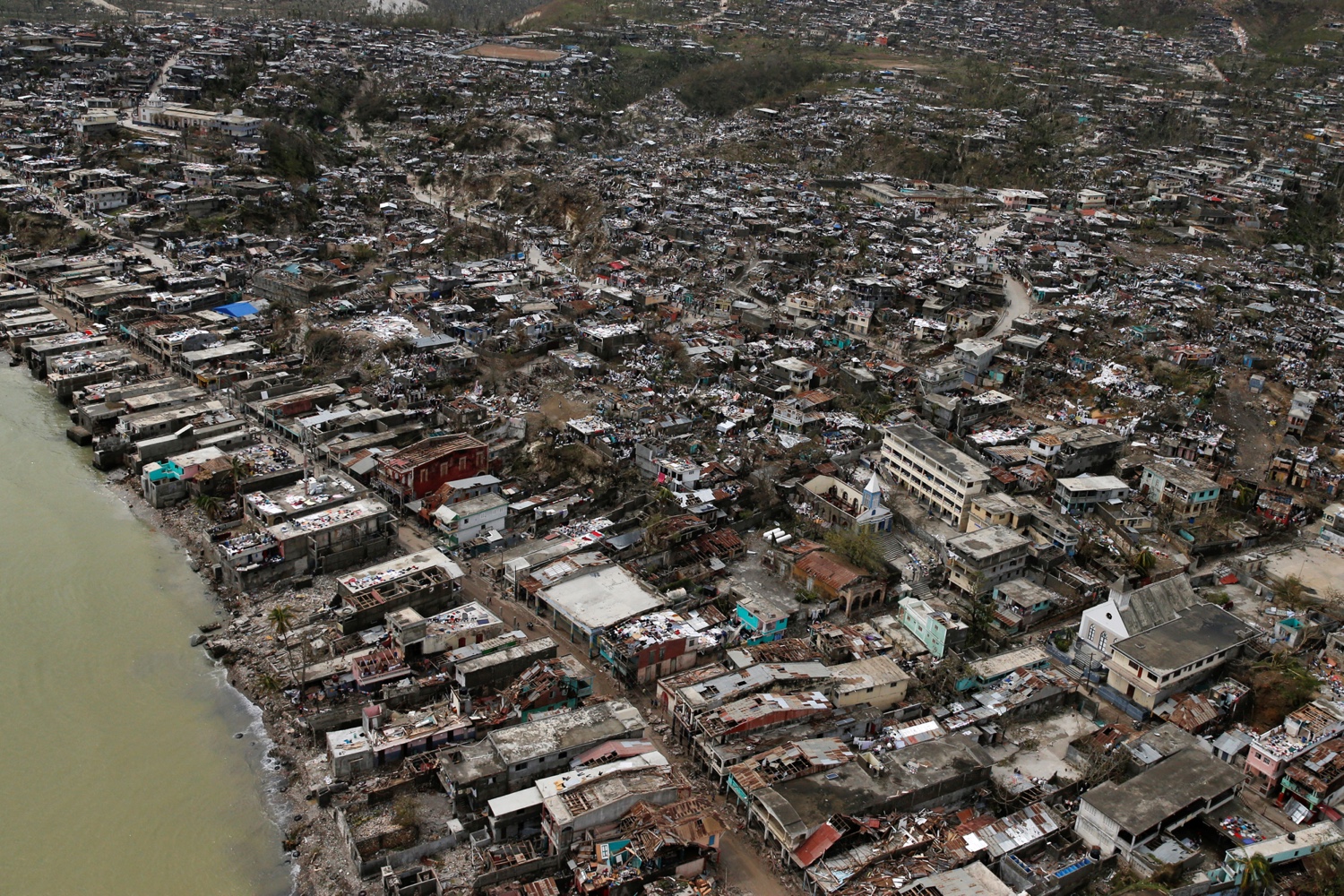
It is hard to appreciate the devastation in Haiti. We still have only an incomplete picture of the damage brought about by Hurricane Matthew. What we do know is that Haiti is likely the least capable country in the Western Hemisphere to deal with the destruction. Many areas of the country are still inaccessible because of damage to the transportation infrastructure. Some humanitarian relief is arriving in the country, but without a central government able to allocate and distribute the aid effectively, it is hard to imagine that the aid can be immediately effective. The biggest fear right now is the spread of disease due to the lack of clean water. Having said all that, it is hard to explain why the international community has been so slow to react to this crisis–the tepid response thus far will alleviate very little of the suffering.

8 October 2016 Leave a comment
Politics in the US is often (incorrectly) defined in liberal/conservative terms. The distinction is misleading because in political theory “liberal” refers to a special attitude toward the role of the individual society: liberal politics maximizes human freedom, a position often attributed to “conservative” thinkers in the US. Not only is the distinction misleading, it also seems to be increasing irrelevant. A more meaningful distinction has emerged over the last 8 years. Political controversies are better understood from the perspective of an attitude toward globalization. Attitudes toward trade, immigration, and refugees are the issues being contested most directly today.
The UN Security Council discussed two competing resolutions on the Syrian civil war, but ultimately rejected both. The Russian resolution called for a separation of extremist and moderate forces in Syria but did not call for a bombing halt against the city of Aleppo. That resolution only received four affirmative votes. The French resolution, which called for a truce on the bombing of Aleppo and for humanitarian aid, received 11 affirmative votes, but was vetoed by the Russians. The Russians have used the veto power on five Syrian resolutions in the last five years.
The Guardian has a fascinating piece on Iranian objectives in Iraq and Syria. The US and Iran are silent allies in this conflict. Both want the defeat of Daesh (the Islamic State). But Iranian aspirations are to develop a corridor of control from Tehran to the Mediterranean. If Iran were to gain control over such a corridor using Syria and the Kurds as allies, it would certainly shift the balance of power in the Middle East away from the Sunni states of Saudi Arabia, Kuwait, Qatar, and Egypt. The US would be confronted with difficult decisions if such a shift were to occur.

7 October2016 Leave a comment
Marjory was a student in the very first class I ever taught at MHC in 1976. She has been a tireless advocate for human rights and the human spirit her entire life.
7 October 2016 Leave a comment
Haiti was devastated by Hurricane Matthew. Latest reports have about 800 people killed by the storm, and an estimated $1 billion worth of damage. That may not sound like much to a rich country, but it reflects about 11% of Haiti’s GDP. Proportionately, it would be like the US suffered about $1.2 trillion worth of damage. It is also likely that there will be continuing side effects from the storm, most likely the spread of cholera due to the lack of appropriate sanitation facilities.
The US government has formally accused the Russian government of hacking into the computer files of American political organizations. The statement explicitly states that the hacking was approved by high Russian government officials:
“These thefts and disclosures are intended to interfere with the US election process. Such activity is not new to Moscow—the Russians have used similar tactics and techniques across Europe and Eurasia, for example, to influence public opinion there. We believe, based on the scope and sensitivity of these efforts, that only Russia’s senior-most officials could have authorized these activities.”
The specificity of the accusation clearly indicates the the US government is thinking about its response. The Russians, for their part, indicated that they are thinking about re-opening former air bases in Cuba and Vietnam, in addition to its new air base in Syria. It’s not clear, however, that either Cuba or Vietnam would welcome such a move. Coincidentally, today if Putin’s birthday!!!

The European Union has raised tariffs on certain types of Chinese-made steel by almost 74%. The EU believes that the Chinese are “dumping” the steel in an effort to keep their steel mills operating at high capacity. Dumping means that the Chinese are selling their steel at a loss, and the tariff is designed to compensate for the artificially low price. The Chinese government is presumably subsidizing their steel mills so that no workers need to be fired. Dumping is an economic strategy to drive the domestic producers of the same product out of business; once those producers are bankrupt, the exporting country will then raise its prices to a more profitable level. We will have to see what the Chinese reaction to the EU move will be.
6 October 2016 Leave a comment
China’s economy has become a critical component of the global economy. As it became a dominant producer and exporter of manufactured goods, Chinese economic growth played a critical role in stimulating the overall global economy even as it decimated the manufacturing sectors of some well-established economies such as the US. China has played out that phase of its economic growth and is now trying to create an economy that is fueled by its own domestic economy. The transition will be difficult and creates huge risks for the global economy, particularly as the Chinese government uses debt to substitute for demand for its exports. The whole world has a stake in making sure that the transition is facilitated and that the integration of the Chinese economy proceeds seamlessly.

US policy in Syria is currently in flux and there is growing sentiment that the US has a humanitarian responsibility in the civil war. There is no question that the US has an obligation to use its considerable power to protect innocent civilians. But the moral obligation needs to have some form of operational possibility. We should be very careful about how we think about what would constitute an effective humanitarian mission that does not also carry with it the possibility of a wider war. Micah Zenko has a very good essay in Foreign Policy which asks some very pointed questions. Steven Simon and Jonathan Stevenson wrote an op-ed for the New York Times which actually warns against a humanitarian intervention.
The use of social media is a new phenomenon for many of us and I continue to be surprised at how information is being communicated by official state organs. The Ministry of Defense of the Russian Federation has its own Facebook page, and in a post put out today, it warned US and other allied forces that it had issued orders to its forces manning the anti-aircraft systems in Syria (c-300 and p-300 systems which are top of the line) to take whatever measures are necessary to protect themselves. (The page can be translated by Google) In a more pointed warning, it suggested that the anti-aircraft systems will not have the time to identify their targets before they shoot. In other words, they will shoot without warning. The rhetoric between the US and Russia continues to escalate. At this time I still believe that we are watching a war of words and that there is no intent to start a great power war. But the risk of an accidental war continues to increase. We need to remeber that the US accidentally attacked a Syrian army outfit on 17 September.
5 October 2016–Update Leave a comment
For an especially insightful essay on US strategy in Syria, check out Fred Kaplan’s essay in Slate.

