Even though the practice is illegal, slavery is a common feature of most economies in the world. The International Labor Organization (ILO) defines involuntary servitude as “work or service exacted from people against their will and ‘under the menace of any penalty'”. The majority of modern slaves are women and last year there were about 25 million slaves. The most common tasks assigned to slaves are prostitution and domestic housekeeping, but the range of tasks is extraordinary.
“Researchers found that forest areas in South America, Africa and Asia – which have until recently played a key role in absorbing greenhouse gases – are now releasing 425 teragrams [1012 (one trillion) grams] of carbon annually, which is more than all the traffic in the United States.”
The researchers note that one of the more effective ways to protect forests from degradation is to protect the rights of the indigenous peoples that inhabit them against those who wish to use forest resources for other purposes.
The US ambassador to Israel, David Friedman, has given an interview to an Israeli news channel in which he asserted that Israel controls only 2% of the West Bank. Ambassador Friedman seems to be referring to the actual physical footprint of Israeli settlements in the West Bank. The statement appears to be at odds with traditional US policy which regards the entire West Bank as Occupied Territory. Prior to his appointment as Ambassador, Friedman had made clear his opposition to the two-state solution in the Middle East, and his statement may signal a change in US policy toward the Israeli-Palestinian dispute.
As the North American Free Trade Agreement (NAFTA) is being renegotiated, the US just slapped a 220% tariff on a new line of Bombardier jets produced in Canada. The US claims that the Canadian company has received unfair government subsidies from its government and from Great Britain where some of the plane’s components are produced and has placed the planes produced by American jet makers (Boeing) at a competitive disadvantage. There are fears that the action could precipitate reciprocal action from Great Britain which is a big buyer of Boeing planes. This sequence of events is the way a trade war starts and trade wars always end very badly.
“….realistic scenarios show an ice loss between 49% and 64%. Finally we show that there is great variation in the region in glacier response to climate change, which is caused by differences in glacier characteristics and projected local climate change.”
The findings are especially troubling since a very large percentage of humanity relies upon the fresh water released by the slow melting of glaciers. The Himalayan plateau is the site of the headwaters for some of the great rivers in Asia, such as the Yangtze, Brahmaputra, Mekong, Indus, Salween, and Yellow Rivers. These rivers serve almost half of the world’s population.
Rivers that Originate in the Tibetan Plateau
FiveThirtyEight is a highly respected polling company and it has compiled information on how global attitudes toward the US have changed since the election of Donald Trump as President. As shown bythe graph below, the change as been dramatic. The polls show widespread disapproval of five of President Trump’s foreign policy proposals, such as withdrawal from the Paris Climate Agreement, building the wall between the US and Mexico. withdrawing from the Iranian nuclear agreement, withdrawing from major trade agreements, and restricting visitors from primarily Muslim-majority countries.
QUESTION: Could I – yeah, could I move on to Kurdistan?
MS NAUERT: Sure.
QUESTION: Yes.
MS NAUERT: Let’s start there.
QUESTION: Can you, first of all, give – we saw the statement that you issued, but has anything transpired since the conclusion of their referendum? Have you arrived at any other – any position?
MS NAUERT: Well, I know that the actual vote numbers have not come in yet. It’s – we know that the turnout was obviously quite high and we certainly would understand why, a lot of enthusiasm, certainly, for that. I think our position, the U.S. Government’s position on the Kurdish referendum we’ve talked about since the very day I got here, and that was that we did not support that referendum. Despite our efforts and our ongoing conversations with both Mr. Barzani and Mr. Abadi – the Secretary had spoken with them both by phone, I know, in recent days – we expressed our deep concern about that, and also our disappointment that they decided to go ahead and conduct that vote yesterday. We look at that as a unilateral referendum and it was something that the coalition partners, the D-ISIS coalition – I don’t think there was a single nation that supported that.
QUESTION: Today, the Iraqi Government said – or in fact, they gave ultimatum to the Kurdistan region to close their airport system because they intend on closing their airspace. Do you have any comment on that?
MS NAUERT: Yeah.
QUESTION: Does that drive both —
MS NAUERT: So we’ve seen that – I’ve certainly seen that report. I’m aware of it. One of the things we would do is call on all sides to engage constructively. That, if that is, in fact, accurate, would not be an example of engaging constructively. We want the – both sides to come together and have some conversations and be able to move things forward, but do it in a constructive fashion.
QUESTION: Thank you.
QUESTION: Heather?
MS NAUERT: Okay. Yeah, hi.
QUESTION: Thank you. So on your statement, you said that you will continue your historic relationship with the Kurdish people. Do you mean only the Kurdish people or with the Kurdish government as well?
MS NAUERT: Well, I think our conversations will be ongoing. We will continue to have conversations both with our friends in Baghdad as well as our friends in the north as well. We have a lot of conversations, as you all know. We have a close relationship with both. The United States Government and the coalition’s concern about this and the timing of this referendum was we didn’t want to splinter Iraq. We see the primary issue as taking on ISIS, defeating ISIS, annihilating ISIS, so that they never come to try to rule over and terrorize the Iraqi people again. We’d like to keep our eye on the ball with that. That failed; that is a concern of ours and is deeply disappointing.
QUESTION: And one more question. Aren’t you worried that by clearly taking the side of Baghdad you might discourage compromise on the side of Baghdad, or you might actually increase —
MS NAUERT: I would take issue with the premise of your question. We don’t see it as taking sides with Baghdad. We support a unified, democratic Iraq. Okay?
QUESTION: But by opposing the referendum, isn’t that taking side with Baghdad’s position?
MS NAUERT: We support a unified, democratic Iraq, and we want everybody to keep the – keep their eye on the ball, and that is annihilating ISIS.
QUESTION: And on Iran’s decision to halt air flights between Kurdistan – from and to Kurdistan, would you condemn that?
MS NAUERT: I’m not aware of that, so I’m sorry, I don’t have anything for you on that. Anything – anything? Anything with – Laurie. Hi, how are you?
QUESTION: I’m fine. You said you want to see constructive dialogue. What about President Erdogan’s statement that – threatening to close the border and to cut off oil exports? “When we close the… taps, their revenues will vanish… they won’t be able to find food.” Is that constructive dialogue?
MS NAUERT: I think that that would – that certainly sounds like a threat on the part of President Erdogan. But I’m not going to comment on what he’s had to say.
QUESTION: And what about these implicit threats of military action against the Kurdistan region? What is your view of them?
MS NAUERT: Military action by —
QUESTION: By Turkey, Iran, and Iraq.
MS NAUERT: Look, we want safety and security for the Iraqi people. We had tremendous concerns with this referendum. We’ve certainly talked about that a lot. That referendum had no basis in the Iraqi constitution or the law, and I’ll just leave it at that. Okay?
QUESTION: But these military – these threats of military action, you don’t firmly oppose them?
MS NAUERT: Look, we oppose violence from any party. I mean, that is clear. We would oppose violence in any way. We want to keep our eye on the ball of ISIS, and that is it. Okay?
Opposing the referendum, despite its overwhelming support for greater autonomy, while at the same time supporting the position of the Iraqi government is not a tenable position. If the Kurds are confused, they have every right to be. And there is no clear evidence that the US would support the Kurds if they were attacked by any of their neighbors. Talk about hanging a reliable ally out to dry. Al Jazeera has a very good video on whether the Kurds can support an independent state.
Saudi Arabia has granted women the right to obtain a driver’s license without needing the consent of a legal guardian. Saudi Arabia is the last country to deny the freedom to drive to women and the change mirrors other changes that have been implemented since Saudi Arabia’s new Crown Prince, Mohammed bin Salman, has tried to modernize the Saudi economy. The issue has been a human rights embarrassment for the Kingdom for many years, reflecting the profound control of conservative clerics on Saudi society. We shall see if the move induces a backlash.
“Since the U.S. declared war on our country, we will have every right to make countermeasures, including the right to shoot down the U.S. bombers even when they are not yet inside the airspace border of our country”.
The statement ratchets up the harsh rhetoric between the two states, although the actual substance of the rhetoric remains opaque. The US and North Korea have been in a technical state of war since 1953 since the Korean War ended only with an armistice, not a peace treaty. The two states do not even share diplomatic relations. But the threat of shooting down US airplanes in international airspace is extraordinary. Joseph DeThomas has written a superb essay on the risk of war for the blog, 38North, which outlines the heightened risks we now all face.
North Korean Airspace
Today marks the 60th anniversary of the desegregation of the schools in Little Rock, Arkansas. Nine brave young African-Americans were escorted to school under the protection of National Guard units who were following the 1954 decision of the US Supreme Court in its decision, Brown vs. the Board of Education, Topeka Kansas and ordered to do so by President Eisenhower. The Governor of the state, Orval Faubus, had closed the schools in order to resist the order to integrate. The integration of Little Rock schools was an important moment in the civil rights movement in the US.
But it was only a moment. To be followed by other “moments”. As athletes in the US take action to demand racial equality in the US today, it is worthwhile to remember other times in US history when athletes have taken a stand. One of the most stirring moments was when boxing champion, Muhammad Ali, refused induction into the armed forces because of his opposition to the war in Vietnam. Ali was similarly excoriated when he took he stand and he was convicted for the crime and stripped of his championship. The Supreme Court overturned his conviction in 1971. But Ali was clear in his beliefs:
Finally, in the 1968 Olympics held in Mexico City, Tommie Smith and John Carlos, winners in the 200 meter race, held their arms up on the podium while the “Star-Spangled Banner” was being played.
“On the morning of 16 October 1968, US athlete Tommie Smith won the 200 meter race with a world-record time of 19.83 seconds. Australia’s Peter Norman finished second with a time of 20.06 seconds, and the US’s John Carlos won third place with a time of 20.10 seconds. After the race was completed, the three went to the podium for their medals to be presented by David Cecil, 6th Marquess of Exeter. The two US athletes received their medals shoeless, but wearing black socks, to represent black poverty. Smith wore a black scarf around his neck to represent black pride, Carlos had his tracksuit top unzipped to show solidarity with all blue-collar workers in the US and wore a necklace of beads which he described “were for those individuals that were lynched, or killed and that no-one said a prayer for, that were hung and tarred. It was for those thrown off the side of the boats in the Middle Passage”. All three athletes wore Olympic Project for Human Rights (OPHR) badges after Norman, a critic of Australia’s former White Australia Policy, expressed empathy with their ideals. Sociologist Harry Edwards, the founder of the OPHR, had urged black athletes to boycott the games; reportedly, the actions of Smith and Carlos on 16 October 1968 were inspired by Edwards’s arguments.
“The famous picture of the event was taken by photographer John Dominis.
“Both US athletes intended to bring black gloves to the event, but Carlos forgot his, leaving them in the Olympic Village. It was Peter Norman who suggested Carlos wear Smith’s left-handed glove. For this reason, Carlos raised his left hand as opposed to his right, differing from the traditional Black Power salute. When The Star-Spangled Banner played, Smith and Carlos delivered the salute with heads bowed, a gesture which became front page news around the world. As they left the podium they were booed by the crowd. Smith later said, “If I win, I am American, not a black American. But if I did something bad, then they would say I am a Negro. We are black and we are proud of being black. Black America will understand what we did tonight.”
Protests invariably incite a negative reaction. But the passage of time often vindicates those who were brave enough to take a stand. It is unfortunate that these lessons are too often forgotten.
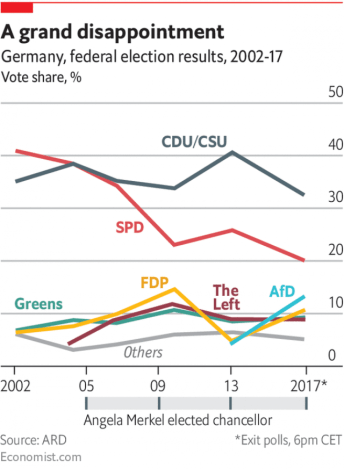
“Updated projections have the CDU/CSU (Christian Democrats/Christian Social Union) on 33.1%, an improvement but still below the party’s lowest vote-share since 1949. And they have the SPD (Social Democrats) on a dismal 20.4%, almost three points below its previous post-war nadir in 2009.”
On Monday, 25 September Kurds in Iraq will vote in a referendum concerning possible Kurdish independence. The Kurds constitute one of the largest nations in the world (between 25-30 million people consider themselves to be Kurds) without a state. There was a possibility for an independent Kurdistan early in the 20th century. After World War I and the collapse of the Ottoman Empire, the British and French concocted the Treaty of Sèvres which divided up the Ottoman Empire into different nation-states, including an independent Kurdistan. The Turks, led by Mustafa Kemal Ataturk, fought several battles against the Allied powers, culminating in the Armistice of Mudanya (1922) with Turkish troops in control of critical parts of Anatolia. That Armistice led to the Treaty of Lausanne in which the Sèvres Treaty was nullified and modern Turkey was created and the promise of and independent Kurdistan was squashed.
Treaty of Sèvres (1920)
Treaty of Lausanne (1923)
Ultimately, however, both of these Treaties were frauds. The intentions of the British and the French were clearly stated in their secret Sykes-Picot Treaty in 1916. The two powers deluded themselves into thinking that their empires would survive the ongoing World War and they had every intention of integrating the collapsed Ottoman Empire into them. The Sèvres and Lausanne Treaties were partial capitulations to those aspirations, but both countries intended to treat the “new” countries as semi-colonies. Indeed, some Kurds actually fought on the side of the Turks in the war against the Allies between 1920 and 1923 because they feared becoming that the proposed “independent” country of Kurdistan would be a satellite of the British.
Kurds in Iran once did have an independent state. During World War II British and Soviet troops occupied Iran, and Kurds in the northern zone controlled by the Soviet Union declared the independent Republic of Kurdistan in Mahabad, Iran in January of 1946. The Kurdish armed forces were led by Mustafa Barzani, the father of the current leader of Iraqi Kurds. The Mahabad republic lasted less than a year before it was crushed by Iranian forces.
Given this history, it is not surprising that every state in the region, including the US which has armed and used Kurdish forces in its war against Daesh (the Islamic State) in Iraq and Syria, is opposed to Kurdish independence, with the single exception of Israel. Israel sees an independent Kurdish state as an important counterweight to Iranian influence in the region. The Kurds never seem to catch a break.
It is always difficult to interpret political rhetoric, but the exchanges between Us President Trump and North Korean leader Kim Jong-un are especially difficult to analyze. Zack Beauchamp has written an article which tries to parse out the language and he argues that the most recent exchanges are significant, largely because the North Korean statement signals the first time Kim has personally identified with the statement. Beauchamp also makes an obvious point: the US needs to stop responding to North Korea’s rhetoric. Every time it responds, it only increases North Korea’s insecurity. The best course of action would be for the US simply to stick to behind the scenes diplomacy. Unfortunately, the US decided to fly two B1-B Bombers over waters close to North Korea but still in international airspace.
Iran has tested a new intermediate-range ballistic missile, ignoring US President Trump’s concerns that such tests violate the “spirit” of the nuclear agreement. Iran is not constrained either by the nuclear agreement with the P5 +1 or by the Non-Proliferation Treaty to test missile technology. The Iranian Defense Minister, Amir Hatami, minced no words in defending the test: “As long as some speak in the language of threats, the strengthening of the country’s defence capabilities will continue and Iran will not seek permission from any country for producing various kinds of missile”. President Trump must report to the Congress on 15 October on whether Iran has upheld the terms of the nuclear agreement. It will be interesting to see what he does on that date.
Vijay Prashad has resigned from the editorial board of a once-prestigious journal, Third World Quarterly, because it published what he considered to be a “mediocre” essay entitled, “The Case for Colonialism”. The essay has subsequently been withdrawn, but Prashad has written a essay for Quartz which delivers a broadside to a rash of publications, beginning with Niall Ferguson’s Empire: How Britain Made the Modern World, which have tried to temporize European imperialism. There is nothing good that comes from a coercive and violent relationship such as imperialism. Whatever “benefit” accrued could have been more effectively realized in a peaceful and cooperative relationship.
North Korean Foreign Minister Ri Yong-ho warned that Pyongyang could test a hydrogen bomb in the Pacific Ocean in response to the volley of insults being thrown by US President Trump and North Korean leader, Kim Jong-un. Needless to say, such a move would be a highly provocative act would rattle everyone in the world–no state has tested a nuclear bomb in the atmosphere for over 40 years. But since North Korea is no longer a signatory to the Non-Proliferation Treaty (it abrogated the Treaty in 2003) the test is perfectly legal, albeit highly dangerous. Russian Foreign Minister Sergei Lavrov made this comment about the behavior of the US and North Korea:
“Together with China we’ll continue to strive for a reasonable approach and not an emotional one like when children in a kindergarten start fighting and no-one can stop them”.
Although the Russians also have much to account for in Ukraine and Syria, the sentiment is likely shared by many in the world. I have become increasingly worried about this dispute getting out of hand even as I continue to believe that neither side wishes to see an open conflict. This dispute is foolish.
Two researchers have published a paper which examines the rise of right-wing and nationalist parties in Europe. Their findings are intriguing. They believe that the rise of these parties does not reflect a rise in such sentiments among the European populations, Rather, they argue that the rise of these parties indicates a loss of faith in “political institutions and leaders.” In other words, Europeans have not become more right-wing; they have become more strongly anti-establishment, and the nationalist parties are the only way to express their dissatisfaction. If true, this conclusion offers a degree of hope if the traditional parties in Europe (and, in the US as well) begin to offer good solutions to the economic malaise the people are enduring.
The North Korean Press Agency issued Kim Jong-un’s response to US President Trump’s speech to the United Nations. Here are some excerpts:
“But, far from making remarks of any persuasive power that can be viewed to be helpful to defusing tension, he made unprecedented rude nonsense one has never heard from any of his predecessors.
“A frightened dog barks louder…..
“The mentally deranged behavior of the U.S. president openly expressing on the UN arena the unethical will to ‘totally destroy’ a sovereign state, beyond the boundary of threats of regime change or overturn of social system, makes even those with normal thinking faculty think about discretion and composure.
“His remarks which described the U.S. option through straightforward expression of his will have convinced me, rather than frightening or stopping me, that the path I chose is correct and that it is the one I have to follow to the last.
“Now that Trump has denied the existence of and insulted me and my country in front of the eyes of the world and made the most ferocious declaration of a war in history that he would destroy the DPRK, we will consider with seriousness exercising of a corresponding, highest level of hard-line countermeasure in history…..
“Action is the best option in treating the dotard who, hard of hearing, is uttering only what he wants to say.
“As a man representing the DPRK and on behalf of the dignity and honor of my state and people and on my own, I will make the man holding the prerogative of the supreme command in the U.S. pay dearly for his speech calling for totally destroying the DPRK…..
“Whatever Trump might have expected, he will face results beyond his expectation.
“I will surely and definitely tame the mentally deranged U. S. dotard with fire.”
It is hard to determine what Mr. Kim intends to do. The language of the two leaders defies analysis.
The US Congressional Budget Office issued a report last year on the distribution of wealth in the US. Wealth is more difficult to measure than income since it includes assets, such as homes, works of art, and other valuable objects, that are not assessed in monetary terms on an annual basis. But wealth is probably a more important variable to measure when there are discussions about how “fair” the distribution of economic power might be in a given society. The report described a highly unequal society:
“In 2013, families in the top 10 percent of the wealth distribution held 76 percent of all family wealth, families in the 51st to the 90th percentiles held 23 percent, and those in the bottom half of the distribution held 1 percent. Average wealth was about $4 million for families in the top 10 percent of the wealth distribution, $316,000 for families in the 51st to 90th percentiles, and $36,000 for families in the 26th to 50th percentiles. On average, families at or below the 25th percentile were $13,000 in debt.”
Moreover, the rate of change toward a more unequal society seems to be accelerating:
“The distribution of wealth among the nation’s families was more unequal in 2013 than it had been in 1989. For instance, the difference in wealth held by families at the 90th percentile and the wealth of those in the middle widened from $532,000 to $861,000 over the period (in 2013 dollars). The share of wealth held by families in the top 10 percent of the wealth distribution increased from 67 percent to 76 percent, whereas the share of wealth held by families in the bottom half of the distribution declined from 3 percent to 1 percent.”
It is unlikely that this trend is politically sustainable over the longer term. In many respects, this data explains a great deal about the anger in the electorate which seems to be growing.
Since the Great Recession of 2008-09, many governments in the world have increased their total indebtedness. According to the Pew Research Center, “the total amount of government debt now exceeds $63.1 trillion”. The growth of debt has been particularly high in the rich countries: “In the world’s seven major advanced economies (known as the Group of Seven), debt as a share of GDP increased by an average of 22.2% between 2008 and 2011”. Debt is a very imperfect indicator of economic health. The real index is whether the debt will ultimately contribute to generating economic growth that will make repaying the debt easier. But debt is an marker for vulnerability to specific, unforeseen events. From that perspective, we should all hope that we are not surprised by natural or political disasters anytime soon.
US President Trump’s speech at the United Nations has received a wide range of responses. China’s People’s Dailyran an editorial which said:
“Trump’s political chest-thumping is unhelpful, and it will only push the DPRK to pursue even riskier polices, because the survival of the regime is at stake. It is time for the US to realize that irresponsible words and actions are backing the DPRK into a corner with no way out, and it would be a tragedy if Trump’s risky game of chicken with the DPRK crosses the point of no return.
“In over 30 years in my experience with the UN, I never heard a bolder or more courageous speech. President Trump spoke the truth about the great dangers facing our world and issued a powerful call to confront them in order to ensure the future of humanity.”
Iranian President Hassan Rouhani responded today to President Trump’s characterization of the nuclear agreement and stated that: “I declare before you that the Islamic Republic of Iran will not be the first country to violate the agreement; but it will respond decisively and resolutely to its violation by any party.” He went on to say:
“The ignorant, absurd and hateful rhetoric, filled with ridiculously baseless allegations, that was uttered before this august body by the president of America yesterday (Tuesday), was not only unfit to be heard at the United Nations – which was established to promote peace and respect between nations – but indeed contradicted the demands of our nations from this world body to bring governments together to combat war and terror.”
I have yet to read an analysis of the speech that is dispassionate. The speech clearly targeted certain constituencies which have responded somewhat predictably. But the language of the speech, particularly its emphasis on sovereignty and what I believe to be some misunderstandings of sovereignty suggested that the speech was an attempt to be something doctrinal. I have not yet figured out the specifics of the doctrine.
Spanish authorities raided Catalan government offices and arrested several Catalan government officials in an attempt to stop the proposed referendum on Catalan independence scheduled for 1 October. The Spanish Constitution has no provision for provincial secession and the central government argues that any effort to secede is illegal. Up to this point, it seemed as if the referendum would not support Catalonian independence, but the raids on the Catalonian governmental offices might provoke a counter-reaction to the central government. We should watch how this unfolds.
US President Trump gave his first speech to the United Nations today. In keeping with the character of his Presidency, the speech eschewed diplomatic language and was unusually blunt for a UN speech. The speech was anchored in what was called “principled” realism. He emphasized the centrality of sovereignty to his worldview, a point of view that is consistent with the language of “America first”. But he was straightforward in condemning specific states for following policies that they believe are essential to the protection of their sovereignty (and territorial integrity). For example, his criticism of North Korea’s nuclear program was apocalyptic:
“The United States has great strength and patience, but if it is forced to defend itself and its allies, it will have no choice but to destroy North Korea…Rocket Man is on a suicide mission for himself and for his regime”.
The purpose of war is most emphatically not to “destroy” one’s opponent; the purpose of war is to coerce one’s opponent to change a course of action. “Destroying” another country is rhetoric that is dangerous–if practiced, it is nothing other than genocide. Moreover, referring to the leader of a country in derogatory terms is a deliberate attempt to goad one’s opponent into a confrontation. Referring to Kim Jong-un as “Rocket Man” in a highly public forum personalizes the conflict. Such disrespect begs a countermove and President Trump seems to want an excuse to use force against North Korea. No leader should ever wish to use force. The use of force is a confession of failure to resolve a dispute without violence.
Similarly, President Trump signaled his clear dissatisfaction with the nuclear agreement with Iran:
“We cannot abide by an agreement if it provides cover for the eventual construction of a nuclear program….” calling it “one of the worst and most one-sided transactions the United States has ever entered into” and “an embarrassment to the United States. And I don’t think you’ve heard the last of it. Believe me.”
President Trump failed to mention that the agreement was one sanctioned by the very body he was speaking to: the United Nations. It was also an an agreement that the US voluntarily signed, fully exercising its sovereignty to agree or disagree with the agreement. It is also an agreement that all parties involved agree has had Iran’s full compliance. But the US undoubtedly has the sovereign right to leave the agreement. What President Trump left unsaid was what would come after the US leaves the agreement and whether the other six signatory countries would continue to adhere to the agreement. It is not enough to criticize the status quo; the purpose of criticism is to propose something better. As of yet, we have no idea what that better agreement might be.
There was also a thread to the speech that was inconsistent with the venue. President Trump emphasized the importance of nationalism in no uncertain terms:
“Are we still patriots? Do we love our nations enough to protect their sovereignty and take ownership of their futures?”
Again, this is rhetoric, but rhetoric that is at odds in an international body whose purpose is to maximize cooperation among nations. Indeed, these words from the Preamble to the United Nations Charter were expressed to counter the excesses of nationalism that had led to World Wars I and II:
to practice tolerance and live together in peace with one another as good neighbours, and
to unite our strength to maintain international peace and security, and
to ensure, by the acceptance of principles and the institution of methods, that armed force shall not be used, save in the common interest, and
to employ international machinery for the promotion of the economic and social advancement of all peoples
We will have a much better sense of the impact of the speech after more time to reflect on the words.




 World Politics News