A new study published in Science indicates that a committed minority of about 25% of a given group can fundamentally change the attitudes of the entire group. The study was conducted the Annenberg School of Communications at the University of Pennsylvania and its findings are worth pondering. According to Scientific American:
“….the paper describes an online experiment in which researchers sought to determine what percentage of total population a minority needs to reach the critical mass necessary to reverse a majority viewpoint. The tipping point, they found, is just 25 percent. At and slightly above that level, contrarians were able to ‘convert’ anywhere from 72 to 100 percent of the population of their respective groups. Prior to the efforts of the minority, the population had been in 100 percent agreement about their original position.”
Further studies are needed to verify the findings, but they raise interesting questions about the dynamics of democracy and governance. And we need to figure out what determines that high level of cohesion and commitment within the minority.
The UN International Organization for Migration, based in Geneva, has, for the first time since 1951, voted down the US candidate to lead it. The US had proposed Ken Isaacs, who works for the Christian nonprofit Samaritan’s Purse, but there was evidence that suggested that Isaacs had, in the past, spoken negatively about Muslims, climate change, and refugees. The member states also took into consideration the US withdrawal from the Paris Climate Accords and the Human Rights Council and the generally negative attitude of the current administration toward international organizations. Isaacs was also opposed by hundreds of non-governmental organizations working with refugees and the issue of migration.
The US ambassador to Estonia, a career diplomat named James D Melville, has resigned over disagreements with President Trump’s policy toward Europe. He joins US ambassador to Panama John Feeley and Elizabeth Shackelford, who worked in Nairobi for the US mission to Somalia, There are also dozens of open Ambassadorships for which the Trump Administration has yet to name candidates. The US State Department remains severely understaffed and underfunded.
The news website, Axios, is reporting that US President Trump has been contemplating taking the US out of the World Trade Organization (WTO). The details in the report are sketchy so it is difficult to determine how credible the report is. But Axios has good sources within the Trump Administration and a US withdrawal would be consistent with President Trump’s rhetoric on the issue of trade. Needless to say, a US withdrawal would severely hamper the mission of the WTO and somewhat self-defeating since the WTO has ruled in favor of the US in most of its decisions. And it would be further evidence of President Trump’s desire to dismantle the international liberal order.
The new Italian government, comprised of the populist 5 Star Movement and the right-wing League, held a very hard line on immigration and refugee policy at an all-night meeting of the European Union. According to National Public Radio (NPR):
“In the early hours of Friday, the EU states said they agreed on a package of plans, which included key demands from Italy: more support for ‘front-line’ entry countries, stronger efforts to counter human smuggling and the establishment of more centers for holding and processing asylum-seekers.”
The agreement threatens the refugees who embark from Libya who attempt a dangerous sea route to Italy to escape the turmoil of their countries, not just in Libya but throughout western Africa. The hardline stance of the new Italian government is apparently being well-received by the Italians as the popularity of Interior Minister Matteo Salvini has soared in recent weeks.
I am still pondering the wisdom of President Trump’s meeting with Russian President Putin in Helsinki on 16 July. The more I think about it, the more concerned I become. Analysts believe that President Putin holds all the cards for the summit and there is little leverage that Mr. Trump can use to change Russian policy in Syria, Ukraine, or toward Europe. Christopher Cadelago has written a very interesting piece for Politico which demonstrates how Russia has been able to control the narrative and the flow of news about its relations with the US. Throughout the Trump Presidency, Russia has been able to leak news without the knowledge of US officials, effectively disarming their ability to control how interactions are interpreted. The phenomenon is a distinctive part of the Russian ability to manipulate US public opinion.
The RAND Corporation has published a study on the future of the international world order. The study extrapolates economic growth into 2050 and correlates economic power with international commitments. One of the most interesting findings in the report is:
“An important finding of the study, in fact, is that the most significant overarching threat to the postwar order comes not from direct challenges by states but from rising grievances against the order’s underlying socioeconomic consensus. Historical cases suggest that orders must rest upon some normative and teleological foundation, a shared vision among the societies and governments of a critical mass of leading powers. If that fades, there is no basis for a multilateral order.”
There is little question that the consensus on liberal principles is under severe pressure in most of the countries in the world. Yet, as of now, there is no emerging set of principles which seems to be able to take its place.
Presidents Trump and Putin will meet in Helsinki, Finland, on 16 July, right after President Trump attends the NATO meeting. This will be a first extended one-on-one meeting between the two leaders and we do not know what is on the agenda. NATO would like President Trump to push President Putin to pull Russian forces out of Crimea, but it seems unlikely that President Trump will do so since he believes that Russia has a legitimate claim to Crimea since “everyone there speaks Russian.” It is also possible that they may discuss Russian interference in US elections, but President Trump tweeted today that “Russia continues to say they had nothing to do with Meddling in our Election!” President Trump continues to take Putin’s word despite the unanimous consensus among US intelligence officials that Russia did in fact interfere with the US elections in 2016. Most likely, President Trump would like Putin to agree to keep Iran out of southwestern Syria in order to protect Israel. But Putin will make that decision on the basis of his relationship to Israel–the US has no leverage over Russian decision making in Syria. In short, it is not at all clear to me why the two leaders are meeting.
Wilson Center Interview on An Israeli Perspective on Russia’s Role in the Middle East
Sunjay Sudhir, Joint Secretary for international cooperation at India’s petroleum ministry, stated that “India does not recognize unilateral sanctions, but only sanctions by the United Nations.” The statement was in response to the US State Department announcement that it would sanction any buyer of Iranian oil. India buys a great deal of oil from Iran, about 700,000 barrels a day. The decision suggests that the US and India may be heading for a confrontation. The outcome of that dispute will undoubtedly affect how other states respond to the US ultimatum.
Global Forest Watch has released a new report based upon satellite data that indicates that forest loss in 2017 was the second highest level recorded. The losses came from agricultural activities and from forest fires associated with high drought levels in Brazil. According to the report:
“In total, the tropics experienced 15.8 million hectares (39.0 million acres) of tree cover loss in 2017, an area the size of Bangladesh. That’s the equivalent of losing 40 football fields of trees every minute for an entire year.”
The US State Department has warned buyers of oil that they will face penalties if they buy Iranian oil. In 2017, Iran sold about 2 million barrels of oil a day to consumers in Europe and Asia, and oil prices in the US spiked by nearly 4% when news of the announcement spread. It remains to be seen if oil producers like Saudi Arabia will be able to make up the difference in order to reduce prices. But, since the US announcement is predicated on its departure from the Iranian nuclear deal–a decision not shared by any of the other partners to the deal–we need to wait to see if Europe and Asia decide not to follow the US lead. The main sanction the US can impose is to prevent international banks from participating in the financial clearing system known as SWIFT. We will be able to tell what happens as we track the behavior of gasoline prices.
Reuters has conducted an intensive investigation of the behavior of Myanmar troops toward the Royingha who were forced to leave the country or face death. The Royingha are a Muslim ethnic group who have lived the the western province of Rakhine for centuries. But the Buddhist majority in Myanmar regards them as invaders from Bangladesh and have refused to grant them citizenship. The reports of rape, murder, and pillage have been rife since the expulsions began in August of 2017, but the Myanmar government and military have denied the reports. But the European Union has imposed sanctions on Myanmar and finally it fired the general in charge of the atrocities. By and large, however, the response of the international community to these horrors has been tepid.
Chinese President Xi Jinping told a group of business executives that it “must also stay vigilant because … we have seen a surge of trade protectionism, isolationism and populism”. The trade rhetoric continues to heat up and, according to reports, the Wall Street Journal quoted Xi as saying: “In the West you have the notion that if somebody hits you on the left cheek, you turn the other cheek. In our culture we punch back”. We still do not know if the threatened tariffs by both China and the US are going to go into effect, but investors are becoming increasingly nervous about the possibility of a trade war. In a sign of how some businesses are being affected, Harley Davidson, the maker of motorcycles, said today that it would shift production of motorcycles bound for Europe away from its American factories to factories in other places of the world not affected by the European tariffs.
Recep Tayyip Erdoğan has won the national election in Turkey and will rule the country with vastly expanded powers. The turnout for the election was 87%–a very high percentage. But Erdogan’s party, Justice and Development (AKP), only got 43% of the vote, an actual decline from the party’s performance in the last election. Nonetheless, the coalition with the Nationalist Action Party (MHP) assures control of Parliament. The Kurdish Party, the Peoples’ Democratic Party (HDP), got more than 10% of the vote assuring it of seats in the Parliament which was a victory for Turkish Kurds. The outcome does consolidate Erdogan’s grip on Turkish politics, moving it closer to an “illiberal” democracy or to authoritarianism, depending on one’s perspective, and it complicates US foreign policy in the region.
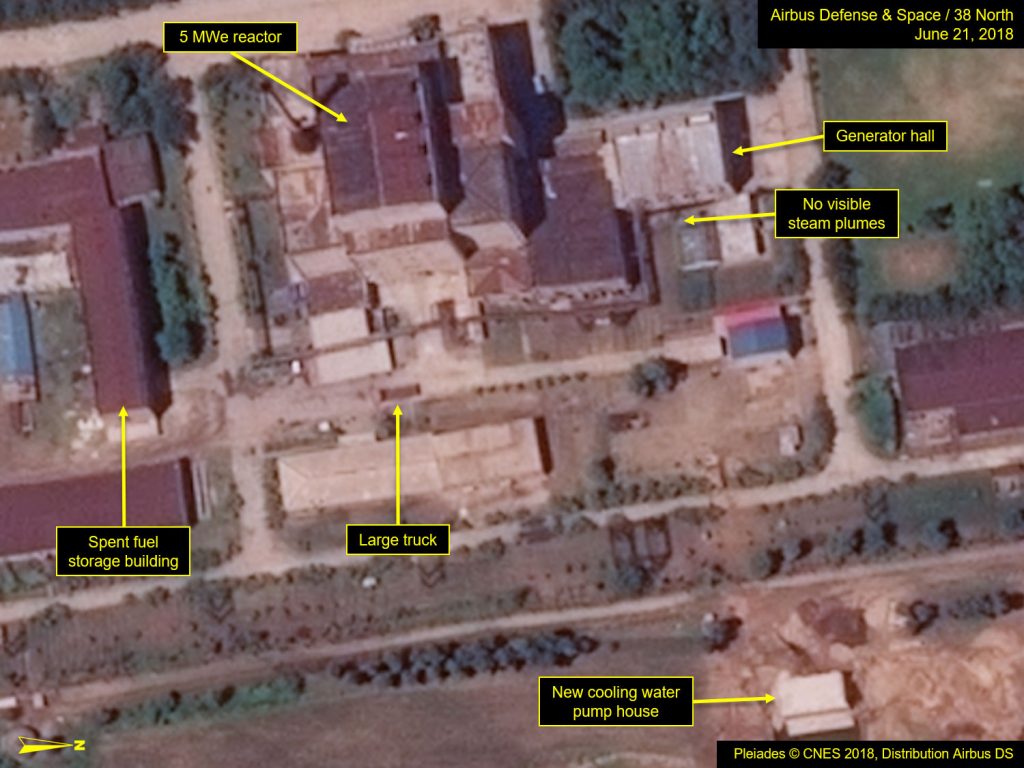
US policy toward North Korea continues to defy careful analysis. Despite statements yesterday by US Defense Secretary Mattis that North Korea would be given a list of US expectations for the process of denuclearization, today US Secretary of State Pompeo said that there is no “timeline” for those steps. It would be highly unlikely that North Korea would agree to any timeline offered up by the US and there is no reason to believe that North Korea will denuclearize at a rate that the US would consider expeditious. It is not clear at all what the next steps for the US-North Korea discussion will be.
On 13 June US President Trump tweeted: “Just landed – a long trip, but everybody can now feel much safer than the day I took office. There is no longer a Nuclear Threat from North Korea.” But yesterday, President Trump signed an Executive Order that:
“The existence and risk of proliferation of weapons-usable fissile material on the Korean Peninsula; the actions and policies of the Government of North Korea that destabilize the Korean Peninsula and imperil United States Armed Forces, allies, and trading partners in the region, including its pursuit of nuclear and missile programs; and other provocative, destabilizing, and repressive actions and policies of the Government of North Korea continue to constitute an unusual and extraordinary threat to the national security, foreign policy, and economy of the United States. For this reason, I have determined that it is necessary to continue the national emergency declared in Executive Order 13466 with respect to North Korea.”
Turkey will hold a national election on Sunday. The current President, Tayyip Erdogan, has dominated Turkey for the last 15 years and most observers expect him to win the election. The challenger, Muharrem Ince, is from the Republican People’s Party (CHP) which has a decided secularist bent and which has been waging a vigorous campaign against the growing power of Islamists in the country. As is usually the case, the economy is central to the concerns of the voters and the Turkish economy has been going through difficult times and Erdogan has been spending more money than the country can reasonably afford. The election is being heavily monitored and the election could mark a decisive point in Turkish politics.
Muharrem Ince
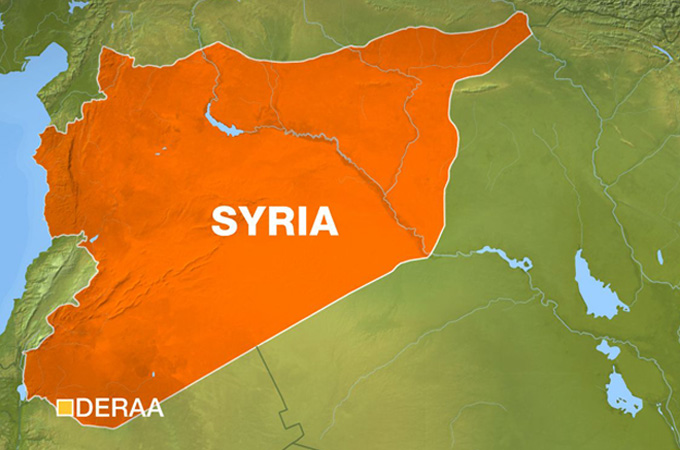
For the last week, Syrian government forces have been attacking US-backed rebels near the city of Deraa. The city is in the southwestern part of Syria and the US had been led to believe that Syria would not move in that area and has protested vigorously against the move, not only to Syria but also its backer, Russia. The US is concerned that the offensive is too close to its allies, Jordan and Israel, and wishes to avoid any chance of a misunderstanding or miscalculation. Syrian President Assad, however, does not seem to be swayed by the US protests.
The Pew Research Center conducted a fascinating study on how accurately US adults discriminate between “factual” and “opinion” articles in media sources. The Center carefully constructed these articles and one should read the article to determine whether the distinction was viably made in the study. Given that caveat, the study revealed a surprising lack of critical thought among most American adults and, not surprisingly, a high degree of correlation between the politics of those surveyed and whether they thought the article was “factual” or “opinion”. According to the study:
“The main portion of the study, which measured the public’s ability to distinguish between five factual statements and five opinion statements, found that a majority of Americans correctly identified at least three of the five statements in each set. But this result is only a little better than random guesses. Far fewer Americans got all five correct, and roughly a quarter got most or all wrong. Even more revealing is that certain Americans do far better at parsing through this content than others. Those with high political awareness, those who are very digitally savvy and those who place high levels of trust in the news media are better able than others to accurately identify news-related statements as factual or opinion.”
It is difficult to figure out how to redress this problem. One must want to know the truth in order to do the difficult work to determine whether something is true. Apparently, supporting a political position is more important to many Americans than is being accurate.
The European Union (EU) has slapped retaliatory tariffs on US products in response to the US tariffs on aluminum and steel. The retaliatory tariffs will raise the cost of imports from the US by about $34 billion. In a letter to the World Trade Organization (WTO), the EU listed the very specific products on which it is raising tariffs. In the letter, the EU justified the tariffs in terms that are permitted by the rules of the WTO:
“On 8 March 2018 the United States of America (“United States”) adopted safeguard measures in the form of a tariff increase on imports of certain steel and aluminium products (at rates of 25% and 10%, respectively), effective from 23 March 2018 and with an unlimited duration. The effective date of the tariff increase with respect to the European Union was deferred to 1 May and subsequently to 1 June 2018. Notwithstanding the United States’ characterisation of these
measures as security measures, they are safeguard measures.
“The United States failed to notify the WTO Committee on Safeguards under Article 12.1(c) on taking a decision to apply safeguard measures.”
The United Nations is asserting that more than 500 people have been killed in Venezuela by an extra-judicial government group known as the “Operations for the Liberation of the People”. The killings are designed to stifle protest and opposition to the autocratic rule of Nicolás Maduro. The UN was not allowed into Venezuela to conduct its investigation, but had to rely on electronic testimony as well as interviews with Venezuelan exiles. The UN charges that the rule of law is “virtually absent” in Venezuela. The matter was referred to the UN Human Rights Council, but no concrete action against the government of Venezuela was suggested.
One of the most important issues facing every country right now is how to create jobs. Outsourcing and automation have been the twin forces driving down the value of labor and most evidence suggests that we have only seen the beginning of the process of replacing humans with robots or robotic processes. According to researchers at the University of Oxford “47 percent of American jobs at high risk of being automated in the years ahead.” A company called Creator will introduce the first robotic burger restaurant in San Francisco on 27 June. According to Bloomberg:
“The product, from Bay Area-based Creator, a culinary robotics company, is assembled and cooked in a machine that contains 20 computers, 350 sensors, and 50 actuator mechanisms. It does everything from slicing and toasting the brioche bun to adding toppings (to order) and seasoning and cooking the patties, all in five minutes. The meat is ground to order—why it’s touted as so fresh—and sourced from premium ingredients. It emerges from the machine piled with tomatoes and lettuce, sprinkled with seasonings, and drizzled with sauces, at which point it’s transferred by human hands to the customer. The price: $6.”
Young people often find their first jobs to be low-paying and repetitive ones. When I was young, entry-level jobs included pumping gas, working check-out at a grocery store, working as a bank teller, or flipping burgers. Now we pump our own gas, scan our own groceries, or use an ATM. Flipping burgers was one of he last bastions for youth employment but it appears that even that option will disappear soon.
At a rally in Duluth, Minnesota, US President Trump asserted that “Sentence one [of the agreement signed by leader Kim Jong-un] says ‘a total denuclearization of North Korea’. There will be denuclearization. So that’s the real story.” There are two things wrong with that assertion. First, the agreement only commits North Korea to “work toward” denuclearization. Second, there is no agreement between the US and North Korea over the meaning of denuclearization. I am not sure when Mr. Trump will begin to understand that his meeting with leader Kim was only the first step of a process.
Saudi Arabia is taking its campaign against its neighbor, Qatar, to extreme lengths. It has proposed building a canal, called the Salwa Canal, that would turn the peninsula of Qatar into an island. It would be “a 38-mile-long, 65-feet-deep, 660-feet-wide channel.” Five international construction companies have submitted bids to build the canal and it is projected to be finished within a year. Saudi Arabia accused Qatar of sponsoring terrorism last year and announced a boycott of the country. Egypt, the United Arab Emirates, Bahrain, Libya, Yemen, and the Maldives have joined the boycott. The group has made 13 demands on Qatar, including the closing of the media outlet, Al Jazeera.
Hungary has passed a new law that states that “helping migrants legalize their status in Hungary by distributing information about the asylum process or providing them with financial assistance could result in a 12-month jail term.” Additionally, according to Joshua Keating in Slate: “The government also changed the constitution to make it illegal to ‘settle foreign populations’ in Hungary, a response to EU efforts to resettle refugees throughout the bloc’s member states.” The law is specifically intended to stop the Open Society Foundation founded by George Soros. Hungary’s Prime Minister, Viktor Orban, is determined to create what he calls an “illiberal” state. The change augurs ill for the European Union and the governments in Poland, the Czech Republic, and Slovenia seems to be moving in the same direction.
The Bharatiya Janata Party (BJP) has pulled out of the coalition which has ruled Indian-controlled Kashmir which means that the region will now be ruled by the central Indian government until a new coalition is created. The decision to leave the coalition stemmed from increased violence in the region. The BJP had been in a coalition with the Muslim-backed People’s Democratic Party (PDP) since 2015, but the alliance was always uneasy. The change to direct rule by the central government will make governing the region very difficult and it is likely that violence will increase in Kashmir. The governance of Kashmir has been a highly contentious issue between India and Pakistan since the founding of the two states in 1947.
Today is World Refugee Day, a day designated to bring attention to the plight of the most vulnerable people in the world: refugees. In 2017, 2.9 million additional people sought political asylum, the highest number of people ever recorded. Of that number, only 100,000 were given refuge. The total number of people seeking refuge in the world is almost 70 million. But there is little question that the attitude toward refugees today is as hostile as it was in the 1930s. And the day is recognized on the same day that the US left the UN Human Rights Council.




 World Politics News