The British Parliament has approved the Withdrawal Agreement Bill agreed upon by Prime Minister Boris Johnson and the European Union. But the Parliament decided not to implement the agreement before the official deadline of 31 October. The delay means that Britain will need an extension from the EU but it also means that Members of Parliament and the British public will have time to study the agreement carefully which means that opposition to the agreement will have time to organize. The leaders of all 27 EU countries will have to approve the extension, but the EU Council President, Donald Tusk, indicated that approval was “likely”. Johnson will probably push for a final vote before the 31st, but it does not seem as if that will happen. The BBC summarizes its understanding of the Withdrawal Agreement:
It sets out exactly how the UK will make “divorce bill” payments to the EU for years to come
It repeals the European Communities Act, which took the UK into the EU, but then reinstates it immediately for as long as a post-Brexit transition period lasts
It contains language on how the new protocol on Ireland – setting up a customs and regulatory border between Northern Ireland and Great Britain – will work in practice. An accompanying impact assessment lays out some of the costs and bureaucracy that companies doing business in Northern Ireland will face
It sets out areas in which the European Court of Justice still plays a role in the UK, and makes the withdrawal agreement in some respects “supreme” over other areas of UK law
Its language on workers’ rights – an important issue for many MPs – is pretty vague, because Mr Johnson’s deal moves obligations in this area from the withdrawal agreement to the non-binding political declaration on future relations
It suggests that if the government doesn’t ask for an extension of the transition period beyond the end of 2020, parliament won’t have a say in changing that, even if a free trade deal isn’t ready in time
In the section on citizens’ rights it sets up an independent monitoring authority (IMA) with which EU nationals in the UK can lodge any complaints about the way the government treats them
In several policy areas, particularly in Northern Ireland, the bill gives ministers a lot of power to change the law (through secondary legislation) without MPs getting to vote
Prime Minister Johnson may decide to call for a new election if Parliament does not approve the agreement before 31 October. Perhaps a new election will give him a Parliament more willing to accept the terms of the agreement. In any event, Brexit remains uncertain.
Turkish President Erdogan and Russian President Putin met in Sochi, Russia, to discuss the future of the northeast region of Syria. The press is reporting that the two states will conduct joint security operations in the region, replacing the US troops that had conducted similar operations. We now have the bizarre situation of Russia patrolling the southern border of NATO, the very state for which NATO was created to contain. Russia and Turkey will oversee the removal of all Kurdish YPG forces, the Kurdish militia that fought alongside the US to remove ISIS from Syria and Iraq. Reuters reports:
“Under the deal with Moscow, the length of border which the YPG would be required to pull back from is more than three times the size of the territory covered by the U.S.-Turkish accord, covering most of the area Turkey had wanted to include.
“’The outcome of the Putin-Erdogan meeting in Sochi today indicates that Erdogan has become a master of leveraging the U.S. and Russia against each other to maximize Ankara’s gains,’ Soner Cagaptay, director of the Turkish program at the Washington Institute said in a tweet.”
Russia obviously negotiated the presence of Turkish troops in Syrian territory, even though Turkey had long sought the removal of Syrian President Assad throughout the Syrian civil war which began in 2011. It is hard to believe that Assad has forgotten the Turkish opposition. I am certain that Assad is wondering whether the Turkish troops will leave, or whether Syria has just been chopped up for the interests of the Great Power game being conducted on its territory.
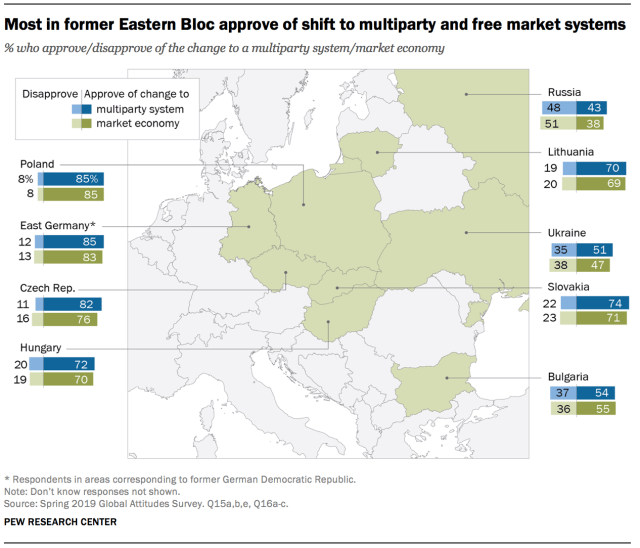
It has been 3 decades since most of the communist countries in East and Central Europe underwent a dramatic change in their systems. Many of those states have embraced liberal values and institutions and most sought membership in pre-communist institutions such as NATO and the European Union. The Pew Research Center conducted a poll in those states to see how the citizenry now regards those changes. In most cases, it appears as if citizens believe that the change was beneficial. The Center found that:
“Thirty years ago, a wave of optimism swept across Europe as walls and regimes fell, and long-oppressed publics embraced open societies, open markets and a more united Europe. Three decades later, a new Pew Research Center survey finds that few people in the former Eastern Bloc regret the monumental changes of 1989-1991. Yet, neither are they entirely content with their current political or economic circumstances. Indeed, like their Western European counterparts, substantial shares of Central and Eastern European citizens worry about the future on issues like inequality and the functioning of their political systems.”
Perhaps the most pervasive reservation the European publics have in the transition is the sense that elected officials are not really responsive to the interests of the broader public. In many respects, that belief underlies the growth of the nationalist/populist regimes in some states.
“Netanyahu had been given 28 days to secure the 61 seats necessary to achieve a functioning majority by building support from other, smaller parties in the 120-member Knesset. After the most recent election — the country’s second inconclusive vote in less than six months — Likud won 32 seats, but the scandal-plagued prime minister could not make up the gap necessary to obtain a majority and secure his fifth straight term in office.
“Now, on Netanyahu’s 70th birthday, Rivlin has turned to the prime minister’s principal rival, Benny Gantz, a former army chief of staff and leader of the centrist Blue and White party. In a tweet Monday, Gantz responded to the new mandate quite simply: ‘It is time for blue and white.'”
Gantz now has 28 days to form a government. The Jerusalem Post gives a nice timeline of what Gantz will have to do and what happend if he cannot organize a coalition. The Israeli political system is incredibly complex, but it is also fairly robust. The current situation, however, is highly unusual.
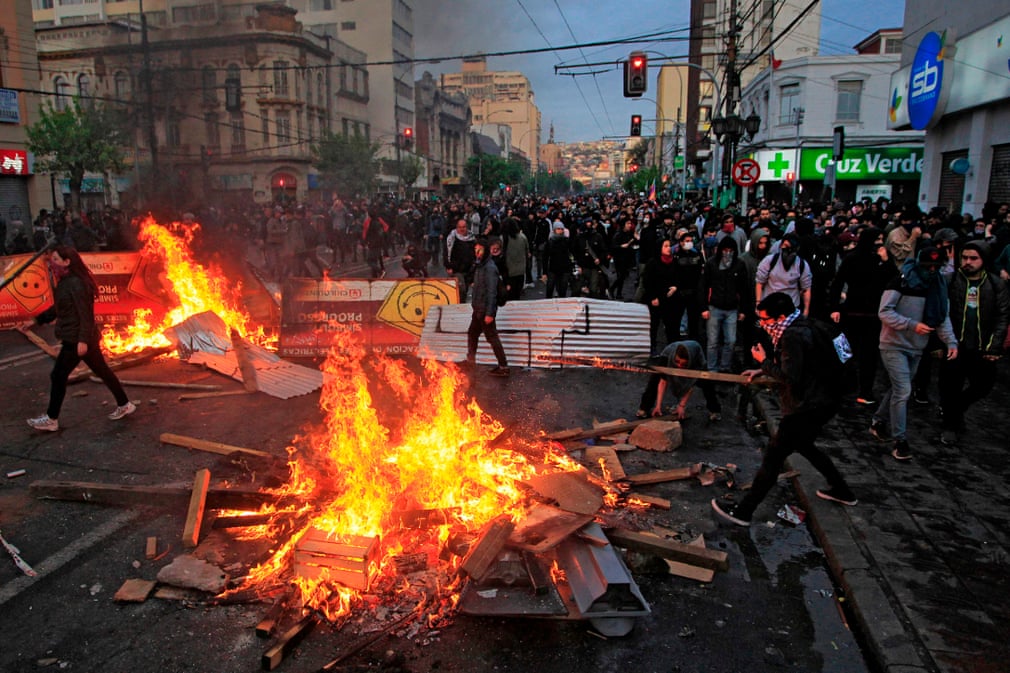
Chile has been rocked by protests, largely led by students who were protesting increases in fares for the metro system in Santiago but also fueled by concerns over economic inequality. After 7 days of protests, the government reversed its decision on metro fares and declared a state of emergency and a curfew. But the protests have continued. The protests in Chile have followed large protests in Peru and Ecuador over similar issues. Violent protests have also occurred in Lebanon, as citizens appear to be fed up with the incompetence of their government. Protests in Hong Kong have entered the third month as Hong Kongers continue to fear the encroaching authority of the Beijing government. One should also not forget the protests by Extinction Rebellion in various European cities. It appears as if there is widespread dissatisfaction in many polities in the world–these protests are not simple coincidences. But figuring out the common thread in all of them is very difficult.
Protests in Valparaiso, Chile
The British Parliament, in a rare Saturday session, refused to ratify the agreement reached by Prime Minister Boris Johnson with the European Union. Essentially, the Parliament was asking for more time, but it meant that Prime Minister Johnson will have to ask that the 31 October deadline be extended. Johnson did send such a request (which he did not sign) but also sent a second letter to the EU stating his intention to get Parliamentary approval before the deadline. So we now have to see whether Johnson can pressure the Parliament to approve the agreement. Johnson does not want a lot of time to pass–every day delayed means that opposition can build to specific parts of the agreement. But if the Parliament does not approve the agreement in a second vote, the situation becomes very murky. The alternatives now include a three month delay (if the EU approves–not a given), a second referendum, a new election which may give Johnson a genuine majority), or a “no-deal” Brexit.
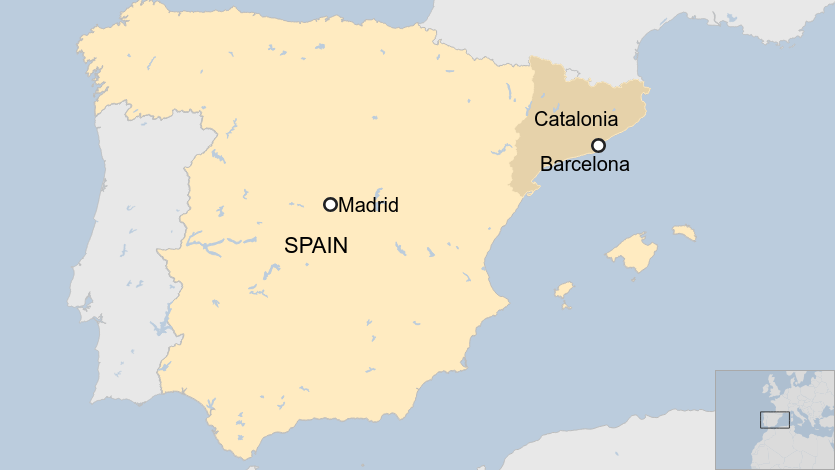
For last few years, many people in the Catalan region of Spain have been agitating for independence from the Spanish state. These movements are not really new–for centuries, Catalonians have considered themselves to be a separate nation from the Spanish nation. These attitudes have sharpened in recent years as Catalan has been quite prosperous and Catalonians think that their wealth is being siphoned off to finance the Spanish state. In 2017 there were pressures for a referendum so that Catalonians could secede from Spain, a move that is not permitted under the Spanish constitution (similar to the US Constitution’s prohibition against secession and quite different from the British system which allows secession). The Spanish Supreme Court has jailed several of the supporters of that referendum and many Catalonians believe the sentences to be excessive and unfair. In response, there have been large protests in Catalan cities, such as Barcelona. The sentiment in Catalonia is mixed on the issue of independence: ” Independence is a highly divisive issue, with a poll in July showing backing for secession in the region at its lowest level in two years, with 48.3% of people against and 44% in favour.”
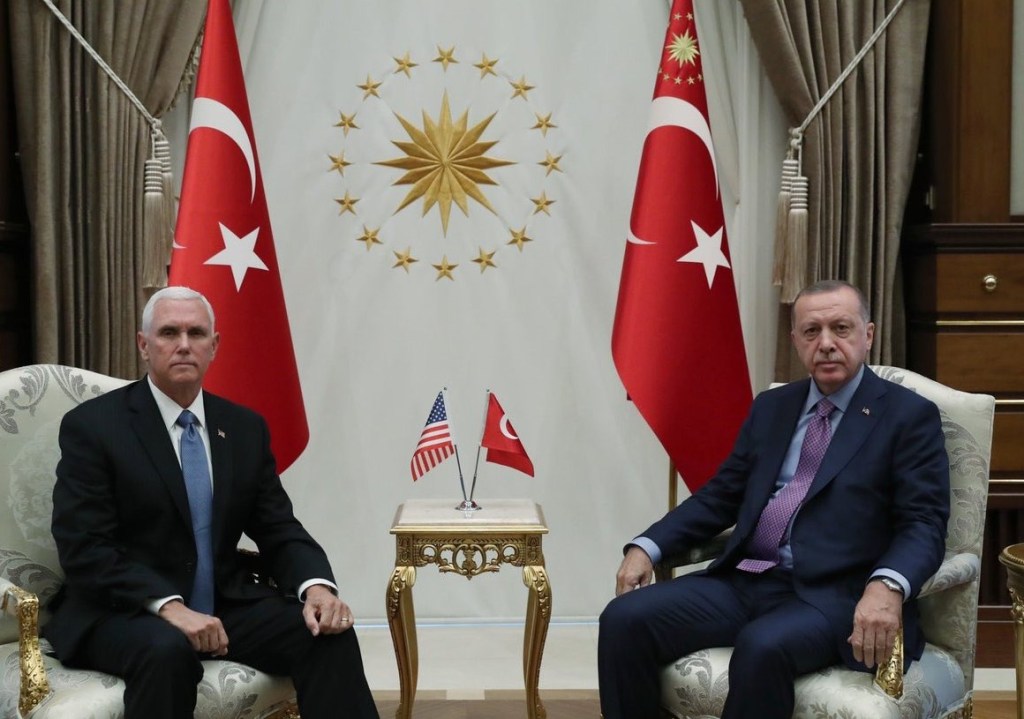
US Vice-President Pence was sent to Turkey to seek a cease-fire between Turkey and the Kurds in northeast Syria. Prior to his arrival, Turkish President Erdogan had emphatically rejected a cease-fire, saying “Declare a ceasefire, they say. We will never declare a ceasefire. We do not sit at the table with terrorist organizations.” We shall see what happens, but the photo below suggests that neither man was looking forward to the discussion. Additionally, note that, in violation of standard diplomatic protocol, Vice-President Pence in sitting in front of a Turkish, not an American, flag. Usually the format is that of the two smaller flags on the small table between the two men. Perhaps the Turks did not have a large US flag. Or perhaps President Erdogan wants deliberately to show disrespect.
Nonetheless, a cease-fire was agreed upon by the two powers. But it is a very strange cease-fire. The cease-fire requires the Kurds to leave the swathe of territory in northeast Syria. That outcome was the objective of the Turkish invasion. In other words, Pence agreed to allow Turkey to ethnically cleanse the region without firing its weapons. The agreement is essentially the second part of the abandonment of the Kurds. Moreover, Turkey will enforce the cease-fire. According to The Guardian:
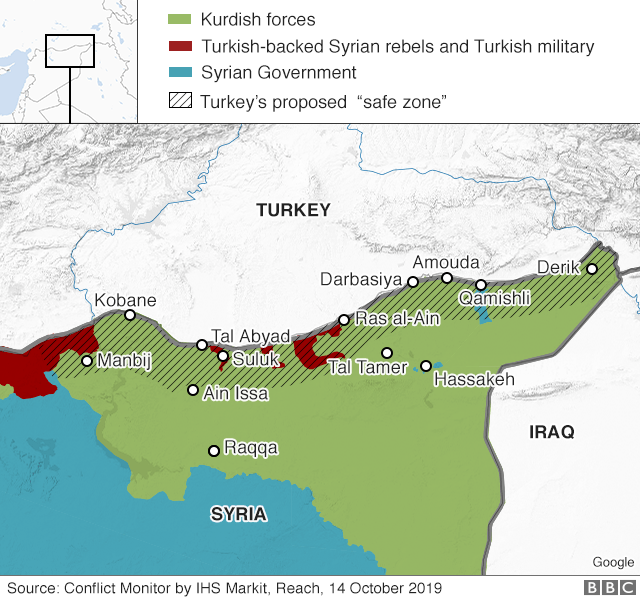
” A statement released after the meeting reiterated the US understanding of Turkey’s need for a safe zone which will be ‘primarily enforced by the Turkish Armed Forces’ after the Kurdish withdrawal, implying that Ankara still intends to occupy the 270m (440km) stretch of land, which includes several important Kurdish towns and parts of a major highway.”
What is still unclear is the status of the Syrian and Russian troops in the region. Will Syria consent to the Turkish occupation of its sovereign territory? And will the Kurds agree to leave the homes they have occupied for many, many years? And do the Turks think they agreed to a case-fire or just a pause in their operations? According to the Turkish media group, Anadolu Agency:
“The pause of Turkey’s anti-terror operation in Syria is not a cease-fire, cease-fire can only happen between the two legitimate sides, the Turkish foreign minister said on Thursday.
“‘Turkey will end the operation in northern Syria only after YPG/PKK terrorists leave [safe zone], Mevlut Cavusoglu [the Foreign Minister] told a news conference.
“‘We [Turkey and the U.S.] agreed on collecting heavy weapons of YPG, destructing their positions and fortifications,’ Cavusoglu added.”
Great Britain and the European Union have apparently reached an agreement on Brexit. The deal was made possible because of revisions to the relationship between Northern Ireland, the EU, and Great Britain. Jen Kirby, writing for Vox, explains:
“What’s changed in the withdrawal agreement is the format for the so-called “Irish backstop,” which has been the major sticking point in the Brexit deal for the better part of the past year.
“To recap, the Protocol on Ireland and Northern Ireland, as it’s technically called, is a safeguard in the Brexit withdrawal agreement to guarantee that, no matter what happens with the future EU-UK relationship, the border between Northern Ireland (which is part of the UK) and the Republic of Ireland (which is an EU member-state) remains free of infrastructure and physical checks on goods.
“This commitment was seen as vital to the peace process in Northern Ireland. That’s because that border was heavily militarized during the Troubles, the decades-long conflict in Northern Ireland between “nationalists,” who identified more closely with Ireland and sought a united Ireland, and “unionists,” who identified more closely with Britain and wanted to remain part of the UK.
“During that period, the border became both a symbol of the divide and a very real target for nationalist paramilitary groups such as the Irish Republican Army (IRA).
“A 1998 peace deal, known as the Good Friday Agreement, formally ended the conflict. That agreement included greater cooperation between Northern Ireland and Ireland, which meant softening the border between the two. Today, that border is all but invisible.”
The revised agreement is quite complex, but essentially keeps Northern Ireland in accord with the rules of the EU allowing goods to flow freely between Northern Ireland and the Republic of Ireland. The difficulty is that British Prime Minister Boris Johnson has to get the agreement approved in the British Parliament. And part of the coalition in Johnson’s majority is the Democratic Unionist Party (DUP), an Irish party that controls 10 votes in Parliament. The DUP has announced that it does not support the new agreement:
“In a statement, the Democratic Unionist Party, which the government relies on for support in key votes, said: ‘These proposals are not, in our view, beneficial to the economic well-being of Northern Ireland and they undermine the integrity of the Union.’
“The DUP deputy leader Nigel Dodds criticised Mr Johnson, telling BBC News: ‘If he’d held his nerve – and held out – he would, of course, have got better concessions which kept the integrity, both economic and constitutional, of the UK.’
“He said he expected a ‘massive vote’ against Mr Johnson’s deal on Saturday in the House of Commons – and the DUP expected to ‘play a crucial role in amending the legislation.”
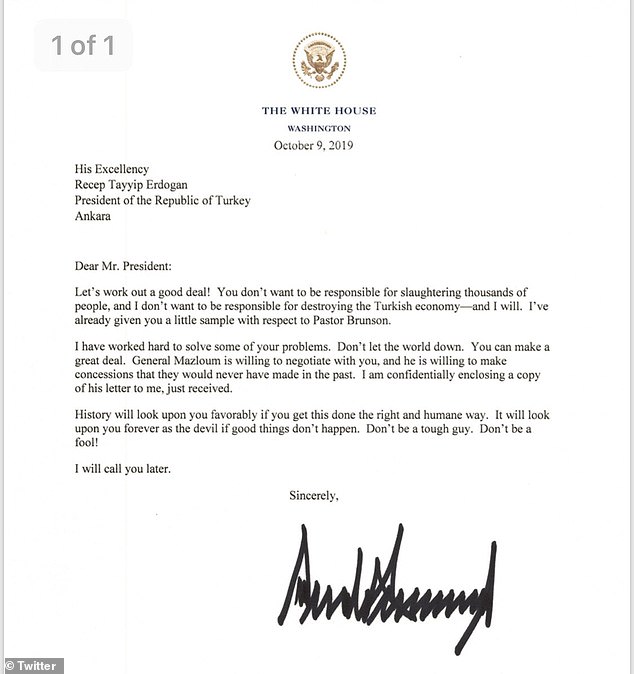
US President Trump sent this letter to Turkish President Erdogan seven days ago–three days after his telephone conversation with Erdogan and after he authorized the removal of US troops from Syria. The letter does not reflect a great deal of thought: it is unclear what President Trump is expecting.
He had already given Erdogan the green light in invading the northeast region of Syria without being explicit about what the limits of the invasion should be.
He had no reason to believe that Erdogan would shy away from killing Kurds given that Erdogan had already made clear that he thought the Kurds were terrorists.
It’s not clear what Mr. Trump means by getting “this done the right and humane way”. Is there a right and humane way to invade another country?
He makes no mention about the safety of US troops who were in other areas of Syria.
It is not clear whether he had the Kurdish General’s permission to reveal the letter.
The threat to “destroy” the Turkish economy is spurious–Turkey has the 17th largest GDP in the world.
The letter does not acknowledge that the US and Turkey are members of the same security alliance–NATO.
The last sentence–“I will call you later”–suggests that there was actually no plan to follow up on the letter.
The letter is also very poorly written. It clearly was not reviewed by anyone in the White House and was probably dictated by Mr. Trump and sent off without further review.
It is hard to imagine anyone taking this letter seriously and it is a profound embarrassment to all the foreign policy professionals who work for the US government. It also failed to prevent the humanitarian crisis among the civilian population in northeast Syria. Where did Mr. Trump expect the Kurds to go?
Extinction Rebellion is a group organized first in Great Britain dedicated to civil disobedience in pursuit of effective action against climate change. Affiliated groups have sprung up all over the world. The explicit objective of Extinction Rebellion is to cause civil disruption, such as blocking roads and subways, in order to force governments to change their policies. Today, almost 400 scientists, representing 20 different countries, endorsed the tactics of the group. Reuters quotes one of the scientists:
“‘We believe that the continued governmental inaction over the climate and ecological crisis now justifies peaceful and non-violent protest and direct action, even if this goes beyond the bounds of the current law,’ said Emily Grossman, a science broadcaster with a PhD in molecular biology. She read the declaration on behalf of the group.
“‘We therefore support those who are rising up peacefully against governments around the world that are failing to act proportionately to the scale of the crisis,’ she said.”
In just a matter of days, Russian troops have taken over key positions in Syria once held by US troops. The US continues to ferry its troops out of Syria and the Kurdish forces once allied with the US have sought protection from Turkish troops from Syrian government forces. At one point, the US sought the removal of Syrian President Assad, but Assad is now back in control of most of Syrian territory. Turkey also sought the removal of Assad, but it now seems to be content with simply taking control of the northeast corridor of Syrian territory. There are many reasons why deferring to Turkey’s move is a serious mistake. Turkey and Russia have been moving closer together, but their vision of the future of Syria are not completely compatible. The Washington Post elucidates:
” Moscow, which has friendly ties with both the Syrian and Turkish governments, appeared uniquely positioned to prevent the two militaries from clashing around Manbij and elsewhere in Syria. At the same, Russia has made clear that it opposes Turkey’s military operation. Lavrentyev, Russia’s Syria envoy, said Tuesday that the offensive in Syria was ‘unacceptable.’
“’We have never favored and never supported the idea of sending, for instance, Turkish units there, not to mention Syrian armed opposition,’ he said, referring to the Turkish-backed rebel groups, according to Interfax.”
“Turkish manufacturers supply 2 million of the 30 million tons of iron and steel that the United States imports annually as part of its total consumption of 100 million tons. In terms of value, Turkish iron and steel exports to the United States were worth about $1.1 billion last year.
“Trump’s tariffs came at a time when Turkish sales to the United States were already on the decline, despite an increase in the country’s overall steel exports. According to figures by the Steel Exporters Association, Turkey’s overall steel exports stood at 3.2 million tons in the first two months of the year, a 1.3% increase from the same period in 2017. Though Trump’s new levies took effect in March, anticipation of the move led to a 60% decrease in steel exports to the United States in the January-February period. Turkish producers seem to have already turned to European markets to make up for the decline. Steel exports to European Union countries increased 62% to reach 1.3 million tons in the same period.”
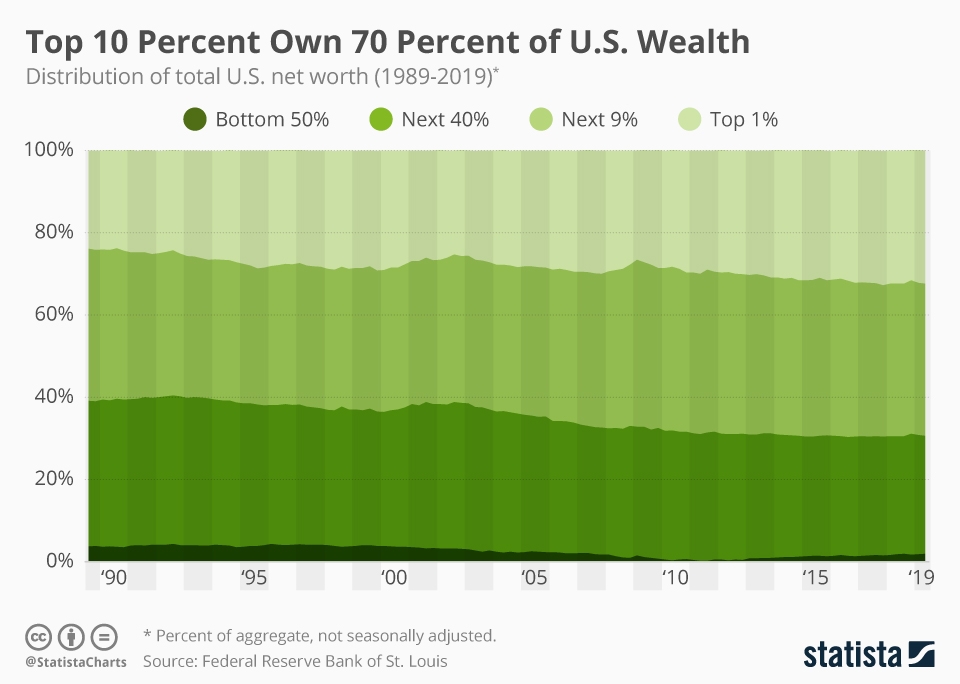
Katharina Buchholz, writing for Stastista, has written about the distribution of wealth in the US over time, and the evidence confirms that wealth concentration continues in the US. Her analysis is depressing:
“10 percent of the richest people in the United States own almost 70 percent of the country’s total wealth. As of June 2019, the top 10 percent held 69.4 percent of total U.S. net worth (that is the value of all assets a person holds minus all their liabilities).
“The top 1 percent held about half of that wealth – 32.4 percent, while the next 9 percent held approximately another half at 37 percent. The bottom 50 percent of U.S. residents only held about 2 percent of all of U.S. wealth. As recently as 2011, that number was as low as 0.2 percent, caused by the downswing of the Great Recession.
“Looking the development of U.S. wealth distribution since 1989, the rich have in fact gotten richer, with the top 1 percent expanding their wealth share from 24 percent to 32 percent. The next 9 percent has remained steady at 37 percent while the 50-90 percentile has been holding less wealth, 29 percent in 2019 – down from 35 percent in 1989. The bottom 50 percent, after the recession setback, have only now recovered to pre-recession levels.”
The Syrian situation defies analysis. I don’t think I have ever seen such a massive screw-up, and I certainly can’t remember reading about such a miserable situation. It is hard to believe that someone could find humor in such a desperate situation, but the Onion comes through. It would be extraordinarily funny if it weren’t also true.
” AIN ISSA, SYRIA—As they streamed out of detention camps in northern Syria following U.S. withdrawal of military support in the region, jubilant ISIS prisoners on Monday hailed their American liberators. “We never thought we’d see the day when someone would finally stand up for us and free us from the Syrian Democratic Forces’ clutches,” said ISIS member Mohsin Al-Lateef as hundreds of his recently liberated fellow jihadist militants praised President Donald Trump and raised American flags in tribute to their emancipators. “For years, we opposed the United States for their intervention in our lands, but now we see that they strongly believe in our mission to establish a caliphate across our ancient lands and put infidels to death. We will honor the U.S. for not only standing down in support of our fight against the Syrian Kurds but for stoking chaos in the region to give us a chance to regroup and re-emerge stronger than ever before. God bless America!” At press time, President Trump had shared a video of the liberated ISIS prisoners celebrating and thanked them for their support. “
In the rapidly changing strategic situation in Syria, the US has decided to pull all its troops out of northeast Syria. The decision comes as the US forces became entangled in a messy situation with ISIS prisoners being freed, Turkish troops on the move, and Syrian government troops moving into the region. There are no front lines and no defensible positions in the chaos. There are reports that the Kurds have requested Syrian troops to defend them in the absence of US troops, but it is not yet clear whether those Syrian troops will engage the Turkish troops. If those reports are correct, then it is highly likely that Russian forces will provide support for the Syrian troops, boosting the leverage that Russia already has in the region. It is extraordinary how quickly Russia has been able to fill the power vacuum created by the US withdrawal. The Washington Post quotes a Kurdish woman on the strategic shift:
“‘For the regime to intervene and deploy its forces on the Turkish border is a comforting thought,’ said the woman, who gave her name as Nowruz. ‘If a deal with the regime is what it takes to stop these massacres, then so be it. At the end of the day, we are all Syrians, and the regime is Syrian, too.’
“’The Americans betrayed us. We do not trust them anymore,’ she added.”
The US and China have agreed upon a temporary truce in their trade war (or, as President Trump calls it, “Phase I of the Talks“). It is hard to figure out what was actually decided although the US announced that it will not impose the $250 billion of tariffs scheduled to go into effect and China announced that it would buy $50 billion of US agricultural products. The agreement was only verbal so there is no way to determine whether progress has been made on the most nettlesome issues, such a the protection of intellectual property. The pressure on both sides to reach an agreement was intense as both countries fear an economic slowdown:
“Concerns about economic slowdowns pushed both countries toward a deal. The September ISM Manufacturing Report on Business in the U.S. declined to the lowest level in 10 years, with capital spending and exports also treading lower than a year earlier.
“China is facing the prospect of a growth rate below 6% for July through September. Both countries were eager to avoid further damage to their economies.”
The agreement is hardly a breakthrough, but we should hope that the concessions made by both sides indicate a willingness to reach a broader agreement. The two sides will meet again at the Asia-Pacific Economic Cooperation summit in Chile in November.
Jared Bernstein has written a fascinating essay on why market capitalism has failed to address the problem of climate change in the world. Prices should reflect scarcity and it does appear as if a benign environment is becoming less available every day. But Bernstein argues that our awareness of the value of a benign environment is profoundly lacking:
“And yet, there’s a key area where prices fail us every day. They fail us every time you fill up your gas tank: Fossil fuels are severely underpriced.
“What do I mean by that? I mean that fossil fuels are imposing costs on our environment, our economy, and our future that are not being captured by their price.
“That underpricing has consequences. Energy costs are so low and so unresponsive to the environmental challenge we face that they send us a signal to literally keep cruising along, ignoring the pressing reality of climate change.
“How is it that a discipline fundamentally based on scarcity has failed to accurately price in the damage we’re doing to our most important, scarce resource: the environment? Naomi Klein writes that the climate crisis is ‘born of the central fiction on which our economic model is based: that nature is limitless.’
“But I don’t think the economic model fails because it denies scarcity and embraces limitless nature. It fails because of its interaction with two things in particular: 1) our tendency to focus on the present at the expense of the future; and 2) the toxic cycle of profit and influence that distorts policy making and blocks the accurate pricing of carbon.
“This diagnosis matters because we need to either unjam the model and attach a sustainable price on carbon or recognize that politics as currently practiced won’t allow us to do that, in which case we’ll need to figure out other, bolder ways to fight climate change. The Green New Deal may well play a role in that alternative vision.”
This way of looking at climate change divests us of the illusion that there are market-based solutions to the problem of climate change. The solution clearly lies in the political arena, not in the hidden hand of the market. Bernstein is explicit about the real problem which he identifies as the “toxic intersection of capitalism and money in politics.”
President Trump’s decision to pull some US troops out of Syria still remains a puzzle, although we are getting more information about how the decision was made. It seems clear that the President did not consult with his military or diplomatic advisers, but we are learning that the Kurds were not informed either. Newsweek reports:
“Newsweek sources say Washington’s crucial allies in the area, the fighters of Syria’s Kurdish ethnic minority, were blindsided as well.
“‘No one in the U.S. government told us’ about the U.S. decision to reposition troops, or possibly even pull out of northern Syria as Trump suggested, a Kurdish intelligence official tells Newsweek.
“‘When we heard the news of American withdrawals, well, it was over Twitter, we had no idea, we were like, ‘What is this shit?'”
 World Politics News