We have known for some time that the process of economic globalization has benefited many in what we now call the emerging countries. Indeed, China’s success in reducing absolute poverty levels is due to the process and is one of the most stunning economic transformations in human history. New studies, however, indicate the globalization, while beneficial to poorer countries, clearly benefit rich countries more. The inequality between rich and poor countries has actually increased dramatically as globalization has taken hold. The disparity may lead many to think about alternatives ways of managing the process of globalization.
Peter Beinart has written a fascinating article for The Atlantic that draws parallels between the foreign policy of Vladimir Putin and American conservatives, usually referred to as neo-conservatives. There is a great deal of power in his analysis, but the underlying theme of the article (not openly stated by Beinart) is that both Putin and the neo-conservatives are classic realists. There is nothing unusual about realists behaving in similar ways–indeed, realism would expect their behaviors to match fairly closely. But, if true, then let’s dispense with all the flowery rhetoric about self-determination (Putin) and international law (Obama and the West): it’s simply old-fashioned great power politics.
We tend to think about border disputes as somewhat episodic–we only care about them when conflict seems likely, and therefore we relegate them to the back-burner. Consequently, we are surprised when the disputes emerge. There are, however, very few states in the system that don’t have border disputes. According to the CIA Factbook, there are only 71 countries that do not have border disputes, and of that number, 49 are island countries. Plenty of potential for conflict–something is always simmering. (I won’t ask any questions on the quiz about the linked information in this specific note).
I do not usually add another post on the same day, but I just read a troubling article on The Guardian which suggests a very worrying state of affairs in Ukraine. The US is growing increasingly concerned that Russia is massing troops along the Ukrainian border far in excess of what would be regarded as normal or merely threatening. The Guardian is normally a reliably lefty newspaper not given to anti-Russian hysteria (I would have a different attitude is the report came from CNN). I will try to find other sources that can corroborate this report or place it in a different context.
Protests have re-emerged in Spain, as the austerity policies imposed on the country continue to depress economic growth. Spain had a credit bubble (largely in the housing market) that was roughly comparable to those experienced by other countries in the early 2000s. The austerity policies are designed to depress the costs of production in the country so that it can reduce its dependence on debt. Unfortunately, the policies have also led to extremely high rates of unemployment and vastly reduced economic growth.
Turkey has shot down a Syrian military jet it claimed had violated its airspace. Turkey and Syria share about 500 miles of common borders, and Turkey has been explicit about its desire to see Syrian President Assad removed from office. There have been several cross-border incidents between the two countries, but this represents a rather dramatic escalation of violence. Alternatively, it could just suggest a desire on the part of Turkish Prime Minister Erdogan to divert attention from the corruption scandals swirling around his government.
One of the difficulties in coordinating sanctions against Russia for its annexation of Crimea is that Europe and the US are unequally dependent on Russia oil and gas exports. The US is coming close to being self-sufficient in both (and may start exporting them at some point). Europe, however, is very dependent on Russian exports. Here’s a breakdown of European dependence.
Under these circumstances, the European states fear Russian retaliation for harsh sanction. It is also notable how some of the former Soviet states are vulnerable, although they are the ones most worried about additional Russian moves. Worryingly, shots have been fired in the Crimea as Russia has taken over a Ukrainian military base. Once blood is shed, nationalist sentiments are easily stoked.
The situation in Venezuela continues to deteriorate. Inflation has reached 57%, and the right and left wing parties are escalating their protests and counterprotests. It does not appear as if President Maduro is interested in any sort of reconciliation, but has chosen the path of confrontation. Under such circumstances, it is very difficult to see any resolution in the immediate future.
Richard Falk, United Nations special rapporteur on human rights in the Palestinian territories, has accused Israel of “ethnic cleansing” in East Jerusalem. Falk pointed out that since 1996, about 11,000 Palestinians have lost their right to live in the city. Israel rarely grants building permits in the city to non-Jews and often revokes residency rights of Palestinians who have lived in the city for many years. The Israeli government did not immediately respond to the charge.
I’ve commented in earlier posts about the middle class nature of many of the protests going on in the world. This characterization seems to accurately describe the protests in Venezuela. The poor in Venezuela generally supported Hugo Chavez and have yet to desert his successor, Maduro. The protests in Venezuela seem to be populated mostly with people who are better off, and their primary concern seems to be on the accountability of the government. The protests appear to have become less violent, but the discontent seems to be ongoing.
As Prime Minister Erdogan fights corruption charges in Turkey, he has become increasingly belligerent. His most recent tactic was to ban Twitter which he claimed was spreading malicious lies about him. It does not appear that his fellow citizens thought highly of the move, as Twitter usage exploded in Turkey as work-arounds the ban were quickly disseminated. We continue to ponder the political effects of social media as it becomes more pervasive.
This is not world politics, but I cannot resist noting that the National Weather Service is predicting a “Nor’easter bomb” for next Tuesday night. Bad karma.
I have posted many articles on the very large number of protests that have occurred in the world since 2011, and have noted that many of these protests are middle-class. One of the great mysteries of this phenomenon is how short-lived these movements seem to be. Zeyneb Tufecki has written a very insightful op-ed for The New York Times which suggests that social media is not only responsible for the large number of protests, but also for their fleeting nature. The essay is highly intriguing and I will have to ponder its insights–it raises huge questions about the nature of political participation and the meaning of democracy.
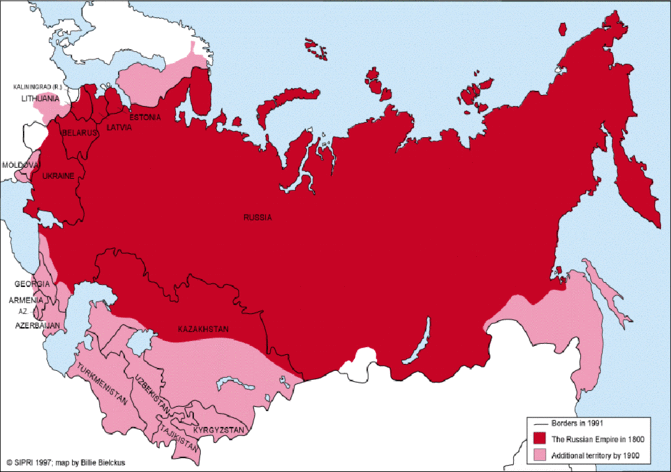
After the annexation of Crimea, the big question is whether Russia has any designs on other parts of Ukraine. The former Russian Empire (before the creation of the Soviet Union) actually controlled about 85% of Ukraine, as well as substantial parts of other nation-states that currently exist. There are huge hypothetical spaces that Russia could claim, a possibility that raises great concern in those areas.
There have been productive talks between Iran and the P5+1, and the negotiations have recessed until early April. Nonetheless, there are reports that Israel continues to allocate substantial moneys (nearly $3 billion) to prepare for an armed strike to attempt to destroy Iran’s nuclear program. The negotiations have been somewhat rattled by Russia’s statement that the West’s sanctions against the annexation of Crimea may cause it to change its position on Iran’s nuclear program. Given the recent Israeli strikes in Gaza and the Golan, it seems clear that the situation remains highly delicate and fragile.
Ukraine has announced that it will withdraw its troops from Crimea. Such a decision is incredibly difficult for a sovereign state, and Ukraine is to be applauded for not taking actions that would only make the life of its citizens much worse. The decision accepts the fact that Russia now controls the territory and the violence would only give Russia an excuse to take similar actions in other parts of Ukraine. The decision is radically different from the decision the Melians made in the Peloponnesian War. Now the Ukrainians can step back and work out a long term plan to recover its territory under more favorable circumstances.
A British newspaper, The Independent, got a leaked copy of a UN report on climate change that is due to be released next month. The report emphasizes the international dimensions of climate change which are likely to be violent and very difficult to manage. The underlying dynamic of these dislocations wil likely be the migration of millions of people who cannot survive under the circumstances of climate change. The mass movement of peoples is more than likely to precipitate violence as resistance to the migrations will be intense and nasty.
There has been a rapid uptick of violence in the Middle East, between the Israelis and the Gaza as well as the Israelis and Syria in the Golan Heights. The negotiations between the Israelis and the Palestinians seem to be breaking down over a variety of issues. But perhaps the most dangerous development is the growing movement in the Israeli Knesset to exert control over the Al-Aqsa Mosque in East Jerusalem. The Mosque is the third holiest site in Islam, and is supposed to be under the protection of Jordan. If the Israelis try to exert sovereign control over the Mosque, the dispute will become much more significant than a regional conflict.
Humanitarian intervention remains one of the most problematic policies in the current world order: it is often difficult to separate humanitarian from imperial motives. Moreover, humanitarian interventions often fail to realize their stated objectives and sometimes the end result is worse than the situation that was supposed to be rectified. Michael Doyle and Camille Strauss-Kahn offer some guidelines for making such interventions more effective in the future.
The Russian press is well aware of the West’s reaction to the annexation of Crimea. The Russian Times gives a thorough synopsis of the negative reactions. The sanctions leveled by the West seem unlikely to impose heavy penalties on Russia, so now the focus shifts to Russia’s intentions in other areas. The West is somewhat hamstrung by the strength of a strongly nationalist party in Ukraine, Svoboda, with an unsavory background that finds support from other right-wing parties in Europe such as the National Democratic Party (NPD) in Germany.
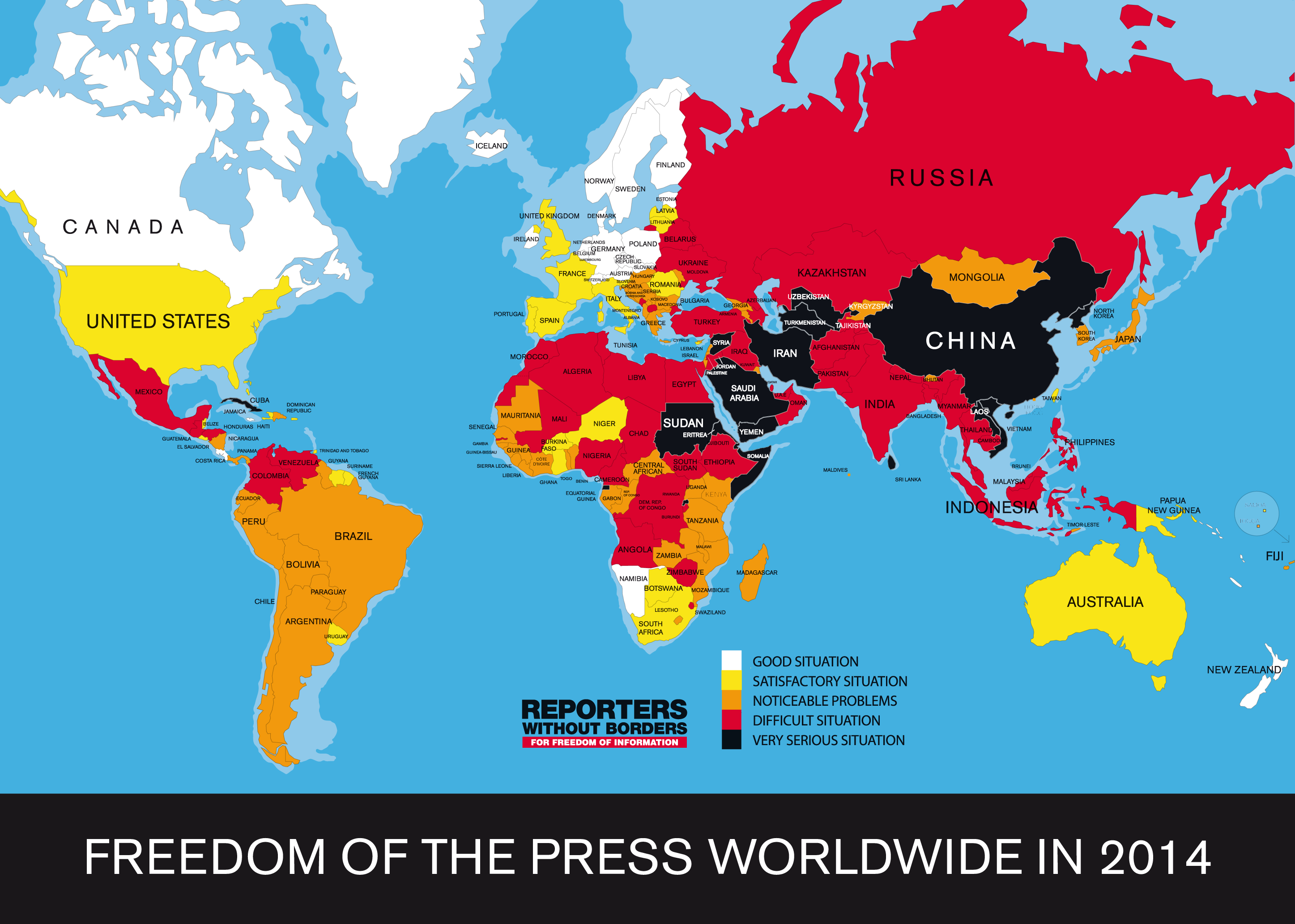
Reporters without Borders has published its index of journalistic freedom in the world. According to its index, Finland has the freest press; Turkmenistan, North Korea, and Eritrea has the least free. The US, despite its rhetoric concerning freedom, came in at 46th.
The Economist ran an article assessing the value of learning another language. In business terms, being multilingual is quite valuable, and studies have been done assessing the economic value of different languages. Unfortunately, the article only assesses the value of European languages. I would the economic premium on non-European languages would be substantially higher.
The recent Israeli-Palestinian negotiations have been centered on Israel’s demand that it be recognized as a Jewish state. That demand is unlikely to be satisfied by the Palestinians. The Christian Science Monitor sheds light on how contentious that issue is.
The rules governing recognition of a secessionist movement are somewhat murky. The right of self-determination is well-recognized, but is constrained by whether other states in the system believe that self-determination is really the motive for a new state. That constraint is necessary because there are other possible interpretations of an independence movement, such as external support for independence that overrides what the people in the new state actually want; in short, possible imperial actions. Such was the case in the independence of Kosovo in 2008. In the West, Kosovar independence was necessary because of the fear of Serbian hostility to the people of Kosovo which might have resulted in crimes against humanity (occasioned by the violence that characterized the fight against Bosnia by the Serbs in the 1990s). Many states now recognize Kosovar independence, but Kosovo is not a member of the United Nations. The referendum in Crimea is not, however, a vote for independence–it is a vote on whether Crimea should rejoin Russia. So there will not be a “means test” on the vote. States will not withdraw their recognition of Russia because of the referendum and they will not recognize Crimea as an independent state.
The early results from the Crimean election indicate strong support for secession. According to the BBC, 95.5% of the voters voted to join Russia. Now the matter goes to the Russian Duma to decide whether to accept Crimea into the Russian Federation. While the outcome of the election is clear, what is not clear is what percentage of the Crimean population voted. The Tatars said they would not participate in the election, and we don’t know how many non-Russian Ukrainians may have boycotted the election as well. Those numbers will suggest how legitimate the election actually was.
Austerity policies generally affect taxes and government spending. In Greece, however, austerity policies imposed by the IMF, the EU, and the European Central Bank have forced the government to consider selling historic national sites. One can imagine how Americans would react to a demand from an international organization to sell the Statue of Liberty, or how the French would react to a demand to sell the Eiffel Tower. The loss of heritage sites may be the political last straw for many Greeks.