Archive for the ‘World Politics’ Category
It’s been a bad day.
First, the US has confirmed that the Malaysian airliner was shot down by a surface to air missile while flying through Ukrainian airspace. Still unconfirmed is who fired the missile. The airplane was flying at 30,000 feet so that excludes the possibility that it was shot down by a shoulder-fired surface to air missile, the type that the Russian separatists in the eastern part of Ukraine have access to. Experts are working to figure out exactly from where the missile was launched. It may, however, be difficult for experts to access the wreckage since the plane’s remains are in territory controlled by the separatists. If it is true that the separatists were responsible for this atrocity, then it is likely that there will never be a full investigation into the matter: the separatists have no interest in having the truth come out.
The fear is that the missile used was a Russian, not a Ukrainian, missile. If it turns out that Russia had supplied the separatists with such sophisticated weaponry, it is highly likely that Western states will feel obliged to exert considerably more pressure on the Russian government. It is precisely events such as this one that bring wild cards to the situation and make it much more volatile.
The other bad news was that Israel had launched a ground attack on the Gaza Strip over night. After ten days of aerial bombardment, Israel has decided that the only effective way to address the rocket threat is to bring the fight directly to Hamas. It is doubtful that Hamas could muster an effective response to the invasion, but the prospect of long and drawn out ground activity would unquestionably raise the death toll significantly. Israel will fight it more difficult to distinguish combatants from non-combatants under these circumstances, and several human rights organizations, such as Human Rights Watch and Amnesty International have already criticized Israel for violating this cardinal rule of international humanitarian law. B’Tselem, the Israeli Information Center for Human Rights in the Occupied Territories, has also issued a report that severely criticizes the Israeli conduct thus far. The death toll in Gaza has reached 214, with 1585 injured. About 80% of the casualties have been civilians, according to the United Nations.
Hamas is also guilty of violating the laws of war by launching unguided missiles into populated areas. Fortunately, there has only been one recorded death in Israel attributed to the missiles.
The protection of civilians in wartime is a principal objective of the laws of war. In the recent Gaza violence, Israel has fired warning shots and used telephones to warn Palestinians that a house was going to be bombed. The high rate of civilian casualties, however, suggest that, while admirable, these tactics are not always effective. Some claim that the casualties are due to a deliberate strategy of Hamas to use civilian as “human” shields: “Hamas, in other words, has exploited a rising global interest in civilian protection by encouraging innocent Palestinians to remain in the line of fire.” Others claim that there is no place for the Palestinians to find shelter in the densely populated area of the Gaza. The issue is a non-trivial one, but very difficult to ascertain given the limited access the outside media have to the Gaza. The rhetoric of war needs to be questioned rigorously.
In 1995, Serbian forces overran the UN-protected enclave in the town of Srbenica in Bosnia. Subsequently, almost 8,000 Bosnian Muslims, who had sought refuge in the enclave, were slaughtered. Peacekeepers from the Netherlands were supposed to protect the civilians, but were unable to do so because of the very strict rules of engagement laid down by the UN Security Council. A Dutch court ruled today that the Dutch state had failed in its responsibility to protect the civilians and was therefore liable for 300 of those deaths. The ruling is very controversial and will undoubtedly have a negative effect on the willingness of states to contribute troops to future peacekeeping operations. It was, on the other hand, a victory for those who believe that the UN must take its peacekeeping role more seriously.
The current conflict in the Gaza Strip raises an interesting question in international law: is Israel justified by the doctrine of “self-defense” to launch attacks in the Gaza Strip? The right of self-defense is clearly protected by Article 51 of the UN Charter, and there is little question that the rockets launched from the Gaza Strip by Hamas do constitute an armed attack on the state of Israel. So it seems to most observers that Israel has the right to respond to the attacks.
But the status of the Gaza Strip is ambiguous. The United Nations and virtually every country in the world considers the Gaza Strip to be Occupied Territory which is governed by International Humanitarian Law. The International Committee of the Red Cross spells out the laws on Occupied Territory:
The duties of the occupying power are spelled out primarily in the 1907 Hague Regulations (arts 42-56) and the Fourth Geneva Convention (GC IV, art. 27-34 and 47-78), as well as in certain provisions of Additional Protocol I and customary international humanitarian law.
Agreements concluded between the occupying power and the local authorities cannot deprive the population of occupied territory of the protection afforded by international humanitarian law (GC IV, art. 47) and protected persons themselves can in no circumstances renounce their rights (GC IV, art. 8).
The main rules o f the law applicable in case of occupation state that
The occupant does not acquire sovereignty over the territory
Occupation is only a temporary situation, and the rights of the occupant are limited to the extent of that period.
The occupying power must respect the laws in force in the occupied territory, unless they constitute a threat to its security or an obstacle to the application of the international law of occupation.
The occupying power must take measures to restore and ensure, as far as possible, public order and safety.
To the fullest extent of the means available to it, the occupying power must ensure sufficient hygiene and public health standards, as well as the provision of food and medical care to the population under occupation.
The population in occupied territory cannot be forced to enlist in the occupier’s armed forces.
Collective or individual forcible transfers of population from and within the occupied territory are prohibited.
Transfers of the civilian population of the occupying power into the occupied territory, regardless whether forcible or voluntary, are prohibited.
Collective punishment is prohibited.
The taking of hostages is prohibited.
Reprisals against protected persons or their property are prohibited.
The confiscation of private property by the occupant is prohibited.
The destruction or seizure of enemy property is prohibited, unless absolutely required by military necessity during the conduct of hostilities.
Cultural property must be respected.
People accused of criminal offences shall be provided with proceedings respecting internationally recognized judicial guarantees (for example, they must be informed of the reason for their arrest, charged with a specific offence and given a fair trial as quickly as possible).
Personnel of the International Red Cross/Red Crescent Movement must be allowed to carry out their humanitarian activities. The ICRC, in particular, must be given access to all protected persons, wherever they are, whether or not they are deprived of their liberty.
The Gaza’s status as Occupied Territory does something strange to the idea of self-defense. It is not a “foreign power” but rather a territory that is controlled by Israel. Israel does not recognize the Gaza Strip as Occupied Territory. It argues that it disengaged from the Gaza in 2005 and that the control of the territory was handed over to the Palestinian Authority (and, subsequently, due to the split in the PA, to Hamas).
However, Israel does control Gaza Strip’s airspace, territorial waters and controls the movement of people or goods in or out of Gaza by air or sea. After the two armed conflicts with Hamas, Israel has also controlled the flow of food, fuel, medicine, and water into the area. Moreover, the Palestinian Authority is barred from raising a military for the defense of the territory.
Thus, the Gaza Strip is not a sovereign state, and one could make the argument that it is a territory subordinated to the control of the Israeli government. Does Hamas meet the criteria of a sovereign state? Not by any traditional metric. It more accurately fits the traditional definition of a colony.
Does the right of self-defense extend to attacks from a colony? Or are the Palestinians merely freedom fighters whose cause has traditionally been recognize by the international community within the realm of self-determination? There is no clear answer to that question.
Some pundits have compared the political turmoil in 2014 to the turmoil in 1914 that led to World War I. There are some interesting parallels, but historical analogies are both revealing and dangerous. The dangers of such analogies are that we overemphasize the similarities and ignore critical differences. The rising tensions in East and Southeast Asia occasioned by the rise of China have led some to compare the situation to the rise of Germany in the late 19th century. There are, however, many reasons to question the usefulness of the 1914 analogy in Asia.
The rocket attacks fired by Hamas on Israel are unquestionably unlawful under the laws of war: they are not precisely targeted and therefore place noncombatants in jeopardy. There is a question, however, about their lethality. Phan Nguyen has done a very detailed analysis of the deaths attributed to the rockets in the three conflicts against Israel: Operation Cast Lead (December 27, 2008–January 18, 2009), Operation Pillar of Defense (November 14, 2012–November 21, 2012), and the ongoing Operation Protective Edge (July 8, 2014–). In total, 27 Israelis have died from the rocket attacks. Nguyen also raises some very interesting points about how the attacks are characterized in the media. The analysis is quite thorough.
The Ukrainian government has launched several offensives to retake control of territory held by Russian-speaking separatists. One of its transport planes was shot down when it was at an altitude higher than the range of the shoulder-held antiaircraft missiles available to the separatists, raising the possibility that it was downed by a missile fired from Russia. The fighting in Ukraine has begun to intensify after a period of somewhat low-intensity. It is unclear what Russia plans to do if the Ukrainian government succeeds in putting down the rebellion.
Today was declared to be an international day of rage by the Popular Committees of Palestine, and protests were organized in many cities, primarily in Europe. The protests were against the Israeli actions in Gaza, and most of the protests were peaceful. Unfortunately, in Paris the protest took a very ugly turn as some of the protesters besieged a synagogue. A former student was in Paris and sent me a photo (below) of the protest there. Such actions should be condemned in the strongest terms possible. The conflict we are all witnessing is about land and power–it is not about religion. There are, in fact, some Jews who oppose the existence of the state of Israel; some of Israel’s strongest supporters are Christians.
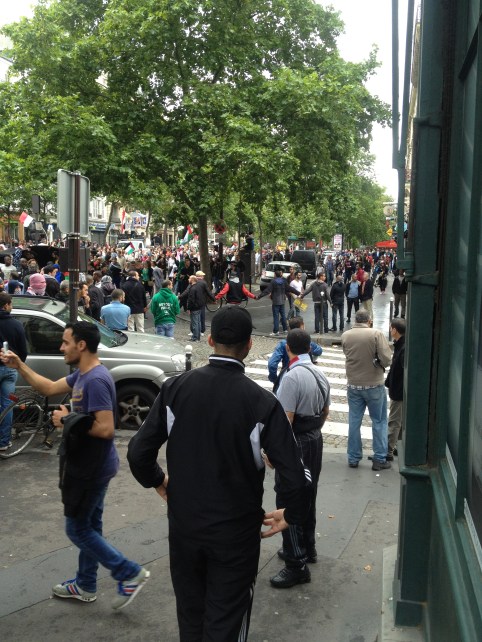
The conflict, however, can be strongly opposed on the issue of land and power: as such, the targets of the protest should be either the current government of the state of Israel that is conducting the actions or the ruling party of Hamas that is responsible for the rockets being launched from Gaza. My own opposition to the conflict is that it is a brutal exercise of power that will accomplish nothing of value and will kill many innocent lives in the process. Since 1967, there have been similar conflicts between Israel and the Palestinian people:
1978-2000 Fighting between Israel and Hezbollah in Lebanon, which included a lengthy occupation of the southern part of Lebanon by Israel
1987–91: First Intifada
2000–2005: Second Intifada
December 2008, Operation Cast Lead
After 22 days of fighting, Israel and Hamas each declared separate unilateral ceasefires. Casualties of the Gaza War are disputed. According to Hamas, they included as many as 1,417 Palestinians including as many as 926 civilians. According to the Israeli Defense Forces, 1,166 Palestinians were killed, and 295 were non-combatants.
November 2012, Operation Pillar of Defense
Gaza officials said 133 Palestinians had been killed in the conflict of whom 79 were militants, 53 civilians and 1 was a policeman and estimated that 840 Palestinians were wounded. Hamas fired over 1,456 rockets at southern Israel, killing 6, including a pregnant woman, and injuring hundreds.
Despite all this violence, the two sides are no closer to an agreement and are in many respects much further apart. There is absolutely no reason to believe that the current violence will have a different outcome from these previous wars. At some point, a different strategy must be attempted. This war cannot be justified by any feasible policy objective.
As the fighting in Gaza continues, both sides accuse each other of reprehensible tactics. Both sides are taking actions that jeopardize the lives of civilians. The rockets used by Hamas cannot be precisely targeted and therefore pose a risk to civilians; fortunately, no Israelis have yet been killed by the rockets. Israel has more precisely guided weaponry and it takes very active steps to avoid civilian casualties. But the Gaza Strip is very densely populated, and it is impossible to target any building without posing a risk to civilians; at this point, more than 100 Palestinians have been killed. This asymmetry in deaths is striking, and it is a pattern that was true in previous conflicts between Israel and Hamas in Gaza. Unfortunately, the US media is mostly based in Israel, and reports of the deaths of Palestinians is not generally covered. It takes more effort to find out the damage done in the Gaza, but the effort is necessary to get an accurate view of the conflict.
Jessica Matthews has written a very good essay on the situation in Iraq which will appear in a forthcoming issue of the New York Review of Books. She analyzes many aspects of the current turmoil in Iraq, but she makes a very important point about how we should think about the Sunni-Shia divide in Iraq: that the divide is really political and not religious at all:
The story, which has seemed to be all about religion and military developments, is actually mostly about politics: access to government revenue and services, a say in decision-making, and a modicum of social justice. True, one side is Sunni and the other Shia, but this is not a theological conflict rooted in the seventh century. ISIS and its allies have triumphed because the Sunni populations of Mosul and Tikrit and Fallujah have welcomed and supported them—not because of ISIS’s disgusting behavior, but in spite of it. The Sunnis in these towns are more afraid of what their government may do to them than of what the Sunni militia might. They have had enough of years of being marginalized while suffering vicious repression, lawlessness, and rampant corruption at the hands of Iraq’s Shia-led government.
A college education is very expensive, but its cost has traditionally been considered as an investment: college-educated people have traditionally made more money than those without a degree. In recent years, however, some have begun to question the economic basis for the investment. The calculation remains sound, but the underlying logic has changed. The incomes of both college-educated and non-college-educated people are still diverging, but that’s because the incomes of non college-educated individuals have gone down sharply since 1991. Indeed, the average income of a college-educated person is roughly the same as it was in 1991.

Just as the invasion of Iraq in March 2003 damaged the image of the US in world affairs, Russia’s intervention in Ukraine has undermined Russia’s reputation in the world. The Pew Research Center has conducted a poll of how outsiders now view Russia, and the results show a dramatic drop in favorable opinions of Russia. For now, President Putin remains highly popular in Russia, but as economic sanctions bite into Russia’s economic growth, that support may drop as well. Unilateral interventions have heavy costs in the world, and it is often difficult to shake the image over time.

The rise of social media has uncovered all sorts of questions about how human beings communicate. Traditionally, the most effective means of communicating ideas has been through talking with each other. Talking is a very complex process, and it demands the development of important ancillary skills, such as reading body behavior. The ubiquity of electronic communication (such as this blog, or other forms such as email and texting) has reduced our reliance on these ancillary skills. The critical question is whether the loss of these other skills is going to ultimately affect our social development. I suspect that it will, and that loss, while incalculable, is possibly tragic.
The Stockholm International Peace Research Institute is one of the most highly regarded research organizations in the world. They publish a Global Firepower Index which takes 50 variables and makes a composite index measuring the military power of all the countries in the world. The list does not contain many surprises, but the index gives a great deal of depth to what analysts mean when they talk about the military power of a particular country.
The violence between Israel and Hamas in the Gaza Strip continues. Hamas has launched more than 200 missiles into Israeli territory and has disrupted life in Israel to a considerable extent. Fortunately, there have been no reported injuries from the rocket attacks–the missiles have a short range, they are unguided, and Israel has an anti-missile system (“Iron Dome”) that has shot many of the incoming missiles. Israel has relied on air strikes into Gaza and claims that it has only targeted known military sites. Unfortunately, the air strikes have killed many civilians, and the Washington Post has some extraordinary photos and videos of the havoc created by the air strikes. The tactics used by both sides are profoundly inconsistent with the laws of war.
Both Joko Widodo and Prabowo Subianto have claimed victory in Indonesia’s Presidential election. The unofficial vote gave the election to Widodo, but Subianto has contested that outcome. In this election, there was a relatively clear choice between the old and new guard in the world’s third largest democracy. Widodo is a certified outsider, although he has served as the governor of Jakarta, Indonesia’s largest city. Just nine years ago, he was a furniture salesman, and many young Indonesians strongly identify with him. Subianto is a former general and closely identified with the former dictatorship of Suharto. How Indonesia handles this controversy will be a stern test of its civic culture.
There are serious questions that are being raised about the health of democracy in the world. Such questions are not new, but since 2001 they have been asked more frequently and with greater urgency. Michael Ignatieff is a very perceptive political analysts who has written an essay in the New York Review of Books, that addresses the significance of the rise of authoritarianism in the world and how it challenges our ideas about liberal democracy.
The ubiquity of video cameras in the world has given us the opportunity to see things in war that were often unseen. The Washington Post has posted two videos, one of the effects of Israeli bomb strikes in the Gaza Strip and the other from the Israeli Defense Forces, that give us a sense of how the conflict between Israel and Hamas is being conducted. Warning: the video of the bomb effects in the Gaza Strip is graphic. What is clear from both videos is that there is no such thing as a “surgical” strike in an area as densely populated as the Gaza.
The outbreak of the Ebola Virus in West Africa continues to spread with a total of 844 cases including 518 deaths in the epidemic that began in February. The World Health Organization has begun strenuous efforts to contain the disease, but, while progress has been made in Guinea, the cases continue to rise in Sierra Leone and Liberia.
Buddhists in Sri Lanka have begun attacking Muslims in the country, paralleling the violence against the Muslim minority in Myanmar. The violence is being perpetrated by the Bodu Bala Sena (BBS) (Buddhist Power Force), an organization that was established in 2012. Sri Lanka is no stranger to ethnic and religious violence, and the United Nations is investigating the violence. Many believe that the BBS has the support of the Sri Lanka government, which is also resisting investigations into alleged atrocities against the Tamil community during the long civil war in the country.
Hamas has taken responsibility for firing more than 40 rockets into southern Israel from the Gaza Strip. Hamas asserts that the rocket fire is in response to Israeli attacks in Gaza that killed 6 Hamas members. There is no moral defense for firing indiscriminate weapons into civilian areas, no matter what the provocation. Fortunately, there are no reports of any deaths from the rockets. Israel has announced that it is mobilizing 1500 reservists and it is likely that there will be further violence in the Gaza. At this time, there does not appear to be any movement toward de-escalation.
Propaganda is an intrinsic part of world politics, and governments use many different tactics to communicate their basic ideology. In the 1930s, the Nazi Party in Germany used the photograph of the perfect “Aryan” child to reinforce their ideology of race superiority. Unbeknownst to the Nazis, the photograph they used was actually the photograph of a young Jewish child. No one knew at the time, but the parents knew the truth of the propaganda.
The Organisation for Economic Cooperation and Development (OECD) has just published it forecast of global economic growth to 2060. It forecasts a slowing growth pattern from previous years, and growing stresses due to environmental degradation. In particular, its forecast on how that economic growth will be distributed is sobering:
With growth increasingly driven by knowledge and skills, growth in itself could keep generating rising tensions and inequalities. On current trends, earning inequality in the average OECD country may have risen by more than 30% in 2060 and would then face almost the same level of inequality as is seen in the United States today. Moreover, structural adjustment will continue, especially across firms within sectors (e.g. from low to high productivity and from polluting to less polluting firms) and in emerging economies, and the consequences for workers’ wellbeing will have to be managed. If left unaddressed, such increases in inequality and costs of adjustment could eventually backlash on stability and growth.

