The outrage over the downing of the Malaysian airliner has grown more intense in Europe as the task of recovering the bodies from the crash has been dilatory and insensitive. But Europe depends heavily on oil and natural gas exports from Russia. So the question of whether to base a foreign policy on values or interests has been raised in stark relief. The overwhelming dependence of Europe on Russian exports can be seen from the map below.
As the Islamic State has consolidated its control over territories in Syria and Iraq, the nature of its rule is becoming more overt. The al-Khansaa Brigade is an all-women group that enforces a strict code of behavior over the women in the Islamic State. The contrast between a liberal conception of human rights and the conception espoused by the Islamic State is quite dramatic.
Following the details of the current Israeli-Palestinian conflict is very difficult–much is asserted and little evidence is verifiable. There is, however, a much broader context in which the conflict is occurring. The entire region is in turmoil: Libya is disintegrating, Syria has experienced some of the worst fighting of the civil war in recent days, and, hovering over all of these immediate crises, the Arab Spring remains tumultuous but unfulfilled. The countries that have traditionally acted as “brakes” on local conflicts in the Middle East (mostly for ill, but sometimes for good) are withdrawn and unreliable. We are witnessing the unraveling of the regional system that has governed the Middle East for over a century. It is virtually impossible to imagine what the outside world could possibly do to mitigate the turmoil–the impotence of power is palpable.
We tend to think that diplomacy is the stuff of striped pants and euphemistic words (Winston Churchill said it best: “Diplomacy is the art of telling people to go to hell in such a way that they ask for directions”) Sometimes, however, diplomacy degenerates into a childish exchange. Brazil criticized Israel for its “disproportionate” use of force in the Gaza Strip. Israel’s response was to refer to Brazil’s loss in the World Cup tournament: “This is not football. In football, when a game ends in a draw, you think it is proportional, but when it finishes 7-1 it’s disproportionate. Sorry to say, but not so in real life and under international law.” The Brazilians have yet to respond, but, admittedly, it’s hard to respond to such an irrelevant riposte.
Attempts to broker a cease-fire have thus far been unsuccessful as Israel rejected the proposal by US Secretary of State Kerry for a week-long truce, “as it stands”. Israel rejected the proposal because it believed that the truce would only give Hamas a breathing space in which it would re-arm. Hamas has rejected previous proposals because they did not include a lifting of the blockade of the Gaza Strip. Meanwhile the Palestinian Authority gave approval to a protest march in the West Bank–the first such permit in almost ten years–and the protest exploded in a “day of rage” that led to three Palestinian deaths near Jerusalem.
Russia is apparently upping the ante in Ukraine. NATO asserts that Russia has massed 15,000 troops along the Ukrainian border and is sending heavy military equipment to the separatists in the eastern part of the country. Most analysts had expected the tension in the region to ease at least temporarily as a result of the downing of the Malaysian airliner. Instead, Russia seems to be escalating tensions It is difficult to anticipate what the next moves might be.
A patient who was diagnosed with the Ebola virus was forcibly removed from the hospital by relatives. The patient is now moving around Sierra Leone’s capital of 1 million people. According to Reuters, there are dozens of people who have tested positive for the disease who are moving within the general population of the city of Freetown. The security breach is a nightmare for medical personnel as the mortality rate for untreated Ebola is about 90 percent. It is hard to believe that Sierra Leone’s medical infrastructure is capable of dealing with a general outbreak of the disease.
The protection of civilians is one of the most important tenets of international humanitarian law. In recent years, we have heard various rationalizations justifying the killing of civilians, whether accidental or intentional. These rationalizations need to be repudiated forcefully by the international community. The protection of civilians is what separates war from massacre. Massacres serve no political purpose.
The financial media is buzzing about a relatively new phenomenon in tax policy: inversion. The practice is relatively simple. US corporations find a smaller company in a non-US country with a more favorable corporate tax policy (Ireland is one such country, due to the policy of austerity imposed on it after the Great Recession of 2008-09). It “relocates” its head office to that country (not really–it is simply a sham head office) and therefore avoids paying the US corporate tax rate. It is a great way to lower the taxes paid, but, from a political point of view, it raises a critical question: do corporations have a national identity? If not, then should such corporations benefit from the infrastructural (transportation, education, communications) benefits of national policies? Or should they somehow be forced to pay for using the infrastructure paid for by the taxpayers?
With the world’s attention focused on the Gaza Strip and Ukraine, we have lost sight of the ongoing violence in Syria. In the last two days, over 700 Syrians have been killed as government forces loyal to President Assad have been fighting the rebels of the Islamic State for control of an important gas field near the city of Homs. The takeover of Syrian oil and gas fields has been an important source of revenue for the Islamic State, allowing it to buy weapons and the cooperation of corrupt officials. Thus, the fighting has been fierce.
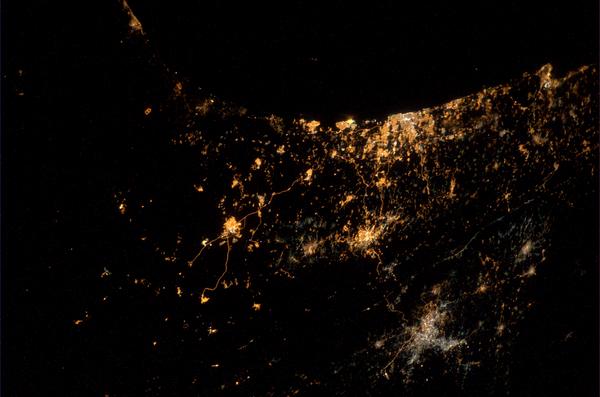
Astronauts aboard the International Space Station have photographed the exchange of fire at night in the Gaza Strip. The flashes of light captured rocket trails and explosions. I cannot imagine what the aliens are thinking about the human race right now.
The United NationsHuman Rights Council (UNHRC) has voted to investigate possible war crimes in the recent fighting in the Gaza Strip. The resolution called for an independent commission of inquiry to investigate “all violations of international human rights law and international humanitarian law in the occupied Palestinian territory, including East Jerusalem, particularly in the occupied Gaza Strip”. The vote was 29 states in favor, one against, and 17 abstentions. The US was the only state to vote against forming the independent commission. There have been earlier such commissions, notably the Goldstone commission after Israel’s Operation Cast Lead in the Gaza in 2008-09 in which 1,400 Palestinians died. Israel rejected the findings of the commission and refused to cooperate with the investigation.
The Ukrainian Parliament was debating the appropriate response to the downing of the Malaysian airliner within its airspace and sentiments in the Parliament ran amok. The far right Svoboda Party disagreed quite strongly with the sentiments expressed by the lawmakers from the eastern part of the state where Russian separatists are quite strong. The video is below:
The government of Israel has renewed its policy of punitive home demolitions in the West Bank. The government destroys the homes of people it deems are threats to Israel as a way of punishing individuals and to deter others from harming the state of Israel. The policy had been dropped years ago after the Israeli military determined that the policy was not effective. In the wake of the recent violence, the government of Israel has decided to reinstate the policy in order to separate Hamas supporters from the Fatah faction within the Palestinian community. It remains to be seen whether this iteration of the punishments will be at all effective. The ongoing conflict has begun to rattle the Arab population within Israel (about 20% of the total population of Israel).
It’s been such a wretched week. We all need a little comic relief. Here’s a video from China that makes serious fun of North Korean leader, Kim Jong Un. But it also ridicules other world leaders, such as Obama, Shinzo Abe, and Vladimir Putin. Have a good laugh.
To help explain the conflict in Gaza, I have chosen two articles that articulate the positions of both sides. The first, by Greg Shupak, gives the Palestinian point of view, particularly on the perception of Hamas toward the proposals for cease-fires that have been advanced. The second is by Michael Herzog from Foreign Policy which is titled “A War We Didn’t Want. Some of the points are responsive, but many of them pass like ships in the night. Some things are not noticed or never seen even though they are in plain view.
Not surprisingly, the Russian public is receiving a completely different understanding of the crash of the Malaysian airliner in Ukraine. Before one dismisses these explanations as fanciful (although, admittedly, some of them are), try a thought experiment. Is there any way for the people in the West to know whether or not the US and European explanations are equally spurious? After all, virtually all of the information about how the airliner was brought down is coming from Western intelligence sources.
The US National Oceanic and Atmospheric Administration (NOAA) announced that the global temperature for June was the highest ever recorded for that month. It follows a record-setting month of May as well. The global June temperature was 16.2C (61.2F), which is 0.7C higher than the 20th-century average. It beat 2010’s record by one-twentieth of a degree. Not all regions of the world recorded such high temperatures, so people in some areas of the world did not experience the record.
Whenever there is a war, such as the one going on in the Gaza Strip, we are all tempted to choose one side or the other. The need to make a moral judgment in the face of killing is probably inevitable, but it ill serves our role as analysts. The killing is evil, but it is not explained by evil. Wars are fought largely because both sides have persuaded themselves that the “other” deserves to die. As analysts we need to figure out how “desert” is determined and try to address the underlying cause of that rationalization. The need to maintain that clinical perspective is necessary because the Israelis and Palestinians are now far beyond the point where they can view the conflict with clear eyes.
The death toll in the Gaza war increased quite dramatically overnight. Thirteen Israeli soldiers were killed, and that is the highest number of soldiers killed in recent years. The Palestinian death toll stands at more than 425, with the vast majority of those dead civilians.
Roger Berkowitz has written an essay in The American Interest that is incredibly sobering. He thinks about the possibility that there is no solution to the crisis between the Israelis and the Palestinians. We are reluctant to think about conflicts that defy reconciliation–even the atrocity of apartheid ultimately disappeared. But Berkowitz’s rumination leads us to a different way of thinking about the nature of world politics: that the nature of the state, the bedrock of the international order since the 17th century, must be profoundly transformed. If the problem cannot be solved, perhaps it is time to redefine the problem.
Timothy Garton Ash is one of the most perceptive analysts of European affairs (as well as a gifted writer). He has written an op-ed piece for the New York Times on how to interpret the behavior of Russian President Putin. Perhaps the most chilling insight of the essay is the way Ash links the Nazi use of the word “volk” to Putin’s use of the phrase “russkiy mir” (Russian world). The link between ethnic identity and nationalism is a dangerous and volatile combination.
The BRICS countries (the Federative Republic of Brazil, the Russian Federation, the Republic of India, the People’s Republic of China and the Republic of South Africa) have begun to create an alternative economic system as an alternative to the US/European dominated Bretton Woods Institutions (the IMF, the World Bank, and the World Trade Organization). The countries have announced as their first step the creation of a bank with an initial capitalization of $100 billion. The five countries comprise a significant economic bloc with great potential. The difficulty of creating a long-term viable alternative is extraordinary, however. The five countries are remarkably diverse and opposition to Western dominance is a powerful force, but not necessarily strong enough to overcome the differences.
Thousands of Parisians defied the government’s ban on pro-Palestinian demonstrations and marched through the streets of Paris protesting Israeli actions in the Gaza Strip. Despite the fears of a confrontation with the Jewish Defense League similar to the one last week at a synagogue, there were no such face-offs. There were also protests in Montreal and Toronto, in Kashmir, Bangladesh, Germany, Britain, and Turkey.
Today the world celebrated the first Nelson Mandela Day. It is a day to honor the man who endured much suffering to liberate his people. Much of the world celebrated the occasion by performing 67 minutes of community service to mark Mandela’s 67 years of dedication to South Africa. He was truly one of the greatest figures of the 20th century.
France has banned pro-Palestinian protests. The move was made because of fights last week between supporters of Israel and supporters of the Palestinians, and the state decided that it could not guarantee security. Large demonstrations had been planned by the pro-Palestinian groups, and we will have to see if the law is observed. Needless to say, the ban on free speech in France is a serious matter. Concerns about free speech on the Israel-Palestinian conflict have also been raised by the removal of two reporters, one by NBC and one by CNN, after comments were made that criticized the actions of Israel in Gaza.
In one bit of good news, the negotiations over the Iranian nuclear program, scheduled to end on 20 July, have been extended for another 4 months. The parties have not been able to agree how about how many centrifuges, necessary to enrich uranium, Iran will be allowed to keep out of its current 19,000. No new sanctions will be imposed on Iran during the 4 months, and previous sanctions that had been lifted for the last six months will not be reinstated. Overall, the terms suggest that the negotiations are very difficult, but not impossible to bring to fruition.