Archive for the ‘World Politics’ Category
There are more reports of violence between Turkish forces and Kurdish rebels, and these reports include evidence of attacks on civilians. The violence was in the town of Cizre, a primarily Kurdish town in the southeastern part of Turkey. The town has been under a seven-day, twenty-four curfew, and life for the people of the town has been miserable. It is likely that other Kurdish strongholds have undergone similar attacks, but information about those attacks is difficult to obtain. The US supports Turkey and relies upon Turkish support for the continued use of the military base at Incirlik. But tje Kurds have been the most reliable ground force against the Islamic State. At some point, the US is going to have to decide which of those priorities is more important to its strategic objectives.

In a 119-8 vote, with 45 abstentions, the United Nations General Assembly approved the flying of both the Vatican and the Palestinian flag at UN headquarters. The vote recognizes the nonmember observer state status of both and is a significant symbolic victory for what the UN now recognizes as the “State of Palestine.” The US opposed the move, arguing that it does nothing to resolve the Israeli-Palestinian conflict which it believes can only be solved through direct negotiations between the parties and not through the intervention of the UN.
Germany has been one of the most welcoming to the refugees coming to Europe from Syria, Eritrea, and other countries experiencing serious dislocations. This attitude has been true despite the adamant opposition of some anti-immigrant groups, located primarily in some of the smaller towns and villages of Germany. The reason for this attitude is that Germany is undergoing a rather dramatic demographic shift and is suffering a shortage of younger workers. The refugees offer an effective way to remedy that shortage–the refugees are generally eager to join the work force.

Russia is apparently building a new military base along its border with Ukraine. The new base suggests that Russia clearly intends to maintain the ability to provide assistance to Russian-speaking separatists in eastern Ukraine. The base likely spells the death knell of the Conventional Armed Forces in Europe (CFE) Treaty that was signed on November 19, 1990 in an effort to minimize the likelihood of a conventional war in Europe. The Treaty has been subject to a variety of revisions since 1990 and the breakup of the Warsaw Pact and the expansion of NATO into some of the eastern European and Baltic states has made precise interpretations of the Treaty difficult.
The back story to the flood of refugees rushing into Europe is quite dark. Smugglers are responsible for making many of the arrangements for the refugees, but show little or no responsibility toward their well being. One smuggler, portrayed in an article in Speigel was responsible for leaving refugees trapped in a truck in Austria, ultimately leading to the death of everyone in the truck. The trip from Syria to Europe will cost a refugee €2,500, a price that many have to sacrifice everything to afford. These smugglers have made about €16 billion since 2000, profiting off human misery.
Myanmar is beginning an election cycle which is an important step forward for a country that has existed under martial law for far too long. There are 92 political parties vying for power and over 6,200 candidates. There is, however, a serious problem: there is not a single Muslim party or candidate in the election, even though Muslims constitute the second largest minority group in the primarily Buddhist country. Unfortunately, that omission is true even for the National League of Democracy led by Aung San Suu Kyi, the Nobel Peace laureate. One could have hoped more from her after her 15-year house imprisonment and her intimate understanding of what it means to be excluded.
The violence between Kurdish groups and the Turkish government has escalated. Elements of the Kurdistan Workers’ Party (PKK) killed 14 Turkish policemen in response to bombing by the government against PKK strongholds. At one time Turkish Prime Minister Erdogan was quite committed to ending the long-term conflict between the government and Kurdish parties. But after the recent elections in which the Turkish parties secured sufficient seats in Parliament to deny Erdogan’s party, the AK, a majority of seats, Erdogan reversed his cooperative stance and seems intent on using anti-Kurdish sentiment to regain the majority in Parliament.
There are currently about 4 million Syrian refugees in the world (not counting the Syrians who are still in Syria but who have left their homes). While the media has paid the most attention to the refugees who are trying to get to Europe, the vast majority of those refugees are in Lebanon, Turkey, and Jordan (one in 4 people in Lebanon are Syrian refugees, although I suspect that the number is closer to 1 in 3). The Los Angeles Times has a breakdown of where the refugees are.
In response to reports that Russia is building a military base in Latakia, Syria in order to help maintain the power of President Assad, Bulgaria has closed its airspace to Russian planes. The Russians clearly regard the move as unfriendly and deny that there are Russian soldiers in Syria. It is more than likely that Bulgaria made the move at the request of the US.
The Hungarian Prime Minister of Hungary has used inflammatory rhetoric against what he considers to be a Muslim invasion of Christian Europe to justify his treatment of the refugees from Syria. That rhetoric is not new to that region of Europe. In 1389 Serbian forces faced an invasion of the Ottoman Empire on the “field of blackbirds” (kosovo polje). In 1989, on the 600th anniversary of the battle, Slobodan Milosevic, who ultimately became the leader of Serbia and waged a brutal genocidal war against the primarily Muslim Bosnians, referred to that battle in these terms:
“Six centuries ago, Serbia defended itself in the field of Kosovo, but it also defended Europe. Serbia was at that time the bastion that defended the European culture, religion and European society in general.”
The fear of Muslim “invasions” in southeast Europe is long-standing and apparently impossible to erase.

Hundreds of refugees stranded at the Hungary-Serbian border stormed past the border control and entered Hungary. They complained of inadequate facilities at the border and feared being stranded there without any support. Germany stepped up its promises to aid the refugees, as did the French. The British promised to admit 5,000 refugees over the next five years. These promises are important steps but remain inadequate to the problem. The US still refuses to make substantial commitments.
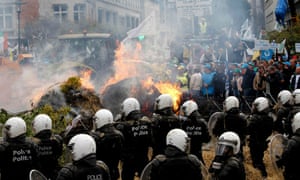
Europe was also troubled by the discontent of its farmers. Thousands of farmers descended on Brussels to protest high taxes and plunging food prices. Tractors blockaded the streets of Brussels and the protesters hurled eggs and sprayed the police with milk and hay.
Uzbekistan has banned the teaching of Political Science in the country. Islam Karimov has been President of the country since its independence after the break-up of the Soviet Unionand one can safely classify the regime as authoritarian. The ban is based upon Karimov’s belief that Political Science does not take into account the “Uzbek model” and is a pseudo-science. According to The Guardian: “The last remaining course in the subject widely taught in the country, which will now be called The Theory and Practice of Building a Democratic Society in Uzbekistan.” I always knew I was dangerous.

Austria has announced that it intends to lift the emergency measures which allowed the free flow of refugees across its borders. The emergency steps of lifting any checks on the people crossing the border was in response to the flood of refugees who had been bottled up in Hungary. Austria, after consultation with both Germany and Hungary, has decided to reinstate the controls indicating that it wished to resume to a more “normal” situation. Border checks are a long-standing feature of the nation-state system so the move is not a surprise. But such checks are time-consuming and subject to capricious implementation–both attributes somewhat inappropriate in the present desperate circumstance.
UN humanitarian programs such as the High Commissioner on Refugees are rapidly running out of money. These agencies had a 10% cut in their budgets last year, and the needs for their services has simply exploded this year with the crisis in Syria. We tend to focus on the flow of refugees into Europe, but other countries, such as Turkey, are bearing a much heavier burden. The World Health Organization was severely taxed because of the Ebola crisis in West Africa, and the World Food Programme has had very high demands this year as well. It seems clear that the global institutions entrusted with humanitarian protections are not up to the tasks they currently confront.
There is increasing evidence that Russia is building a military base in Syria in order to prop up the regime of President Assad. Russia already has a naval base in Tartus and there is satellite evidence that the Russians are building an air base at Latakia from which the Russians can fly missions against the Islamic State (the same objective as current US policy). Nonetheless, US Secretary of State Kerry has expressed concern to Russian Foreign Minister Lavrov about the build-up. Obviously, the US does not believe in the balance of power proposition: “the enemy of my enemy is my friend.”

US President Obama met with Saudi King Salman in Washington and discussed the Iranian nuclear agreement. Saudi Arabia has expressed great anxiety about the prospect of Iran developing nuclear weapons, but King Salman left Washington apparently satisfied with Obama’s assurances that the agreement will prevent that outcome. The US-Saudi alliance has been under great strain in recent years, but it seems clear that both sides believe that they need each other in the Middle East. The successful outcome of the meeting gives additional impetus to the Iranian agreement which the US Congress will debate on 17 September.
Vietnam and the Philippines are close to agreement on a strategic partnership. Such an alliance would be truly historic and reflects the apprehension on both sides about increased Chinese power in the South China Sea. The Philippines already has a relationship with both Japan and the United States. It is likely that China will find the proposed relationship offensive, a classic problem of the security dilemma.
Enough Senators have come out in favor of the Iranian nuclear deal to assure that the US Congress will not be able to scuttle the deal. The news assures US President Obama of a significant political and diplomatic victory, and also assures that the US will be able to keep its promises to its allies: Britain, France, and Germany. It also suggests a new and still undefined relationship to Israel. US support for Israel was never really in question; the only question was whether the deal improved or degraded Israel’s security. But the evidence suggests that the defining moment in the minds of many Senators was House Majority Leader Boehner’s decision to invite Israeli Prime Minister Netanyahu to address Congress without first consulting with President Obama. The move implicitly raised the question of whether a vote against the deal was a vote for American or Israeli national interest.
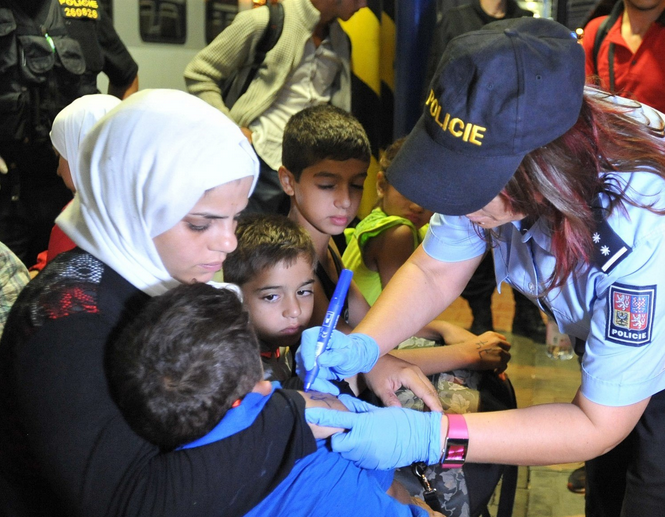
In what can only be described as a macabre situation, Czech police are reportedly taking refugees off trains bound for Germany and writing numbers on their arms in ink. The parallel to the treatment of Jews in the 1930s is striking, but appears to have been not fully appreciated by Czech authorities. No one disputes that the handling of such a large number of desperate people must be orderly, but European authorities seem unwilling to devise plans to treat the refugees in a more effective and humane manner. The treatment of refugees is outlined in the Convention relating to the Status of Refugees adopted on 28 July 1951 by the UN and signed by all the European states.
Those refugees who had been stranded in the train station in Hungary have set off on foot to walk to Vienna. The desperation of the refugees is matched only by their determination. Fortunately, it appears as if Hungary is backing down from its refusal to allow the refugees to pass through. We should remember that Steve Jobs was the child of a Syrian migrant to the US who came in 1954.

The number of displaced persons in the world is the largest since World War II. Many of these refugees are from war torn areas, particularly Syria. Ishaan Tharoor of The Washington Post examines the rhetoric in Europe about the refugees and how closely it parallels anti-Jewish rhetoric in the 1930s, although in the present case the rhetoric is anti-Islamic. The reactions in Europe to the refugees has been mixed. By and large, the cities, particularly in Germany, have been welcoming to the refugees. But in the smaller towns, the attitudes have been quite harsh. One thing is clear: the refugees are not entering Europe in search of a “better” life; they are entering Europe to simply stay alive. The question few in the mainstream media have been asking, however, is where is the US in this tragedy? Why hasn’t it stepped up to take in the refugees?
A Turkish Border Guard Carries the Body of a Dead Syrian Child

Hungary is refusing to allow the refugees to leave the country on trains, insisting that the refugees must first go to camps. The decision reflects the attitude of Prime Minister Orban who considers the refugees as a threat to Europe’s “Christian identity”. In an op-ed written for the German newspaper, the Frankfurter Allgemeine, Orban wrote:
“We shouldn’t forget that the people who are coming here grew up in a different religion and represent a completely different culture. Most are not Christian, but Muslim…. That is an important question, because Europe and European culture have Christian roots.”
The refugees are stranded in the Keleti rail terminus in Budapest and they have no place to go and are surrounded by Hungarian police.
One should not underestimate the difficulties associated with accepting refugees. But there are about 300,000 refugees seeking entry into Europe, a continent with about 490 million people. The countries of Turkey, Lebanon, Jordan, and Iraq have taken in the vast number of the estimate 4 million Syrian refugees, and those countries are significantly less well off than those in Europe or in the US. The country of Lebanon, for example, has taken in a total number of refugees that equal about a third of the Lebanese population: an unbelievable hardship.

One of the negative consequences of globalization is its bias towards capital and the consequent growing inequality which virtually every country in the world has experienced over the last 40 years. Indeed, in the US income inequality is as skewed toward the rich as it was in the late 1920s, just before the onset of the Great Depression. Many think that income inequality is merely an economic issue, but the growing dissatisfaction of those at the bottom of the income spectrum poses as national security risk as well.

One of the interesting aspects of income inequality is how the bias toward capital influences our policy choices. The management teams of the 30 largest fossil fuel companies have taken home $6 billion over the past five years. These companies have carbon-based reserves that, if burned, would emit approximately 2,795 gigatons of carbon dioxide, “five times the amount of carbon that researchers tell us would push the globe into catastrophic climate change, everything from extreme flooding and drought to a significant rise in sea level. ” In short, we are heavily rewarding those who would doom civilization. Strange choice.
The Times of India is reporting that recently declassified documents from the American CIA indicate that Prime Minister Indira Gandhi considered attacking presumed nuclear facilities in Pakistan in 1981. India exploded its first nuclear bomb in 1974 and Gandhi wished to preserve Indian nuclear superiority. At that time, India and Pakistan had fought three wars since securing independence in 1947. Pakistan ultimately exploded its first nuclear bomb in 1998. Relations between the two states remain, however, quite strained.
An update to a previous post. I earlier noted that William Bradford, a professor at West Point, had published a paper entitled “The Treason of the Professors” in which he claimed that there were about 40 professors in the US who should be tried as “enemy combatants” because of their Islamist sympathies. West Point has just announced that Mr. Bradford has left West Point.
Today is the anniversary of the beginning of World War II. The German army moved into Poland on 1 September 1939 and the British decided that the expansion of German power in the Rhineland, in Austria, and in Czechoslovakia had gone far enough. The Soviet Union also announced the approval of the German-Russian non-aggression pact, known as the Molotov-Ribbentrop Treaty, which freed Germany from worrying about Russian intervention on the Eastern front. That Treaty paved the way for the Soviet invasion of Poland later on in the month.

US President Obama has called for new icebreakers to patrol the Arctic Ocean to counter what he considered to be a Russia threat to dominate the polar region. Russia currently has a large number of icebreakers (not surprisingly given the extent of the Russia border that is above the Arctic Circle), but the US only has a small number (again, not surprisingly given that it is only the Alaskan coastline that is above the Circle). But Russia is also building up a large number of forward bases to buttress its claims to own an area that may have very large reservoirs of oil and natural gas.


