Brazil’s Guanabara Bay will be the site of many of the Olympic Games next year. Unfortunately, the Bay is an environmental disaster, and the Brazilian government does not seem to be taking effective steps to clean it up. If it isn’t cleaned up, then the image of Brazil will be sullied. Given the economic problems besetting the country and the political crisis that seems to have weakened the government, it seems unlikely that Brazil will be able to summon up the resources and the will to meet its responsibilities as host of the Olympic Games.
Guanabara Bay
China’s assertion of control over the South China Sea represents some major changes in policy from its earlier positions on maritime control. When China was a developing power, it shared many of the positions currently held by other developing powers such as Vietnam and the Philippines. But as a major power, its current policies conflict with those positions. The contrast is clear: China’s current stance on the United Nations Conference on the Law of the Sea (UNCLOS) is quite similar to the US positions in the early negotiations on the treaty. The US is not yet a signatory to UNCLOS but has announced that it will follow the rules of UNCLOS.
The left-wing party, SYRIZA, has apparently come in first in the Greek election with about 35% of the vote. The conservative party, New Democracy, conceded defeat and came in second. It is not entirely clear what the outcome of the vote will mean for Greece. The elections were called because a more radical wing of SYRIZA wanted a stiffer response to the German demands in the debt negotiations. It seems likely that SYRIZA will forge a coalition with the right-wing Independent Greeks party which is adamantly anti-austerity. We should probably expect that the debt negotiations will become more difficult in the next few months.
The ethnic mix of Europe seems to be going through a massive change because of the emphasis placed on the refugee crisis. But the ethnic mix of Europe was pretty well established prior to the crisis and, in a continent of 490 million people, it is hard to change the mix all that much. The Pew Research Center did an analysis of the ethnic mix in Europe prior to the crisis and the information is a good base from which to think about the impact of the refugees. One cannot deny that the flood of refugees is incredibly difficult to manage and accommodate in the short term. But it is unlikely that Europe will be transformed by it.
Laszlo Toroczkai is the mayor of Asotthalom, a town on the Hungary-Serbia border and he has produced a video designed to discourage refugees from coming to his town. He is a member of the 64 Counties Youth Movement (if you cannot read Hungarian, Google can translate the page) which is an ultranationalist group closely aligned with the Hungarian Prime Minister, Viktor Orban. The video is quite remarkable.
The commander of US naval forces in the Pacific, Admiral Harry Harris, told the US Senate Armed Services Committee that the US should challenge Chinese activity in the South China Sea. According to Reuters:
“‘I believe that we should exercise – be allowed to exercise, freedom of navigation and flight – maritime and flight – in the South China Sea against those islands that are not islands.’
“Asked if this meant going within 12 miles, he answered, referring to the artificial islands: ‘Depending on the feature.” He added: “Conducting that kind of … freedom-of-navigation operation is one of the operations we’re considering.'”
Admiral Harris has international law on his side, but one should expect the Chinese to respond quite forcefully to such a move.
Yesterday the US Federal Reserve Bank announced that it would not raise interest rates in the US above its current level of 0.0-0.25%. The Fed cited “global concerns” for the decision, a basis for which unnerved many investors. The effective interest rate of zero has been maintained since 2009 and such a low level has never occurred for such a long time in financial history. There is little question that the global economy is in uncharted territory right now and it is difficult to figure out what the future holds.
Mesopotamia, c 3000 BC: 20%
Babylon, Code of Hammurabi, 1772 BC: codified earlier Sumerian custom of 20%.
Persian conquest (King Cyrus takes Babylon), 539 BC: rates of 40+%.
Greece, Temple at Delos, c. 500 BC: 10%
Rome, Twelve Tables, 443 BC: 8.33%
Athens/Rome: circa the first two Punic Wars, 300-200 BC: 8%
Rome: 1 AD: 4%
Rome, under Diocletian, 300 AD: 15% (estimated)
Byzantine Empire, under Constantine, 325 AD: limit 12.5%
Byzantine Empire, Code of Justinian, 528 AD: limit 8%
Italian cities, c. 1150: 20%
Venice, 1430s: 20%
Venice, (Leonardo da Vinci paints “The Last Supper in Milan), 1490s: 6.25%
Holland, beginning of the Eighty Years’ War, 1570s: 8.13%
England, 1700s: 9.92%
US, West Florida annexed by the US, 1810s: 7.64%
US, circa World War II, 1940s: 1.85%
US, Reagan administration, 1980s: 15.84%
US, Fed does not hike rates in September, 2015: 0-0.25%
Zero interest rates are a manifestation of the sluggish growth in wages in the US and around the world. There actually has been incredible growth in some sectors of the economy, but those gains are not spread evenly across the population. The St. Louis Federal Reserve Bank provided statistics comparing corporate profits and wage growth in the US since 2009, the onset of the Great Recession. The chart is revealing:
It certainly does not appear as if wealth has “trickled-down.” But Jamie Dimon, CEO of one of the largest banks in the world, JP Morgan Chase, does not believe that the statistics reveal the truth. Bloomberg reports Dimon as saying:
“It’s not right to say we’re worse off,” Dimon said Thursday at an event in Detroit in response to a question about declining median income. “If you go back 20 years ago, cars were worse, health was worse, you didn’t live as long, the air was worse. People didn’t have iPhones.”
For the record, I do not have a smartphone (nor do I want one). And I suspect that most people would enjoy at least some share of the corporate profits since their labor produces those profits. But the corporations do not even need to be profitable for income inequality to get worse. Jeff Smisek, the former CEO of United Airlines, was forced to step down because of corruption charges. Even though United’s stock is down 15% this year, Smisek received the following severance package:
“United will hand Smisek nearly $5 million in cash plus other financial compensation that could top $20 million.
“In case he’s ever in the mood to travel, no problem. Smisek gets free first-class tickets on the airline for the rest of his life.
“He also gets free airport parking for life, health insurance until he’s eligible for Medicare in about four years and, oh yes, the keys to his company car.
Nice work if you can get it.
For those who have followed this blog for some time, it is no secret that I believe that climate change is occurring and have little patience for so-called “deniers“. One of the more persistent themes in the denial meme is that there has been a “pause” in the rise in global temperatures, presumably indicating that human activity cannot explain the variations in temperature since the warming process has not been “linear.” There are four new studies, one which tested the data with economists who were asked to review the data labelled as “agricultural” production (in other words, a test which presumably screened out bias on the issue of climate change), which emphatically refute the idea that there has been a “pause” in the rate of global warming.
Last October protesters forced the President of Burkina Faso, Blaise Compaore, from extending his 27-year rule over the country. An interim government has ruled in his place until a military coup d’etat ended that promising beginning of democracy. The coup will likely prevent the elections that had been promised for this coming 11 October. Burkina Faso had emerged as a hopeful sign to other countries in Africa that citizens could overcome the tyranny of a long-standing dictator. Those hopes were dashed by the coup.
Bills to change Japan’s military posture in world affairs appear ready to pass the Japanese Parliament despite large protests on the streets and within Parliament itself. The change proposed by Prime Minister Abe is not a fullscale repudiation of Japan’s disavowal of projective military power. The main bill gives Japan the right to come to the aid of Japan’s allies (presumably the US) if those allies are acting in defense of Japan’s interests. Nonetheless, many, both inside and outside of Japan, interpret the move as a slippery slope in a return to Japan’s militarist past.
The Syrian government has begun to use new weapons supplied to its army by Russia. Very little is publicly known about the weapons but they are an index of Russia’s renewed commitment to supporting President Assad. Using the new weapons, the Syrian has begun to attack the city of Raqqa which has been held by the Islamic State for some time. Not coincidentally, Raqqa is a frequent target of the US-led coalition against the Islamic State. So the US and Russia are de facto allies in the civil war, even though the US continues to insist that Assad must go. At some point, actions speak louder than words.
Nigerian President Muhammadu Buhari has indicated that his government is negotiating with the extremist group, Boko Haram. The group has been terrorizing many parts of Nigeria in its pursuit of an Islamic state in northern Nigeria, and has kidnapped over 200 Nigerian girls. The group, whose name means “Western education is a sin”, has been difficult to control and has destabilized the economy of Nigeria to a considerable extent. Buhari has made bringing the group under control one of his top priorities. Nigeria’s progress on this matter has been difficult to assess.
Sri Lanka endured a 26-year civil war between the dominant Sinhalese and the minority Tamil on the island which finally ended in 2009. The end of the civil war was bloody and raised all sorts of questions about the conduct of the war. The UN has finished an investigation into the conduct of the war and has issued a report which asserts that many war crimes and crimes against humanity occurred. The report does not name any particular individuals involved in the crimes but the implications of the report suggest that the former President, Mahinda Rajapaksa, was involved in the commission of the atrocities. Sri Lanka now will wrestle with whether a domestic court of inquiry is an acceptable alternative to the suggested international court.
11 September marked the end of the ice melting season in the Arctic, and the amount of ice recorded was the fourth lowest since satellite monitoring began in the 1970s. The lowest level ever recorded was in 2011, followed by 2007 and 2011. The trend seems unmistakable: Arctic sea ice is diminishing and the likely cause if global warming. The prospect of an ice-free Arctic in the summer months could potentially be destabilizing in world politics and states compete for what are believed to be significant oil and gas resources in the region.
Hungary has mobilized its army to control its border with Serbia. The leader of Hungary, Viktor Orban, believes that it is Hungary’s task to defend what he calls “Christian” Europe against the “invasion” of Muslims. Orban is distinctive, but not unique, among new leaders and movements in Europe. The National Front in France, the Golden Dawn in Greece, the True Finns in Finland, and the Party for Freedom in the Netherlands have all adopted similar rhetoric. There are terrifying parallels to what happened in Europe in the 1930s and what is happening today. We can only hope that the European Union is strong enough to defuse this trend toward fascism.
Four weeks ago China claimed that it had stopped dredging in the South China Sea in its efforts to claim soveriegnty over certain reefs. However, on the eve of Chinese President Xi Jinping’s visit to Washington, DC, evidence has surfaced that the build-up of the reefs has continued. The news will no doubt strain the meeting between Obama and Xi which was already suffering from accusations about cyber spying and the continued hacking of US government sites by what Washington believes to be Chinese military units. We will see how the parties navigate these tensions during their negotiations.
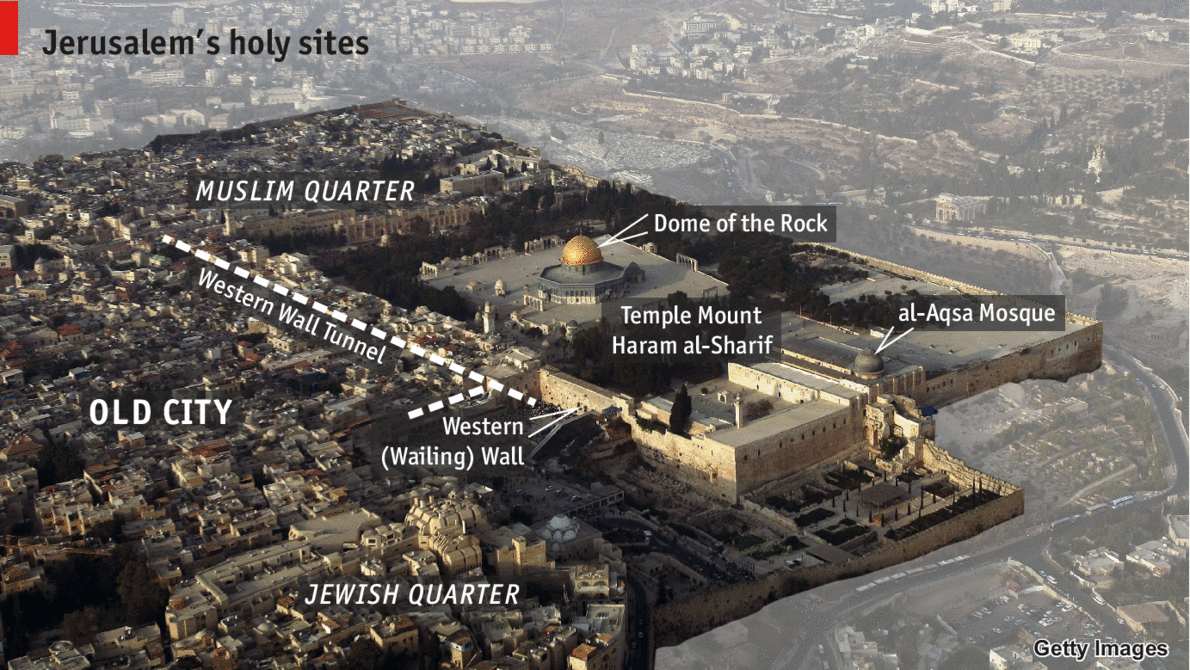
Tensions have been rising for several weeks over the status of what Jews call the Temple Mount and what Muslims call the Noble Sanctuary in the city of Jerusalem. The site exists in Old Jerusalem which was controlled by Jordan until the 1967 war after which has been controlled by the Israelis. Since 1967, Israel has prevented Jews from praying on the site in deference to the tradition giving access to Muslims to the al Aqsa mosque. Recently, however, some Jews have insisted on praying on the site and violence has broken out between those Jews and the Muslims defending the mosque. Rumors are swirling that the Israeli government of Prime Minister Netanyahu is going to change the rules to allow Jewish prayers as a matter of course. Such a change would likely precipitate a harsh reaction from Muslims all over the world.
There seems to be a consensus emerging among many of the outside powers involved in the Syrian civil war that the only solution to the slaughter is to line up behind President Assad. With Iranian support consistent and likely to increase once Iran is able to sell its oil again and the Russians building a military base to support Assad, it seems as if Assad’s position is assured. The Europeans are more or less deciding that ending the civil war as quickly as possible is the only way to staunch the flow of refugees. And the Americans, although rhetorically opposed to the Assad regime, is in fact supporting Assad by attacking the Islamic State. In the end, it seems as if the cruel logic of realism will prevail: better to deal with the butcher who appears most likely to win.
The Brazilian economy recently fell into a recession (two quarters of negative economic growth), its bond rating was lowered to junk status, and the popularity of its President, Dilma Rousseff, is in single digits. Now the country has to go through painful fiscal austerity. It has increased taxes and reduced subsidies to infrastructure and poor families in an effort to balance its budget. No one knows if the austerity will ultimately prove to be successful, but the initial shock of austerity will be very difficult for most Brazilians. The global economy continues to weaken.
We sometimes talk about the “hard” and “soft” power of a state in the international system. Hard power is defined as those assets that are tangible and can be used to directly influence the decisions of other states. Soft power is less concrete and is made up of attributes that make the influence of a state attractive to others. For example, much of American influence in the world comes from the fact that many in the world enjoy American culture: rock and roll, jeans, McDonalds. For a long time, the liberal systems embraced by the West (representative democracy, market capitalism, and human rights) were viewed by others as a desirable objective. Steven Erlanger of The New York Times suggests that the attractiveness of those liberal systems is waning in world affairs.
Timothy Snyder is the author of an important book, The Bloodlands, in which he chronicles the land between Germany and the Soviet Union during the Second World War and how both regimes unleashed genocidal forces on the populations living there. He has written an op-ed for the New York Times in which he parallels the desire of states for agricultural land in the expected process of climate change and how those desires will lead to similar genocidal forces. Unfortunately, most of the “available” arable land is on the continent of Africa, and there is plenty of evidence that countries such as China are attempting to access that land.
Although Germany has indicated that it is willing to take up to 800,000 refugees from war-torn countries, making it one of the most open countries in Europe, it just announced that it is implementing emergency border controls that appear to be inconsistent with the open borders promised by the Schengen Plan of the EU. The two positions are not necessarily inconsistent, it is clear that any slowdown in processing the refugees will leave many of them trapped in openly hostile countries like Hungary. The flood of refugees is an unprecedented crisis (the most dramatic movement of refugees since World War II) and governments are clearly unprepared to deal with the crisis. The US remains an incredible laggard in the crisis, promising only to take in 10,000 Syrian refugees.
Denmark historically has had a reputation for being one of the most open countries in Europe. Since the election of Lars Løkke Rasmussen of the Venstre Party, a center-right party, the country has changed its attitudes toward immigrants and refugees. Many refugees are now leaving the country for Sweden which has maintained its policy of openness. Last week Denmark halted all train traffic through Germany in an effort to stop the flow of refugees. Denmark’s policies are not as harsh as Hungary’s policies, but the message to refugees is unmistakable.
Congressional Republicans have not given up on their effort to prevent the Iranian nuclear agreement from coming into force. Senate Majority Leader, Mitch McConnell, indicated that he will bring the same legislation disapproving the deal back to the floor. House Republicans have indicated that they will try to impose controls over the money that can be used to implement the agreement. The debate over the agreement is also working through the Iranian legislative process.
Venezuelan politics was rattled by the conviction of Leopoldo López, the opposition leader. López was convicted of inciting violence in the elections held in 2014 that led to the administration of Nicolás Maduro. The trial was conducted in secret and no defense witnesses were allowed, even though there were more than 100 witnesses for the prosecution. López was sentenced to 14 years in prison, an extraordinarily harsh sentence. The opposition parties have called for protests on 19 September. The Venezuelan economy is in chaos with very high inflation and shortages of most goods, and the situation is very unstable: it is hard to predict where the protests might lead.
The UN General Assembly has voted on a resolution to protect countries who are experiencing pressures for repaying debts from unreasonable demands for reforms and budget cutbacks that harm the general citizenry. All countries have the sovereign right to repudiate debt but the consequences for such defaults is usually that the country is frozen out of international credit markets for an extended period of time. Short of that right, countries are generally hostage to laws that overwhelmingly favor the creditors to demand whatever reforms they deem appropriate. The General Assembly resolution is designed to limit the scope of those demands. Unfortunately, General Assembly resolutions are not binding (only Security Council resolutions are binding). The vote, however, was overwhelmingly in favor and it does send a political message.
It now appears as if US President Obama will be able to begin lifting sanctions against Iran in order to implement the Iranian nuclear agreement. Analysts will be pondering Obama’s success in getting the agreement passed over the strenuous objections of the Israeli government. Jeffrey Goldberg argues in The Atlanticthat it was Prime Minister Netanyahu’s strategy that ultimately led to the willingness of the Democrats in the US Senate to side with the President.
Economic hard times often lead to right-wing politics, and no where is that tendency more obvious than in Greece. Greece has been in a sustained depression for the last five years and it has gone through three debt bail-outs which have only made the economic situation worse. In this climate it is no surprise that a new political party, called Golden Dawn, has emerged. The party is powerfully anti-immigrant and has adopted a swastika-like image as its political symbol. As with most right-wing parties, it places a strong emphasis on the historical narrative of the nation–in this case, the battle of the Spartans against the Persians at Thermopylae in 480 B.C.E.
A Flyer From One of the Most Historically Inaccurate Films Ever Made–the 300