Archive for the ‘World Politics’ Category
British Prime Minister David Cameron sent a note to the European Union outlining his conditions for Great Britain to remain a member of the Union. The demands are as follows:
- Protection of the single market for Britain and other non-euro countries
- Boosting competitiveness by setting a target for the reduction of the “burden” of red tape
- Exempting Britain from “ever-closer union” and bolstering national parliaments
- Restricting EU migrants’ access to in-work benefits such as tax credits
The demands are ambiguous and designed to guide the debate in Britain as it moves toward a referendum in 2017. It will be interesting to see how the eurosceptics in Britain mount their attack on the Union before that date.
Reuters is reporting that Russia is working toward an 18-month political framework to resolve the civil war in Syria. Russia is denying the report, but it rings true to the diplomatic offensive that Russia has been waging to retain its influence over Syria and to bolster its presence in the Middle East. The draft document apparently holds out the possibility the Syrian President Assad could remain in power, a position adamantly opposed by the US and Turkey. But it doesn’t seem to require that Assad remain in office, so there is a little wiggle room for all sides.
Odeleite River, Portugal
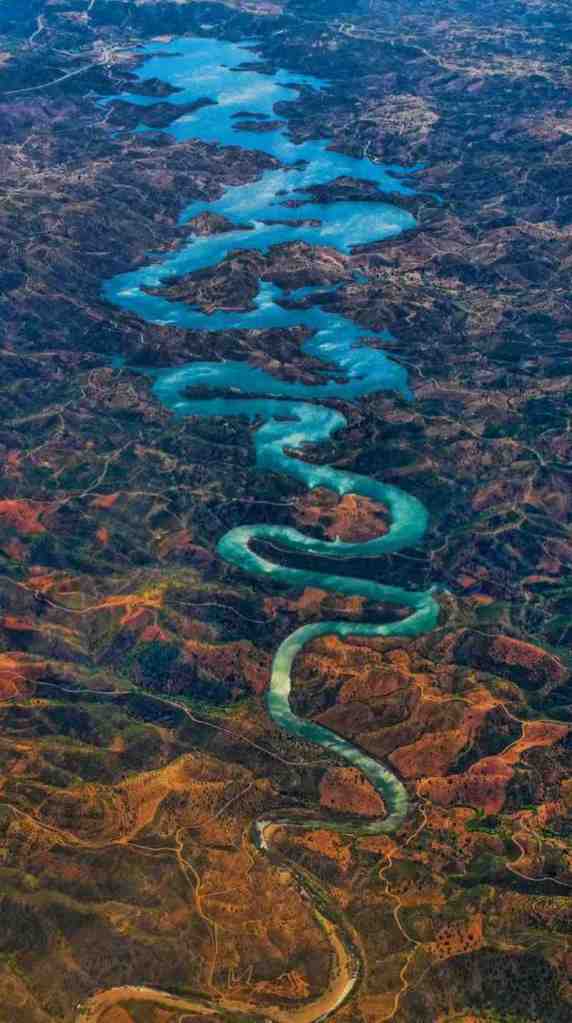

The above photograph captured the attention of millions of people in China, who quickly noticed that the river was reminiscent of a dragon–an auspicious symbol in China. It has been dubbed the “Blue Dragon River” after the photo was published on Imgur.
The beginning phases of industrialization are always tough on the environment. Both London and Los Angeles were famous for their polluted air, and it is only recently that progress has been made in preventing many particulates from entering the atmosphere. China now has some of the most polluted air on the planet (although New Delhi in India is reportedly quite bad as well). The World Health Organization puts the limit on toxic air particulates at 25 micrograms per cubic meter of air over 24 hours. The recent reading in the Chinese city of Shenyang registered at 1,400 micrograms. The photos are brutal.

9 November is an important day in German history. In 1938 it was the night of Kristallnacht, when thugs roamed the streets of Germany smashing the windows of stores and homes owned by Jews. The word refers to the sound the smashed glass (crystal) made all throughout the night. That night signaled the beginning of the Holocaust although measures against Jews had already become extensive throughout Germany. In 1989 it was the day the Berlin Wall fell. The wall had divided East and West Berlin since 1961 and was a stark symbol of the Cold War between the US and the Soviet Union. The fall of the Berlin Wall ultimately led to the dissolution of the Soviet Union in 1991.
Kristallnacht The Fall of the Berlin Wall


Catalonia’s regional government has decided to declare independence from Spain in 2017. The Catalonians are angry with the Spanish central government since the province is one of the more economically dynamic areas of Spain and the central government takes more tax revenues out of the province than it returns in the form of governmental assistance. The central government, led by Prime Minister Mariano Rajoy, will vigorously resist the move, but it is likely that Spain will have to endure a constitutional crisis.
US officials are “99.9%” certain that a bomb brought down the Russian airplane over the Egyptian Sinai. The belief rests upon US, British, and Israeli intelligence services, but the Egyptians are still reluctant to accept the verdict since such a finding would jeopardize the tourist industry, one of the most reliablle sources of income for the Egyptian government. Russian teams have been sent to sour the departure area of the Sharm el Sheikh airport, suggesting that the Russians are investigating the possibility that the bomb was placed on the plane by an insider.
Myanmar held its first relatively free election in 25 years. The election was not completely free because Aung San Suu Kyi was not allowed to run, but her party, the National League for Democracy, apparently won the largest number of votes (the final results of the election will not be available for 36 hours). Additionally, about a million Rohingya Muslims were excluded from the vote, a legacy of the hostility toward the minority group by the majority Buddhist population in Myanmar. The problems notwithstanding, the election is a giant step forward for Myanmar.
The World Bank has just issued a new report on the urgent need to address climate change and global poverty in tandem. The global poor will have a very difficult time adapting to climate change and they are already subsisting on the brink of disaster. Issues such as crop failures, water shortages, the rising oceans, and temperature increases will all have negative effects on the 702 million people (9.6% of the total population of the planet) who live in extreme poverty. Climate change could force another 100 million people into the condition of extreme poverty.

Military spending in the US is unusually difficult to analyze. Most weapons now are extremely sophisticated and require funding over many years, sometimes decades. And defense contractors are notoriously unreliable in their initial cost estimates. The US has just named Northrup Grumman as the company to build the next generation of strategic bombers. The problem is that no one knows how much it will cost. If the F-35 is any example, we can expect the cost to be at least double the initial estimate of $56 billion for a fleet of 100 bombers.
Artist Rendering of Proposed Long-Range Bomber

US President Obama has decided that the US will not build the Keystone XL pipeline that was proposed to bring Canadian heavy oil to the US. Environmentalists have opposed the pipeline for a variety of reasons, but the fossil fuel industry has been staunchly supportive. President Obama noted that his opposition to the pipeline was rooted in concerns over climate change and the need to move away from hydrocarbons. Such a statement would have been almost impossible several years ago.
Tensions escalated in the Occupied West Bank as Palestinians used firearms to attack Israelis instead of knives and stones. Three people were injured in the attacks in the city of Hebron, and a Palestinian was killed by Israeli forces. “Since mid-September, 11 Israelis were killed in Palestinian attacks, most of them in stabbings, while 72 Palestinians were killed by Israeli fire….” The use of firearms indicates that the violence will likely escalate, and there is virtually no reason to believe that it will subside in the near future. On Monday, US President Obama and Israeli Prime Minister Netanyahu will meet to discuss US-Israeli relations. It does not appear as if renewed Israeli-Palestinian negotiations is on the agenda for that meeting.
The US formally annexed Hawaii by an Act of Congress in 1893. Prior to that point it was known as the Kingdom of Hawaii. There is currently a move in Hawaii to recognize formally the rights of native Hawaiians within the framework of Hawaiian statehood in the US. The move is different from Federal recognition of Native American nations on the North American continent–those nations were formally incorporated into the Federal government as “domestic dependent nations.” But the status of Native Hawaiians has never been legally determined and there is some question about whether the Congressional annexation makes any sense in an international law framework. By most legal precedents, Hawaii should be considered “occupied territory” for those who never accepted the rule of the US government. The debate is a contemporary example of the difference between nation and state.
A new report indicates that the US attack on a hospital in Kunduz, Afghanistan which was run by Doctors Without Borders on 3 October of this year was, at best, a brutal example of extraordinary incompetence and, at worst, a fairly clear-cut war crime. I have been waiting for more information about the attack, and this latest report does not answer all the questions about the attack, but sheds enough light to indicate that the US is morally culpable for the incident. I will continue to wait for the US government report before I reach a conclusion, but these preliminary results are quite discouraging.
President Pierre Nkurunziza remains in office after his election in a disputed third term in office (the constitution only allows two terms). The country has been very tense since that disputed election and Nkurunziza amplified the tension by passing a edict requiring all citizens to hand over any guns in their possession. Analysts fear that violence will explode in the country as the deadline for the handovers of 7 November nears. Burundi has long experienced violent instability and a new flare-up will return the country to that depressing path.

Presidents Xi Jinping of China and Ma Ying-jeou of Taiwan are scheduled to meet this weekend in Singapore for the first such meeting since the Chinese civil war in 1949. In that year, the Kuomintang fled the mainland of China and set up an independent Republic of China in opposition to the People’s Republic of China established by Mao Zedong. The US supported the Republic of China until 1972 when US President Nixon recognized the PRC as the official government of the Chinese people. Since that time, China has regarded the government in Taiwan as a renegade province that needs ultimately to be unified with China. Presumably, that reunification will be a concern for the two Presidents, but it is unlikely that either side will make any explicit comments about it.
In a setback to efforts to control greenhouse gas emissions, researchers have found that China has underestimated its coal consumption by about 17%, or about the same amount of carbon dioxide that Germany emits in a year. The news will undoubtedly have an effect on the climate change talks scheduled for the end of the year in Paris. The discrepancy is an indication of how difficult it is to gather accurate information about the ecological consequences of human activity and does not necessarily reflect an attempt by China to distort its figures.
The latest theory behind the Russian airline tragedy in Egypt is that a bomb was responsible for the disaster. At this time, all I have are assertions by British intelligence agencies with hints of confirmation by US intelligence. There is no reason to rush to a judgment. I intend to wait for the evidence to be presented and assessed by experts. I vividly remember how we were all assured that Iraq had weapons of mass destruction in 2003.
In a very important development, Russia has indicated that it is not “important” for Syrian President Assad to remain in power. The working assumption behind the explanation for the strong Russian intervention in Syria was precisely that Russia wanted to keep Assad in power even though the West had said repeatedly that Assad had to go. Apparently, there have been behind the scene discussions between US Secretary of State Kerry and Russian Foreign Minister Lavrov that have been fruitful. How Assad leaves will depend on how Russia defines a “graceful” departure and how much slack the West in willing to give Assad–perhaps immunity from prosecution for war crimes or the retention of great wealth. We will see how Iran responds.
The Defense Ministers of the Association of Southeast Asian Nations (ASEAN) are meeting and struggling with the question of whether to take a stand on China’s territorial claims in the South China Sea. Most of the members oppose China’s claims, but Cambodia (which does not have a claim) is a strong Chinese ally. Since ASEAN insists on not taking votes but relies on consensus decisions instead, a statement would require a break from that rule. The decision will mark an important moment in the evolution of ASEAN as a political agent.
The pressure of refugees flooding into their countries is forcing some European nations to consider closing their borders in the same way that Hungary did a few weeks ago. Right now, the refugees are moving through the Balkan states of Croatia, Serbia, and Slovenia, into Austria and ultimately to Germany. Many, however, fear that the pressure on Germany to restrict the number of refugees it accepts will only grow, trapping the refugees in countries with much smaller populations and economies. Croatia is holding a national election in a few days, and if the right-wing candidate wins, it will almost certainly close its borders.

The Justice and Development Party (AKP) in Turkey won a decisive victory in the snap elections on Sunday. The results obviate the need for a coalition government and will undoubtedly strengthen the hand of President Erdogan who made no secret of his desire for single party rule in the run-up to the election. The results were a blow to the Kurdish parties and the Republican People’s Party (CHP). The Organization for Security and Co‑operation in Europe and the Parliamentary Assembly of the Council of Europe both raised doubts about the legitimacy of the election, noting the violence encountered in certain election districts. But those doubts will not affect the outcome at all.
The US Department of Defense spent $43 million to build a compressed natural gas station in Sheberghan, Afghanistan making it the world’s most expensive gas station. Similar gas stations in neighboring Pakistan cost about $500,000 to build. The gas station was built in order to prove that such stations were feasible for automobiles, but no one can explain why this particular gas station cost so much. The Task Force in charge of building the gas station was decommissioned last March and apparently there is no one who can answer any questions about the gas station at the Pentagon. The “fog of war” is clearly a source of incredible corruption.

Stephen Kinzer was a reporter for the New York Times and has written extensively on Iran. He has published a rather long essay on life in Iran now that is definitely worth reading. There are so many misconceptions about Iran in the West, fueled by incessant government propaganda, that it is difficult for many in the West to truly understand what is going on in the society. Kinzer gives a very good summary of the major issues dividing the West and Iran but offers a great deal of hope that the nuclear deal can signal the beginning of a better relationship.
Another publisher has been murdered in Bangladesh. Faisal Arefin Dipan published the works of Avijit Roy who was murdered last February. Roy was a blogger who sharply criticized religious fundamentalism in Bangladesh. Defenders of secularism has have a tough time in Bangladesh as religious extremists seek to impose religious law in the country. Bangladesh’s Prime Minister, Sheikh Hasina, has criticized those who defend secularism and has been quoted as saying that writers should “not hurt anybody’s [religious] feeling. When you are living in a society, you have to honor the social values, you have to honor the others’ feelings.”
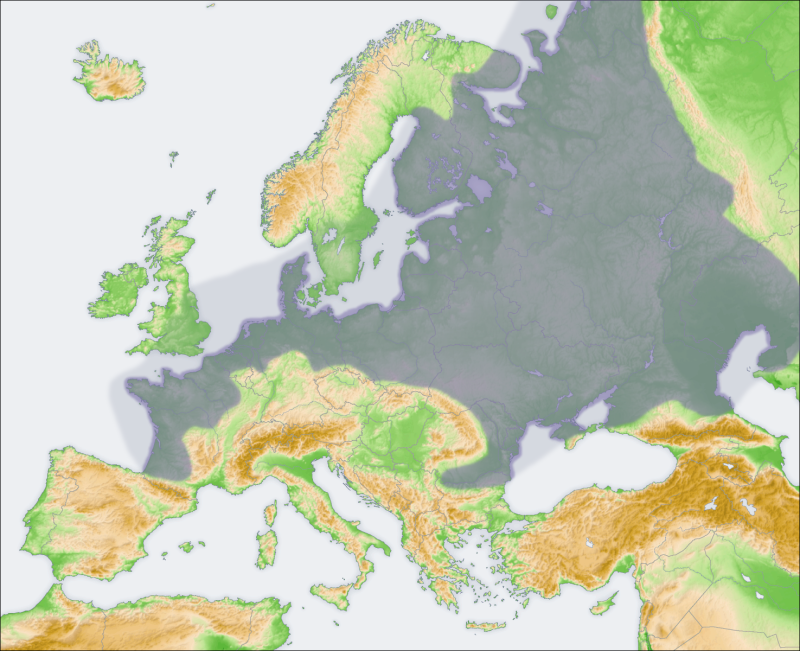
It is impossible to know Russian President Vladimir Putin’s true objectives in moving into Ukraine and Syria. But Tim Marshall argues that geography explains a great deal of Russian motives. Marshall argues that the relatively flat “European plain” is a very inviting corridor for those who wish to invade Russia (think Charles XII, Napoleon, and Hitler), and Russia is constantly worried about creating defensive barriers to such invasion by controlling countries along its western border. Geopolitics can explain a great deal.
The European Plain
What countries receive US foreign aid?

There are fires burning in the forests of Indonesia that are emitting more carbon dioxide than the US does. Not only are the trees and other vegetation burning, but the underlying peat is burning as well. The smoke pervades Indonesia and spreads to Singapore and Malaysia as well. The threat to endangered animal species is quite high, as is the threat to human lives. The last time fires were as widespread in Indonesia as they are today, 17,000 children died from the effects of the smoke.

The Permanent Court of Arbitration at The Hague has ruled in favor of the case submitted by the Philippines concerning maritime claims in the South China Sea and has accepted jurisdiction on the case. The ruling is a setback to China which had claimed that the court had no jurisdiction over the matter, and China had not submitted any materials to the court disputing the case bright by the Philippines. China rested its refusal on Article 298 of the UN Conference of the Sea which reads, in part:
“Article 298. Optional exceptions to applicability of section 2
“1. When signing, ratifying or acceding to this Convention or at any time thereafter, a State may, without prejudice to the obligations arising under section 1, declare in writing that it does not accept any one or more of the procedures provided for in section 2 with respect to one or more of the following categories of disputes:
(a)
(i) disputes concerning the interpretation or application of articles 15, 74 and 83 relating to sea boundary delimitations, or those involving historic bays or titles, provided that a State having made such a declaration shall, when such a dispute arises subsequent to the entry into force of this Convention and where no agreement within a reasonable period of time is reached in negotiations between the parties, at the request of any party to the dispute, accept submission of the matter to conciliation under Annex V, section 2; and provided further that any dispute that necessarily involves the concurrent consideration of any unsettled dispute concerning sovereignty or other rights over continental or insular land territory shall be excluded form such submission;
(ii) after the conciliation commission has presented its report, which shall state the reasons on which it is based, the parties shall negotiate an agreement on the basis of that report; if these negotiations do not result in an agreement, the parties shall, by mutual consent, submit the question to one of the procedures provided for in section 2, unless the parties otherwise agree;
(iii) this subparagraph does not apply to any sea boundary dispute finally settled by an arrangement between the parties, or to any such dispute which is to be settled in accordance with a bilateral or multilateral agreement binding upon those parties;(b) disputes concerning military activities, including military activities by government vessels and aircraft engaged in non-commercial service, and disputes concerning law enforcement activities in regard to the exercise of sovereign rights or jurisdiction excluded from the jurisdiction of a court or tribunal under article 297, paragraph 2 or 3;
A ruling could be issued sometime in the first half of 2016, and it is probable that other states may now join the Philippines in pursuing legal redress. How China will respond to this ruling has yet to be seen.
The Responsibility to Protect (R2P) is a new doctrine in world politics which insists that sovereignty is not merely a right of nation-states, it is also an obligation to protect innocents from war crimes, atrocities, and genocide. In such cases the world community has an obligation to override sovereignty and to protect these innocents. Unfortunately, R2P has not been implemented well. A team of researchers has analyzed the shortcomings of the doctrine and pose some changes necessary to make it more effective.

