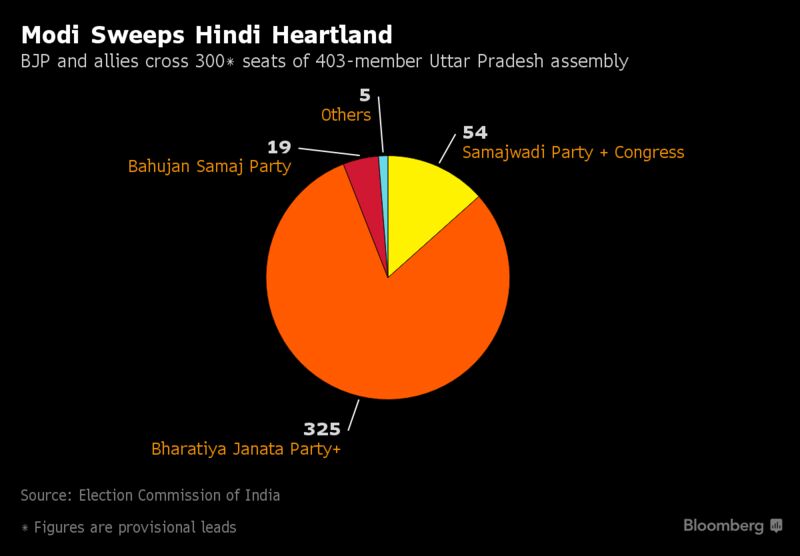
Following the decisive victory of the Bharatiya Janata party (BJP) in India’s most populous state, Uttar Pradesh, Prime Minister Modi has appointed Yogi Adityanath as its chief minister. Mr. Adityanath has repeatedly called for India to be called a Hindu rastra, or Hindu nation, and has criticized popular Indians such as Mother Teresa and the Bollywood actor Shah Rukh Khan for their comments in support of a secular India. According to The Guardian: “Adityanath is facing criminal charges of attempted murder, defiling a place of worship and inciting riots in Uttar Pradesh.”
Yogi Adityanath
Paul Pillar used to work for the CIA and is currently a professor at Georgetown University. He is a brilliant analyst and has written an essay for The National Interest on the rise of anti-Semitism in the US and the world, and its relationship to the resurgence of white nationalism in the US and US policy toward Israel. It is a very careful and deliberative analysis which lays out many of the tensions that exists in these tangled relationships. His conclusion is worth thinking about carefully: “They should worry about it. It has been said, with good reason, that Jews are the canary in the coal mine as far as prejudice and sometimes lethal hatred are concerned, because they often have been the first to suffer from it.” Anti-Semitism is a virulent disease that demands our total attention.
The Whanganui River on New Zealand’s North Island has long been considered sacred by the Maori people. The river has now been granted all the rights, duties, liabilities, and privileges of a legal person in order to preserve its integrity as a living presence to the Maori people. Gerrard Albert, the lead negotiator for the Whanganui iwi [tribe] describes the legal victory in this way: “We have fought to find an approximation in law so that all others can understand that from our perspective treating the river as a living entity is the correct way to approach it, as in indivisible whole, instead of the traditional model for the last 100 years of treating it from a perspective of ownership and management.” The ruling is a possible guide to ways we can think about the earth in a manner that does not make the earth subservient to human interests.
The Security Dilemma is one of the bedrock analytical frameworks of world politics. It is a very simple framework that posits that even purely defensive security moves by a state will likely be perceived as aggressive moves by another state. Thus, when a state takes measures to enhance its security, it inevitably sets off a reaction from other states who are forced to interpret those moves as threatening. Robert Jervis is the scholar who has developed this framework to an incredible degree, and in an interview with The Atlantic’s the Security Dilemma to analyze US-North Korean relations Kathy Gilsinan, uses . The framework unfortunately leads to some troubling conclusions. The interview is a very valuable insight into the dynamics of world politics.
The G20, the group of 20 nations that collectively account for the vast majority of the world’s GDP, has issued a communique at the end of its 2-day annual meeting. The communique, for the first time in many years, dropped its boiler-plate language in favor of free trade and against protectionism, apparently because of opposition by the US to the language. It also dropped its language exhorting financial commitments to prevent climate change that has only recently been adopted because of opposition from the US and Saudi Arabia. According to Reuters:
“In a meeting that some said was at times 19 against one, the U.S. did not yield on key issues, essentially torpedoing earlier agreements as the G20 requires a consensus.”
The change in stance is truly dramatic from past G20 meetings.
The rise in hate crimes and incidents in the US since the beginning of the year has been astonishing, and the increase has prompted 156 civil rights organizations in the US to issue an open letter to President Trump demanding a stronger response to them by the US government. The letter reads, in part:
“Just this year, we have seen an alarming increase in accounts and reports of hate-based acts of violence and intimidation. Some recent examples include:
The February shooting in Olathe, Kansas, where two Indian Hindu Americans were attacked, killing Srinivas Kuchibhotla;
Four mosques burned in the past two months, in Texas, Washington, and Florida, and more defaced by acts of vandalism;
Numerous bomb threats against Jewish Community Centers, synagogues, and ADL offices around the country;
The recent shooting in Washington state of a Sikh American outside of his home;
Racist graffiti targeting African Americans in Stamford, Connecticut and at a high school in Lake Oswego, Oregon;
An attack on a Latino man in Daly City, California, and an attack on a Hispanic woman in Queens, New York, with both targeted because of their ethnicity;
The murders of seven transgender women of color, including six African Americans and one Native American.”
US Secretary of State Rex Tillerson has made the remarkable statement that diplomacy “has failed” to halt North Korea’s nuclear weapons program. The statement is an accurate description of diplomatic failures thus far, but offers little hope for anything other than a military response to the matter. The Chinese were clearly rattled by the US position, but they have failed diplomatically as well. But it is a sad state of affairs when a country’s chief diplomat gives up on diplomacy. Tillerson went on to say that the US had lost its “strategic patience” and that military options were “on the table.”
US President Trump and German Chancellor Merkel met today in the White House for what appeared to be a very awkward moment. During a photo opportunity, the press requested that Trump and Merkel shake hands, a gesture that is standard fare in most diplomatic meetings. When President Trump ignored those requests, Chancellor Merkel leaned over and noted that the press wanted a handshake. President Trump continued to ignore both Merkel and the press and refused to shake Merkel’s hand. It is difficult to describe the depth of that diplomatic insult. One should not underestimate the significance of a handshake in diplomatic circles.
The US has been accused of causing significant civilian casualties in an air attack in Syria. The attack was against suspected al Qaeda rebels in Syria, but observers on the ground claim that a mosque was destroyed in the attack. The attack signals a stepped up US military role in Syria and there are reports that the rules of engagement for US forces have been expanded to include decisions made exclusively by the CIA and military commanders on the ground. The Obama Administration had tightly restricted the role of US forces in Syria in order to prevent the alienation of the civilian population in Syria, but those restrictions apparently have been relaxed.
The Trump Administration is thinking about sending 1,000 more US troops to Syria, in a major escalation of the US ground commitment to defeat Daesh (the Islamic State). The build-up is in support of the effort to dislodge Daesh from the city of Raqqa, and it would likely be in support of Kurdish and Arab rebels fighting against Syrian President Assad. But the commitment also places US soldiers directly in opposition to Russian efforts to prop up the Assad regime. There does not seem to be any overarching strategy dictating the disposition of the troops: what is the objective of additional military power? The incremental build-up of combat forces is reminiscent of the American commitment to South Vietnam during the Kennedy Administration in 1961.
Exit polls are giving the party of Prime Minister Mark Rutte a decisive voice in the new Dutch Parliament. Rutte’s center-right party apparently defeated the right-wing party of Geert Wilders, signalling a repudiation of the harsh anti-Islamic rhetoric of the Party for Freedom and its anti-EU stance. Wilders has clearly had an effect on Dutch politics, as Rutte moved quite hard to the right to secure the victory. But Rutte’s success gives hope to those who are opposed to the right-wing movements in both France and Germany.
Chinese Premier Li Keqiang gave a press briefing in Beijing at the end of the annual meeting of the National People’s Congress. He spoke extensively on US-Chinese trade relations, warning against the possibility of a trade war between the US and China if US President Trump imposes tariffs on Chinese imports into the US.
The European Court of Justice has ruled that companies can ban their employees from wearing visible religious symbols. The case involved a woman who wished to wear a hijab at work but was told by her employer that she could not. The ruling prohibits any political or religious symbol and that the rule had to be uniformly enforced. The European interpretation of secularism is more radical than the American definition: personal expression of religious beliefis allowed in the US as long as it does not interfere with commercial objectives.
Russia has moved to incorporate a break-away part of Georgia, South Ossetia, into the Russian military. South Ossetia was carved out of Georgian territory in 2008, along with a section of the country called Abkhazia, by a Russian military intervention. Georgia had been part of the Union of Soviet Socialist Republics, but became independent after the break-up of the USSR in 1991. Russia, under the leadership of Vladimir Putin, is reluctant to accept the break-up of the USSR and claims that it has a sphere of influence in what it terms the “near abroad”, a category which also includes Ukraine and the Baltic Republics. Russia fears that Georgia is too close to both the EU and NATO.
As US and North Korean relations continue to deteriorate over the North Korean nuclear weapons program, the country with perhaps that greatest ability to affect the outcome, China, has remained relatively silent. The Chinese have much to fear from a US-South Korean-Japanese alliance, but the Chinese also have little influence over North Korean as long as North Korean believes that a nuclear arsenal is its only hope to forestall a US invasion. The Chinese have some ideas about how to proceed, but they need to become more forthright in their objectives.
Nicola Sturgeon, the Scottish first minister, announced that she will seek another referendum on Scottish independence following the British decision to leave the European Union. The majority of Scots voted to remain in the EU in the Brexit referendum, and many Scots do not believe that Scottish interests are served best by leaving the EU. Scotland would need permission from the British to hold another referendum and it is not clear that Britain would allow another vote. But if the Scottish Parliament votes for independence, it would difficult for Britain to refuse another referendum.
The Hill is reporting that US President Trump wants to cut back US financial support for the United Nations by 50%. The US is by far the largest contributor to UN programs and such a cut, if implemented, would devastate the international organization. The Trump budget already cuts the US State Department and the Agency for International Development by 36%. It is not clear how these budget proposals would fare in the US Congress, but the proposed cuts would clearly signal the end of US authority in world affairs.
Turkey is scheduled to hold a referendum next month on whether to give the President new and expanded powers under the constitution. Turkey allows its citizens abroad to cast ballots in elections (like many other countries) and has requested permission from various European countries to send representatives to the large Turkish communities to encourage them to vote in favor of the referendum. The Netherlands and Germany has been reluctant to grant such permissions because it fears that domestic Turkish politics might flare up in the their countries. The response of the Turkish government has been angry, and the rhetoric surrounding the controversy has become quite volatile and nasty.
On Tuesday, German Chancellor Merkel and US President Trump will have their first face-to-face meeting. It is arguably the most important meeting the two countries will have since German reunification began in 1989. Merkel represents that last solid bastion of the liberal order championed by the US in 1945 but in danger of being repudiated by the new American President. The future of NATO and the European Union hangs in the balance.
Do you think the traffic is bad? Do you dread your morning commute? Just be thankful you are not abroad this train trying to leave Dhaka, Bangladesh.
The Bharatiya Janata Party (BJP) won an overwhelming electoral victory in the Indian state of Uttar Pradesh, solidifying Prime Minister Narendra Modi’s control over the Indian political system. Modi will now be able to pursue his economic agenda. Surprisingly, poor Indians who suffered greatly from Modi’s policy to demonetize the economic system by banning currency notes of a certain size, voted in support of the BJP. Modi is clearly one of India’s strongest leaders over the last three decades.
The United Nations humanitarian coordinator, Stephen O’Brien, said today that the world is facing the worst humanitarian crisis it has seen since 1945. O’Brien singled out four countries–Yemen, South Sudan, Somalia, and northeast Nigeria–in which more than 20 million people are at risk from death by starvation. All four countries have been ravaged by conflicts and their governments are completely dysfunctional. The UN is asking for $4.4 billion in relief funds by July.
Piers Brendon has written an excellent article on propaganda in the period between World War I and World War II. It was in this time that propaganda became almost a science and governments took great care is manipulating evidence to assure the loyalty of their citizenry. It is wise to keep this history in mind as current governments wrestle with information that seems to be at variance with preferred policies. It would be a serious mistake to assume that the techniques have not been continually refined since the 1930s.
South Korean President Park Geun-hye has been removed from office by the country’s constitutional court. Her impeachment follows evidence of widespread corruption within her administration and has also led to the detention of the CEO of Samsung, one of the country’s largest industrial enterprises. The impeachment leads to a political vacuum in a vital US ally at a time when East Asian international relations are being tested by China, North Korea, and Japan. Elections are scheduled for May and early polls give Moon Jae-in, a progressive who has favored more benign relations with North Korea, a strong lead. Moon’s elections would not sit well with the rhetoric coming out of the US Trump Administration regarding North Korea.
In an interview with the TV station, CNBC, the newly confirmed administrator of the US Environmental Protection Agency, Scott Pruitt, was asked whether he believed that human activity leading to the emissions of carbon dioxide (CO2) was responsible for climate change. He responded:
“I think that measuring with precision human activity on the climate is something very challenging to do and there’s tremendous disagreement about the degree of impact, so no, I would not agree that it’s a primary contributor to the global warming that we see.”
David Roberts has written an important article on the significance of this denial. Pruitt’s position, which contradicts the positions of the most informed scientists in the world, is not based on ignorance or stupidity. His position is much more than simply “mistaken.” Pruitt is taking a position based upon his power to do so and his interests in constructing a truth based on something other than science. The position is reminiscent of the Athenian advice to the Melians: “The strong do as they will, while the weak suffer what they must”.
A seemingly minor change to the US nuclear weapons arsenal has significantly enhanced its destructive power. The US has relied heavily on what it calls a “triad” of delivery systems for its nuclear weapons: land-based, sea-based, and air-launched missiles. Each of these delivery systems has significant costs and benefits, and in the case of sea-launched missiles from submarines, the advantage was always their difficulty to track, but their disadvantage was imprecise targeting. A new fuzing mechanism for the submarine launched missiles has improved their accuracy to the point where submarine-launched missiles could be used in precision strikes against missile silos of opposing countries. According to a recent study:
“As a consequence, the US submarine force today is much more capable than it was previously against hardened targets such as Russian ICBM silos. A decade ago, only about 20 percent of US submarine warheads had hard-target kill capability; today they all do.”
The Russians will likely regard this new capability as highly threatening–it means that undetectable US submarines could theoretically disarm the Russian land-based missile systems before the Russians would even know what was happening.
The US has decided to send additional troops to fight in Syria. A new contingent of 200 soldiers, brings the number of American troops on the ground in Syria to about 700. The troops are mobilizing to join in the attack against Daesh (the Islamic State) in the city of Raqqa. Initial information suggests that the US troops will be working with Kurdish troops, a move that will certainly anger its ally, Turkey, which is also opposed to Daesh. The defeat of Daesh in Raqqa would be largely symbolic since the operational effectiveness of Daesh as a central organizing operation has been steadily waning in recent months. Left unstated is who will control Raqqa once the insurgents are defeated.