Today marks the centenary of the beginning of the battle of Passchendaele which begin on 31 July 1917 and ended on 10 November 1917. It was the third battle in what was known as the Ypres Salient. In those three battles, beginning in 1914, more than 800,000 soldiers on both sides lost their lives. Those battles are testimony to the absolute futility of the war and the foolish tactics employed by the generals who were completely oblivious to the realities of the first industrial war.
The Ruins of Passchendaele
Mitchell Blatt has written an op-ed on how to think about “illiberal” regimes. Some governments, such as Viktor Orban’s Hungary, Poland’s rule under the Law and Justice Party, and perhaps even Donald Trump’s America, have been moving in a direction which does not uphold the idea of individual rights as vigorously as liberal politics demand. Blatt writes that the key to thinking about liberal governments is the emphasis on constitutional rule that protects individual rights, not necessarily an emphasis on the idea of voting rights. It is an intriguing essay and provokes one to think more clearly about the nature of liberalism.
Khairuldeen Al Makhzoomi and Adel Albdeewy have written a very interesting essay on the Qatari crisis which I found truly enlightening They identify three major political axes in the Middle East, led by Saudi Arabia, Iran, and Turkey. Each of these alliances in the region have different and often cross-cutting objectives and the controversy over Qatar has thrust these differences into the open. The perspective is a refreshing and more intelligent one than the one that emphasizes the role of US interests in the region. Indeed, the US turns out to be almost irrelevant, except as a genuinely destabilizing force, to the dynamics of this issue which could potentially explode into open conflict in the region.
Offshore banking is a tactic that is often used to avoid taxation. Many individuals and corporations use offshore banking by moving money to places with low taxation in a manner that their home countries cannot identify. The Apple corporation, for example, plays a tax of 0.005% on its profits in Europe. Given the nature of offshore banking, we do not really have good estimates of how much tax revenue is lost, but responsible estimates suggest that between $500 and $650 billion of tax revenues are lost annually by this technique. According to Oxfam:
“Over the last few decades, however, figures show that the tax contributions of large corporations are diminishing as governments compete in a race to the bottom on corporate taxation. Over the last thirty years, net profits posted by the world’s largest companies more than tripled in real terms, from $2 trillion in 1980 to $7.2 trillion by 2013”.
Needless to say, the costs of setting up an offshore account are prohibitively expensive for those with lesser means. Globalization works for some and against others.
The United States Effective Corporate Tax Rate (1947-2011)
At least 13 people died across Venezuela in protests against the election of the constituent assembly. With the opposition boycotting the election, there is little question that the constituent assembly will be approved. But Venezuela has been censured by many other countries for the actions of President Maduro. And the US, which has already levied sanctions on specific individuals in the Venezuelan government will probably add additional sanctions against Venezuela. It is hard to see how Maduro can emerge from this crisis even with a rewritten constitution.
On this day in 1966, “Wild Thing” by The Troggs reached #1 on the Billboard charts. It was their only real hit, but it has endured.
Tomorrow is the day Venezuelan President Maduro has designated for the election of a constituent assembly to rewrite the Venezuelan constitution. His opponents believe that the assembly will simply write a constitution to further embed his power and have promised to boycott the vote and to protest against the referendum. He, in return, has banned any demonstrations or public activities. In other words, tomorrow will be a confrontation that promises to tear the country apart. We will have to watch carefully what happens and to assess what outcomes are possible for the troubled country.
It is a serious mistake to think that the concentrations of wealth that we are experiencing at the beginning of the 21st century are anomalous. One of the striking features of human society is its tolerance of extreme wealth in the hands of a single person Unfortunately, that pattern is ubiquitous in history and is not unique to European-based societies. Go to the site and click on Visual Capitalist’s infographic to read the information about each person in a more comfortable format.
I posted on 25 July about China’s military build-up along the North Korean border. At that time, I discounted the idea that China had any plans to invade North Korea (and still do not believe that that is a likely outcome). But some others have a different explanation: that China does indeed intend to take over North Korea in order to have direct access to the Sea of Japan. In what China regards as an unequal Treaty, the territory blocking China’s access to the Sea of Japan was ceded to Russia in the Convention of Peking which ended the Second Opium War in 1860. Most likely, China would not initiate hostilities but rather take advantage of turmoil created by a US action against North Korea. If one wishes to be conspiratorial (and to use the pure lens of Realpolitik), it would not be unprecedented for the US and China to agree to such a course of action secretly. The US could easily concede North Korean territory as the price for Chinese support for regime change in North Korea.
Pakistani Prime Minister Nawaz Sharif was removed from office by an order from the country’s Supreme Court. The order stems from the evidence implicating Sharif in financial fraud coming from the leaks from what are called the Panama Papers, evidence of financial accounts in Panama designed to avoid official scrutiny and taxation. Sharif’s Pakistan Muslim League-Nawaz (PML-N) party will still control the Parliament and Sharif will undoubtedly continue to wield power behind the scenes. Nonetheless, Pakistan is likely to experience a period of great political instability in the near future.
“On July 27, the US Congress passed a new bill on tougher anti-Russia sanctions. This measure is further proof of the Unites States’ extremely hostile foreign policy. Hiding behind its sense of superiority, the United States arrogantly ignores the stances and interests of other countries.”
It remains to be seen how President Trump will respond to the bill which was passed by overwhelming majorities in both houses of Congress.
Foxconn is a Tawainese electronics company that recently signed an agreement to open a new manufacturing facility in the US state of Wisconsin. It produces most of the iPhones in the world from its factory in China and has long been a source of controversy. There was a rash of suicides at the factory because of the harsh working conditions, with many of the people committing suicide by jumping off the roof of the factory. Foxconn’s first response to those suicides was to place nets around the roofs. Wisconsin beat out six other US states for the factory, and provided huge financial incentives to the company to locate in the state. The cost to Wisconsin for the tax incentives? $237,500 per job.
The US Treasury announced new sanctions against Venezuela for its continuing violations of human and democratic rights under the Maduro Administration. The sanctions are part of a concerted effort by a number of states to persuade Maduro not to hold an election this coming Sunday for a Constituent Assembly to rewrite the Venezuelan constitution. There have been 4 months of violent protests against the policies of Maduro and few believe that the election on Sunday will create an assembly that fairly represents the interests of the Venezuelan people.
From Today’s Protests in Venezuela
The Taliban has seized the Afghan provinces of Paktia, Faryab and Ghor from government control. The Taliban have made steady gains against the central government in Kabul, raising powerful questions about the long-term strategy of the US in the country. The US invaded Afghanistan in October 2001 and after 16 years of war, the Taliban control at least 40% of the country. At what point does the US concede that the military strategy has not worked?
There are reports that China is building up its military defenses along its border with North Korea. There is no reason to believe that China wishes to use military force against North Korea so a possible alternative explanation is that China fears a collapse of the North Korean regime which could unleash a flood of refugees into China. The move suggests that China fears US action against North Korea, either in terms of a military attack against the nuclear sites in North Korea or a possible attempt to change the regime through an assassination attempt against Kim Jong-un. There is no evidence that indicates that the US is planning either policy although the US military build-up in the Western Pacific is certainly intimidating (three aircraft carrier groups).
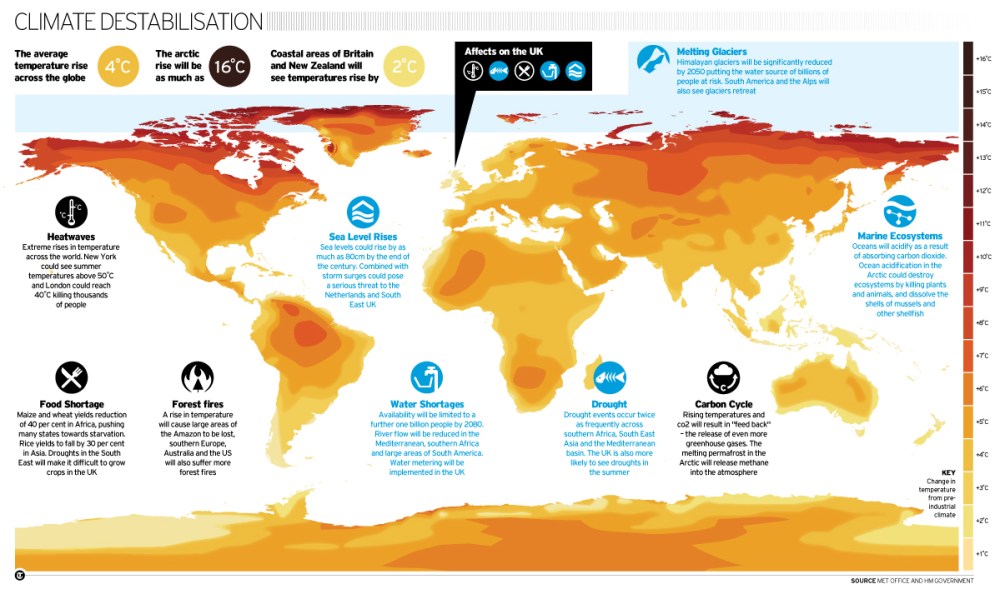
Congressman Lamar Smith (R-TX) has written on op-ed on climate change for The Daily Signal, a publication issued by the Heritage Foundation. Rep. Smith argues that there are benefits to global warming, including increased photosynthesis which would foster greater plant growth. Additionally, he argues:
“Also, as the Earth warms, we are seeing beneficial changes to the earth’s geography. For instance, Arctic sea ice is decreasing. This development will create new commercial shipping lanes that provide faster, more convenient, and less costly routes between ports in Asia, Europe, and eastern North America. This will increase international trade and strengthen the world economy.”
One of the more perplexing characteristics of the US economy is the profound decline in employment in the manufacturing sector over the last 30 years despite a dramatic increase in the value of manufactures in the same time period. What is also interesting is that while most Americans are well aware of the decline in manufacturing employment, very few Americans are aware of the fact that the US continues to be one of the leading manufacturing countries in the world. There are two reasons for this unawareness. First, the share of manufacturing in the US GDP has unquestionably gone down, despite the increase in value. The increase in the value of services, particularly in the financial sector, has been substantially greater. Second, much manufacturing is now being done by robots–fewer workers are necessary to produce the same products. The labor component of manufacturing will undoubtedly continue to decline in the future, not only in the US but in other countries as well.
Over the last ten years, the US has increasingly relied upon drones to pursue and kill individuals it believes are involved in terrorist activities. President Obama significantly increased US reliance on these new weapons because they offered the possibility of degrading the ability of terrorist and rebel groups to carry out their activities with limited exposure to danger for American soldiers. There have been claims that these strikes have been effective, but we actually know very little about hoe the drones are used and how effective and ineffective they have been. Jacqueline L. Hazelton has written an essay on how to think about the use of drones and the dangers they pose to an effective foreign policy. Her conclusion is that drones are of limited value:
It is, unfortunately, too late to put this genie back into the bottle.
Amnesty International has released a report on sexual violence on a “massive scale” in South Sudan. The violence is being committed by both sides in a civil conflict pitting President Salva Kiir, from the Dinka ethnic group, against the opposition leader, Riek Machar who is from the Nuer ethnic group. The conflict has been going on years and shows no sign of abating. South Sudan is desperately poor and relies heavily on funds from nongovernmental organizations and wealthy nation-states. That aid could be used as a lever to force the combatants to halt the sexual violence, but the price of withholding that aid would be a worsening of an already horrific situation. Humanitarian interventions are never as clear-cut as they appear.
Israel is removing the security detectors around the al Aqsa Mosque in hopes of defusing the tensions in Jerusalem and the West Bank. The decision was made after a telephone conversation between Israeli Prime Minister Netanyahu and Jordanian King Abdullah II. The metal detectors were viewed by many Muslims as an assertion of Israeli sovereignty at the site. Israel will try to employ security measures that do not suggest ownership of the site.
The Trump Administration is trying to figure out how to respond to the crisis in Venezuela. As the economy crumbles and President Maduro takes an increasingly hard line against protesters, the US has a very strong interest in seeing such a close and important neighbor avoid a catastrophic collapse. But that objective is difficult to attain since many would view American intervention as a self-interested intrusion. Additionally, some interventions might be counterproductive. One sanction currently being advanced in Congress is to embargo Venezuelan oil, a step that would undoubtedly crash the economy. But a Russian oil company, Rosneft, owns 49.9% of CITGO, the Venezuelan oil company. If an embargo were to occur, it would probably lead to a Russian takeover of CITGO which would give Russia an important foothold in the economies of the Western Hemisphere.
The US Congress is close to passing, by a substantial majority, new sanctions on Russia, Iran, and North Korea. If the bill passes, we will have to see if President Trump vetoes the bill. Mr. Trump has been opposed to new sanctions on Russia (not to Iran and North Korea) because he believes that the law intrudes upon his authority as Chief Executive to determine foreign policy. Congress does have authority to regulate international trade, but the bill is also a test of Mr. Trump’s willingness to confront Russia on the charges of electoral interference. It is not clear whether the Republican majorities in Congress will support a veto, but doing so would also be a test of the Republican Party’s stance on the issue of interference.
Violence continues in Jerusalem and the West Bank over the issue of Israeli controls over the al-Aqsa Mosque. The leader of the Palestinian Authority, Mahmoud Abbas, declared that security cooperation with Israeli authorities would cease until the security measures were removed. There was also an attack on the Israeli Embassy in Amman, Jordan, which some fear is related to the situation in Jerusalem. Jordan serves as the custodian to the Mosque even though Israel physically controls the site. The issue over the Mosque is essentially symbolic, but the violence indicates how important the symbolism is to many.
Poland is worrying many in Europe. Under the leadership of President Jaroslaw Kaczynski and his Law and Justice Party, Poland has systematically abandoned some important democratic principles. Most recently, there is a bill, which has passed the lower house of the Parliament, which will give the President and the party the power to appoint justices which few restrictions, including justices on the Supreme Court. The departure from traditional liberal checks on the concentration of political power threatens Poland’s commitment to the European Union. The European Commission is investigating Poland’s vote in the Union, but all its decisions require unanimous votes and Hungary, led by Viktor Orban, himself no friend to liberal values, has indicated that it would veto any sanction against Poland.
Humanity has developed through three phases of material production: hunting/gathering; agriculture; and industrialization. There is increasing evidence that the human role in industrialization is becoming more and more circumscribed as manufacturing has automated, and is seems as if humanity is entering a fourth phase which is as of yet unnamed but which will rely on digitization and robotization. As this process unfolds, the role of labor in human society will dramatically change. Right now, everyone has to produce something (a good or a service) to sell in order to secure an income. What will happen when every good and service is produced by a machine or a robot? How will people earn an income? That future has always seemed remote, but the future is now in the most important human activity: food production, historically the most labor intensive of all activities.
Violence broke out in Jerusalem and the West Bank as tensions rose over Israel’s decision to place metal detectors at the entrance to the al-Aqsa Mosque. The violence was predictable, but what is not clear is whether the impasse can be resolved. Israel responded to the violence by banning all men under the age of 50 from entering the Mosque, but that policy is not sustainable over the long run. Al Jazeera published a video of the violence and raised questions about the long-term security arrangements at the Mosque.





 World Politics News