About a dozen US State Department officials have charged Secretary of State Tillerson with violating the Federal law designed to stop foreign militaries from using Child Soldiers. The Child Soldier Prevention Act (CSPA) was passed in 2008 and requires that countries that conscript children for the military be excluded from US military assistance. An Action Memo for the Secretary dated 21 June 2017 identified the following countries as using children under the age of 18 in their military: Afghanistan, Mali, Democratic Republic of Congo, Iraq, Burma, Nigeria, Somalia, Sudan, South Sudan, Syria, and Yemen. Secretary Tillerson decided to ignore the unanimous recommendations of his staff and excluded Iraq, Burma, and Afghanistan from the prohibited list. The decision triggered off the use of what is known as a “dissent channel” for the State Department officials who opposed Tillerson’s decision. The dissent channel memo can be accessed here. The dissent memo indicates a high degree of opposition to Secretary Tillerson’s decision.
Researchers at the University at Oxford and the University of Leeds have come up with a very interesting index which purports to show rising global temperatures in real time. The researchers spell out the assumptions of the model and what exactly they measured to come up with the index. I lack the credentials to verify the legitimacy of the index, but the data underlying the model seem solid. Its accuracy, however, is probably less important than its ability to remind us that climate change is real.
President Mugabe has apparently resigned, although one cannot be sure that his decision to resign is final. Now the question is what is next for Zimbabwe? According to the constitution, Vice-President Emmerson Mnangagwa should succeed Mugabe, but, given that Mugabe fired Mnangagwa, it is not clear if he is still the legal Vice-President. If he does become President, it is doubtful that the economic situation in Zimbabwe will improve. Mnangagwa is reputed to be as corrupt as Mugabe. There are not any real good choices for the upcoming election in 2018 if those elections are actually held.
Joy in the Streets of Harare After News of Mugabe’s Resignation
After weeks of negotiations, the German parties–Christian Democrats CDU, the Bavarian Christian Social Union (CSU), the pro-business Free Democrats (FDP) and the Greens–failed to come to agreement on a coalition government led by Chancellor Angela Merkel. It does not appear as if the Free Democrats and the Greens will change their minds and a resurrection of a coalition with the Social Democrats (SDP) seems unlikely since the previous coalition did not seem to help the SPD at all. A minority government is a possibility with decisions made on an ad hoc basis but that solution is inherently unstable. If no coalition is possible, then the only alternative is another election, an outcome that will rock Europe’s last predictable politics. After Macron in France, Brexit in Great Britain, and the growing illiberal governments in Eastern Europe (Poland, Hungary, and the Czech Republic), politics in Europe has become highly uncertain.
The World Trade Organization is predicting slower growth in international trade in the next quarter of 2017. For most of the 20th century and the beginning of the 21st, international trade has always grown faster than global economic growth. Trade has been the engine of economic growth in the process of globalization as productive activities have sought out the cheapest places to produce goods. It may be the case, however, that the link between trade and economic growth is about to change. According to Hellenic Shipping News Worldwide:
“… the volume of world merchandise trade has tended to grow between 1.5 times to twice as fast as world GDP. But since 2012, trade has only been growing at a rate equal to or below that of GDP. In 2016, 20 of the world’s largest shipping companies sold $120 billion, compared to $200 billion in 2012. The downturn of the Chinese economy and other emerging economies, as well as the contraction of investment in the US during recent years, may explain part of this deceleration – but not all of it. Other technological and political factors could indicate a long-term anti-globalization trend. This would create a world very different to the one we know.”
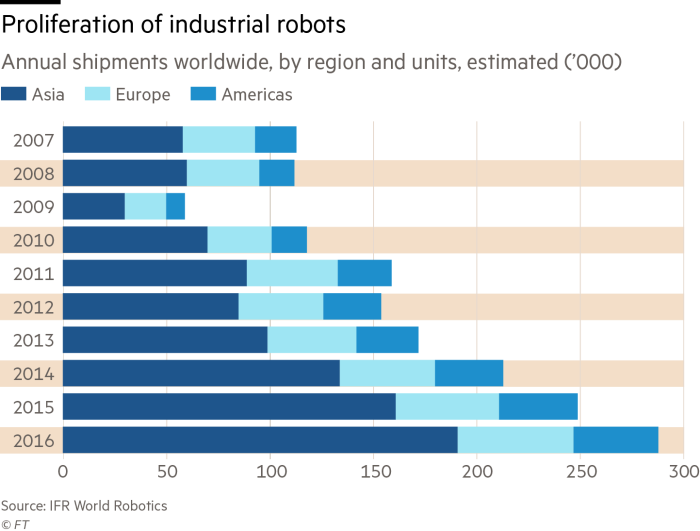
One of the key factors in this change is the radical transformation occurring in the manufacturing process itself as robotization changes the dynamic of labor costs. Firms no longer have to go abroad to produce cheaply. With automated processes, labor costs shrivel and firms can stay closer to the markets for their products. The Financial Times has an informative article on the process which forecasts a dramatic growth in the number of industrial robots globally.
The entity aspiring to be regarded as a state must possess a permanent population;
it must occupy a clearly defined territory;
it must operate an effective government over the extent of its territory; and
it must display capacity to engage in international relations-such capacity including the ability to fulfill international treaty obligations.
But the UN General Assembly also passed Resolution 67/19, “Status of Palestine in the United Nations” on 29 November 2012. The resolution was passed with 138 votes in favor, 9 opposed, 41 abstentions, and 5 absent. Passage of the resolution with more than a 2/3s affirmative vote is considered by some analysts–but not all–as sufficient evidence of common recognition of Palestine by the international community.
In response to the threat by the US, the Palestinian Authority has itself threatened to cut off all communications with the US. The ICC has initiated a Preliminary Examination of the Palestinian complaint against Israel which focuses largely on crimes “in the occupied Palestinian territory, including East Jerusalem, since June 13, 2014”. The US move seems to be a prelude to an new round of peace negotiations between Israel and the Palestinian Authority with the Saudi Arabians and the Egyptians weighing in to pressure concessions from the Palestinians. The US considers the ICC to be an obstacle to its role as negotiator. Ironically, both Israel and the US have yet to ratify their membership in the ICC yet wish to have pre-eminent voices in its deliberations.
“According to the United Nations, Yemen is in urgent need of medicines, vaccines and food. The supplies ‘are essential to staving off disease and starvation,’ the organization said. ‘Without them, untold thousands of innocent victims, among them many children, will die.’ A joint statement from the heads of the World Food Program, UNICEF and the World Health Organization called the situation in Yemen ‘the worst humanitarian crisis in the world.’
“They warn that 3.2 million people are at risk of famine, and 150,000 malnourished children could die in the next month. (Right now, according to Save the Children, 130 children are dying every day in Yemen.)
“A least 17 million other people, including 11 million children, are in desperate need of humanitarian supplies. The shortage of medicine and clean water has also led to the spread of disease. The country is now in the throes of the fastest-growing cholera epidemic ever recorded. Nearly 900,000 people have been affected, according to U.N. figures.”
And there is no end in sight to this pointless war. The Yemeni people are pawns in the proxy war between the Saudis and the Iranians, and the US continues to support Saudi Arabia without conditions.
The situation in Zimbabwe remains muddy. Mugabe’s party, ZANU-PF, gave the leader an ultimatum: resign or face impeachment on Monday. Most thought the situation was resolved, but Mugabe delivered a televised address to the nation in which he made no offer to resign. He was flanked by military officers, giving the impression that he had the support of at least some parts of the military. But it is doubtful that anyone really knows what is going on. We will wait to see if impeachment proceedings begin tomorrow.
For the last two years the U.N. and the Organization for the Prohibition of Chemical Weapons (OPCW) have been trying to figure who was responsible for the use of banned chemical weapons in the civil war in Syria. Recent attempts to renew the mandate for continuing the investigation have been vetoed by Russia which argues that the investigation itself is “fundamentally flawed”. The evidence is overwhelming that both sarin and mustard gas have been used in the conflict, but determining which groups were responsible for the use of the banned weapons has proven to be elusive. Russia has vetoed Security Council actions on the Syrian conflict 11 times since the civil war began in 2011. The UN and the OPCW “concluded the Syrian air force had dropped the deadly nerve agent on Khan Sheikhun” on 4 April 2017 but has yet to determine who gave the order to use the sarin.
Victim of the sarin gas attack at Khan Sheikhun
Paul Pillar is one of the most insightful analysts of security matters around. He picked up on an article published in the New York Times by Azmat Khan and Anand Gopal on civilian casualties in Iraq by air operations conducted by the US coalition against Daesh (the Islamic States). We know very little about civilian casualties but Khan and Gopal have written a meticulously researched article that indicates that civilian casualties are significantly higher than have been reported. The article is truly impressive and clearly demonstrates the effects of the aerial war on the civilian population. Pillar analyzes the data and elaborates on the strategic losses the US suffers when civilians are killed, undermining the effort to earn the support of the population.
The US National Aeronautics and Space Administration (NASA) has put together a video of satellite images of the earth from September 1997 to September 2017. The video shows the changing of the seasons and one cannot help but be struck by the image of the earth as a living organism. According to the site: “On land, vegetation appears on a scale from brown (low vegetation) to dark green (lots of vegetation); at the ocean surface, phytoplankton are indicated on a scale from purple (low) to yellow (high)”. For more information on how to interpret the video, go directly to the site.
Zimbabwean President Mugabe appeared in public today and the military said that it was “engaging” with him, leading to fears that efforts to oust him had been unsuccessful. But senior leaders of Mugabe’s political party, the Zimbabwe African National Union – Patriotic Front (ZANU–PF), indicated that Mugabe no longer had the support of the party. The move to remove Mugabe from office stems from the abysmal state of the Zimbabwean economy. According to Reuters: “Unemployment is now running at nearly 90 percent and chronic shortages of hard currency have triggered hyperinflation, with the prices of imports rising as much as 50 percent a month.” What is next for Zimbabwe is unclear. His likely successor is his Vice President Emmerson Mnangagwa (nicknamed, the “Crocodile”) who is reputed to be just as corrupt as Mugabe.
The Washington Post informative article on the pro-Russian political parties has an that have recently grown-up in Europe. Russian interference was certainly not limited to the US election in 2016. The Russians have made significant progress in undermining the legitimacy of democracy throughout liberal societies. The Russians have found fertile ground in the dissatisfaction of Western European polities to further their strategic interests.
The Israeli media, i24News, is reporting that Israel and Saudi Arabia are sharing intelligence on Iranian activities in the Middle East. Israel Defense Force (IDF) chief-of-staff Lt. Gen. Gadi Eizenkot was interviewed in the Saudi newspaper, Elaf, and he indicated that there was a “complete consensus” between Israel and Saudi Arabia on the “Iranian threat”. The report goes on:
“Echoing a refrain often used by Israeli political leaders, he argued that Iran wants to take control of the Middle East by creating a Shi’ite crescent, ‘from Lebanon to Iran and then from the Gulf to the Red Sea.’
“‘We must prevent this from happening,’ he implored. ‘In this matter there is complete agreement between us and the Kingdom of Saudi Arabia, which was never one of our enemies or fought each other, and I think there is a complete consensus between us and them regarding the Iranian axis'”.
Israel and Saudi Arabia do not have diplomatic relations and the Saudis have historically backed the Palestinian Authority in its negotiations with Israel on possible Palestinian statehood. An Arab newspaper published in Great Britain, The New Arab, has published what it claims to be a secret document from the Saudi Arabian Foreign Ministry that Saudi Arabia will pressure the Palestinian Authority to drop its demand for a “right of return” for Palestinian refugees displaced by the creation of Israel in 1948 in return for concessions by Israel on Palestinian statehood. I cannot confirm that the document is authentic, but its broad parameters conform to US policy, a close ally of both Israel and Saudi Arabia. The sands in the Middle East are certainly shifting.
I find it astonishing that the media is not covering the climate conference currently going on in Bonn, Germany. The UN currently predicts that global temperatures will increase by 3.2ºC by 2100 given current trends. Deutsche Welle has published a fascinating article on how four major cities in the world–New Orleans, USA, Paris, France, Cape Town, South Africa, and Dhaka, Bangladesh–will be affected in that prediction comes true. The probable outcomes are unmanageable and will require significant investments in adaptations if policies do not change.
Hemant Kakkar and Niro Sivanathan have published an interesting paper on why political leaders who pursue a strategy of “dominance” appeal to voters. Their argument is that economic uncertainty leads voters to prefer authoritarian policies:
“We contend that the preference for a dominant leader increases with uncertainty and competitive threats in one’s environment. When faced with a milieu of uncertainty and the resulting psychological lack of control, individuals favor a dominant/authoritarian leader who, they believe, has the capability to brave unfavorable winds and increase their future chances of success.
“We contend that, when faced with uncertainty, individuals prefer a leader who is self-assured and decisive in achieving her objectives. These are the characteristics that people expect to find in a dominant and authoritarian leader rather than in a leader who, although respected and well admired, is less willing to be forceful in pursuing her goals and is commonly perceived as lacking conviction in making tough calls”.
The hypothesis certainly explains the rise of right-wig policies ever since the Great Recession of 2008-09. For those who prefer a socio-psychological explanation of contemporary events, the paper is certainly worth reading.
Robert Mugabe has been President of Zimbabwe since its independence 37 years ago. He is now under house arrest by the Zimbabwean military in what seems to be a coup d’etat although the military denies that it has seized power. The arrest stems from doubts about the successor to the 93-year old President, whether it was to be his wife, Grace Mugabe or Vice President Emmerson Mnangagwa. Last week, President Mugabe fired the Vice-President for disloyalty, clearly indicating that he wished to be succeeded by his wife. Manangagwa, however, had strong support among the security forces and their intervention in the politics of the country indicates that Manangagwa will likely return to the country as the legitimate successor.
According to US Federal Bureau of Investigations (FBI) statistics, the number of simple and aggravated assaults in 2016 against Muslims in the US has exceeded the number in 2001. Hate crimes rose sharply in 2016, according to the Pew Research Center:
“Overall, there were 307 incidents of anti-Muslim hate crimes in 2016, marking a 19% increase from the previous year. This rise in hate crimes builds on an even sharper increase the year before, when the total number of anti-Muslim incidents rose 67%, from 154 in 2014 to 257 in 2015.
“As in previous years, the largest number of all types of hate crime incidents against religious groups targeted Jews. In 2016, there were 684 anti-Jewish hate crime incidents, marking a slight increase from 664 in 2015. By comparison, in 2016, there were 62 hate crimes against Catholics and 15 against Protestants.”
The increase is a very worrying sign for civil society in the US which has begun to fray beyond recognition.
The US Senate is beginning to investigate whether the US President, in its Constitutional role as Commander-in-Chief, has the unilateral authority to launch nuclear weapons. The Constitution grants only the US Congress to declare war, but after the invention of nuclear weapons there grew up an implicit understanding that given the time frame of a nuclear strike–30 minutes after the invention of ballistic missiles–the Congressional requirement was not appropriate for nuclear weapons. This review is long overdue, not only for the citizens of the US but also for all the people in the planet. Such a consequential decision should not be made without some degree of institutional oversight. I doubt that any news laws will be passed, but we need to sustain the debate.
The “nuclear football” follows the President wherever he goes. On several occasions, the President has been separated from the passcard (known as the “biscuit”) that verifies his identity to initiate the process of launching a US nuclear attack.
Fortune magazine has published an article on the distribution of wealth in the world based on information provided by the Swiss bank, Credit Suisse. According to the article:
“Looking at the bottom of the wealth distribution, 3.5 billion people—corresponding to 70% of all adults in the world—own less than $10,000. Those with low wealth tend to be disproportionately found among the younger age groups, who have had little chance to accumulate assets, but we find that millennials face particularly challenging circumstances compared to other generations”.
Further, from the Credit Suisse report itself:
“But confidence in the future has been eroded, and there is a growing sense that the economic recovery is shallow, and has not reached all layers of society. Evidence from our global wealth database supports this view. Using current US dollar exchange rates, wealth per adult has grown at a slower pace during the last nine years, while median wealth has not risen at all in many parts of the world, reinforcing concerns that we will not return soon to the robust and inclusive growth experienced at the start of the century”
Carbon emissions have increased this year ending hope that the leveling off of emissions over the last three years–“0.7 percent increase was reported in 2014, no increase in 2015, and 0.2 percent in 2016”–was a sign that sufficient progress was being made to avert climate change. Carbon emissions are projected to increase by 2% in 2017, higher than the trend line of 2006-2015: “human-caused carbon emissions have grown at an average annual rate of 3.5 percent since 2000, but at a slower pace of 1.8 percent between 2006 and 2015”. The data provides greater urgency to the climate conference scheduled for this week in Bonn, Germany.
“By failing to adequately limit population growth, reassess the role of an economy rooted in growth, reduce greenhouse gases, incentivize renewable energy, protect habitat, restore ecosystems, curb pollution, halt defaunation, and constrain invasive alien species, humanity is not taking the urgent steps needed to safeguard our imperiled biosphere.”
The letter follows the lead of a similar letter signed by scientists in 1992. The new letter contains graphs that, with the single exception of progress against ozone depletion, demonstrate significantly worsening trends in virtually every index of the health of the global ecosystem.
US President Trump is flying home from his Asian trip and there will undoubtedly be a wide spectrum of interpretations of what was accomplished. The South China Morning Post fairly comprehensive article on the Chinese view (published in Hong Kong but regarded as a media outlet favorable to the Beijing government) ran a of what actually was accomplished. The article suggests that President Xi was successful in diverting Mr. Trump from substantive discussions on trade, human rights, and Chinese activities in the South China Sea. The article notes that the $250 billion in commercial deals touted by Mr. Trump were only memorandum of understanding and not actual contracts. The Asia Times noted the use of the term “Indo-Pacific” as opposed to “Asia-Pacific” and referred to the rebirth of the Quadrilateral Security Dialogue which includes the US, India, Australia, and Japan–an alliance once considered as a counter-weight to Chinese power in the region. The original Quadrilateral Security Dialogue ended when Australia left the group, ostensibly under Chinese pressure. Its resurrection seems to be an objective spurred largely by Japan under the leadership of Shinzo Abe.
Poland celebrated its Independence Day today and 60,000 Polish nationalists marched to placards reading “Pure Poland, white Poland!”, “Refugees get out!”, and “Pray for Islamic Holocaust”. Poland received its independence in 1918 after World War I, having been occupied by Russia, Prussia, and the Austro-Hungarian Empire for almost two centuries. The marchers carried flags with the falanga symbol, a vestige of the far-right movement in the 1930s. Nationalism is definitely on the rise in many countries in the world, and fewer are afraid to embrace a “blood and soil” definition of nationalism.
Polish Marchers Falanga Symbol
The EU’s chief negotiator, Michel Barnier, gave a very grim prognosis on the British exit (Brexit) from the European Union. There have been six rounds of negotiations on Brexit, but the British government seems to be paralyzed on critical issues complicated by disarray within the Cabinet of Prime Minister May. The deadline for decisions on most issues is in December at the next meeting of the European Union in Brussels. By then, both sides must agree on how much money Britain would have to pay to honor its previous commitments to the Union even as it leaves the Union.
Agence France-Presse has published a short primer on the rivalry between Saudi Arabia and Iran. If one knows little about the relationship between the two states, it is a good place to start. Saudi Arabia has requested an emergency meeting to discuss the issue of Iran in the region. It might be better for the Arab League to discuss the plight of Yemeni Arabs who are suffering from a cholera outbreak complicated by incessant bombing by Saudi Arabia and a blockade of Yemen that is preventing needed humanitarian supplies from reaching the beleaguered citizens.