“….we estimate large and robust negative effects of robots on employment and wages across commuting zones. We bolster this evidence by showing that the commuting zones most exposed to robots in the post-1990 era do not exhibit any differential trends before 1990. The impact of robots is distinct from the impact of imports from China and Mexico, the decline of routine jobs, offshoring, other types of IT capital, and
the total capital stock (in fact, exposure to robots is only weakly correlated with these other variables). According to our estimates, one more robot per thousand workers reduces the employment to population ratio by about 0.18-0.34 percentage points and wages by 0.25-0.5 percent.”
They also show the geographic distribution of robots in the US, a distribution which bears a striking similarity to the electoral strengths of President Trump in the 2016 election.
Edsall then goes on and shows how robotization has affected the employment of non-college educated workers and how those individuals cast their ballots in 2016. The graphic in the article is quite striking as is described by Edsall in these words: “Among whites with college degrees, support for Trump fell by 11 percentage points compared with support for Mitt Romney; among whites without degrees, Trump’s support rose by 12 points when compared with Romney’s.” Edsall then goes on to point out how this economic dislocation fed into racial resentments, forming the key component of the electoral base for Trump’s victory. This argument deserves very close examination and thought.
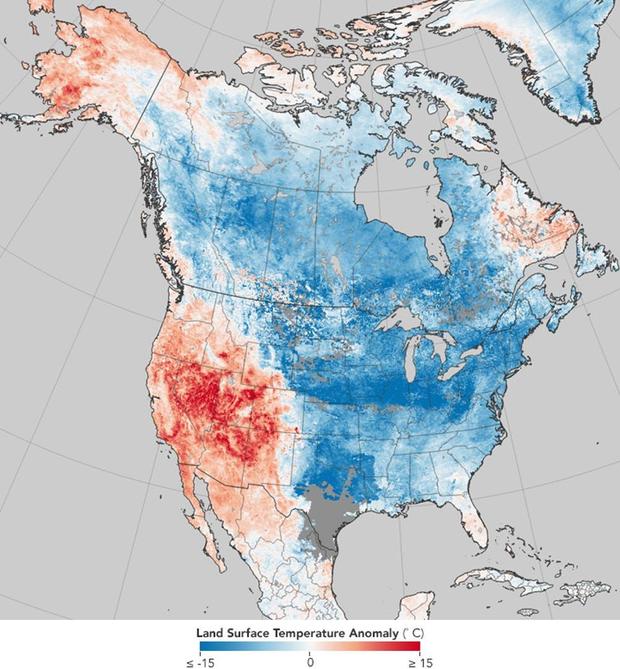
Alaska was warmer than South Hadley, MA in December. It recorded an average temperature for the month which was 15.7ºF higher than the 20th century average. According to Think Progress:
“The National Oceanic and Atmospheric Administration (NOAA) reported this week that Alaska averaged 19.4°F for the month, topping the previous record (1985) by a whopping 2.1°F.”
In addition, Arctic sea ice “set a new end-of-year record low”. The pattern of frigid cold spells in the US northeast because of global warming is an unwelcome pattern. We don’t know yet whether the pattern will become fixed. CBS News describes the science so far: “It’s hard to nail down whether this weather pattern – overall warmer winters in North America but longer cold snaps – will persist. Understanding the mechanisms behind these complex interactions between natural influences and human-caused changes is challenging.” I certainly hope that the pattern does not take hold.
The German newspaper, Bild, conducted an interview with the Hungarian leader, Viktor Orban, on the issue of refugees coming into the member states of the European Union. The EU had required each of its members to accept a certain number of refugees from the Middle East, but Poland and Hungary have refused to do so and several other EU members have admitted far fewer than their allotted quota. Orban has been hostile to immigrants and refugees for some time and considers the EU decision to be a violation of Hungarian solidarity. Orban is quoted in this way in the interview:
And why don’t the Hungarians want refugees?
Orban: “We do not consider these people to be Muslim refugees. We consider them to be Muslim invaders. For instance, somebody who wants to come from Syria to Hungary must cross four countries that are not as rich as Germany, but stable. So they are not running for their lives there. They are economic migrants who are looking for a better life.“
Are they therefore less valuable as human beings?
Orban: “When somebody would like to come to your house, first they knock on the door and then ask: can we come in, can we stay? But they didn’t do that; they crossed the border illegally. That was not a wave of refugees, but an invasion. Concerning the migration issue, I never understood how it is possible that in a country like Germany – which is the best example of discipline and the rule of law – the chaos, anarchy, and illegal crossing of borders could be celebrated as a good thing.”
According to Deutsche Welle, the EU has fallen far short of its goals for refugee resettlement: “A total of 22 countries involved in the resettlement scheme fell short of their “legal commitment.” Although Germany took in more refugees than any other involved in the program with 9,169, it still fell short of its quota of 27,536.”
Viktor Orban
The Environmental Data & Governance Initiative is a private, non-profit group that has been monitoring the US government’s treatment of the issue of climate change. It has issued a report that indicates that the generally open and easily accessible information about climate change that had characterized the websites and publications of most Federal agencies has changed dramatically over the last year. The key findings of the report paint a dismal picture of the efforts to raise public awareness of this crucial public policy issue:
● The Environmental Protection Agency’s (EPA) removal and subsequent ongoing overhaul of its climate change website raises strong concerns about loss of access to valuable information for state, local, and tribal governments, and for educators, policymakers, and the general public.
● Several agencies removed or significantly reduced the prominence of climate change Web content, such as webpages, documents, and entire websites, and the White House omitted climate change as an issue highlighted on its website.
● The Department of State, Department of Energy (DOE), and the EPA removed information about the federal government’s international obligations regarding climate change, downplaying U.S. involvement.
● Descriptions of agency priorities shifted to emphasize job creation and downplay renewable fuels as replacements for fossil fuels. At the DOE, mentions of “clean energy” and explanations of harmful environmental impacts of fossil fuels were also removed .
● Language about climate change has been systematically changed across multiple agency and program websites. In many cases, explicit mentions of “climate change” and “greenhouse gases” have been replaced by vaguer terms such as “sustainability” and “emissions”.
There is no question that the current US Administration does not share the views of previous administrations on the issue of climate change and it is not surprising that it has altered many of the websites and publications to reflect that change in policy. But the deliberate attempt to make previously accessible public information paid for by US taxpayers more difficult to find and access goes beyond an attempt to reflect policy preferences. The attempt to deny access to information is not consistent with a democratic polity.
There has been significant movement in negotiations between North and South Korea concerning North Korean participation in the Winter Olympics and on political and military relations between the two states. Significantly, however, North Korea has been quite clear and insistent that US concerns about the North’s nuclear program are not part of these discussions. North Korea’s chief negotiator, Ri Son Gwon, made the following statement in reference to the discussions between North and South Korea after South Korea introduced the idea of “denuclearization”:
“All our weapons including atomic bombs, hydrogen bombs and ballistic missiles are only aimed at the United States, not our brethren, nor China and Russia….This is not a matter between North and South Korea, and to bring up this issue would cause negative consequences and risks turning all of today’s good achievement into nothing.”
It remains to be seen how South Korea will proceed. A great deal of the tension between the two states comes from the US concern that the North Korean nuclear program threatens the US homeland. That concern clearly affects South Korea since it relies upon US power in any confrontation with North Korea. But as far as nuclear weapons are concerned, South Korea is already vulnerable to a North Korean nuclear attack. North Korea has successfully driven a wedge between South Korea and the US. Whether that wedge can be exploited depends on the willingness of South Korea to tolerate continued testing by the North Koreans despite US opposition. South Korea cannot afford to ditch the US alliance entirely because it serves South Korean interests with respect to Japan, China, and Russia. The US and South Korea must now decide how to recalibrate their interests.
“This life expectancy divide between rich and poor Americans has been growing for decades. A report from the National Academies of Science looked at life expectancy by income groups between 1980 and 2010. In 1980, the richest cohort of middle-age American men could expect to live until about 83 and the poorest, to 76. By 2010, the richest American males had gained six years in life expectancy, living to 89 on average, while life expectancy for the poorest men hadn’t improved.”
This discrepancy can easily be explained by better health care for richer individuals and a host of other factors associated with the benefits of higher incomes. As such, the data provide a compelling reason to regard income inequality as a serious social and political problem.
Uri Friedman has written a fascinating and well-informed essay on how the US National Security Adviser, H.R. McMaster, thinks about the contemporary world political system, particularly with respect to the question of how to deal with North Korea. Interestingly, Friedman dissects McMaster’s views of various scholarly articles and books and finds that McMaster finds tremendous resonance with today’s patterns and those of the pre-1914 world. I personally agree with that framework, particularly as it emphasizes the role of technological change in destabilizing the political order. What I find most intriguing is that McMaster’s perspective is so well-informed but that he has to accommodate the views of the President Trump whose knowledge of history seems to be limited. I highly recommend the essay.
Evan Osnos has written a very insightful essay for the New Yorker on how Chinese officials understand American foreign policy under US President Trump. The essay is quite revealing as it navigates the transition from the Obama’s Administration to reducing American commitments abroad gradually to Trump’s desire to assert American sovereignty as quickly as possible. Perhaps the best example of the difference in style and objectives was the treatment of the Trans-Pacific Partnership (TPP). The Obama Administration assiduously crafted the agreement over a long period of time with eleven other countries–but not China–for the specific purpose of defining trade and investment rules that the Chinese would ultimately have to accept even though they had no voice in formulating them. President Obama had to make many concessions to other countries in order to achieve this end, but he calculated that the losses suffered to the countries involved would be outweighed by the benefits the US would secure by coercing Chinese acceptance of the rules.
Three days after he was inaugurated, President Trump pulled the US out of the Agreement without offering a substitute. Despite the non-participation of the US, the eleven other countries have continued to forge an agreement without the protections Obama had secured for workers’ rights and environmental safeguards. And China is formulating its own grand trade and investment agreement–the Regional Comprehensive Economic Partnership–without US participation. At this point it is impossible to assess whether the US will be better or worse off with these new arrangements, but it is probably safe to assume that these new arrangements do not take into account specific American interests to any great degree.
The TPP is but one example of how different the world is now under the new role the US is evolving under Trump’s leadership. But it seems safe to say that the American withdrawal under Trump is likely more advantageous to Chinese interests than the planned American withdrawal under Obama. Osnos argues that the Chinese clearly interpret the world in these terms:
“For decades, China avoided directly challenging America’s primacy in the global order, instead pursuing a strategy that Deng, in 1990, called ‘hide your strength and bide your time.’ But Xi, in his speech to the Party Congress, declared the dawn of ‘a new era,’ one in which China moves ‘closer to center stage.’ He presented China as a ‘new option for other countries,’ calling this alternative to Western democracy ‘the zhongguo fang’an, the ‘Chinese solution.’”
“During the Mar-a-Lago meetings, Chinese officials noticed that, on some of China’s most sensitive issues, Trump did not know enough to push back. ‘Trump is taking what Xi Jinping says at face value—on Tibet, Taiwan, North Korea,’ Daniel Russel, who was, until March, the Assistant Secretary of State for East Asian and Pacific Affairs, told me. ‘That was a big lesson for them.’ Afterward, Trump conceded to the Wall Street Journal how little he understood about China’s relationship to North Korea: ‘After listening for ten minutes, I realized it’s not so easy.’
“Russel spoke to Chinese officials after the Mar-a-Lago visit. ‘The Chinese felt like they had Trump’s number,’ he said. ‘Yes, there is this random, unpredictable Ouija-board quality to him that worries them, and they have to brace for some problems, but, fundamentally, what they said was ‘He’s a paper tiger.’ Because he hasn’t delivered on any of his threats. There’s no wall on Mexico. There’s no repeal of health care. He can’t get the Congress to back him up. He’s under investigation.’
“After the summit, the Pangoal Institution, a Beijing think tank, published an analysis of the Trump Administration, describing it as a den of warring ‘cliques,’ the most influential of which was the ‘Trump family clan.’ The Trump clan appears to ‘directly influence final decisions’ on business and diplomacy in a way that ‘has rarely been seen in the political history of the United States,’ the analyst wrote. He summed it up using an obscure phrase from feudal China: jiatianxia—’to treat the state as your possession.’”
I find Osno’s interpretation of the Chinese perspective to be highly persuasive. I suspect that the Chinese will find their road to greater global influence significantly more difficult than they anticipate despite the American disengagement. The Chinese have yet to demonstrate that they have a better understanding of how to manage an extraordinarily complex world any better than the Americans had.
The Mekong River runs through three provinces of China, continuing into Myanmar, Laos, Thailand, Cambodia and Vietnam before emptying into the South China Sea. It supports about 60 million people and is the world’s largest inland fishery. It begins on the Tibetan Plateau and is being increasingly harnessed by dams to provide hydroelectric power and irrigation. Control over the river is an incredible source of political and economic power and there have been attempts to coordinate the use of the river through a variety of international agreements. On Wednesday, a meeting will be held of the Lancang-Mekong Cooperation forum which is one of several commissions trying to regulate the resources of the Mekong River. But true cooperation is difficult since China controls the headwaters of the River in Tibet. What seems to be clear is that the river resources are being taxed beyond sustainable limits and that the people downriver are the ones with the most to lose.
The German Social Democratic Party (SPD) is playing hardball with German Chancellor Angela Merkel as she tries to assemble a majority coalition government. The SPD party members believe that they have sacrificed too much in the most recent agreement with Merkel and are demanding a stronger voice in decisions concerning social and infrastructure spending. Merkel’s previous government coalitions have favored austerity measures and tight budget discipline, measures that are consistent with Germany’s position on broader European Union matters. But, as she tries for an unprecedented fourth Chancellorship, Merkel may find that she has to break with the past. It is not clear how strong a coalition could be formed at this point, but Merkel clearly does not wish to default to a minority government which would be likely too fragile to handle the issues Germany and Europe faces in the near future.
Venezuelans continue to suffer in ways that are simply incomprehensible given that the country should be among the richest in the world. The economy is dead in the water and inflation is running at an average of about 50% a month. If one calculates the average wages of Venezuelan workers into calories, it is clear that the country cannot survive:
“… the minimum wage (the wage earned by the median worker) measured in the cheapest available calorie, had declined from 52,854 calories per day in May 2012 to just 7,005 by May 2017 – not enough to feed a family of five.
“Since then, conditions have deteriorated dramatically. By last month, the minimum wage had fallen to just 2,740 calories a day. And proteins are in even shorter supply. Meat of any kind is so scarce that the market price of a kilogram is equivalent to more than a week of minimum-wage work.”
Organized opposition to the government of Nicolas Maduro has been completely neutered. The legislative assembly has been sidelined, opposition parties have been banned, and the judicial branch is completely controlled by the government. The Venezuelan people have been completely abandoned by the international community.
Aftermath of a Food Riot In Venezuela, June 2016
The US is threatening to cut funding to the UN Relief Works Agency (UNRWA), an agency that has supported about 5 million Palestinian refugees since the creation of the state of Israel in 1948. The agency was created in response to the massive movement of Arabs out of the Jewish Zone created by the UN which ultimately became the state of Israel. That movement was considered coerced by many Arabs who did not wish to live in a state governed by Jewish laws and therefore those who left were considered refugees. Israel, however, does not consider those people refugees since they could have decided to stay. Thus, the agency was born in a highly contested political environment and that political atmosphere has never diminished. However, the humanitarian issue of how to care for people who have no permanent residence and lack the protection of a sovereign state is also quite real. The potential cutoff of US aid to these people will simply aggravate the humanitarian crisis and will undoubtedly spill over into political and strategic matters.
The US and South Korea have agreed to postpone their scheduled military exercises until after the end of the Winter Olympics (2 February-25 March). If North Korea takes this action as a possible sign of accommodation (the Chinese and the Russians have been pushing the idea of a “double-freeze”–no military exercises by the US and South Korea in return for no testing by North Korea), then we might have a basis for possible negotiations. The Winter Olympics offers a convenient excuse for the double-freeze since it provides a plausible basis for non-action that does not involve a capitulation to the terms of the other side. If this is indeed what is happening (and there is no way to know for sure), then we should hope that the pause provides an opportunity to build upon.
The last 18 months has been nothing less than a constant succession of bizarre stories that I never could have imagined 2 years ago. Many of these stories have been truly depressing and discouraging, but I had no idea how the string of stories had re-shaped the parameters of what I think is “normal”. But today I had an epiphany, brought about by some geniuses out in internet-land who apparently have had their own definitions of normal distorted as well. And I felt vindicated as I read this snippet from the Twilight Zone:
It is comforting to know that we are all going crazy together. Or that the insanity somehow makes sense. Whatever.
Visualizing Capitalism has produced a graphic that nicely illustrates the cosmopolitan nature of the world’s richest people. They transcend national boundaries and they all share a common interest in protecting their capital. In many respects, this elite shares more common interests than they share with their own citizens. The world’s richest people live lives completely beyond the comprehension of 99% of everyone alive and who have ever existed.
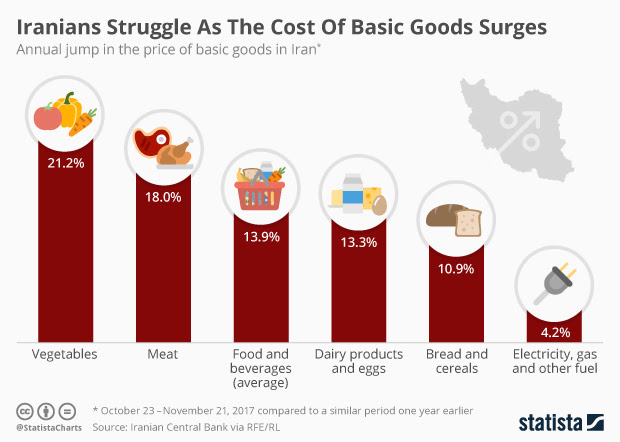
To put the protests in Iran into context, the chart below gives an idea of how prices in Iran have risen in the period from October-November 2017. People go into the streets and risk their lives when their children’s lives are at risk. Politics is clearly a part of that equation, but it very rarely is the principal reason for street protests. The US is calling for a meeting of the UN Security Council to discuss the protests in Iran, but many countries, such as Sweden, regard the Iranian protests to be an internal matter at their current stage. The Russians asked why the UN Security Council had not yet discussed the “Black Lives Matter” issue in response to the American calls for a resolution on the Iranian protests.
It is very, very cold in South Hadley. The temperature tonight is predicted to be about -15ºF and the wind is howling. It’s been a long time since we’ve seen such low temperatures and there are some who are suggesting that the old temperatures refute the idea of climate change (see the video below). Distinguishing between weather and climate is getting tiresome, but I must say that the research suggesting that these polar snaps might be a feature of climate change for New England has me terrified.
“Iran is failing at every level despite the terrible deal made with them by the Obama Administration. The great Iranian people have been repressed for many years. They are hungry for food & for freedom. Along with human rights, the wealth of Iran is being looted. TIME FOR CHANGE!”
“These violent protestors and Trump, who should now be considered allies, are derailing the demands of people for better living standards and transparency. Some of the protestors who are turning rallies into violent scenes are knowingly or unknowingly dancing to the tune of Trump, his inner circle, and the envious Saudi prince who is wishing Iran to degenerate into chaos.”
Such a connection was likely inevitable, but the visibility of the President’s tweets will now undoubtedly be used to delegitimize the protesters. Calling for regime change in Iran as the Tweet suggests will be used by the Iranian government to characterize the protests as an American plot.
The same is true of President Trump’s Tweets about North Korea. On 3 January, President Trump tweeted:
“North Korean Leader Kim Jong Un just stated that the ‘Nuclear Button is on his desk at all times.’ Will someone from his depleted and food starved regime please inform him that I too have a Nuclear Button, but it is a much bigger & more powerful one than his, and my Button works!”
At the very time that the US is trying to persuade Kim Jong-un to halt the testing program, the US President casts doubt on the North Korean capabilities. One could not imagine a more counterproductive move under the circumstances.
“And the gambit appeals directly to Moon’s goals, while trying to force a choice: a peaceful Olympics, or South Korea’s alliance with the United States. As part of his dialogue proposal, Kim explicitly criticized the Moon administration for ‘joining the United States in its reckless moves for a North-targeted nuclear war’ and requested the discontinuation of ‘joint nuclear war drills they stage with outside forces.’ (South Korea and the United States hold regular joint military drills, which North Korea consistently portrays as preparation for an invasion.) But it is Kim himself who wants to hold South Korea’s hosting of the Winter Olympics hostage to his demand for global acknowledgement that the North has (illegally) become a nuclear weapons state.”
There is little question that US allies in the region–South Korea and Japan–as well as the other major powers China and Russia would vastly prefer a solution to the crisis which avoids war, and all these parties may not be as attached the the US objective of the “denuclearization” of the Korean peninsula as is the US. Such an outcome would be perceived as a major defeat by the Trump Administration because it clearly indicates that other parties are willing to accept North Korea’s status as a “nuclear power”.
Whether the US is prepared to accept North Korea as a nuclear power really depends on how much validity the US puts into the theory of deterrence. Deterrence has always been difficult for the US to accept as a national strategy since so much of American history was “threat-free”. After the War of 1812 with Canada and the War of 1846 with Spain/Mexico, the US has not really worried about the threat of invasion which is the reason why the attacks on the American homeland on 7 December 1941 and 11 September 2001 were so traumatic. But while those attacks were incredibly tragic, neither really threatened the viability of the Republic. A nuclear attack, however, is quite different. In an instant, millions of Americans could die rendering the idea of a “victory” after such an attack moot.
But deterrence relies on the idea of mutual annihilation. It accepts the notion that missions of citizens could die in a nuclear attack, but that the ability to threaten the deaths of millions of the other side’s citizens renders the usefulness of a nuclear attack nugatory. No nuclear attack is rational under such circumstances. But that truth is not the problem with deterrence for American strategists. The problem comes from a corollary of that truth: if no nuclear attack is rational, then no threatof a nuclear attack is rational. And it is the threat of a nuclear attack that the US wants to preserve.
The US wants North Korea to believe that the US can and will attack it. That threat protects America’s ally, South Korea, from a North Korean attack. That threat is credible as long as the only people who would be killed in such a war would be Korean. But it becomes incredible if the US has to trade American lives to defend Korea.
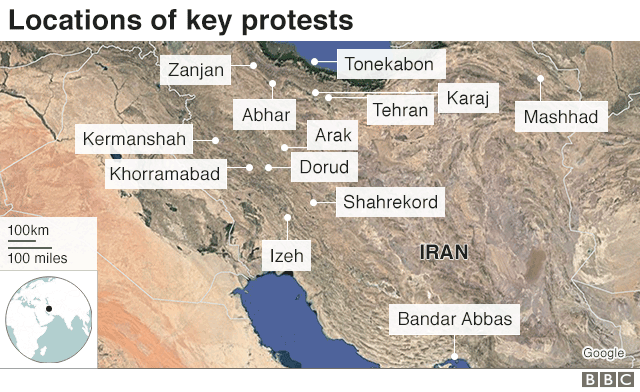
Protests in Iran have continued into the 4th day. Thus far, 12 deaths have been reported, but it is difficult to know exactly what is going on. The protests have occurred in a large number of cities, but they do not appear to be organized nor do they seem to cohere around a single objective. These protests are quite different from those that occurred in 2009 when the “Green Movement” was an organized attempt to derail the re-election of President Ahmadinejad whom many believed was corrupt. These protests seem to be calling for reform, not regime change–the current President, Rouhani, was re-elected handily last May. The US and Israel would be well-advised to pay attention to this difference. Iran is a highly educated, very sophisticated society and if foreign powers become too involved in cheering on the protests, there is a real risk that the protests could be de-legitimized by the hard-liners in Iran.
“The United States has foolishly given Pakistan more than 33 billion dollars in aid over the last 15 years, and they have given us nothing but lies & deceit, thinking of our leaders as fools. They give safe haven to the terrorists we hunt in Afghanistan, with little help. No more!”
Angus Deaton won the Nobel Prize in Economics in 2015. He has written a short essay on inequality that addresses a central concern: is economic inequality simply the result of normal economic activity or is it something that is deliberately constructed through selfish interests? His answer is the latter. The essay is difficult to follow, but not long. It is well worth the effort.




 World Politics News