Archive for the ‘World Politics’ Category
On 15 February I posted a short note on an attack on US and Syrian Democratic Forces (SDF) by Syrian government forces supported by what were suspected to be Russian mercenaries. The Washington Post has published an article which provides significantly more information about the attack. Apparently, the Russian mercenaries are under the control of a close friend of Russian President Putin, a fellow named Yevgeniy Prigozhin, who, according to intercepted communications with the Kremlin, received permission to attack the base on the eastern side of the Euphrates which is the agreed-upon dividing line between Russian-backed and American-backed forces. Russian and American military leaders are in daily communication about their operations in the area in order to avoid accidental contact.
If this information is accurate then it suggests a deliberate attack by Russian-controlled forces on American troops, something which actually never happened during the Cold War (that we know of). But the more accurate way to interpret this information is to assume that Prigozhin was acting on behalf of his own interests:
“According to the U.S. Treasury Department, Prigozhin owns a Russian company called Evro Polis, which, according to the Russian news site Fontanka, struck a deal in 2016 with the Syrian government to receive a 25 percent share of oil and natural gas produced on territory recaptured from the Islamic State. Most of those fields are on the eastern side of the Euphrates, where SDF fighters, accompanied by U.S. forces, have been advancing on the militants.
“The Prigozhin-linked mercenary company Wagner apparently provides the ground forces to help achieve that goal, working under contract with the Syrian government.”
Prigozhin is definitely a seedy character. He is also implicated in the Russian intervention in the US Presidential election in 2016:
“Prigozhin made front-page headlines last week when he was indicted by special counsel Robert S. Mueller III on charges of bankrolling and guiding a long-running Russian scheme to conduct “information warfare” during the 2016 U.S. presidential campaign.”
Yevgeniy Prigozhin

The US is considering a rather remarkable and unprecedented offer from Sheldon Adelson, a Republican donor, to pay for some of the costs of building the US Embassy in Jerusalem. Adelson is a long-time support of Israel and contributed $43,523,100 to primarily Republican candidates in 2016. The State Department is reviewing the legality of private funds to build an official governmental building, but the fact that the offer is being considered is astonishing to me. Moreover, that the offer is being made to support the highly controversial decision to move the US Embassy from Tel Aviv (where every other government has its diplomatic presence) to Jerusalem makes it even more troubling. We know that Ambassadorships are often granted as rewards to campaign contributors, but that the physical building–which would be present for years to come no matter who was President–should not be something up for sale.
The United States Citizenship and Immigration Services (USCIS) has changed its mission statement in a highly significant manner. It has decided to drop the phrase that characterizes the US as a “nation of immigrants”. The original mission statement read:
“USCIS secures America’s promise as a nation of immigrants by providing accurate and useful information to our customers, granting immigration and citizenship benefits, promoting an awareness and understanding of citizenship, and ensuring the integrity of our immigration system.”
The mission statement will now read:
“U.S. Citizenship and Immigration Services administers the nation’s lawful immigration system, safeguarding its integrity and promise by efficiently and fairly adjudicating requests for immigration benefits while protecting Americans, securing the homeland, and honoring our values.”
The change reflects the dramatically different attitude toward immigration and immigrants in the Trump Administration. In a cruel and inexplicable twist of irony, it turns out that the Director of USCIS, Lee Francis Cissna, is himself the son of an immigrant who apparently speaks only Spanish to his children at home. When Cissna’s nomination was submitted to the Congress for approval, ProPublica, published an article on his views about immigration which were quite negative.
A Republican Senator, Jim Risch of Idaho, made some very worrying statements about the prospects for war with North Korea at the Munich Security Conference. The Intercept has published a video of Risch’s comments, and here are some of the excerpts:
“There is no more dangerous place on the earth than the Korean peninsula right now. …
“The president of the United States has said, and he is committed to, seeing that Kim Jong-un is not able to marry together a delivery system with a nuclear weapon that he can deliver to the United States. …
“The consequences of that are breathtaking when you think about how this could happen. …
“If this thing starts, it’s going to be probably one of the one of the worst catastrophic events in the history of our civilization. It is going to be very, very brief. The end of it is going to see mass casualties the likes of which the planet has never seen. It will be of biblical proportions. …”
He went on to say:
“Anyone who doubts that this president isn’t committed to that, I would suggest that they step back, take a breath, listen to what he has said, review the facts on the ground. This president has at his fingertips the ability to dispense what he has said he’s going to dispense, if the North Korean regime, if Kim Jong-un, that he is, uh, the president can do this quickly, and as I said, it is at his fingertips.”
Senator Risch is on the Senate Foreign Relations Committee, but I am not sure how close he is to the President. We should watch carefully what happens after the Olympics end to see if North Korea conducts any missile tests or if the US and South Korea conduct provocative military exercises. The US has already announced the it intends to send highly sophisticated drones to South Korea when the Olympics are over. According to Newsweek:
“On Tuesday, South Korean newspaper Chosun Ilbo claimed the U.S. had scheduled the transfer of 12 MQ-1C Gray Eagle unmanned combat aerial vehicles to an air base in Gunsan, North Jeolla province in March and April. The report said the drones, which were upgraded versions of the MQ-1 Predator, would be used in military exercises that were to take place following the end of the 2018 Pyeongchang Winter Olympics and Paralympics. The article said the weapons could be used to strike not only North Korean sites designated as high-priority targets, but individuals as well.”
The North Korean Press Agency characterized the drone deployment in these terms:
“They are raising the issue that these UAVs equipped with precision-guided bombs and missiles are aiming at the top leaders and important objects of the DPRK in case of emergency.
“The continuation of the new war equipment in South Korea by the US and the US is an insidious goal to block the atmosphere of improvement in the North-South relationship and to push the situation of the Korean Peninsula to the extreme.”
The situation seems to be highly precarious.
12 MQ-1C Gray Eagle Drone

Politico is reporting that the US State Department has been ordered to pare back the sections in its annual human rights report that deal with women’s reproductive rights and the sections on rights that protect individuals against discrimination. For a copy of the 2015 Report, click here.
“State Department officials have been ordered to pare back passages in a soon-to-be-released annual report on global human rights that traditionally discuss women’s reproductive rights and discrimination, according to five former and current department officials.
“The directive calls for stripping passages that describe societal views on family planning, including how much access women have to contraceptives and abortion.
“A broader section that chronicles racial, ethnic and sexual discrimination has also been ordered pared down, the current and former officials said.
We will have to wait to see how the final 2017 report reads, but it seems as if the Trump Administration is deliberately trying to downplay the status of human rights in American foreign policy.
The media typically frame the dispute over control over the South China Sea as one that pits sovereignty against international law. International law is fairly clear on the status of the South China Sea: it is an international sea that does not have natural islands to grant sovereignty to any of the countries in the region. China has built up reefs in order to assert its sovereignty over them, but international law forbids the use of artificial islands to make such a determination. The US uses this interpretation to justify sending its naval vessels past these artificial islands within the 12-mile limit recognized by international law as territorial. As long as China and the US hold these mutually exclusive definitions of international rights and obligations. Yet, in the background, other countries are trying to forge different solutions based on different principles. It is an encouraging development in ad hoc diplomacy that perhaps offers a way out of an adversarial relationship.
The political constellations in Syria continue to defy my ability to analyze. There are a variety of different alliances in the conflict depending on specific circumstances. One can be sure that the Turks will oppose the Kurds, even if that means that it has to test its alliance with the US. One can also be sure that Russia will support Syrian President Assad. But there are a very large number of different rebel groups all of whom have different sponsors. The US has different objectives with respect to ISIS vs. Assad, Iran vs. ISIS, and the Kurds vs. Assad. Choreographing the conflict has always seemed to be within Russian control, but it seems clear that Russia is beginning to lose control as well as it depends on official Russian troops and unofficial Russian mercenaries who act at cross purposes depending on specific circumstances. It also appears as if the Russians are being drawn into a long-term presence in Syria, an outcome not anticipated by President Putin, as Assad’s hold on power is very weak. War only makes sense if there are clear political objectives. Now, however, the Syrian civil/international war is degenerating into what seems to be a demolition derby. Under such circumstances the chances for unplanned escalation increase dramatically.
The Bombing of Gouta

Eliot Cohen is not one of my favorite authors–I have often disagreed with his analyses. However, he has written an essay for The Atlantic that made me think. The argument of the essay is that the current people in charge of foreign policy today do not seem to be highly distinguished. His comments are based on his understanding of the proceedings of the recent Munich Security Conference. I tend to be suspicious of those who believe that the “best and the brightest” create good foreign policy. That phrase was the title of a book by David Halberstam by the US security experts that forged the disaster that was the Vietnam War. However, while it may be true that smart people cannot guarantee good foreign policy, it is probably also true that uninformed people are highly unlikely to produce good foreign policy. One part of the essay that grabbed my attention was this paragraph:
“This political entropy seems to be a near-universal phenomenon in the Western world; why this is so is unclear, and probably has many explanations. But the nicely tailored generation represented in Munich this year seemed baffled by the re-entry into history of today’s authoritarians and fanatics. One wonders whether the attendees possess the steel of the earlier generation that took part in World War II, and in the subsequent struggle with Communism.”
There is a new world order in the wings, but I agree with Cohen that we do not at this time have the people that have the vision to see it.
The Syrian government continues to commit war crimes against its own citizens with an attack on the town of Ghouta, a suburb of Damascus. The reports are still coming in, but the initial estimates are that about 200 civilians were killed in the attack. The town was considered to be one controlled by Syrian rebels opposed to the government of President Assad, but the bombing was so extensive that it should be considered indiscriminate. CNN has a video of the aftermath of the attack which is quite graphic and deeply disturbing. More than 400,000 people live in the eastern section of Gouta and the bombardment seems to be a prelude to a ground assault on the town which will likely increase the casualties significantly. As has been the case in the past throughout the war (which has been going since 2011), the international community seems to be completely indifferent to its responsibilities to protect innocents.

The US is taking actions in East Asia that are low-level provocations to China and potentially disruptive to stability in the region. For the first time in many years, US defense contractors will be holding its annual conference on security measures in Taiwan instead of in the US. China considers Taiwan to be a renegade province and the US upheld the principle that there is only “one China” in 1972. But these efforts to boost Taiwan’s military capabilities are viewed by China as efforts to uphold Taiwan’s hopes for independence. In addition, the US Congress is considering a law that will allow high level US officials to visit the island, with the implicit sense of recognition that such visits suggest. On the issue of North Korea, South Korea has announced that the joint military drills with the US that were postponed because of the Olympics will now take place in April. The Olympics end on 18 March, so this lull in hostility, seems likely to end soon thereafter.
The situation in northwestern Syria has become even more bizarre. At first, there was the odd situation of the US backing Kurdish forces who were then attacked by Turkey, an American ally. The Kurds have been effective fighting forces against ISIS and therefore aligned with the American interest of defeating ISIS (coincidentally, defeating ISIS was also the objective of Iran, an American enemy state). Now the press is reporting that Syrian government forces have made an alliance with the Kurds in the region which has prompted Turkey to threaten to attack Syrian government forces. Of course, ISIS is opposed to the Syrian government, so Turkey is fighting the enemy of its enemy. Such a course of action violates the basic precepts of the balance of power which suggests that the Kurds are the primary Turkish enemy and that no mutual alliances come close to compensating for the degree of animosity to the Kurds. Interestingly, both Turkey and Iran regard the Kurds as enemies (as possible secessionists) and are beginning to coordinate their activities.

Italy has a national election scheduled for 4 March and the election will serve as a good index of political winds in Europe. Since the Great Recession, European politics have tended to repudiate traditional parties as we have seen in France with the election of outsider Macron and in Germany with the weakening of the power of Chancellor Merkel. Generally speaking, right-wing parties have benefited from this disillusionment, amplified by a strong minority adamantly opposed to refugees and immigrants. Italy has experienced very slow economic growth, has very weak banks, and a very high government debt load: a combination that contributes to its historically weak government. What we should look for in the upcoming election is the outcome of a political struggle between these anti-traditional sentiments and those forces who are well aware of Italy’s extraordinary dependence on being a member of the European Union. If the latter group loses, then Italy will be primed for its own right-wing resurgence.
Meehan Crist has written a review of a new book by Jeffrey Goodell entitled The Water Will Come: Rising Seas, Sinking Cities and the Remaking of the Civilised World for the London Review of Books. The review lays out how new research has forced increasingly dire forecasts of sea level rise due to climate change. She writes:
“Global sea level rise is hard for scientists to predict, but the trend is clear. Massive ice sheets in Greenland and the Antarctic have begun to collapse, in a phenomenon known as ‘marine ice-sheet instability’, which previous models of global sea level rise didn’t take into account. When the Paris Agreement was drafted just over two years ago, it was based on reports that ice sheets would remain stable and on the assumption that sea levels could rise by up to three feet two inches by the end of the century. In 2015, Nasa estimated a minimum of three feet. In 2017, a report by the National Oceanic and Atmospheric Association (NOAA), the pre-eminent climate science agency in the United States, revised estimates up dramatically, stating that by 2100 sea levels could rise by more than eight feet. Last year, a study estimated that if carbon emissions continue at present levels, by 2100 sea levels will have risen by as much as 11 feet. Higher sea levels mean higher storm surges, like the nine-foot surge that inundated Lower Manhattan and severely affected neighbourhoods in Long Island and New Jersey, but also that low-lying coastal areas, from Bangladesh to Amsterdam, will be underwater in less than a hundred years. It’s worth remembering that two-thirds of the world’s cities sit on coastlines. In a high-emissions scenario, average high tides in New York could be higher than the levels seen during Sandy. A rise in global sea levels of 11 feet would fully submerge cities like Mumbai and a large part of Bangladesh. The question is no longer if – but how high, and how fast.”
Crist outlines the significance of such a change:
“Today, more than 145 million people around the world live three feet or less above sea level, many in poor countries in the global South. ‘As the waters rise,’ Goodell writes, ‘millions of these people will be displaced, many of them in poor countries, creating generations of climate refugees that will make today’s Syrian war refugee crisis look like a high school drama production.’ There is no longer any doubt that the rise in global sea levels will reshape human civilisation.”
We should also remember that the estimates of sea level rise have changed dramatically in recent years because we have found out things about sea ice that we did not know before. It would not be surprising if there are other aspects of sea ice about which we are still unaware.

Russia has conducted military exercises and is constructing an airbase on islands in what it calls the Southern Kurils and what the Japanese call the Northern Territories. The Soviet Union took control of those islands as part of its share of the surrender of Japan in World War II. The Soviet Union sent its troops onto the islands after the bombing of Hiroshima and Nagasaki. Even though the other Allied powers signed a peace treaty with Japan in 1951, Russia and Japan have never signed a peace treaty and the status of the islands is the dispute that prevents the process. Japanese Prime Minister made the resolution of the dispute a central campaign platform, but it appears as if the Russians have no intention of negotiating with the Japanese. The unwillingness places promised Japanese investments in jeopardy but it also reflects a desire to challenge the Japanese-US alliance. The Russians have been emboldened by the reticence of the US to back the Japanese claims.

Iranian Foreign Minister Mohammad Javad Zarif gave a speech to the Munich Security Conference, an annual event that brings together people from all over the world to discuss the security issues facing the people of the world. The speech was very specific in its criticism of US policies in the Middle East:
“From supporting Saddam Hussein’s invasion of my country in 1980 to aiding and abetting his use of chemical weapons; from the wars to evict him from Kuwait and then to remove him altogether; from first supporting Al-Qaeda and the Taliban, to waging a war to remove them from Afghanistan; from supporting the same brand of extremist terrorists bringing ruin to Syria to dangerously occupying parts of Syria under the guise of fighting the groups they have armed and financed; from Israel’s invasion and subsequent aggressions on Lebanon and its illegal occupation of Palestine to its routine incursions into Syrian airspace; and from the bombing of Yemen with western supplied planes. What have these actions brought the world?
“The U.S. and its local clients in our region are suffering from the natural consequences of their own wrong choices. But they use this and other fora to revive the hysteria on Iran’s foreign policy and obscure its reality. But did Iran force them to make all those wrong choices as some of them ridiculously claim? Are we to blame because we were on the right side of history, fighting Saddam Hussein, Al-Qaeda, Taliban, ISIS, Nusrah and the like, while the U.S. and company were financing, arming and supporting them?”
At the same conference, Israeli Prime Minister Netanyahu identified Iran as the most serious disrupter of global security:
“….nowhere are Iran’s belligerent ambitions clearer than in Syria. There Iran hopes to complete a contiguous empire, linking Tehran to Tartus, the Caspian to the Mediterranean. For some time I’ve been warning about this development. I’ve made clear in word and deed that Israel has red lines it will enforce. Israel will continue to prevent Iran from establishing a permanent military presence in Syria. Israel will continue to act to prevent Iran from establishing another terror base from which to threaten Israel. But Iran continues to try to cross those red lines. Last week its brazenness reached new heights, literally new heights. It sent a drone into Israeli territory, violating Israel’s sovereignty, threatening our security. We destroyed that drone and the control center that operated it from Syria, and when our places were fired upon, Israel destroyed Syrian anti-aircraft batteries. Israel will not allow Iran’s regime to put a noose of terror around our neck. We will act without hesitation to defend ourselves. And we will act, if necessary, not just against Iran’s proxies that are attacking us, but against Iran itself.”
The divide is extraordinary and it is hard to imagine a peaceful resolution between Israel and Iran in the future unless the world intervenes to alter the calculations of both.
The Managing Director of the International Monetary Fund, Christine Legarde, is warning that the tax cuts proposed by the US recently will precipitate a “race to the bottom” that will ignite a tax-cutting war among wealthy countries that will ultimately lead to reduced support for impoverished peoples in those countries. According to Bloomberg:
“What we are beginning to see already and what is of concern is the beginning of a race to the bottom, where many other policy makers around the world are saying: ‘Well, if you’re going to cut tax and you’re going to have sweet deals with your corporates, I’m going to do the same thing,”’ Lagarde said.”
Last October, the IMF issued a report which documented the extent to which economic inequality diminishes economic growth. The report deserves far greater attention by policy makers.
The US continues to chip away at the presumption of free trade in the global economy. The US Department of Commerce has released a report advocating tariffs on imports of steel and aluminum. The analysis was conducted under the authority of Section 232 of the Trade Expansion Acts of 1962 which permits the government to impose tariffs on imports that affect US national security. The report recommends:
“1. A global tariff of at least 24% on all steel imports from all countries, or
“2. A tariff of at least 53% on all steel imports from 12 countries (Brazil, China, Costa Rica, Egypt, India, Malaysia, Republic of Korea, Russia, South Africa, Thailand, Turkey and Vietnam) with a quota by product on steel imports from all other countries equal to 100% of their 2017 exports to the United States, or
“3. A quota on all steel products from all countries equal to 63% of each country’s 2017 exports to the United States.
“Each of these remedies is intended to increase domestic steel production from its present 73% of capacity to approximately an 80% operating rate, the minimum rate needed for the long-term viability of the industry. Each remedy applies measures to all countries and all steel products to prevent circumvention.”
The analysis of the national security effects of steel imports can be accessed here. The analysis on aluminum can be accessed here. The Chinese were quick to threaten retaliation if the tariffs are imposed. The Chinese also pointed to domestic opposition to those tariffs in the US and the high costs of such protection. In an article in China Times:
“The Obama administration’s decision to levy safeguard tariffs on Chinese tires in 2009 temporarily helped save 1,200 jobs in the US tire industry, but at a cost of 900,000 US dollars per job due to higher prices, according to a study by the Peterson Institute for International Economics.
“American trade protectionism – even in the periods most often cited as’successes’ – not only has imposed immense economic costs on American consumers and the broader economy, but also has failed to achieve its primary policy aims and fostered political dysfunction along the way,” said Scott Lincicome, an international trade attorney and adjunct professor at Duke University.”
The data do not support the premise that US steel production has declined–it has, rather, remained fairly constant.

The indictments of Russian individuals and organizations in US elections is based upon information that seems reliably solid. The indictments testify to the full blossoming of what is called “cyberwarfare” although the term is hard to define and blurs our understanding of the long-standing diplomatic practice of propaganda. The spread of false and misleading information has always been an adversarial tool in world politics. But the explosive growth of digital technology and the deep reliance on digital technology in modern economic infrastructures has amplified the power of electronic propaganda. The US is especially vulnerable to cyberwarfare and is hamstrung to confront the problem by two attributes of American society. First, the US concern over privacy makes it difficult to monitor cyber attacks. Second, the US over-reliance on digital technology makes the idea of deterrence though counterattacks very difficult. Of all the countries in the world, the US is perhaps the most vulnerable to technological warfare.
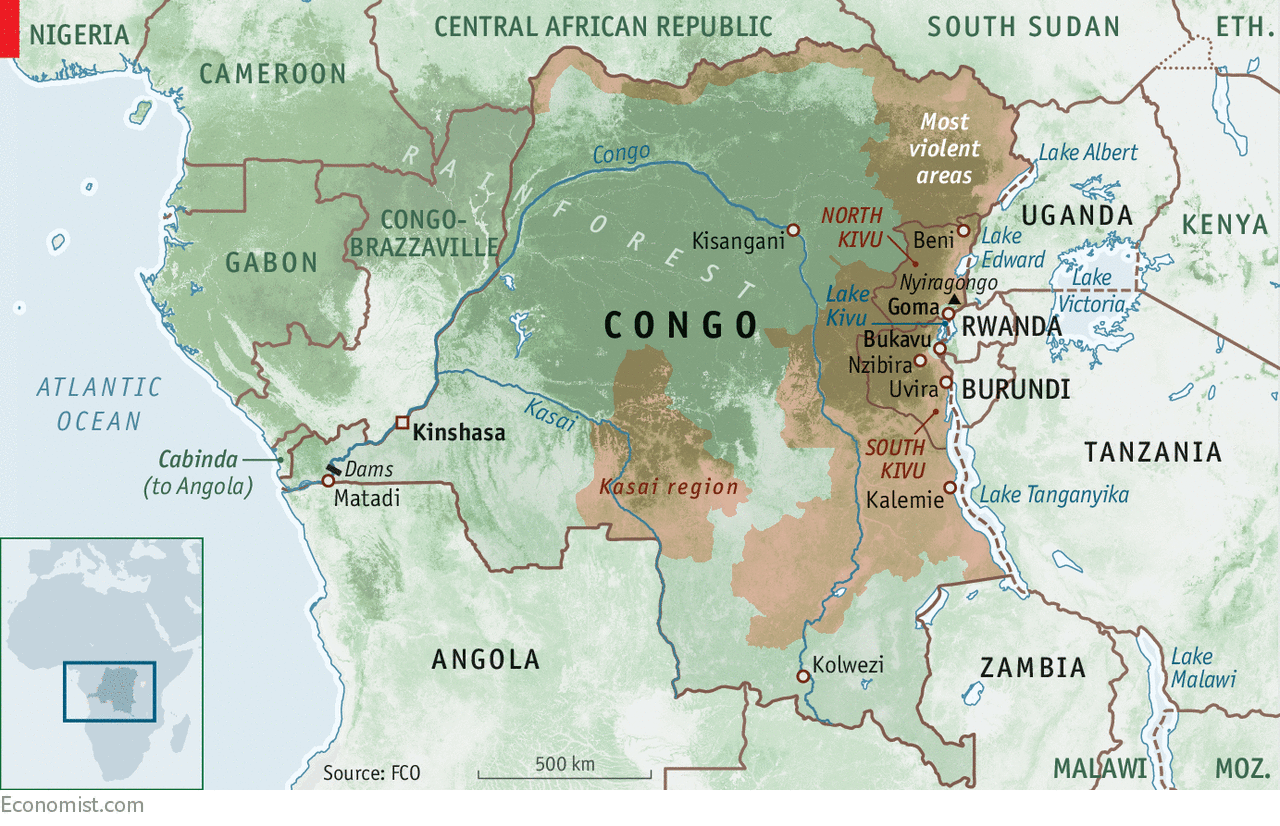
The Economist has a very important article on Congo, a place that has experienced what is perhaps the longest-running conflict in the world today in which as many as 5 million people have been killed over the period of several decades. The weakness of Congo’s politics is unquestionably a legacy of the brutality of colonialism but its very slow progress in overcoming that legacy has allowed the turmoil to continue. The current President, Joseph Kabila, is in the seventh year of a five-year term. The Economist describes the harsh conditions of life in Congo:
“Congo is four times the size of France but has less paved road than Luxembourg. Its population is estimated at 80m but no one is sure (the latest census was in 1986). Whatever the true figure, it is soaring. The average Congolese woman has six children, the third-highest rate in the world; nearly half of Congolese are under 14. And they are grindingly poor. Only one in seven earns more than $1.25 a day. Life expectancy is just 58. Britain, which provides aid to Congo, estimates that by 2030 it could be home to more absolutely poor people than any other country. It lags far behind even neighbouring Zambia on many indicators of development.”
The tragedy of poor governance is that Congo is potentially the richest country on the planet. Its resource base is extraordinary, but most of its riches flow out of the country due to the corruption in the government and the willingness of multinational corporations to subsidize the corruption in pursuit of higher profits.
Brazil’s central government has ordered the Brazilian military to take control of security in Rio de Janiero. The order is in response to a sharp uptick in violence that is being blamed on gang activity in drug trafficking. The violence is undeniable, but some suspect that the order is an attempt by President Michel Temer to distract attention from a controversial reform in Brazil’s pension system, which is financially unsustainable in its current form. It seems as if the violence is most prevalent in the poorer areas of Rio, but violence infected this year’s Carnival festivities. The return of these levels of violence in Brazil is a worrying sign of societal breakdown.

There are things that happen in world politics that are often deliberately “odd”. One such case is the description of the meeting between Palestinian Authority President Mahmoud Abbas and Russian President Vladimir Putin in Moscow. Much of the report makes sense. Abbas apparently told Putin that “”We state that from now on we refuse to cooperate in any form with the U.S. in its status of a mediator, as we stand against its actions” referring to Mr. Trump’s decision to recognize Jerusalem as Israel’s capital. But at the beginning of the joint press conference, Axios is reporting that “Putin revealed he had spoken to Trump and told Abbas the U.S. president ‘conveyed his best wishes’.” I am not sure of all the niceties of diplomatic protocol, but it is highly unusual for one leader to speak on behalf of another who is not present at the meeting. Mr. Trump and Mr. Putin clearly have a strange relationship.
Ethiopian Prime Minister Hailemariam Desalegn unexpectedly resigned, plunging the country into a state of crisis and the declaration of a national state of emergency. Over the last three years, protests have roiled the country and Hailemariam resigned in hopes of reducing some of the tension. The protests began in the homelands of the Oromia and Amhara ethnic groups who believe that their interests have not been fairly represented in the government coalition that has ruled since 1991.

Ronin Bergman has written an op-ed piece for The New York Times about the recent Israeli attack on targets in Syria. The Israeli attack was in response to an Iranian drone entering Israeli territory and some of the aerial sorties came close to Russian military personnel. Bergman is reporting that planned additional attacks by Israel were stopped because of strong Russian opposition, a judgment that, if true, means that Russia is now calling the shots on how the Syrian conflict will evolve. Israel is very concerned that Iran, and its allies, Hamas and Hezbollah, are gaining strategic advantages in Syria over Israeli interests. The configuration of forces suggests that American influence is virtually irrelevant. If Israel believes that the US will not support it in the crisis, it will undoubtedly take whatever unilateral actions are necessary without regard for American interests.
The US is unique in the world in terms of gun ownership and gun violence. Dylan Matthews points out that:
“Think about it this way. In 2013, the US had 106.4 gun deaths per million people. That same year, the UK endured 144 gun deaths total — or 2.2 gun deaths per million people.
“To get to UK levels, we’d need to reduce gun deaths by over 98 percent. Even if we wanted to reach the same levels as Switzerland — the country with the third-highest rate of gun deaths in the OECD grouping of developed nations, after Mexico and the US — we’d need to drop from 106.4 deaths per million to 30.1, more than a 71 percent reduction.
Just how much of an outlier is the US? Look at this chart by Josh Tewksbury:
/cdn.vox-cdn.com/uploads/chorus_asset/file/9371383/guns_country.jpg)
What is amazing is that the US is not, in fact, and outlier in overall crime.
/cdn.vox-cdn.com/uploads/chorus_asset/file/9632469/swanson_slide1.png)
The issue confronting the US is not that it has more criminals. It is, rather, that its criminals have easier access to guns.
Spiegelthe US is engaging in a protectionist trade war has published a piece that highlights the increasing danger that . The focus of the piece is on the US willingness to weaken the dollar, which makes its exports cheaper and its imports more expensive. But the article also highlights the US actions restricting imports through tariffs and quotas. Protectionism only works if a country’s trade partners do not respond in kind. It is clear, however, that both Europe and China will respond to the US actions in kind. A trade war simply means higher prices and less economic activity for everyone.

South African President Jacob Zuma spoke in an interview with the South African Broadcasting Corporation (SABC) and indicated in that interview that he had no intention of resigning. In the interview Zuma said:
“And of course, I asked as to what was the problem. Why must I be persuaded to resign, have I done anything wrong? And of course, the officials couldn’t provide what I have done.”
Fortunately, Zuma has decided to resign. Zuma’s party, the African National Congress, has ruled South Africa since the end of apartheid and recently elected a new leader, Cyril Ramaphosa, who is now the country’s President. The calls for Zuma’s resignation were based upon widespread claims of rampant corruption in the government. They were also based on the horrendous economic situation in South Africa. His decision to resign makes a new path for South Africa.
Cyril Ramaphosa

US airstrikes in Syria have killed an unknown number of Russian mercenaries (some sources are alleging that “hundreds” were killed). The Russians have used non-government forces (or perhaps government forces not wearing official uniforms or insignia) in Ukraine as a way of disguising official Russian government participation in Ukraine. The technique also diminishes the political effect of casualties in foreign areas in the domestic politics of Russia. Apparently, the US was in contact with “official” Russian military units in the general area in order to avoid a direct conflict. But the event signals a troubling escalation of the great power conflicts in Syria. The city of Deir ez-Zor is emerging as a central focus over who controls the oil fields nearby.

Israeli police have recommended the indictment of Prime Minister Benjamin Netanyahu over bribery charges. Concerns over these charges have been swirling around for months and it could take months for the Israeli Attorney General to decide whether to press charges. The Prime Minister has adamantly denied the charges. Netanyahu is currently serving his fourth term as Prime Minister but he leads a coalition in the Knesset that only has a majority of one vote. It is hard to say where these charges will lead, but they clearly weaken Netanyahu over the short term.


